Miami Beach Botanical Garden: A Quiet Tropical Retreat in the Heart of South Beach
Tucked beside the Miami Beach Convention Center and two blocks from Lincoln Road, the Miami Beach Botanical Garden is a free 3-acre tropical landscape redesigned by acclaimed landscape architect Raymond Jungles. Open Tuesday through Sunday, it offers one of the few genuinely calm, green spaces in an otherwise loud and fast-moving part of Miami Beach.
Quick Facts
- Location
- 2000 Convention Center Drive, Miami Beach, FL 33139 — City Center district, near Lincoln Road
- Getting There
- Miami-Dade Transit Bus routes serve the Miami Beach area; closest stops are near the Convention Center. Ride-hail drop-off is straightforward. Metered street parking on 19th Street and Convention Center garages nearby.
- Time Needed
- 45 minutes to 1.5 hours for self-guided walk; up to 2 hours with a guided tour
- Cost
- Free general admission. Guided tours US$10 per person (max 40 guests). All prices in USD.
- Best for
- Couples, solo travelers needing a break from the beach circuit, families with young children, photography enthusiasts
- Official website
- www.mbgarden.org
What the Miami Beach Botanical Garden Actually Is
The Miami Beach Botanical Garden is a free tropical garden covering roughly 3 acres in Miami Beach's City Center district, wedged between the convention center and one of South Beach's busiest shopping corridors. Founded in 1962 as a city park, it spent decades as an underused green space before a $1.2 million landscape renovation in 2011, led by Miami-based landscape architect Raymond Jungles, transformed it into the considered, lush environment it is today.
Jungles is known for naturalistic tropical design that references the ecological character of South Florida rather than imposing imported formal geometry. The result here reads less like a theme park garden and more like a well-curated slice of native and tropical landscape — water features, winding paths, shade canopy, and plant groupings that feel intentional without being sterile.
Given its location, the garden functions as something the immediate area rarely offers: genuine quiet. Two blocks from Lincoln Road Mall and adjacent to a major convention complex, it absorbs almost no noise from either. Visitors who have been walking South Beach for hours often describe the garden as unexpectedly restorative.
ℹ️ Good to know
Hours: Tuesday through Sunday, 9:00 am to 5:00 pm. Closed Mondays and on New Year's Day, Juneteenth, July 4th, Thanksgiving, and Christmas Day. The garden may also close during unsafe weather conditions — worth checking on the official site before visiting during storm season.
The Design and What You Will See
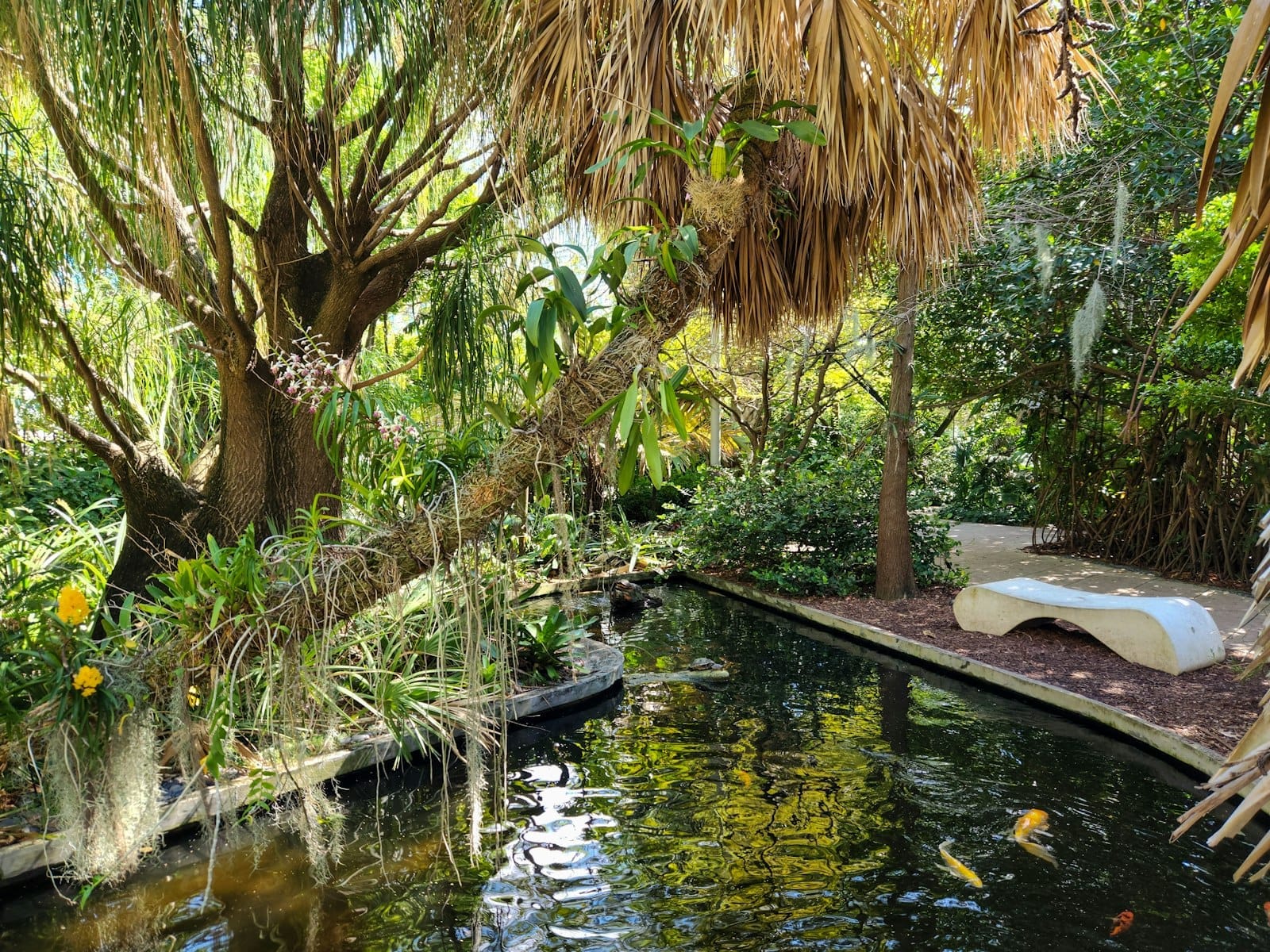
The garden is organized into distinct zones that flow into each other without hard borders. A Japanese garden section features a koi pond with a small wooden bridge, stone lanterns, and sculpted shrubbery — quiet and reflective in mood. Elsewhere, dense tropical plantings include palms, bromeliads, heliconias, and flowering trees that provide overhead canopy on the central pathways.
Raymond Jungles incorporated native Florida plants alongside ornamental tropical species, which means the garden does ecological work as well as aesthetic work. On warm mornings, the air near the water features carries a faint humidity distinct from the salt-tinged ocean breeze just blocks away. Butterflies and small birds are common throughout the day. The soundscape in the garden's interior is dominated by running water and wind through palm fronds rather than traffic.
The garden also contains an event lawn and pavilion space used for private functions, yoga sessions, and educational programming organized by the Miami Beach Garden Conservancy. On days when events are scheduled, certain sections may have limited access, so checking ahead is worthwhile.
Tickets & tours
Hand-picked options from our booking partner. Prices are indicative; availability and final rates are confirmed when you complete your booking.
Double Decker sightseeing bus tour of Miami
From 34 €Instant confirmationFree cancellationMiami private sunset airplane tour with champagne
From 127 €Instant confirmationFree cancellationBest of Miami tour with airboat ride at the Everglades
From 170 €Instant confirmationFree cancellationMiami beach private plane tour with drinks
From 85 €Instant confirmationFree cancellation
How the Experience Changes by Time of Day
Morning visits, especially between 9:00 am and 11:00 am, offer the most peaceful conditions. The light is soft and raking through the canopy, the temperature is manageable even in summer, and the garden sees relatively few visitors. Birds are active, the koi pond reflects surrounding vegetation clearly, and the fragrance from flowering plants is more pronounced in the cooler air.
Midday in summer — roughly June through September — the garden becomes noticeably hotter and more humid. Miami summers routinely reach 89 to 91 degrees Fahrenheit (32 to 33 degrees Celsius), and without consistent ocean breeze the garden can feel close. The shade canopy helps, but anyone sensitive to heat should plan a morning or late-afternoon visit from May through October.
Late afternoon, from around 3:00 pm onward, brings softer light favorable for photography and slightly cooler air. Convention Center activity often picks up around this time, and the adjacent parking areas can become busier. Still, inside the garden itself the experience changes little. The garden closes at 5:00 pm, so arrival after 4:30 pm does not leave much time.
💡 Local tip
For photography: morning light between 9:00 and 10:30 am gives the best conditions for the koi pond and palm grove sections. Bring a polarizing filter if shooting the water features — midday glare washes out color and detail.
Practical Walkthrough: Getting There and Moving Around
The garden's address is 2000 Convention Center Drive. On foot from Lincoln Road, it is about a two-minute walk north. From the beach, the walk along 17th or 19th Street takes around 10 to 15 minutes depending on starting point. The area is flat and fully walkable, which is typical of Miami Beach's grid layout.
Miami-Dade Transit bus routes serve the Miami Beach corridor, with stops near the Convention Center. Ride-hail services drop off directly in front. If driving, metered street parking is available on 19th Street, and the adjacent Convention Center parking garages on 19th and 20th Streets offer validated parking for garden visitors at discounted rates — confirm current rates at the garage.
The garden offers free Wi-Fi across the property. Paths are wide enough for strollers and, based on the general layout, appear navigable for mobility aids, though the official site does not provide detailed ADA pathway specifications. Anyone with specific accessibility needs should contact the garden directly before visiting. For broader transit planning across Miami Beach, getting around Miami covers your main options in detail.
Guided Tours and Programming
The garden offers guided tours at $10 per person, with groups capped at 40 visitors. These tours are organized by the Miami Beach Garden Conservancy, the nonprofit that manages the garden's programming in partnership with the City of Miami Beach. Tours cover the design history, plant identification, and the context of Jungles' renovation work — useful if botanical detail matters to you.
Beyond tours, the conservancy runs workshops, yoga events, and educational programs throughout the year. Schedules are published on the official site. The garden has also hosted art installations and cultural events tied to Miami's broader festival calendar, including periods around Art Basel in December.
💡 Local tip
If your visit coincides with Art Basel Miami Beach in early December, check the garden's event calendar. It occasionally hosts programming or installations during that period that are not widely advertised.
Honest Assessment: Worth the Stop?
For a city primarily associated with ocean, nightlife, and architecture, the Miami Beach Botanical Garden occupies a specific niche. It is small — 2.6 acres does not take long to cover — and it does not attempt to be a comprehensive botanical collection in the way that the Fairchild Tropical Botanic Garden in Coral Gables does. Fairchild spans 83 acres and houses one of the most significant collections of tropical plants in the Western Hemisphere. If depth of botanical content is the goal, Fairchild is the better destination.
What the Miami Beach Botanical Garden does offer is proximity, accessibility, and a rare moment of calm in a relentlessly stimulating part of Miami Beach. Combined with nearby attractions like the Art Deco Historic District and the Wolfsonian-FIU Museum, it fits naturally into a half-day itinerary without requiring a dedicated trip across town.
It is genuinely free, genuinely pleasant, and genuinely uncrowded for most of the week. That combination is harder to find in South Beach than people expect.
Visitors who are primarily interested in beaches, nightlife, or the full spectrum of Miami's art scene will likely find the garden a pleasant 45-minute stop rather than a centerpiece of their trip. Those building a nature-focused itinerary should also consider Fairchild Tropical Botanic Garden in Coral Gables and the broader network of green spaces covered in the free things to do in Miami guide.
Weather and Seasonal Considerations
Miami Beach operates in a tropical monsoon climate. The dry season, roughly November through April, is the most comfortable time to visit an outdoor garden. Temperatures in winter average highs around 76 to 78 degrees Fahrenheit (24 to 26 degrees Celsius), humidity is lower, and afternoon thunderstorms are rare. This aligns with Miami's peak tourist season for good reason.
During the wet season, May through October, the garden is still beautiful but afternoon thunderstorms can arrive quickly and the heat becomes significant by late morning. The garden may close temporarily during unsafe weather. Hurricane season runs from June 1 through November 30, and while individual storms are unpredictable, travelers visiting in this window should monitor forecasts.
⚠️ What to skip
Summer visitors: wear light, breathable clothing and bring water. The garden has shade but limited covered shelter. If you see storm clouds building to the west in the afternoon — which is typical Miami weather in summer — plan to wrap up your visit or take cover nearby.
Insider Tips
- The garden's koi pond is most photogenic in the first hour after opening, when morning light hits the water at a low angle and the surface is typically calm before any foot traffic around the bridge.
- Parking in the Convention Center garage is cheaper with garden validation than standard metered street parking on busy event days — ask at the entrance kiosk when you arrive.
- The garden's free Wi-Fi is reliable enough to use for research while sitting in the shade, making it a practical stop for travelers who need a quiet moment to plan the rest of their day.
- Event programming at the garden often sells out or fills up with little online promotion. Checking the Miami Beach Garden Conservancy's calendar a day or two before visiting increases your chances of catching a yoga session or workshop included in admission.
- On weekdays, the garden sees notably fewer visitors than weekends, even during peak tourist season in winter. If solitude is the goal, Tuesday through Thursday morning visits are consistently the quietest.
Who Is Miami Beach Botanical Garden For?
- Travelers needing a genuine break from South Beach's sensory intensity
- Couples looking for a quiet, photogenic spot that does not require planning or spending money
- Families with young children who want a safe, contained outdoor space away from traffic
- Photography enthusiasts interested in tropical plant texture, light, and water
- Design and architecture visitors who appreciate Raymond Jungles' landscape approach alongside South Beach's built environment
Nearby Attractions
Other things to see while in South Beach:
- Art Deco Historic District
The Miami Beach Art Deco Historic District preserves more than 800 historic buildings along Ocean Drive, Collins Avenue, and Washington Avenue, making it one of the world's largest concentrations of Art Deco architecture. Listed on the National Register of Historic Places in 1979, the district is free to explore on foot and rewards visitors at every hour of the day.
- Española Way
Conceived in the early 1920s as an artists' colony and largely completed by 1925, Española Way is a roughly two-block pedestrian stretch in South Beach where Spanish Revival architecture, open-air restaurants, and a quieter pace of life offer a genuine contrast to the Ocean Drive scene. Admission is free and the street is open around the clock.
- Jewish Museum of Florida–FIU
Occupying two landmark synagogue buildings from 1929 and 1936 at 301 and 311 Washington Avenue, the Jewish Museum of Florida–FIU tells the story of Jewish life in Florida across more than 250 years. The 1936 building alone, designed by Art Deco master Henry Hohauser, is worth the visit for its copper dome and 80 stained-glass windows.
- Lincoln Road Mall
Lincoln Road Mall is an eight-block pedestrian promenade running through the heart of Miami Beach, flanked by over 200 shops, restaurants, galleries, and cafés. Redesigned in the late 1950s by architect Morris Lapidus, it is often cited as one of the earliest open-air pedestrian malls in the United States. Free to enter and open around the clock, it offers a very different experience at 9 a.m. than it does at 10 p.m.