Fairchild Tropical Botanic Garden: Miami's World-Class Tropical Landscape
Fairchild Tropical Botanic Garden is an 83-acre living museum in Coral Gables that has been quietly stunning visitors since 1938. Home to one of the world's most significant collections of palms, cycads, and rare tropical plants, it rewards anyone willing to slow down and look closely.
Quick Facts
- Location
- 10901 Old Cutler Rd, Miami, FL 33156
- Getting There
- No direct Metrorail stop; best reached by car, rideshare, or taxi. Free parking on site.
- Time Needed
- 2–4 hours for a thorough visit; half a day if attending a special event
- Cost
- Paid admission. Members free. First Wednesday of each month: free admission for Miami-Dade County seniors 62+ with Golden Ticket. Free parking.
- Best for
- Plant enthusiasts, families, photographers, slow-travel couples, and anyone escaping Miami's urban heat
- Official website
- fairchildgarden.org
What Fairchild Actually Is (And Why It Matters)
Fairchild Tropical Botanic Garden is not a city park with flower beds. It is an accredited botanical institution covering 83 acres (34 hectares) of Coral Gables, operating as both a public attraction and a center for plant conservation and research. Since opening in 1938, it has built one of the most scientifically significant collections of tropical plants in the Western Hemisphere, with particular depth in palms, cycads, and flowering trees from across the tropics.
The garden was established on land purchased by Col. Montgomery, a lawyer and plant collector with a genuine passion for tropical botany. Montgomery named it after David Fairchild, the pioneering USDA botanist who introduced hundreds of crop plants to the United States, including mangoes, dates, and soybeans. That legacy of scientific curiosity runs through everything here: the labels are detailed, the collections are curated with purpose, and the research staff are working on real conservation problems, particularly around endangered palm species.
For a traveler, what this means practically is that Fairchild rewards genuine curiosity. Visitors who wander through looking for Instagram backdrops will find them, certainly. But visitors who read the plant labels, take the tram tour, or time their visit around the bloom cycle of the garden's flowering trees will leave with something richer.
💡 Local tip
Buy your tickets online or at the on-site kiosk rather than at the front desk and you save $5 per ticket. Free parking is available for all visitors, which is unusually generous for a major Miami attraction.
The Garden by Time of Day
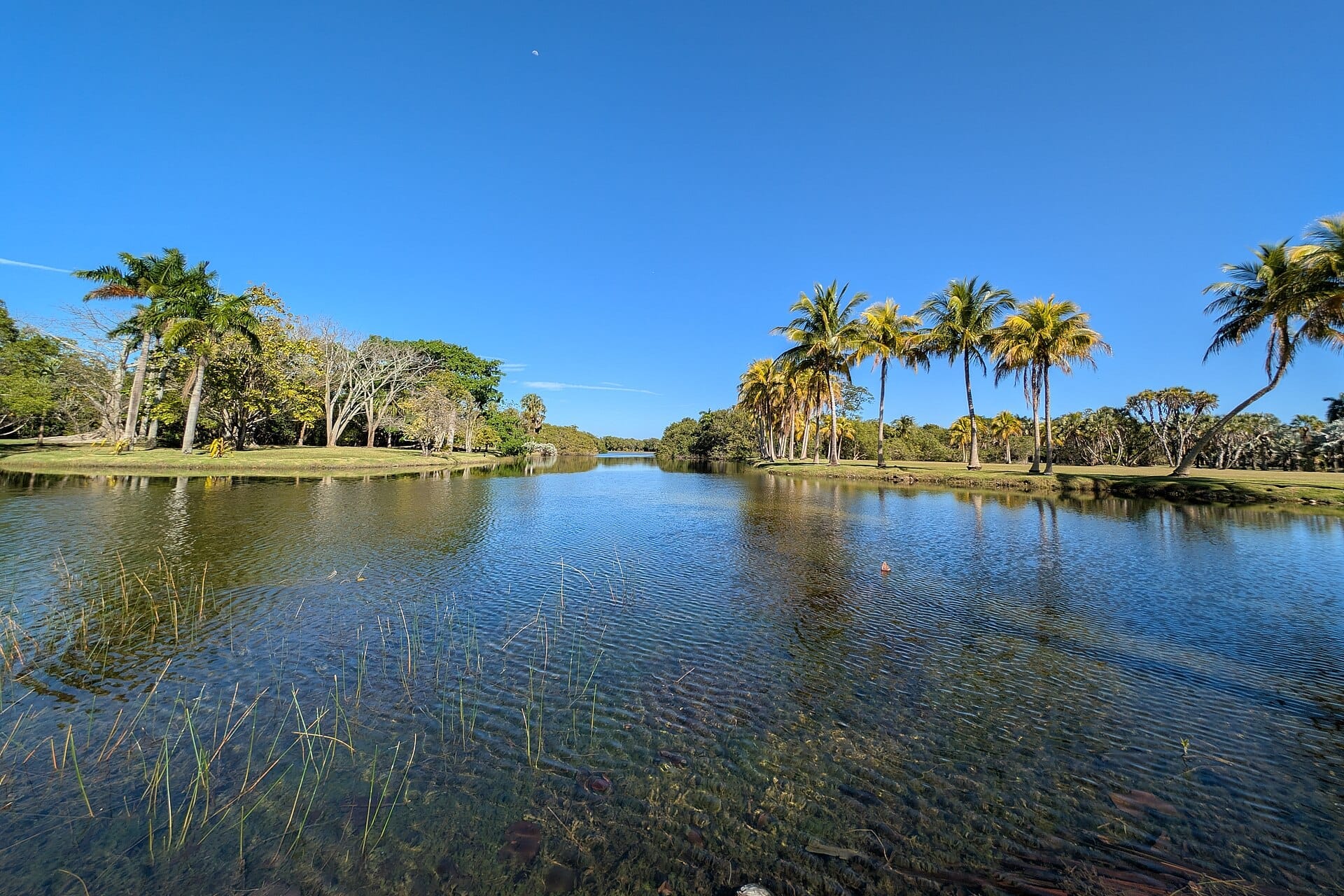
Arriving close to the 10:00 a.m. opening is the single most reliable way to improve your experience. The light at that hour filters through the canopy at a low angle, picking out the texture of palm fronds and the surface of the garden's lakes. It is cooler, quieter, and the bird activity is at its peak. Mockingbirds and warblers are audible from the entrance path, and the pond areas attract herons and anhingas, particularly along the edges of the lakes near the main loop.
By midday, especially from June through September, the combination of Miami's tropical heat (highs routinely reach 89–91°F / 32–33°C in summer) and direct sun makes large portions of the garden genuinely uncomfortable. This is when visitors cluster under the shade structures near the café and butterfly conservatory. If you are visiting in summer, plan your outdoor walking for the first hour or two and use the middle of the day for the indoor spaces.
Late afternoon, from around 3:30 p.m. onward, brings softer light again and somewhat lower temperatures as clouds build. The garden closes at 5:00 p.m. daily, so arriving late limits how much ground you can cover. During Miami's dry season (November through April), midday visits are far more pleasant, with lower humidity and temperatures typically in the high 70s Fahrenheit.
⚠️ What to skip
During Miami's wet season (May through October), afternoon thunderstorms can roll in quickly and with little warning. Bring a compact rain layer or small umbrella if you are visiting in summer. Lightning is a genuine safety concern in South Florida; the garden may ask visitors to take shelter during storms.
Tickets & tours
Hand-picked options from our booking partner. Prices are indicative; availability and final rates are confirmed when you complete your booking.
Vizcaya Museum and Gardens with transportation
From 76 €Instant confirmationFree cancellationEverglades admission ticket with airboat ride and wildlife show
From 24 €Instant confirmationFree cancellationKey West day trip with glass bottom boat ride
From 110 €Instant confirmationFree cancellationEverglades airboat ride with Biscayne Bay boat tour and transportation
From 67 €Instant confirmationFree cancellation
The Collections: What You Will Actually See
The palm collection is the backbone of Fairchild's scientific identity. Palms from across the Caribbean, South America, Africa, and Southeast Asia are grouped through much of the garden's central area. Many of these species are rare in cultivation and some are critically endangered in their native ranges. Walking among specimens that tower 30 or 40 feet overhead, with root systems that have been in the same South Florida soil for decades, gives the garden a sense of permanence unusual for Miami.
Cycads, which are among the most ancient seed plants on Earth and superficially resemble palms, have their own dedicated area. Fairchild holds one of the world's most significant cycad collections, including species from Cuba, Mexico, and southern Africa. They tend to look prehistoric because they are, geologically speaking. The quiet grotesque beauty of a 200-million-year-old plant lineage planted along a Florida path is a genuinely strange and worthwhile experience.
The Wings of the Tropics butterfly conservatory is a fully enclosed structure housing hundreds of free-flying tropical butterflies. It smells of damp earth and rotting fruit (the feeding stations), and the air inside is warm and thick. Children are reliably transfixed. Adults who are not particularly interested in butterflies tend to spend about 15–20 minutes inside; those who are can stay much longer. Photography is encouraged, and the natural light through the structure's panels is generally sufficient without flash.
Flowering trees are distributed across the grounds, and what is in bloom depends entirely on when you visit. Royal poincianas, whose scarlet canopy is one of the defining visual experiences of a South Florida summer, bloom from roughly late May through June. Other species have different cycles. The garden's website and social channels tend to post current bloom updates, which is worth checking before your visit if seeing specific flowering trees is important to you.
Practical Walkthrough: Navigating 83 Acres
At 83 acres, Fairchild is large enough that visitors who walk the full property cover meaningful distance. The main loop around the central lake is the core route and takes roughly 45 minutes to an hour at a leisurely pace, not counting time spent reading labels or photographing. Branch paths lead into the specialty collections, butterfly conservatory, and the sunken garden areas.
A narrated tram tour operates within the garden and covers the main areas with commentary from a guide. For first-time visitors or anyone who finds extensive walking difficult, the tram is a worthwhile investment of time. It provides historical and botanical context that is easy to miss when walking independently, and it covers portions of the garden that foot traffic sometimes skips.
Paths include both paved surfaces and natural ground. Visitors with mobility limitations should contact the garden in advance to confirm current accessibility provisions, including tram availability and which routes are fully paved. Shoes with reasonable grip are sensible; the natural path sections can be uneven, and after rain they become slippery in spots.
Fairchild sits on Old Cutler Road, bordered by Matheson Hammock Park to the north and west. If you are spending a full day in the area, combining both visits makes strong geographic sense. Matheson Hammock has a calm atoll pool and picnic facilities, providing a natural complement to the garden's more curated experience.
How Weather and Season Shape the Visit
The honest answer is that Fairchild is best from November through April. Miami's dry season brings the kind of weather that makes outdoor walking genuinely comfortable: low humidity, daytime highs in the mid-to-upper 70s Fahrenheit, and clear skies through most of the morning. These are the months when you can spend three hours walking the grounds without significant discomfort.
Summer visits are possible but require adjustment. The heat is real, the afternoon storms are frequent, and the humidity is considerable. Against those conditions, the garden is also lush and green in a way it is not during winter: foliage is dense, flowering trees are more active, and the entire landscape has a saturated tropical quality that photographs differently than the winter version. Serious plant photographers and those chasing specific blooms often prefer the wet season despite the conditions.
For a broader view of what Miami's climate means for planning any outdoor visit, see the Miami weather guide, which covers monthly temperature and rainfall averages in detail.
ℹ️ Good to know
Fairchild is open daily 10:00 a.m. to 5:00 p.m., with the exception of Christmas Day (December 25). Hours may differ during special seasonal events; confirm on the official site before visiting.
Photography, Events, and What Else Is On
Fairchild hosts the International Mango Festival each July, which celebrates the garden's historic mango collection. The garden's grounds are also used for evening ticketed events, including holiday light displays that run in late November and December and transform the property after dark in a way that is genuinely distinct from the daytime experience.
For photography, the morning light, the butterfly conservatory, and the lakeside palm reflections are the reliable targets. The cycad garden provides unusual textural material for macro photography. Wide-angle shots of the main palm avenue work best with morning backlight from the east. Tripods are generally permitted in the main garden areas; check with staff if you are bringing professional equipment for commercial purposes.
Fairchild is located in Coral Gables, one of Miami's most architecturally distinctive neighborhoods. After your garden visit, the Mediterranean Revival streetscapes of Coral Gables, the landmark Venetian Pool, and Miracle Mile are all within a short drive and make for a coherent half-day or full-day itinerary in the area.
Who Should Think Twice
Fairchild is not for visitors who need constant stimulation or who are working through a packed sightseeing list. It moves at a deliberate pace, and its rewards are proportional to the attention you bring. Travelers who are not genuinely curious about plants, natural history, or garden design may find the experience pleasant but not memorable. Children under six or seven tend to do best in the butterfly conservatory and the more visually dramatic areas; the research-heavy collection areas hold limited interest for very young visitors.
Visitors who struggle with heat and humidity and are visiting in summer should weigh the trade-offs honestly. The outdoor garden in July or August is not a casual stroll; it requires hydration, appropriate clothing, and a willingness to be uncomfortable at points. Those with significant mobility limitations should contact the garden before visiting to clarify tram access and paved route availability.
Insider Tips
- Buy tickets online or use the on-site kiosk before approaching the front desk. The $5-per-ticket savings is real and the process takes two minutes.
- Miami-Dade County residents aged 62 and older can visit free on the first Wednesday of each month with a Golden Ticket. This program is not widely advertised outside the garden's own materials.
- Check the garden's social media channels in the week before your visit for current bloom reports. The difference between visiting when the flowering trees are at peak and visiting a week before or after is significant for photographers.
- The tram tour is worth doing on a first visit even if you plan to walk the full grounds afterward. The botanical commentary reframes what you are looking at and makes the independent walking more productive.
- If you are combining Fairchild with Matheson Hammock Park next door, start at Fairchild in the morning and walk or drive to Matheson for a waterside lunch. The logical sequence follows the property boundary and minimizes doubling back.
Who Is Fairchild Tropical Botanic Garden For?
- Botany and natural history enthusiasts who want scientific depth alongside scenic grounds
- Families with children aged 5 and up, particularly for the butterfly conservatory
- Photographers seeking tropical canopy light and unusual plant specimens
- Couples looking for a slow, shaded alternative to Miami's beach and nightlife circuit
- Visitors during Miami's dry season (November through April) who want extended outdoor walking without extreme heat
Nearby Attractions
Other things to see while in Coral Gables:
- Biltmore Hotel Coral Gables
Opened in 1926 and designated a National Historic Landmark, The Biltmore Hotel Miami – Coral Gables is one of Florida's most architecturally significant buildings. Whether you're visiting for Sunday brunch, a swim in one of the largest hotel pools in the country, or simply to stand beneath the 315-foot tower, this is a place that rewards the curious traveler.
- Matheson Hammock Park Beach
Matheson Hammock Park is a 630-acre Miami-Dade county park on the shores of Biscayne Bay, just south of Coral Gables. Its signature feature is a man-made atoll pool naturally flushed by tidal action, creating some of the most sheltered, shallow, and calm swimming water in all of South Florida. Open daily from sunrise to sunset, with the park office and marina operating 8 a.m. to 5 p.m., it draws families, kayakers, and anyone needing a break from the crowds of South Beach.
- Miracle Mile
Miracle Mile is the commercial heart of downtown Coral Gables, an approximately half-mile stretch of Coral Way lined with independent shops, restaurants, bridal boutiques, and the historic Miracle Theatre. Free to explore, rich in Mediterranean Revival architecture, and walkable in an afternoon.
- Venetian Pool
Venetian Pool is a 1920s-era public swimming pool carved from a coral rock quarry in Coral Gables, Florida. Fed by a natural underground aquifer, it holds 820,000 gallons of spring water and is listed on the National Register of Historic Places. It is one of the most architecturally distinctive public pools in the United States.