Venetian Pool: Swimming Inside a 1924 Coral Gables Landmark
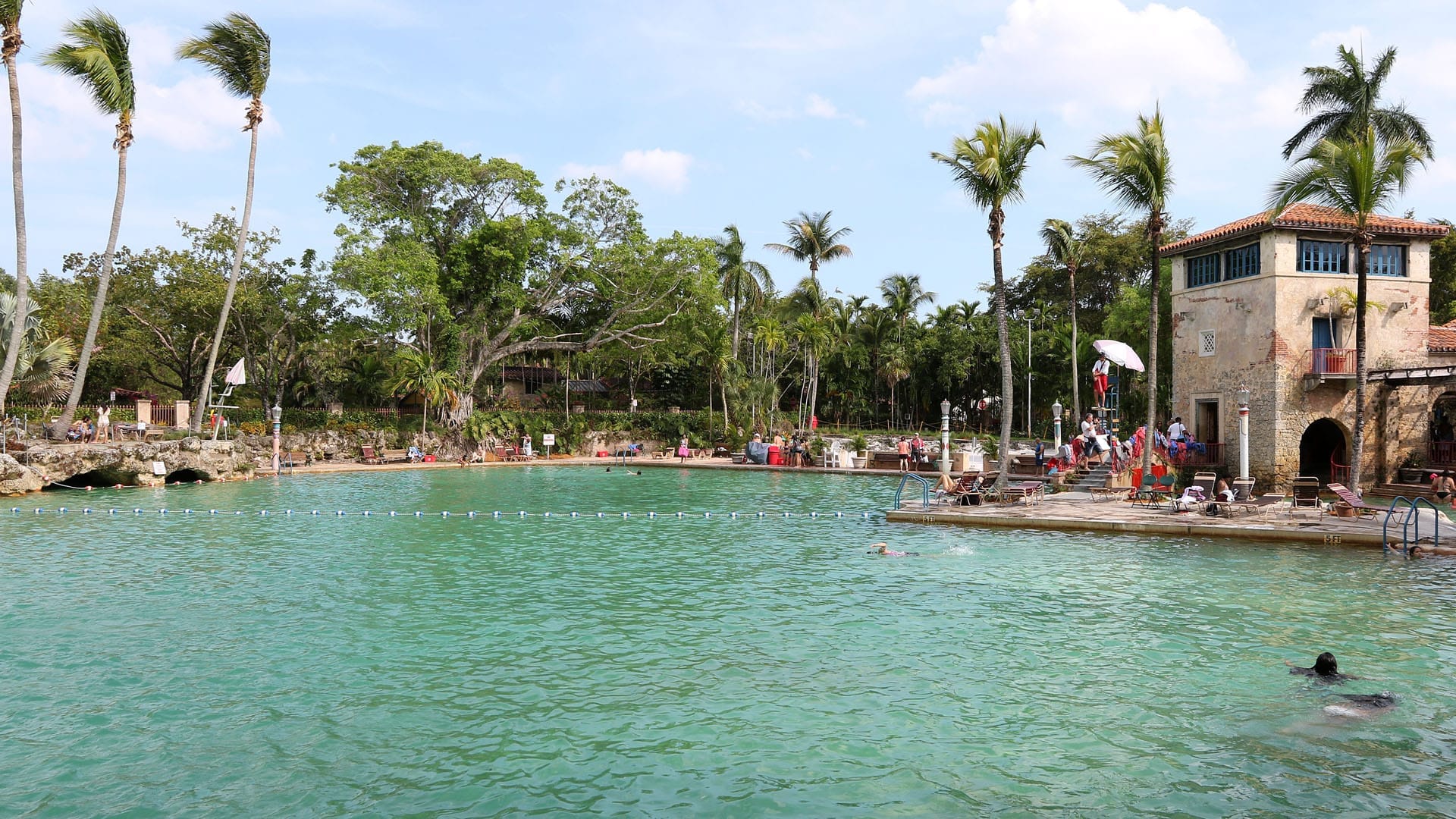
Venetian Pool is a 1920s-era public swimming pool carved from a coral rock quarry in Coral Gables, Florida. Fed by a natural underground aquifer, it holds 820,000 gallons of spring water and is listed on the National Register of Historic Places. It is one of the most architecturally distinctive public pools in the United States.
Quick Facts
- Location
- 2701 De Soto Blvd., Coral Gables, FL 33134
- Getting There
- Drive or rideshare recommended; two parking lots on site near the De Soto Fountain roundabout
- Time Needed
- 2 to 3 hours
- Cost
- Non-residents: $23 adults / $18 children (3–12). Coral Gables residents: $7 adults / $6 children (3–12). Verify current rates before visiting.
- Best for
- History lovers, families, architecture enthusiasts, swimmers seeking something beyond a beach
- Official website
- www.coralgables.com/attractions/venetian-pool
What Venetian Pool Actually Is
Venetian Pool is not a theme park attraction or a resort amenity. It is a city-run public swimming facility that happens to be one of the most visually striking pools in the country. The pool was carved out of a coral rock quarry in 1924, originally named the Venetian Casino, and has operated as a public pool for most of the years since, aside from temporary closures for renovations and maintenance. In 1989 it underwent a significant renovation and today it holds roughly 820,000 gallons of fresh spring water drawn from an underground aquifer, which drains and refills the pool regularly.
The surrounding architecture is Mediterranean Revival, consistent with the design character of Coral Gables as a planned city. Stone loggias, arched bridges, cave-like grottos, two waterfall towers, and Venetian-style lampposts frame the water on all sides. When you are standing inside the pool deck, the coral rock walls rise above you and the whole place feels closer to a Venetian courtyard than a Florida municipal pool. That contrast is part of why the pool is listed on the National Register of Historic Places.
ℹ️ Good to know
The pool is fed by an underground aquifer, not chlorinated city water. The water is drained and replenished regularly. On hot summer afternoons it is noticeably cooler than the air, which makes it a genuinely refreshing experience rather than a purely scenic one.
The History Behind the Pool
When developer George Merrick laid out Coral Gables in the early 1920s as one of the first planned communities in the United States, the coral rock quarry left over from the construction presented a practical problem. The solution was to commission architect Phineas Paist and artist Denman Fink to transform the pit into a public lagoon modeled on the aesthetics of Venice. The pool opened in 1924 as the Venetian Casino, which at the time referred to a social gathering place rather than a gambling establishment.
During the 1920s Florida land boom, the pool served as a marketing centerpiece for the Coral Gables development. It hosted swim exhibitions and social events intended to attract buyers to Merrick's planned city. After the boom collapsed, the pool transitioned into a genuinely community-oriented facility, which it remains today. A major late-20th-century renovation preserved the original structure while updating the infrastructure, and the city of Coral Gables continues to operate it as a public pool with resident-discounted admission.
Coral Gables as a whole rewards exploration beyond the pool. The city's Miracle Mile and the broader Coral Gables neighborhood are built around the same Mediterranean Revival design principles that gave the Venetian Pool its character.
Tickets & tours
Hand-picked options from our booking partner. Prices are indicative; availability and final rates are confirmed when you complete your booking.
Miami sightseeing cruise of South Beach, Biscayne Bay, & Venetian Islands
From 30 €Instant confirmationFree cancellationEverglades admission ticket with airboat ride and wildlife show
From 24 €Instant confirmationFree cancellationKey West day trip with glass bottom boat ride
From 110 €Instant confirmationFree cancellationEverglades airboat ride with Biscayne Bay boat tour and transportation
From 67 €Instant confirmationFree cancellation
What the Visit Actually Feels Like
You arrive through a gatehouse that is itself a small architectural statement, then walk out onto a pool deck framed by coral rock walls and mature ficus trees. The water is a pale aquamarine, lit from below by the aquifer source rather than heavy chemical treatment, and it has a faint mineral quality to it. In the morning the light falls sharply on the stone loggias and the waterfall towers, casting long shadows on the pool surface. Later in the afternoon, the same towers throw shade across the main swimming area, which is when most families with children tend to spread out across the pool.
The pool has two main swim areas connected by an arched stone bridge. The grottos cut into the coral rock walls are genuinely cool to the touch on humid days. Children tend to cluster around the waterfall towers while adults often find a spot on the loggia steps or the shallow ledge near the grottos. The landscaping around the pool, particularly the tropical plantings and the vine growth on the stone, gives it a texture that photographs cannot fully convey. The smell is fresh water and limestone rather than pool chemicals, which is the first thing most visitors comment on.
💡 Local tip
Arrive at opening time if you visit during summer. The pool fills up significantly by mid-morning on weekends, and the experience is considerably more pleasant with fewer people in the water and on the deck.
Best Time to Visit and How Weather Affects the Experience
Under normal circumstances the pool operates seasonally with hours that vary by month and by time of year and the city of Coral Gables publishes the current schedule on its official website. Visiting hours should be confirmed directly before you go, as they shift month to month. In practical terms, the pool is most enjoyable from October through April, when Miami's dry season keeps humidity lower and afternoon thunderstorms are rare. Summer visits are entirely viable, and the spring water temperature makes the pool a genuine relief from 90-plus-degree heat, but you should expect crowds, especially on weekends.
During Miami's wet season, which runs roughly from May through October, afternoon thunderstorms are common and the pool will close when lightning is in the area. If you are visiting in summer, plan to arrive early and be prepared for a possible closure by early afternoon. For broader seasonal planning, the best time to visit Miami guide breaks down the tradeoffs between weather, crowds, and pricing across the full year.
Practical Walkthrough: What to Bring and How to Get There
The facility is handicap accessible. There are changing rooms and lockers on site. Bring your own towel, as rentals are not guaranteed. Water shoes are useful given the coral rock surfaces around the pool, which can be rough underfoot when wet. Sunscreen is essential, and reef-safe formulas are preferable given the aquifer-fed water. The pool does not allow flotation devices other than those provided for young children, and there are specific age and height requirements for different swim areas, so check the FAQ on the official city website before bringing young children.
Getting there by car is the most practical option. The pool has on-site parking, including a lot directly adjacent to the facility and additional parking near the De Soto Fountain roundabout. Both tend to fill on weekend mornings during summer. Rideshare drop-off works well given the parking situation. Miami-Dade Transit bus service reaches Coral Gables, but the specific stop proximity varies, and walking in summer heat with swim gear is less comfortable than it sounds on a map.
⚠️ What to skip
Children under 3 years old or under 38 inches tall are not admitted. Children aged 3–12 must be accompanied by an adult. Confirm age and height requirements on the official Coral Gables site before your visit, as rules are enforced at the gate.
Photography and Honest Expectations
The pool photographs exceptionally well, particularly from the arched stone bridge looking toward the waterfall towers in the morning light. The coral rock textures, the aquifer-colored water, and the Mediterranean detailing give almost any angle a sense of depth that is unusual for a public swimming facility. Social media has increased awareness of the pool significantly over the past several years, which has brought larger crowds but has not changed the physical experience of swimming in it.
A candid note for managing expectations: this is still a public pool. On busy days, the deck fills with families, swim toys appear in the water, and the atmosphere is more neighborhood pool than private resort lagoon. The architecture is genuinely impressive and the water is genuinely refreshing. But if you are expecting a tranquil, uncrowded experience, visit on a weekday morning outside of peak summer weeks.
If the Venetian Pool sparks an interest in Coral Gables' broader architectural heritage, the Biltmore Hotel is a few blocks away and represents the same 1920s Mediterranean Revival ambition at an even grander scale. It is worth walking past even if you do not stay there.
Who Should Skip This
Travelers who are not interested in swimming and are visiting purely for the visual experience may find the admission price harder to justify, since the best views are from inside the pool deck rather than from any public vantage point outside. If your priority is a beach experience, Crandon Park Beach on Key Biscayne offers a comparable natural water quality in an open-air setting without admission constraints. Visitors looking for an active water sports day are also better served elsewhere, as the pool is a swimming facility rather than an adventure venue.
That said, for anyone with an interest in American urban history, planned communities, or early 20th-century landscape design, the Venetian Pool is genuinely worth the detour from South Beach or downtown. There is nothing else quite like it in Florida.
Insider Tips
- Weekday mornings in October or November hit the sweet spot: the water is still warm from summer, the crowds are thin, and the morning light on the stone loggias is at its best.
- The grottos carved into the coral rock walls stay several degrees cooler than the open pool. If you need a break from sun, they are the best spot on the property.
- Coral Gables residents pay a fraction of the non-resident admission. If you are visiting with a local friend or family member, go together, as their address may qualify the group for the resident rate, subject to current city policies at the time of your visit.
- The De Soto Fountain roundabout just outside the entrance is itself a notable piece of 1920s civic design. Walk around it before or after your swim rather than rushing past it in the parking lot.
- Bring a dry bag for your phone and wallet. The locker situation at the pool is functional but basic, and the pool deck is wet throughout.
Who Is Venetian Pool For?
- Families with children old enough to swim (ages 3 and up) who want a distinctive alternative to beach crowds
- Architecture and history enthusiasts interested in early American planned communities
- Photographers looking for a setting that rewards composition over filters
- Visitors staying in Coral Gables or Coconut Grove who want a walkable cultural activity
- Anyone wanting to cool off in a genuinely unique freshwater environment rather than another chlorinated hotel pool
Nearby Attractions
Other things to see while in Coral Gables:
- Biltmore Hotel Coral Gables
Opened in 1926 and designated a National Historic Landmark, The Biltmore Hotel Miami – Coral Gables is one of Florida's most architecturally significant buildings. Whether you're visiting for Sunday brunch, a swim in one of the largest hotel pools in the country, or simply to stand beneath the 315-foot tower, this is a place that rewards the curious traveler.
- Fairchild Tropical Botanic Garden
Fairchild Tropical Botanic Garden is an 83-acre living museum in Coral Gables that has been quietly stunning visitors since 1938. Home to one of the world's most significant collections of palms, cycads, and rare tropical plants, it rewards anyone willing to slow down and look closely.
- Matheson Hammock Park Beach
Matheson Hammock Park is a 630-acre Miami-Dade county park on the shores of Biscayne Bay, just south of Coral Gables. Its signature feature is a man-made atoll pool naturally flushed by tidal action, creating some of the most sheltered, shallow, and calm swimming water in all of South Florida. Open daily from sunrise to sunset, with the park office and marina operating 8 a.m. to 5 p.m., it draws families, kayakers, and anyone needing a break from the crowds of South Beach.
- Miracle Mile
Miracle Mile is the commercial heart of downtown Coral Gables, an approximately half-mile stretch of Coral Way lined with independent shops, restaurants, bridal boutiques, and the historic Miracle Theatre. Free to explore, rich in Mediterranean Revival architecture, and walkable in an afternoon.