Melbourne Cricket Ground (MCG): Inside Australia's Most Famous Stadium
The Melbourne Cricket Ground is more than a sports venue. With a capacity of over 100,000 and more than 160 years of history, the 'G' is the physical heart of Australian sporting culture. Whether you visit on match day or take a guided tour on a quiet Tuesday, the scale and atmosphere are unlike anything else in the city.
Quick Facts
- Location
- Gate 3, Melbourne Cricket Ground, Yarra Park, East Melbourne
- Getting There
- Jolimont Station (5-min walk); Richmond Station also nearby; Trams 48, 70, 75
- Time Needed
- 2–3 hours for tour and museum; 4+ hours on match day
- Cost
- Combined tour + museum: Adult A$50, Child (5–15) A$22, Family A$120. Under 5 free. Check mcg.org.au for current pricing.
- Best for
- Sports fans, history buffs, families, architecture enthusiasts
- Official website
- www.mcg.org.au
What Is the MCG, and Why Does It Matter?
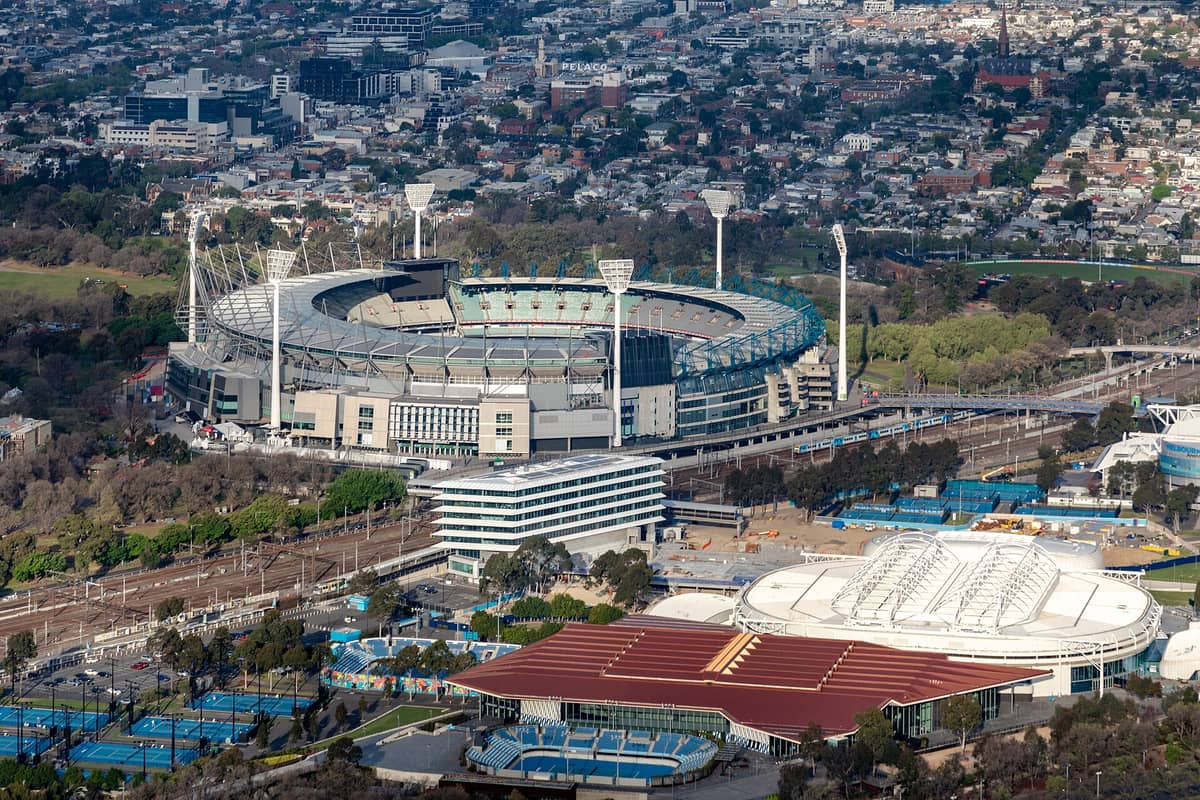
The Melbourne Cricket Ground (MCG) is not simply Australia's largest stadium. It is the venue where the first Test cricket match was played in 1877, where Australian Rules football drew crowds before the sport had a name, and where the 1956 Olympic Games held their opening and closing ceremonies. Australians call it 'the 'G'', with the casual affection reserved for things considered permanent and self-evident. Located on the eastern edge of Yarra Park, the ground seats over 100,000 people and holds the record as the largest cricket ground in the world by capacity.
For international visitors, the scale can be disorienting at first. From Brunton Avenue, the stadium appears as a curved concrete wall rising above the tree canopy of Yarra Park. Walk around the perimeter and the structure keeps going, and going. The four distinct light towers, each over 80 metres tall, are visible from much of inner Melbourne. Getting inside, even on a non-event day, is worth the entry fee.
💡 Local tip
Tours do not operate on all event days, and hours change when matches or concerts are scheduled. Check the MCG website before you visit, especially during the Australian summer cricket season (October to March) and the AFL season (March to September).
The Guided Tour: What You Actually See
MCG guided tours depart regularly between 10:00 a.m. and 3:00 p.m. on eligible days. Each tour is led by a trained guide and takes around 75 minutes. The route takes visitors through areas the general public never accesses on match day: the players' change rooms, the Long Room, the MCC committee room, and out onto the ground-level boundary edge where the pitch unfolds in front of you at an angle that photographs cannot capture.
Standing on the ground and looking up at the four stands rising in tiers to a height of more than 40 metres is genuinely impressive. On a quiet weekday morning, the only sounds are distant traffic and the occasional bird. It requires a conscious effort of imagination to picture 100,000 people filling every seat, but the guides are skilled at supplying context, particularly for international visitors unfamiliar with cricket or Australian Rules football. They point out the members' pavilion, explain which stand was demolished and rebuilt when, and describe what it felt like to be on that ground during the 1956 Olympics.
The players' change rooms are a highlight. Numbered pegs line the walls, and the smell of old timber and liniment is faint but present. The Long Room, with its portraits of past MCC presidents and the MCC Library beyond a glass partition, gives the ground its sense of institution and tradition. This is where cricket's administrative culture in Australia still lives.
Tickets & tours
Live prices and dates from our booking partner. If you book, we may earn a commission at no extra cost to you.
Great Ocean Road reverse itinerary tour from Melbourne
From 77 €Instant confirmationFree cancellationHidden bars of Melbourne guided tour
From 115 €Instant confirmationFree cancellationSecrets of Melbourne guided tour
From 60 €Instant confirmationFree cancellationPenguin Parade Express Guided Tour from Melbourne
From 95 €Instant confirmationFree cancellation
The Australian Sports Museum
The Australian Sports Museum, housed within the MCG's ground-level concourse, is open most days, with exceptions for Good Friday, Christmas Day, and dates when major events are held at the MCG, and is included in the combined tour ticket. It is one of the more substantial sports museums in the Southern Hemisphere, covering not just cricket and football but swimming, tennis, cycling, boxing, and athletics. The collection includes Don Bradman's cricket whites, the VFL Premiership Cup, and artefacts connected to the 1956 Melbourne Olympics.
Allow at least 60 to 90 minutes if you want to read through the exhibits properly. The museum is designed to be interactive in parts, with touch screens and video displays, which makes it genuinely suitable for children who have no prior interest in sports history. That said, if your party has no connection to Australian sports culture at all, some of the exhibits will land with less weight. The museum's strength is context: it explains why these objects matter, not just what they are.
The museum also connects thematically to Melbourne's broader sporting identity. If you want to understand why the city shuts down for the AFL Grand Final or why cricket test matches at the MCG draw crowds over five days, the museum provides the groundwork. For a wider look at Melbourne's relationship with sport, the guide to watching sport in Melbourne covers ticketing, etiquette, and scheduling across all the major codes.
Match Day: A Completely Different Experience
Attending an event at the MCG transforms the visit entirely. The gates open approximately two hours before the first ball or opening bounce, and the atmosphere builds incrementally. By the time the ground is at capacity, the sound from 100,000 people is physical. The crowd noise during a tight finish at a football final, or the eruption that follows a six in a day-night cricket match, is the kind of thing that stays with you.
The concourses fill quickly during breaks in play. Food and drink vendors operate across all four stands, with queues longest at the Ponsford and Great Southern Stands. The MCG's catering has improved considerably in recent years; you can find decent coffee, craft beer, and hot food beyond the traditional pie and chips. That said, prices are stadium prices. Bringing in outside food is not generally permitted; check the MCG's conditions of entry for the specific event you are attending.
One practical point: the MCG uses a ticketed entry system and seating is allocated. Arrive at the correct gate for your stand, or you will walk a long way around the perimeter. The signage is good but the ground is large enough to make navigation confusing on a first visit. Download the MCG's venue map before you arrive.
⚠️ What to skip
On major match days, Jolimont and Richmond stations become extremely crowded immediately after the event. If you are not comfortable in dense crowds, consider waiting 20 to 30 minutes after the final siren before heading to the train. The crush on the platforms can be intense after a Grand Final or Boxing Day Test.
Getting There and Practical Logistics
The MCG sits within Yarra Park, within walking distance of central Melbourne. Jolimont Station, on the Hurstbridge and Mernda lines, is roughly a five-minute walk from the ground's main entrance gates, making it the most convenient option on match days. Richmond Station, served by multiple lines, is about a ten-minute walk through the park. Tram routes 48, 70, and 75 stop at stops along Wellington Parade, from which the ground is a short walk south through the park. For general transit advice across the city, the covers the myki card system and tram routes in detail. within walking distance of central Melbourne. Jolimont Station, on the Hurstbridge and Mernda lines, is roughly a five-minute walk from the ground's main entrance gates, making it the most convenient option on match days. Richmond Station, served by multiple lines, is about a ten-minute walk through the park. Tram routes 48, 70, and 75 stop at stops along Wellington Parade, from which the ground is a short walk south through the park. For general transit advice across the city, the guide to getting around Melbourne covers the myki card system and tram routes in detail.
Driving to the MCG on event days is inadvisable. Parking in the immediate area is extremely limited and the roads around Jolimont and Richmond become gridlocked for an hour or more before and after major events. Ride-share services face the same congestion.
For tour visitors on non-event days, the walk from the CBD along Flinders Street and into Yarra Park is pleasant and takes around 20 to 25 minutes, passing through parkland and past the tennis complex at Melbourne Park. The park itself is worth a short detour; it is one of the larger green spaces this close to the city centre.
History, Architecture, and Cultural Context
The MCG was founded in 1853 by the Melbourne Cricket Club (MCC), which still manages the ground today under a lease from the Victorian Government. The current structure is the result of multiple redevelopments over more than a century. The Great Southern Stand, completed in 1992, was at the time the largest single-tier grandstand in the world. The Northern Stand was completed in 2006 ahead of the Commonwealth Games held in Melbourne that year, bringing the ground to its current configuration of four enclosed stands.
Architecturally, the MCG is not a single coherent design. It is a layered accumulation of different eras, which becomes obvious when you look closely: different cladding materials, varying roof profiles, and subtle differences in seat colour between stands. The result is less aesthetically unified than some modern purpose-built stadiums but historically more interesting. The MCC's Long Room and Members' Pavilion retain a Victorian-era institutional quality that contrasts sharply with the contemporary scale of the surrounding stands.
The MCG sits within Yarra Park, which is itself part of Melbourne's broader green belt running along the Yarra River. The nearby Birrarung Marr parkland connects the MCG precinct to Federation Square and the river, making it possible to walk between the ground and the CBD entirely through green space. The MCG is built on land that is part of the traditional Country of the Wurundjeri Woi-wurrung people of the Kulin Nation.
Photography, Accessibility, and Who Should Skip It
For photography, the best shots of the ground's interior come from the upper tiers of the stands, where the full scale of the oval becomes apparent. On non-event days during the tour, you are permitted to photograph freely inside the stadium. Match days are generally fine for personal photography but check restrictions for professional equipment. The light inside the ground on overcast Melbourne days is flat and workable; on bright summer afternoons, the sun position can create harsh shadows across the pitch depending on your stand.
The MCG has accessible seating and facilities throughout the ground. The Australian Sports Museum features ramps and lifts, and tour routes can be adjusted for visitors with mobility needs. A free mobility shuttle operates within the precinct for visitors who require it. Contact the MCG directly in advance to arrange specific accommodations.
The guided tour and museum are not for everyone. If you have no interest in sport and no particular curiosity about institutional history or large-scale architecture, the combined experience may feel like two hours of material that requires context you do not have. The museum is best appreciated by visitors who either follow Australian sport or are genuinely interested in how a country constructs sporting mythology. Children under ten tend to enjoy the museum's interactive sections but may find the guided tour long.
If you are planning a broader itinerary for Melbourne, the 3-day Melbourne itinerary places the MCG alongside other major attractions in a logical geographic sequence.
Insider Tips
- Book MCG tours online in advance, particularly during the cricket season and AFL finals period. Tour spots are capped and sell out on popular dates.
- The Long Room and members' areas on the tour have a dress standard: avoid beachwear or clothing with offensive graphics. Smart casual is the appropriate baseline.
- If you are visiting for a match, the Ponsford Stand offers some of the best viewing angles for cricket, while the Great Southern Stand is closer to the traditional 'home' end for AFL. Check your ticket carefully before choosing a seat category.
- The walk through Yarra Park from the city is far more pleasant than any road-based approach. Come from Flinders Street Station side, cross the Yarra, and approach through the parkland. You get a better sense of the ground's scale as it reveals itself through the trees.
- The Australian Sports Museum has a separate entry ticket if you want to skip the tour. On non-event days this is a genuinely good option if time is short: the museum alone takes 60 to 90 minutes and is self-guided.
Who Is Melbourne Cricket Ground (MCG) For?
- Sports fans with an interest in cricket, AFL, or Australian sporting history
- Architecture and stadium enthusiasts
- Families with school-age children (the museum's interactive sections engage younger visitors)
- International visitors wanting to understand the cultural weight of sport in Australian life
- Anyone attending a major event: a Boxing Day Test, AFL Grand Final, or international concert at the MCG is an experience with few equivalents
Nearby Attractions
Combine your visit with:
- 1000 Steps Kokoda Track Memorial Walk
The Kokoda Track Memorial Walk, known locally as the 1000 Steps, climbs through fern-filled forest in the Dandenong Ranges east of Melbourne. Free to visit and reached by train, it combines a genuine physical workout with quiet moments of WWII commemoration.
- Albert Park Lake
Albert Park Lake is a vast freshwater reserve just minutes from Melbourne's CBD, offering a 4.7km walking and cycling path around calm water, sports ovals, and open parkland. Free to enter and accessible by tram, it rewards early morning walkers, cycling families, and anyone wanting to understand how Melbourne uses its open spaces.
- Bells Beach
Bells Beach, in Wadawurrung country and also known by its Traditional Owner name Djarrak, is a 48-hectare coastal reserve near Torquay that holds the distinction of being the world's first declared surfing reserve. With its sheer sandstone cliffs, deep bowl-shaped break, and annual Rip Curl Pro competition, it draws surfers and non-surfers alike for one of Victoria's most dramatic coastal experiences.
- Brighton Beach Bathing Boxes
Lined up along Dendy Street Beach in Brighton, Melbourne's 96 privately owned bathing boxes are one of Victoria's most recognisable sights. Free to view from the public beach, they reward visitors who time their arrival with the morning light or an empty tide. Here is what you actually need to know before making the trip.
Planning a trip? Discover personalized activities with the Nomado app.