Maspalomas Dunes: Gran Canaria's Living Desert at the Edge of the Atlantic
The Maspalomas Dunes form one of Europe's most striking natural landscapes: a 400-hectare protected dune reserve at the southern tip of Gran Canaria, where rippling sand corridors, a coastal lagoon, and palm oasis converge. Entry is free, the reserve is open around the clock, and the experience changes dramatically depending on when you arrive.
Quick Facts
- Location
- Southern tip of Gran Canaria, municipality of San Bartolomé de Tirajana, between Maspalomas and Playa del Inglés
- Getting There
- Global bus lines 30 and 66 serve the Maspalomas and Playa del Inglés area. Taxi from Gran Canaria Airport (LPA) takes roughly 30 minutes.
- Time Needed
- 1.5 to 3 hours for a walk through the accessible dune field; half a day if you combine it with the beach and lagoon
- Cost
- Free. No admission fee for the public access areas of the reserve.
- Best for
- Nature lovers, photographers, couples, early risers, anyone who wants a genuine wilderness experience without leaving a resort area
- Official website
- www.masdunas.es
What the Maspalomas Dunes Actually Are
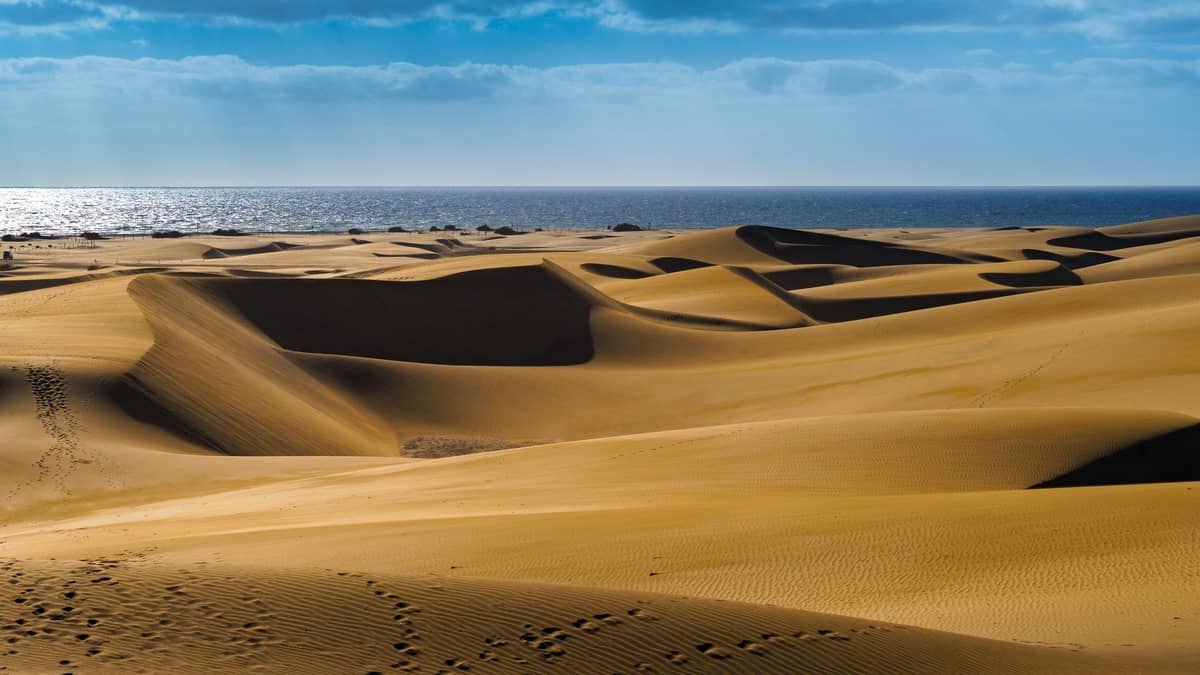
The Reserva Natural Especial de las Dunas de Maspalomas covers approximately 403.9 hectares at the southernmost point of Gran Canaria. It is not a beach with a few sand banks. It is a functioning aeolian dune system: a shifting, wind-sculpted landscape of pale golden sand that can reach several metres in height, broken by corridors of exposed rock pavement and bordered on one side by the Atlantic Ocean. On maps and from the air, it reads like a fragment of the Sahara deposited on a Spanish island, which is geographically not far from the truth. The Canary Islands sit about 100 kilometres off the northwest African coast, and the fine calcareous sand of the Maspalomas system has Saharan characteristics.
The reserve was first protected in 1987 under Spanish conservation law and reclassified in 1994 under Canary Islands Natural Spaces Law as a Special Nature Reserve, its current legal status. It is also designated as ZEC ES7010007 within the European Union's Natura 2000 network, recognising it as a site of European conservation significance. That designation is not ornamental: the reserve is actively managed, parts of it are off-limits to the public, and violations carry fines starting at €150.
⚠️ What to skip
Not all of the dune field is open to visitors. Restricted conservation zones are clearly delineated, and authorities report up to 300 unauthorised access attempts per day. Entering these areas risks a fine and causes real ecological damage to a protected habitat. Stick to marked paths and the publicly accessible corridors.
The reserve is not an isolated wilderness. It sits directly between two of Gran Canaria's busiest resort areas: Maspalomas to the west and Playa del Inglés to the north. This contrast is part of what makes it so striking: you can step off a promenade lined with hotels and be inside a sand wilderness within three minutes.
What You'll See: The Three Zones of the Reserve
Visitors who only scan the edge of the dunes from the Maspalomas beach promenade see perhaps ten percent of what the reserve contains. The landscape divides into three distinct environments, and understanding them changes how you plan your visit.
The dune field itself occupies the core of the reserve. At ground level, the scale is disorienting. The crests of the larger dunes block sightlines entirely, so you move through a sequence of enclosed sandy bowls and ridgelines. The sand surface is not uniform: windward slopes feel firm and compacted underfoot, while the leeward slip faces are loose and deep, and stepping onto them sends cascades of sand hissing downhill. That sound, faint and constant on a breezy day, is one of the more memorable sensory details of the place.
At the western edge of the reserve lies the Charca de Maspalomas, a coastal lagoon separated from the ocean by a sandbar. This wetland is a feeding and resting site for migratory birds, including waders and waterfowl, and is one reason the site holds Natura 2000 status. It can be observed from the edges without entering restricted zones. Depending on the season and recent rainfall, the lagoon's colour shifts from a clear pale green to a darker brackish tone.
The palm grove, Palmeral de Maspalomas, marks the northern edge of the reserve. It is one of the oldest palm groves in the Canary Islands and provides visible shade cover after the open dune field. The transition from open sand to dense palm canopy happens quickly and feels genuinely surprising. The air under the palms is cooler, and the sounds of the resort area return.
How the Experience Changes by Time of Day
Arriving at sunrise is consistently the most rewarding time. The dunes empty of almost all visitors, the light rakes across the sand at a low angle and sharpens every ripple and crest into high contrast, and the air is cool enough to walk comfortably even in summer. The colour of the sand shifts from white to pale amber to deep orange over the first thirty minutes after the sun clears the horizon, and none of it requires a filter. You may hear occasional conservation messaging, but crowd density is at its lowest.
By mid-morning, tour groups from the nearby resorts begin arriving. By 11:00 in summer, the combination of direct sun and soft sand underfoot makes the interior sections genuinely hot and physically demanding. Temperatures in the dune bowl can feel several degrees warmer than the surrounding area because the sand radiates heat and there is no shade. Walking barefoot becomes uncomfortable quickly.
Late afternoon from around 16:00 onward brings the second window of quality light, and the golden hour here is legitimately exceptional. The crowds thin again as day-trippers return to their hotels, and the western light turns the dune crests a deep copper. Conservation messaging is sometimes broadcast during this period. Sunset from one of the higher dune ridges, looking west over the lagoon and the Atlantic, is one of the better natural spectacles available in the south of the island.
💡 Local tip
Arrive by 07:00 in summer or by 08:00 in winter to experience the dunes before the bulk of resort visitors. Bring water regardless of the season: there are no facilities inside the reserve, the sand reflects and amplifies heat, and even a mild crossing of the dune field is more physically demanding than it looks.
Practical Walkthrough: Getting In, Getting Around
The reserve has no ticket booth, no formal entrance gate, and no single designated starting point. Most visitors enter from the Maspalomas beach promenade, which runs along the southern boundary and connects to the coastal strip at the base of the dunes. Others access the dune field from the Playa del Inglés side, walking west along the beach. A third option is approaching from the palmeral side, entering from the northern edge near the golf course.
By public bus, several Global routes serve the Maspalomas and Playa del Inglés resort corridor. From the bus stops, the dune edge is a ten to fifteen minute walk along the seafront promenade. For more detail on getting around the island's south by public transport, see the guide to getting around Gran Canaria.
Footwear matters more here than at most natural attractions. Closed shoes or sturdy sandals with straps are strongly recommended for anyone planning to walk the interior dune field. The sand surface is uneven, the slopes require effort, and the loose sections on dune faces can cause ankle rolls if you are wearing flip-flops. Sunscreen, a hat, and at least one litre of water per person are not optional extras in summer months.
For visitors with reduced mobility, the coastal promenade and several viewpoints along the beach boulevard provide unobstructed views of the dune field without requiring entry onto sand. The interior dune field is uneven, trackless, and not accessible by standard wheelchair. Viewing from the promenade at the southern edge gives a clear sense of the scale of the landscape.
Conservation Status and the MasDunas Project
The Maspalomas Dunes are not in a stable condition. Decades of surrounding tourist development have altered the sand supply and wind dynamics that naturally regenerate the dune system, and invasive plant species have colonised parts of the reserve. The Cabildo de Gran Canaria (the island's governing council) operates an ongoing restoration programme called MasDunas, which focuses on removing invasive vegetation, restoring natural sand movement corridors, and enforcing access restrictions more rigorously.
The enforcement element is increasingly active. Authorities report between 150 and 300 daily unauthorised accesses into restricted zones, and the Cabildo has responded by deploying additional surveillance resources, particularly around the late-afternoon period when visitor numbers peak. Multilingual audio announcements in the buffer zones during morning and evening windows are part of this effort.
For anyone who wants to understand the ecological value of the reserve before visiting, the official MasDunas site at masdunas.es explains the restoration work in detail. This context is worth reading: the dunes are not just a photogenic backdrop but a specific and increasingly pressured habitat. The Maspalomas Beach that borders the reserve to the south is part of the same protected coastal system.
Photography: Making the Most of the Light
The Maspalomas Dunes photograph well under almost any light, but they photograph exceptionally under raking early morning or late afternoon sun. The key compositional element is the sand ripples: each dune surface carries a texture of fine parallel ridges left by wind, and low-angle light turns these into alternating bands of highlight and shadow that give depth and scale to images that would otherwise look flat.
The absence of vegetation in the core dune field means the horizon is clean. Shooting upward from a dune base with a clear sky above works well. Shooting from a high dune ridge looking across the field gives scale. The lagoon at the western edge introduces reflective water and bird movement, which adds variety to a sequence of images. Midday light in summer is harsh and flattens the texture almost entirely; if you are visiting specifically to photograph, the middle of the day is the least productive window.
The dunes pair well with the nearby Maspalomas Lighthouse, which sits at the southwestern tip of the reserve and offers a fixed architectural reference point against the open landscape.
Who Should Think Twice Before Visiting
Visitors who expect a manicured natural attraction with clear paths, shade, refreshment kiosks, and interpretation panels will find the interior of the reserve disorienting and physically demanding. There is no infrastructure inside. The experience is genuinely unstructured: you navigate by sense of direction, the sun, and the sound of the ocean.
Families with very young children or pushchairs should approach from the beach promenade and stay at the edge; the interior is not suitable for pushchairs. Visitors who are sensitive to intense sun exposure and cannot walk on uneven sand for extended periods will find the promenade viewpoints a more comfortable option. And anyone looking for the full cultural programme of Gran Canaria's south, combining beaches, boat trips, and markets, should note that the dunes are best used as one part of a broader itinerary: see the full guide to things to do in Gran Canaria for context on how the dunes fit alongside other attractions.
Insider Tips
- The dunes are at their coolest and emptiest on weekday mornings between December and February. Winter light in the Canary Islands is lower in the sky all day, so the texture of the sand stays photogenic for longer than in summer.
- Walking from the Playa del Inglés beach end westward toward the lagoon gives you the full sequence of environments: open beach, dune field, lagoon edge, palmeral. This east-to-west route avoids backtracking and ends near the Maspalomas promenade, where buses and taxis are easy to find.
- Bring a bag for your shoes. Most people take their shoes off at the beach edge and carry them; the sand is soft enough in the public access corridors to walk barefoot in the early morning before it heats up.
- The Charca lagoon at the western edge of the reserve is best observed from the palm grove access point rather than from the beach side. Light is better in the morning from this angle and the bird activity is more visible.
- The MasDunas project coordinates volunteer days for habitat restoration. If you are in Maspalomas for an extended stay, checking masdunas.es for upcoming volunteer sessions is a way to engage with the reserve beyond a standard visit.
Who Is Maspalomas Dunes For?
- Photographers who want to shoot a Saharan-style landscape within walking distance of a resort
- Early risers who want a genuine outdoor experience before the resort crowds emerge
- Couples looking for a dramatic natural setting in Gran Canaria's south
- Nature-focused travellers interested in European protected habitats and conservation
- Anyone combining a beach day with a landscape walk in a single morning
Nearby Attractions
Other things to see while in Maspalomas:
- Maspalomas Beach
Playa de Maspalomas sits on the southern coast of Gran Canaria, where 2.7 kilometres of pale sand meets one of Europe's most remarkable dune systems., where 2.7 kilometres of pale sand meets one of Europe's most remarkable dune systems. Free to access year-round, it draws everyone from families seeking calm water to naturists and serious sunset-watchers.
- Maspalomas Lighthouse
Standing at the southern tip of the Gran Canaria resort coast since 1890, the Maspalomas Lighthouse is a working 19th-century navigation tower surrounded by some of the most dramatic coastal scenery in the Canary Islands. Free to visit, with an accessible ethnographic-style visitor centre inside, it sits at the meeting point of the Atlantic, the famous dune field, and the Meloneras seafront.