Maspalomas Lighthouse (Faro de Maspalomas): The Landmark at the Edge of the Dunes
Standing at the southern tip of the Gran Canaria resort coast since 1890, the Maspalomas Lighthouse is a working 19th-century navigation tower surrounded by some of the most dramatic coastal scenery in the Canary Islands. Free to visit, with an accessible ethnographic-style visitor centre inside, it sits at the meeting point of the Atlantic, the famous dune field, and the Meloneras seafront.
Quick Facts
- Location
- Plaza del Faro 15, Maspalomas, San Bartolomé de Tirajana, Gran Canaria, Spain
- Getting There
- Global bus lines 18, 25, 30, 36, 66, and 90 stop near Avenida Cristóbal Colón — roughly a 5-minute walk to the lighthouse
- Time Needed
- 45 minutes to 1.5 hours, depending on whether you walk the surrounding seafront
- Cost
- Free entry to the visitor centre
- Best for
- History lovers, photographers, families, and anyone combining a dunes visit with a coastal walk
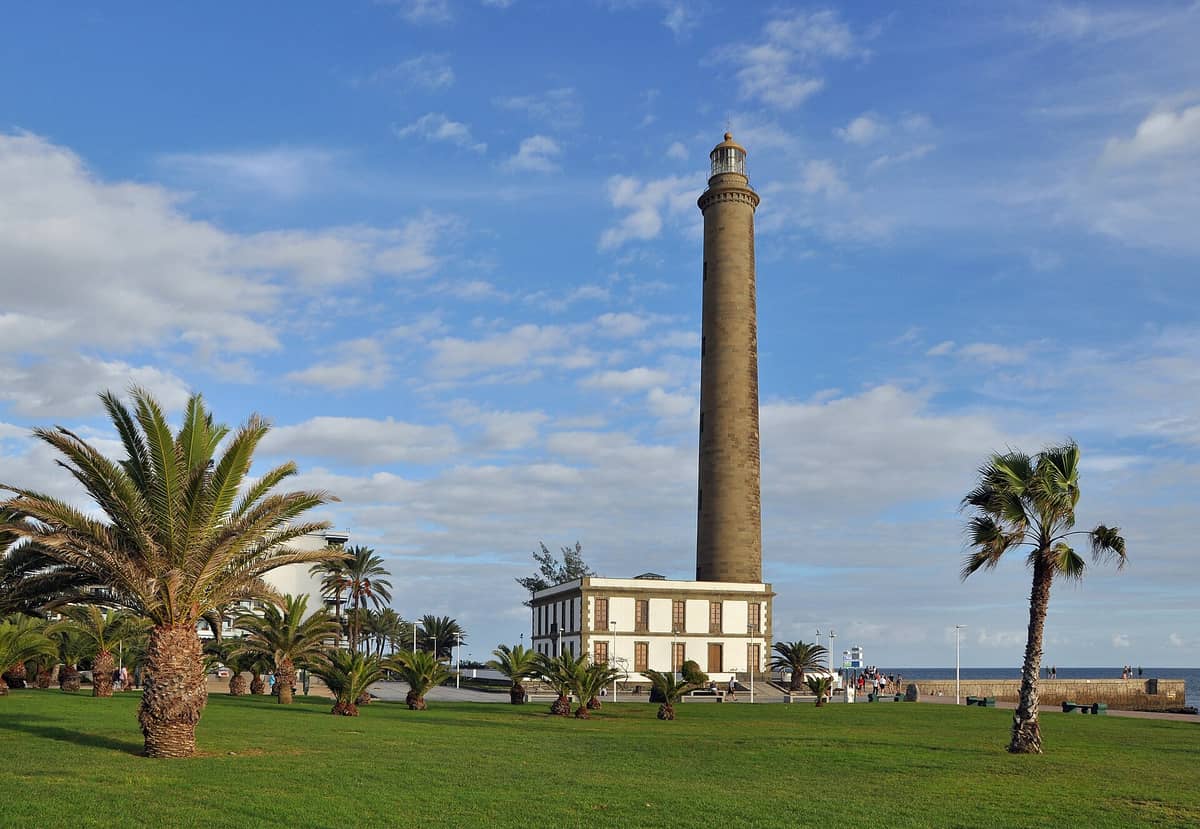
What the Maspalomas Lighthouse Actually Is
The Maspalomas Lighthouse, known locally as the Faro de Maspalomas, is an active 19th-century lighthouse that has guided Atlantic shipping around the southernmost point of Gran Canaria since its light was first lit on 1 February 1890. More than 130 years later, the tower still functions as a working navigational aid, which gives it a different quality from purely decorative historic structures. You can see the lamp housing at the top; you know it turns on every night.
The building anchors a small plaza at the edge of the Maspalomas dune system, with the Atlantic stretching south and west, the famous golden dunes rising to the east, and the Meloneras seafront promenade curving away to the west. The setting is what makes this more than a standard landmark visit. Most people encounter the lighthouse at the end of a walk across the dunes or midway along the Meloneras coastal path, and in both cases it arrives as a genuine focal point rather than a destination you have to go out of your way to reach.
ℹ️ Good to know
Opening hours: generally Tuesday to Saturday, 10:30 to 14:30, with some periods operating 11:00 to 17:00; check the official site for current timetable. Entry is free. A tourist information office operates at the same location during opening hours.
The Museum Inside: What You Will Find
The lighthouse complex houses the Centro Etnográfico del Faro de Maspalomas, a compact visitor centre and ethnographic museum built into the lighthouse keeper's former quarters. The exhibition covers the history of the south of Gran Canaria and the workings of the lighthouse itself, alongside the broader story of how this coastline shaped local communities and island traditions. Panels are presented in multiple languages, and the museum includes descriptions in Braille and QR codes linking to expanded information, making it one of the more thoughtfully accessible small museums on the island.
An elevator serves both floors, so visitors with mobility concerns can move through the space without relying on the staircase. The museum is compact, and most people move through it in 20 to 30 minutes, but it rewards close reading, especially the sections on the fishing communities that once worked the waters immediately around Maspalomas Point. For a free attraction, the quality of the display is noticeably above what you might expect.
The lighthouse sits within a short walk of the Maspalomas Dunes, and many visitors combine the two into a single half-day route. If you are planning that combination, go to the museum first while you have energy, then walk the dunes, finishing back at the lighthouse for a rest before returning along the seafront.
How the Experience Changes by Time of Day
In the morning, from opening until around noon, the lighthouse plaza is relatively quiet. The light at this hour is clean and direct from the east, which works well for photographs of the tower against a clear Atlantic backdrop. The white-painted cylindrical shaft catches the sun sharply, and the surrounding low scrub vegetation still holds some shade. Tour groups tend to arrive between 10:30 and 11:30, so arriving right at opening or after 14:00 gives you the space to look around properly.
By mid-afternoon, the area picks up foot traffic from beachgoers finishing on Maspalomas beach and day visitors completing a dunes crossing. The light shifts to the southwest, which softens the contrast on the tower but improves the quality of photographs looking out over the ocean. The Meloneras promenade to the west fills with walkers and cyclists from around 16:00 onward.
Sunset at the lighthouse is genuinely good. The tower faces approximately southwest, which means the evening light hits the face of the building directly. Photographers position themselves along the low rocky shoreline to the west to get the tower with the sun dropping behind it. The ocean smell is stronger in the evening, salt and something faintly organic from the rock pools, and the sound of the Atlantic is more noticeable once the daytime wind dies down slightly.
💡 Local tip
For the best light on the tower itself, arrive in the late afternoon, roughly 15:00 to 17:00. For sunset photography with the lighthouse as a silhouette element, position yourself 100 to 150 metres west along the rocky shoreline before closing time.
Historical and Architectural Context
When the Faro de Maspalomas was completed in 1890, the south coast of Gran Canaria was not the dense resort corridor it is today. The lighthouse was built to mark one of the most strategically significant navigation points in the eastern Atlantic, the point where ships travelling between Europe, Africa, and the Americas had to round the island's southern tip. The shipping lanes around Maspalomas Point were genuinely dangerous in pre-radar navigation, and the lighthouse represented a significant investment by the Spanish administration in maritime safety.
The tower is cylindrical and white-rendered, rising to a height that made it visible well out to sea. The design is functional rather than ornate, typical of late-19th-century Spanish lighthouse construction, with thick masonry walls tapering slightly toward the lamp gallery. The keeper's quarters flanking the base of the tower are lower and more domestic in character, which gives the complex a human scale that photographs do not always convey. Standing next to the base of the tower, the walls feel solid in a way that mass tourism architecture in the surrounding area conspicuously does not.
The surrounding area has changed almost beyond recognition since 1890. The Maspalomas Dunes to the east are a protected natural reserve, and the Maspalomas beach to the northeast draws large crowds. The contrast between the quiet solidity of the 1890 lighthouse and the resort infrastructure immediately around it is one of the more interesting things about the visit.
Getting There and Practical Walkthrough
The lighthouse is located at Plaza del Faro 15, Maspalomas, in the municipality of San Bartolomé de Tirajana on the south coast of Gran Canaria. Several Global bus lines serve stops on Avenida Cristóbal Colón nearby, including commonly lines 18, 25, 30, 36, 66, and 90, though routes and numbers can change. From those stops, the walk to the lighthouse takes roughly five minutes. If you are arriving from Playa del Inglés or Maspalomas town centre, lines 30 and 66 are the most convenient connections, though you should verify current timetables before your visit as schedules change.
By car, paid parking is available at Plaza del Faro or along Avenida Cristóbal Colón. In high season, the parking fills by mid-morning, and the surrounding streets are not well-suited to street parking. If you are coming specifically for the lighthouse and museum, arriving before 11:00 or after 14:30 avoids the worst of the parking competition.
On foot from Maspalomas beach, follow the shoreline west and southwest. The dune path from the beach toward the lighthouse takes 20 to 40 minutes depending on how far into the dune field you have walked. From the Meloneras seafront, the lighthouse is visible from a considerable distance, and the promenade walk from the main Meloneras hotel strip takes about 15 to 20 minutes at a comfortable pace.
⚠️ What to skip
There is minimal shade around the lighthouse plaza itself. In summer, temperatures on the exposed southern tip regularly reach 28 to 30°C by midday. Bring water, and consider a hat if you plan to spend time outside the museum.
What the Lighthouse Delivers, and Where It Falls Short
The Faro de Maspalomas is not a destination that will occupy most of an afternoon on its own. The museum is free and worthwhile, but it is compact. The exterior is photogenic and the setting is excellent, but once you have walked around the base, looked at the ocean, and taken your photographs, there is not a great deal more to do at the lighthouse itself. Visitors who arrive expecting a major museum experience or who cannot walk the surrounding coastline may find it underwhelming.
It works best as part of a longer route: arrive from or continue to the dunes, walk the Meloneras promenade in either direction, or combine it with a stop at Maspalomas beach. As an isolated half-hour stop, it is pleasant but not remarkable. As the anchor point of a two to three hour coastal walk, it is genuinely satisfying.
If the lighthouse forms part of a wider exploration of the south, the Gran Canaria things to do guide covers how it fits into a broader itinerary, including day trip options and combination routes from the main resort areas.
Insider Tips
- The tourist information office inside the lighthouse complex is one of the better-stocked on the south coast. Even if you skip the museum, it is worth stopping in for maps and current event information, especially if you have just arrived in the area.
- The rocky shoreline immediately west of the lighthouse is a good spot for watching seabirds, particularly in the early morning. The flat volcanic rocks at the water's edge also give you a lower angle for shooting the tower against the sky.
- If you are crossing the dunes and planning to finish at the lighthouse, time your walk for early afternoon. The ethnographic museum typically closes around 14:30; after that, the light is still good for photography and you can rest in the plaza before walking the Meloneras promenade back toward your hotel.
- The lighthouse plaza occasionally hosts small outdoor events and craft markets, particularly on weekend mornings in spring and autumn. There is no fixed schedule, but if you notice activity as you approach, it is worth slowing down to look.
- Parking along Avenida Cristóbal Colón is often metered and can include short-stay limits. If you are staying longer than an hour, check the Plaza del Faro parking area first, as it typically allows longer stays.
Who Is Maspalomas Lighthouse For?
- Photographers and architecture enthusiasts drawn to working 19th-century maritime structures
- Families with children who want a free, accessible, and manageable cultural stop alongside a beach day
- Walkers completing a dunes crossing who want a defined endpoint before turning back along the seafront
- First-time visitors to Maspalomas who want historical context for the area before exploring the beaches and dunes
- Travellers interested in the maritime history of the Canary Islands and the Atlantic shipping routes
Nearby Attractions
Other things to see while in Maspalomas:
- Maspalomas Beach
Playa de Maspalomas sits on the southern coast of Gran Canaria, where 2.7 kilometres of pale sand meets one of Europe's most remarkable dune systems., where 2.7 kilometres of pale sand meets one of Europe's most remarkable dune systems. Free to access year-round, it draws everyone from families seeking calm water to naturists and serious sunset-watchers.
- Maspalomas Dunes
The Maspalomas Dunes form one of Europe's most striking natural landscapes: a 400-hectare protected dune reserve at the southern tip of Gran Canaria, where rippling sand corridors, a coastal lagoon, and palm oasis converge. Entry is free, the reserve is open around the clock, and the experience changes dramatically depending on when you arrive.