Lotus Mountain Scenic Area: Ancient Quarry, River Views, and Stone Cliffs in Panyu
Lotus Mountain Scenic Area (莲花山旅游区) in Panyu, Guangzhou is a 2.33-square-kilometre park built around a 2,000-year-old quarry site. Dramatic stone cliffs, a hilltop Guanyin statue overlooking the Pearl River, and a compact network of trails make it one of the more rewarding day trips south of the city centre.
Quick Facts
- Location
- Shilou Town, Panyu District, Guangzhou, Guangdong Province, China
- Getting There
- Guangzhou Metro Line 3 to Shiqiao Station or Panyu Square area, then local bus Pan 92 or Pan 93
- Time Needed
- 2–3 hours for a relaxed visit; half a day if you linger at viewpoints
- Cost
- CNY 54 standard admission; verify concessions at the gate
- Best for
- History buffs, photography, weekend hikers, families with older children
- Official website
- http://www.lhs123.com
What Is Lotus Mountain, Exactly?
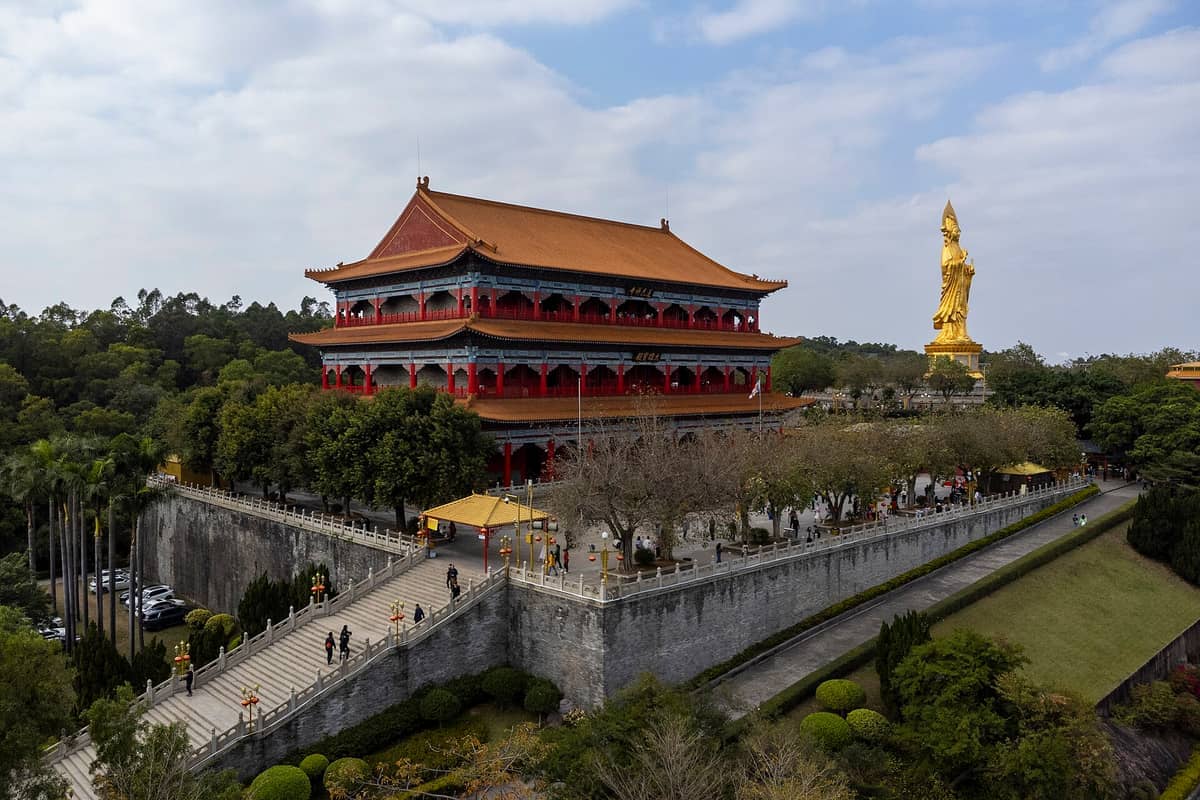
Lotus Mountain Scenic Area (莲花山旅游区) is not a mountain in the dramatic sense. It is a former quarry site, active for roughly 2,000 years, that left behind a landscape of exposed red sandstone cliffs, narrow rock corridors, overhanging ledges, and stone terraces. The highest point sits at 108 metres, modest by any measure, but the open summit offers unobstructed views over the Pearl River Delta that are surprisingly expansive on a clear day.
The scenic area covers approximately 2.33 square kilometres in Shilou Town, Panyu District, roughly 40 kilometres south of central Guangzhou. The combination of geological curiosity, layered history, and a prominent hilltop Guanyin statue gives the park an unusual character: part cultural heritage site, part religious landmark, part geological walk-through.
💡 Local tip
Opening hours are listed as 07:00–17:00 daily. Arrive before 09:00 on weekends if you want the cliffs and summit largely to yourself — tour groups tend to arrive mid-morning and concentrate around the Guanyin statue and main viewing platforms.
The Stone Cliffs: A Quarry Landscape Unlike Anything Nearby
The cliffs are the heart of the visit. Over centuries, quarry workers extracted red sandstone in a way that left near-vertical rock faces, some reaching tens of metres high, studded with tool marks still visible in the stone. The colour of the rock shifts noticeably depending on the light: a deep terracotta under overcast skies, and a warm amber when the sun catches it directly in the morning.
Walking through the narrower rock corridors at the base of the cliffs, you feel the temperature drop a few degrees. The stone holds moisture, and there is a faint mineral smell at ground level that disappears as you climb. Ferns and small shrubs have established themselves in cracks and ledges throughout, softening what would otherwise be a stark industrial landscape. It is genuinely unusual terrain for southern China, and one of the clearest reasons to make the trip out to Panyu.
Photography is particularly effective in the early morning when the low sun rakes across the cliff faces and emphasises the texture of the stone. By midday the light is flat and the cliffs lose most of their drama. A wide-angle lens is helpful given how close you are to the rock faces in places.
The Hilltop and the Guanyin Statue
The trail to the summit is the park's main ascent. It is not technically demanding, but sections involve stone staircases and uneven surfaces, so comfortable shoes with grip are advisable. At the top stands a large bronze Guanyin statue that has become the site's most recognised landmark. The statue faces the Pearl River, and the combination of the religious monument and the wide water view gives the summit a contemplative quality that contrasts with the raw geology below.
On clear autumn and winter mornings, the view from the summit reaches across the Pearl River Delta in a way that makes the scale of the region tangible. In summer, haze frequently reduces visibility. The summit is also where crowds concentrate most heavily on weekends, particularly around midday when tour groups complete their ascent. If the statue and the crowds are not your priority, the upper trail that runs around the perimeter of the hilltop offers similar views with considerably fewer people.
⚠️ What to skip
The summit area can be exposed and hot in summer (June to August). Guangzhou's humidity is significant in those months, and the climb, though short, will feel demanding in midday heat. Bring water and sun protection. Autumn and winter visits are noticeably more comfortable.
Getting There from Central Guangzhou
Panyu is not directly on the central metro grid in the way that Yuexiu or Tianhe are, but it is reachable without difficulty. Take Guangzhou Metro Line 3 or Line 4 to the Panyu Square area (石桥/番禺广场), then transfer to a local bus, commonly cited as Pan 92, Pan 93, or Pan 128, which serve the scenic area. Confirm current bus routes locally, as service patterns can change. The total journey from the city centre typically takes around 45 to 60 minutes depending on connections.
Ride-hailing via DiDi is a practical alternative, particularly if you are travelling with a group or have luggage. The drop-off at the scenic area gate is straightforward, and fares from the Panyu metro area are modest. Taxis are also available but flagging one down for the return journey can take time, so a ride-hailing app is the more reliable option for getting back.
Lotus Mountain can be combined efficiently with other Panyu attractions into a full day out. Baomo Garden and Shawan Ancient Town are both in the same district and reward the effort of making the trip south from the city centre.
How the Experience Changes Through the Day
Early morning, between 07:00 and 09:00, the park is quietest. The air is cooler, particularly in the shaded cliff sections, and the light is at its most directional and photogenic. Local visitors arrive first, often completing a loop of the lower paths before the organised tour groups begin to arrive.
By 10:00 on weekends, the main paths and the summit approach become noticeably busier. The park is not overcrowded in the way that some urban attractions in Guangzhou can feel, but the concentrated flow around specific viewpoints and the Guanyin statue creates pinch points. Weekday visits are noticeably calmer at any hour.
Late afternoon, from around 15:00 onward, the light returns to the western-facing rock sections and the park begins to thin out. The 17:00 closing time is enforced, so factor in your descent from the summit and the walk back to the exit gate.
Practical Notes and Who May Want to Skip This
The standard admission fee is CNY 54, with concession pricing of CNY 27 reported for eligible visitors. Verify current pricing at the gate or on the official site at budget travel in Guangzhou is a consideration, since CNY 54 is on the higher end of Guangzhou park admission.
Accessibility across the site is limited. The lower cliff sections involve uneven stone paths, and the summit ascent uses staircases throughout. Visitors with mobility difficulties will find access to much of the park's most distinctive terrain challenging. The paved lower section near the entrance is more manageable, but the summit and cliff walks are not wheelchair accessible in any practical sense.
Visitors who are primarily interested in formal gardens, air-conditioned museums, or urban cultural experiences may find Lotus Mountain underwhelming relative to the travel time required. The park rewards curiosity about geology and history, and it suits those who enjoy walking in green space with meaningful context. It is not a spectacle in the way that a large theme park or skyline viewpoint might be.
If dramatic natural scenery is your priority, Baiyun Mountain offers longer trails and a bigger park footprint, though it lacks the geological history that makes Lotus Mountain distinctive. For Panyu-specific planning, see the Panyu district guide.
Historical Context: 2,000 Years of Quarrying
The quarrying of red sandstone at Lianhua Mountain began during the Western Han dynasty, roughly 2,000 years ago. The stone extracted here was used extensively in construction across the Pearl River Delta region. The site was later preserved as a scenic area, which kept the raw landscape that makes it visually compelling today. Without that history, this would simply be a low hill in Panyu. Because of it, the terrain has a layered documentary quality: the rock faces are a record of human labour at a specific place across a very long period.
This context is easy to overlook if you arrive without knowing it, and the on-site interpretation does not always present it prominently in English. Taking a few minutes to read about the quarrying history before your visit significantly changes how you experience the cliffs and stone corridors. What looks like abstract geological texture is, on reflection, the accumulated evidence of thousands of working days.
Insider Tips
- Arrive at opening (07:00) on a weekend morning to experience the cliff corridors in near-silence with the best directional light for photography. The difference versus a 10:00 arrival is substantial.
- The perimeter trail around the upper hilltop offers the same Pearl River Delta views as the main summit platform but with far fewer people. Follow the signs past the Guanyin statue rather than stopping at the main viewing deck.
- The rock faces photograph best when backlit or side-lit in early morning. By 11:00, flat overhead light removes most of the texture and shadow that make them interesting to shoot.
- Bring cash for the entrance fee. Card and mobile payment availability at scenic area gates in outer Panyu can be inconsistent, though this may have changed; carry a backup.
- If combining with Shawan Ancient Town in the same day, visit Lotus Mountain first in the morning while it is cool and the light is good, then move to Shawan in the afternoon when crowds there also thin out.
Who Is Lotus Mountain Scenic Area For?
- Photography enthusiasts interested in geological texture and dramatic rock landscapes
- History-minded travellers drawn to Han dynasty heritage and visible craft history
- Weekend hikers looking for a manageable half-day walk outside the city
- Families with older children (8+) who can manage staircases and uneven paths
- Visitors building a full Panyu day trip combining nature, history, and traditional town culture
Nearby Attractions
Other things to see while in Panyu:
- Baomo Garden
Baomo Garden (宝墨园) in Panyu District is one of the most ornate classical gardens in Guangdong, fusing Lingnan architectural traditions with sculpted waterways, intricate ceramic murals, and Qing-dynasty decorative arts. Originally built in the late Qing era and extensively rebuilt from 1995, it rewards visitors who appreciate craft and detail over theme-park spectacle.
- Chimelong Paradise
Chimelong Paradise is Guangzhou's large themed amusement park, located in Panyu District and home to more than 60 attractions. From white-knuckle roller coasters to family-friendly rides and seasonal shows, it attracts visitors from across the region. Here is what to expect before you arrive.
- Chimelong Safari Park
Spread across more than 2,000 mu (about 330 acres) in Panyu District, Chimelong Safari Park is one of the largest safari-style wildlife parks in Asia. This guide covers how to get there, what the experience is actually like, and how to make the most of a full day.
- Chimelong Water Park
Spanning over 300,000 square meters in Panyu District, Chimelong Water Park is one of Asia's largest water parks. Whether you're chasing record-breaking slides or looking for a lazy river afternoon, here's everything you need to know before you go.