Baiyun Mountain (White Cloud Mountain): Guangzhou's Green Escape Above the City
Baiyun Mountain, known in Chinese as 白云山 (White Cloud Mountain), is Guangzhou's major urban scenic area, covering 20.98 square kilometers of forested ridges, temple ruins, and panoramic viewpoints in Baiyun District. With a mountain admission fee of just 5 CNY, it draws a cross-section of the city: early-morning tai chi practitioners, weekend hikers, and families looking for fresh air without leaving the city limits.
Quick Facts
- Location
- Baiyun District, Guangzhou, Guangdong Province
- Getting There
- Guangzhou Metro — check current lines serving Baiyun District; buses also serve the area
- Time Needed
- 2–5 hours depending on trail and pace
- Cost
- Mountain admission: 5 CNY; Vehicle admission: 15 CNY
- Best for
- Morning hikers, city-view seekers, families, and budget travelers
- Official website
- www.baiyunshan.com.cn/bysen/index.shtml
What Baiyun Mountain Actually Is
Baiyun Mountain (白云山) is a large forested scenic area sitting in northeast Guangzhou in Baiyun District. It covers 20.98 square kilometers, making it far more than a single hill — it is a patchwork of ridges, valleys, reservoirs, temples, and observation points that takes a full half-day to explore even partially. The name translates as White Cloud Mountain.
For a city of nearly 19 million people, having a forested mountain accessible by public transit and priced at 5 CNY for entry is genuinely unusual. Locals treat it as an extension of daily life, not a tourist destination. That distinction matters: the experience here is shaped more by Guangzhou residents than by visitor infrastructure.
ℹ️ Good to know
Opening hours: 8:00–18:00 daily. Mountain admission: 5 CNY. Vehicle admission (for those entering by private car or taxi): 15 CNY. Prices are in Chinese yuan (CNY/RMB). Verify current rates before your visit, as fees can be revised.
How the Experience Changes Through the Day
Arrive before 8:30 and you will find the trails already occupied by older residents moving at a deliberate pace, many carrying folded fans or small radios playing Cantonese opera softly. The morning air on the lower slopes smells of damp stone, pine, and the faint smoke from incense at the small shrines scattered along the paths. The light is cool and diffused, filtering through dense subtropical canopy. This is when Baiyun Mountain is at its quietest and, for most travelers, most rewarding.
By mid-morning on weekends, the character changes. Families arrive with children, vendors near the entrances set up stalls selling cold drinks and packaged snacks, and the main paved paths become noticeably noisier. The noise is not unpleasant — it is the ordinary sound of a large public park — but if solitude is what you are looking for, you will need to move off the main routes or arrive early on a weekday.
Afternoons in summer are the one time the mountain becomes genuinely uncomfortable. Guangzhou's summer runs from roughly June through August, with temperatures that regularly exceed 33°C and humidity that makes movement feel laborious. In those months, the mountain is best visited in the early morning or avoided entirely in favor of a return trip in autumn. The rest of the year, afternoon visits are manageable if you carry water and wear light clothing.
💡 Local tip
Best visiting months: October through March for cooler, drier conditions. October and November in particular offer clear skies and comfortable temperatures — ideal for reaching the upper viewpoints. For more on seasonal timing, see the guide to visiting Guangzhou in autumn.
The Terrain: What You Will Actually Walk Through
The scenic area is divided into several named zones, each with its own character. The lower slopes are dominated by wide, well-paved paths that accommodate slow walkers and families. As you gain elevation, the paths narrow, the vegetation thickens, and the paving gives way to stone steps worn smooth by decades of foot traffic. The subtropical forest is dense — broad-leafed trees, bamboo clusters, ferns growing from rock faces — and it provides genuine shade even on warm days.
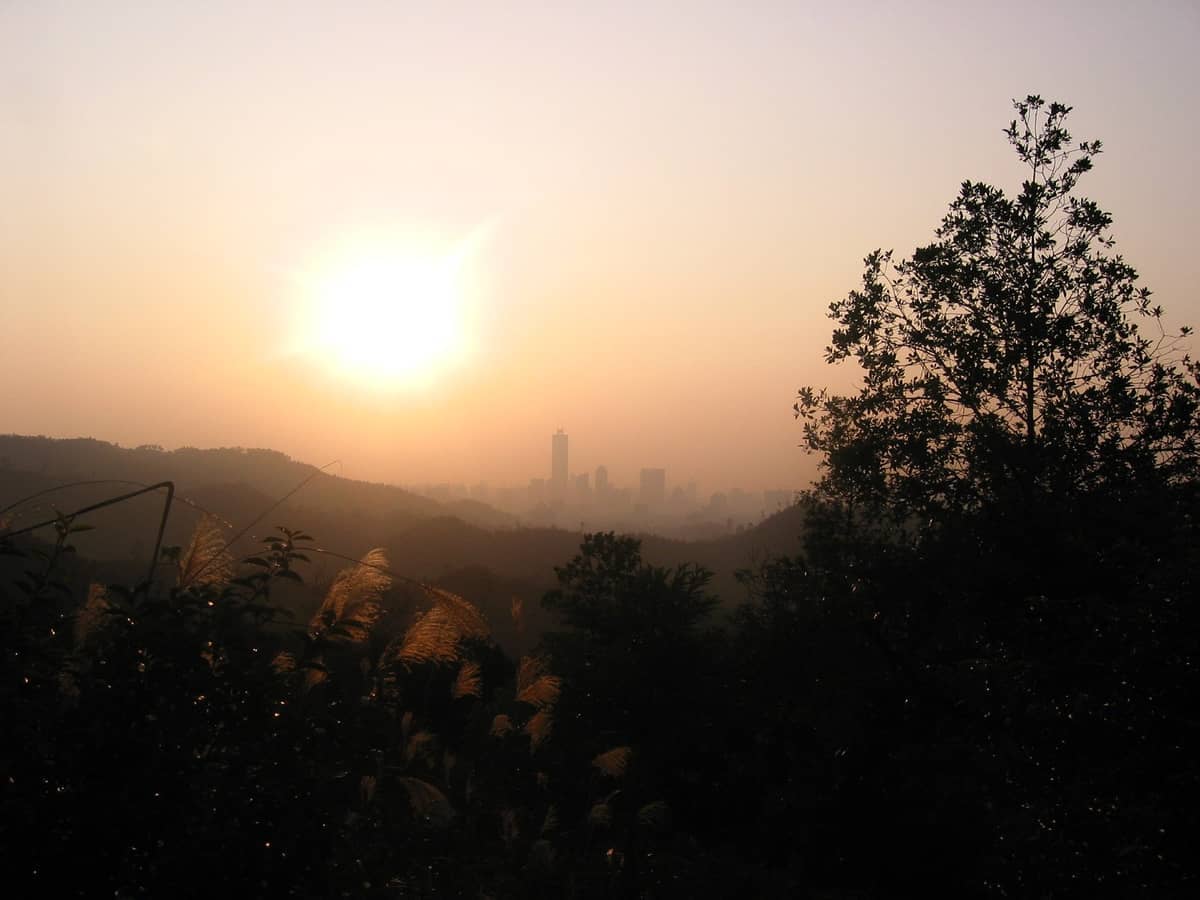
The summit area, Moxing Ridge (摩星岭), is Baiyun Mountain's highest point at 382 meters above sea level and the destination most worth the climb. On a clear day, the ridge offers an unobstructed panorama over Guangzhou's skyline: the Canton Tower visible to the south, the towers of Tianhe's central business district, and the Pearl River threading through the urban fabric below. The contrast between the forested ridge underfoot and the dense city spread below is one of the more arresting views available in Guangzhou.
For those who want to extend their exploration of the city's viewpoints, the best views in Guangzhou guide covers how Moxing Ridge compares to other elevated spots around the city, including the Canton Tower observation deck.
Vehicular access inside the scenic area is available for an additional 15 CNY, which covers transport up the main road rather than walking the full ascent. This option is worth considering for visitors with limited mobility or those traveling with young children and strollers, though the specific accessibility of individual trails within the park is not fully documented in official materials.
Historical and Cultural Context
Baiyun Mountain has been a place of cultural significance for Guangzhou for centuries. During the Tang and Song dynasties, scholars, poets, and religious figures made the ascent a ritual, and the mountain's misty peaks appeared repeatedly in Cantonese landscape painting and poetry as a symbol of the city's natural identity. Several temple sites are distributed across the scenic area, though the structures visible today are largely reconstructions or modern additions rather than preserved historical buildings.
The mountain's role shifted considerably in the 20th century as Guangzhou urbanized rapidly. What had been a relatively remote destination became, through successive decades of city growth, an island of green surrounded on all sides by one of China's largest metropolitan areas. The current scenic area designation and the 20.98 km² boundary preserve that green corridor as the city continues to expand.
Travelers interested in Guangzhou's broader relationship with its landscape and natural spaces may also find value in the Baiyun Mountain hiking guide, which covers specific trail options in more detail.
Getting There
Baiyun Mountain sits in Baiyun District, north of the city centre. The Guangzhou Metro serves nearby access points, and buses run to the main scenic area entrances. Check current metro line maps before your visit, as route coverage in this part of the city has expanded in recent years. Taxis and ride-hailing apps such as DiDi are a practical alternative, particularly if you are arriving from Tianhe or Yuexiu and want a direct connection.
If you are working out a broader itinerary, the getting around Guangzhou guide explains transit options, metro payment methods, and how to use DiDi in the city.
⚠️ What to skip
The scenic area gates close at 18:00. If you plan to reach the upper elevations, allow plenty of time from the main entrance. Starting after 14:00 on weekends is not recommended if you want a relaxed summit experience.
Photography and Practical Preparation
For city skyline photography, the upper ridge provides the widest framing. Morning light from the east illuminates the downtown towers well, but haze is common throughout the year and can significantly reduce visibility. Autumn and winter mornings after a rain offer the clearest conditions. The forest itself photographs well in the early morning at lower elevations, where mist clings to the canopy and the light is soft.
Wear proper walking shoes. The stone steps on the steeper sections are smooth and can be slippery after rain. Lighter trail shoes are fine for most routes; full hiking boots are not necessary unless you are exploring the less-maintained perimeter paths. Carry at least 500ml of water per person, more in warmer months. Tap water in Guangzhou is not recommended for drinking without boiling or filtration, so bring sealed bottled water from outside the park if you prefer to avoid vendor pricing.
Dress in layers in cooler months. The summit can be several degrees cooler than the city below, and the wind picks up on the open ridge. In summer, light, moisture-wicking fabric is the right call; sun protection is important above the treeline.
An Practical Assessment: Who This Is For, and Who Might Be Disappointed
Baiyun Mountain is not a dramatic alpine experience. The highest point sits at 382 meters above sea level. The trails are well-maintained and unchallenging by most hiking standards. If you are looking for technical difficulty or genuine wilderness, this will not satisfy. What it offers instead is a genuine slice of how Guangzhou residents use their outdoor space: communal, accessible, unpretentious, and free of the choreography that shapes more tourist-oriented attractions.
Travelers who arrive expecting a polished nature reserve with interpretive signage in English will find the experience somewhat raw. Signage is primarily in Chinese, facilities vary in quality across the scenic area, and the park's scale means some zones are better maintained than others. For travelers who can navigate ambiguity and pace themselves well, that rawness is part of what makes the visit feel authentic.
Baiyun Mountain pairs naturally with a broader day in Baiyun District or, for those interested in continuing to other green spaces, with a trip to the South China National Botanical Garden, which showcases the region's subtropical plant diversity in a more curated setting.
Insider Tips
- Arrive before 8:00 to beat weekend crowds and catch the mountain in its quietest state. The gates open at 8:00, but the real advantage is the first 30–45 minutes before larger groups arrive at the main trailheads.
- The vehicle admission ticket (15 CNY) covers a shuttle-style road up the mountain. If you have difficulty with stairs or extended uphill walking, this is a legitimate option rather than just a shortcut.
- Small food and drink stalls inside the scenic area charge a premium. Buy water and snacks at a convenience store in the city before you arrive.
- On hazy days, the summit view is underwhelming. Check the city's air quality index before making the summit climb a priority. If visibility is below 3 km, the lower forest trails offer more reward for the effort.
- Weekday mornings after national holidays are unusually quiet, as most visitors exhaust the attraction during the holiday itself. If your schedule allows a Tuesday or Wednesday visit after a Golden Week period, the trails can feel almost empty.
Who Is Baiyun Mountain For?
- Budget travelers looking for a full half-day of outdoor activity at near-zero cost
- Photographers wanting a high vantage point over the Guangzhou skyline, particularly in clear autumn conditions
- Families with older children who can manage 1–2 hours of walking on paved and stone paths
- Visitors who want to observe how Guangzhou residents actually spend their leisure time, away from tourist infrastructure
- Anyone looking for cooler air and tree cover during the milder months of the year
Nearby Attractions
Other things to see while in Baiyun District:
- Moxing Ridge
Moxing Ridge (摩星岭) is the highest point of Baiyun Mountain, sitting at 382 metres above Guangzhou's urban sprawl. Once known as Biyun Peak, this summit rewards hikers and sightseers alike with sweeping city panoramas, cooler air, and a rare sense of elevation in an otherwise flat Pearl River Delta city.
- Yuntai Garden
Covering 250,000 square meters at the southern foot of Baiyun Mountain in Baiyun District, Yuntai Garden (云台花园) is one of Guangzhou's largest purpose-built flower gardens. Themed zones, seasonal blooms, and sculpted landscapes make it one of the city's most photogenic green spaces, conveniently reached via Metro Line 11 at nearby Yuntai Garden Station.