Moxing Ridge: Reaching the Summit of Baiyun Mountain
Moxing Ridge (摩星岭) is the highest point of Baiyun Mountain, sitting at 382 metres above Guangzhou's urban sprawl. Once known as Biyun Peak, this summit rewards hikers and sightseers alike with sweeping city panoramas, cooler air, and a rare sense of elevation in an otherwise flat Pearl River Delta city.
Quick Facts
- Location
- Baiyun Mountain Scenic Area, Baiyun District, Guangzhou
- Getting There
- Access via Baiyun Mountain scenic-area gates; sightseeing cars and cable car available within the park
- Time Needed
- 2–4 hours for the summit and surroundings; allow a full half-day if combining with other Baiyun Mountain areas
- Cost
- Approx. CNY 5 for Moxing Ridge; scenic-area entrance fee applies separately. Verify locally before visiting.
- Best for
- City panoramas, morning hikes, photography, and escaping Guangzhou's urban heat
What Is Moxing Ridge?
Moxing Ridge (摩星岭) is the summit peak of Baiyun Mountain (白云山), the sprawling natural reserve that rises north of Guangzhou's city centre in Baiyun District. At 382 metres above sea level, it is the highest point in the entire scenic area and one of the few places in Guangzhou where you can actually feel altitude. The name translates loosely to 'Touching the Stars Ridge,' a poetic nod to the sensation of standing above the city's low-lying delta terrain. The peak was originally called Biyun Peak before it was renamed Moxing Ridge in later usage.
For context, Guangzhou is a largely flat city built on the lower reaches of the Pearl River. Most visitors spend their time at street level or inside air-conditioned malls and museums. Moxing Ridge offers something genuinely different: open sky, tree cover, and a horizon that stretches across the metropolitan skyline. On clear days, the scale of Guangzhou becomes suddenly apparent from up here.
Baiyun Mountain itself is one of the city's most-used recreational spaces, drawing locals for morning tai chi, weekend family outings, and weekday trail runs. Moxing Ridge is the destination for those who want to go all the way to the top. If you are planning a broader exploration of the mountain, consult our Baiyun Mountain hiking guide for route options and gate details.
The View from the Top
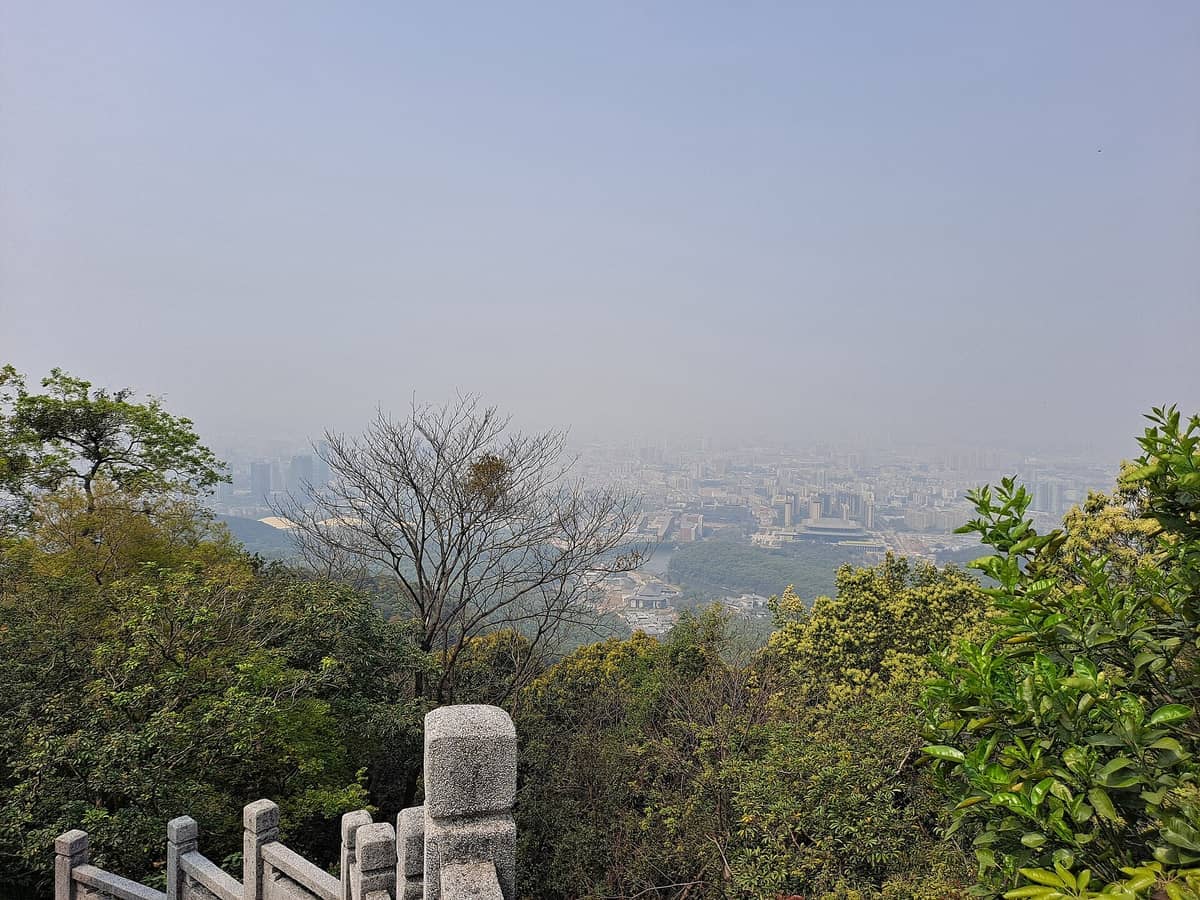
The panorama from Moxing Ridge is the main event, and it earns its reputation. Standing at the summit, you look south over the full sweep of Guangzhou: a dense urban mosaic of towers, expressways, and the thin silver thread of the Pearl River cutting through the middle distance. On particularly clear days in autumn and winter, the Canton Tower and the Zhujiang New Town skyline are visible on the southern horizon.
The quality of the view changes significantly with weather. Guangzhou's humid subtropical climate means haze is common from late spring through summer. The best visibility occurs between October and February, when cooler, drier air replaces the heavy moisture of the rainy season. Morning visits on these clear days can produce a pale golden light over the city that photographers specifically plan around.
💡 Local tip
Photography tip: Arrive at or shortly after sunrise on a clear autumn or winter morning. The low angle of light from the east catches the city towers at their most dramatic, and the summit is rarely crowded before 8am on weekdays.
For a broader rundown of where to find elevated city views across Guangzhou, the best views in Guangzhou guide puts Moxing Ridge in useful perspective alongside the Canton Tower observation deck and other rooftop options.
Getting to the Summit: Trails vs. Transport
There are two main ways to reach Moxing Ridge: on foot via the mountain trails, or by using the cable car and sightseeing shuttle network within the Baiyun Mountain Scenic Area. Most visitors use a combination of both, riding up and walking down or vice versa.
The sightseeing cars and shuttle routes connect key nodes within the scenic area, including the South Gate, Peak Square, Moxing Summit, and Mingzhu House. These are practical for visitors with limited mobility, families with young children, or anyone who wants to conserve energy for the summit experience rather than the ascent. The cable car option provides an aerial perspective of the forested slopes and is worth taking at least one-way for that reason alone.
Walkers who prefer a proper ascent will find marked paths through dense subtropical forest. The trail surfaces include stone steps in many sections, worn smooth in places by decades of foot traffic. Expect some steeper sections as you approach the summit ridge. Sturdy footwear with grip is useful, especially after rain when the stone steps become slippery. Lightweight trail shoes or hiking sandals are fine for dry conditions.
⚠️ What to skip
Weather caution: Baiyun Mountain receives significant rainfall between April and September. After heavy rain, trail surfaces can be slick and some paths may have drainage runoff across the stone steps. Check local weather before setting out and avoid the exposed summit during electrical storms.
How the Experience Shifts Through the Day
Early mornings, particularly on weekdays, belong to Guangzhou's older residents. Groups gather at wider path junctions and flat areas lower on the mountain for tai chi, fan dancing, and group exercise. The sounds drift upward: recorded music from portable speakers, the rhythmic shuffle of footsteps, occasional birdsong. By the time you reach the upper trails toward Moxing Ridge, the crowds thin and the atmosphere becomes noticeably quieter.
Midday on weekends is the busiest period across the entire mountain. The summit area fills with families and groups of young visitors taking photographs. Queues form for the cable car. Food and drink stalls near the base and mid-mountain are active. This is not an unpleasant experience, but it is a different one: social, energetic, and crowded at the popular viewpoints.
Late afternoon brings a gradual shift. The light softens, the crowds begin to descend, and the summit takes on a calmer tone. Sunset from Moxing Ridge, when conditions allow, produces a warm orange haze over the city skyline. However, note that scenic-area entrance and facility hours may restrict late access, and the mountain trails should not be navigated after dark without proper lighting and preparation.
Historical and Cultural Context
Baiyun Mountain has held significance for Guangzhou for centuries. Historical records link the mountain to early Taoist and Buddhist activity, and several temples and pavilions have stood on its slopes at various points in history. The mountain's Cantonese name, Baiyun (White Cloud), comes from the mist that frequently gathers around its higher elevations in humid weather. Moxing Ridge, the summit, sits at the spiritual and geographic apex of that long association between the city and its mountain.
The renaming of the peak from Biyun (Jade Cloud) to Moxing (Touching the Stars) reflects a shift in the poetic framing of the summit over time, from soft cloud imagery to something more aspirational. Today, the summit functions primarily as a recreational and scenic destination, but the layered naming history hints at the mountain's deeper role in local identity.
Baiyun Mountain sits within the broader Baiyun District, a large northern district that also contains Guangzhou's main international airport and several suburban residential areas. The mountain forms a green anchor for a district that is otherwise defined by infrastructure and development.
Practical Details for Your Visit
The Moxing Ridge summit carries a reported admission fee of approximately CNY 5. The Baiyun Mountain Scenic Area entrance fee is charged separately. Published gate hours for the scenic area have included 8:00 to 18:00, though hours vary by gate and season. Verify current hours and fees locally or through official channels before visiting, as these details are subject to change.
The scenic area address most commonly referenced is 801 Guangyuan Middle Road, Baiyun District, Guangzhou. This is the reference point for navigation apps. Multiple gates provide different access points to the mountain; the South Gate is one of the main entry options and connects to the internal transport network.
ℹ️ Good to know
Accessibility: The cable car and sightseeing shuttle routes reduce the physical demands of reaching the summit area, but formal step-free access to the peak itself has not been confirmed. Visitors with significant mobility limitations should inquire at the gate about current accessible route options.
Water and snacks are available at stalls within the scenic area, but supply becomes thinner as you ascend. Carry at least 500ml of water per person, more in summer. The summit offers limited shade, so a hat and sun protection are practical additions between April and October. Use sealed bottled water if you prefer to avoid unfiltered tap water.
If you are visiting Guangzhou for the first time and building an itinerary, the 3-day Guangzhou itinerary suggests how to combine Baiyun Mountain with the city's key cultural sites across a short visit.
Who Will Enjoy This, and Who Should Reconsider
Moxing Ridge works best for visitors who are comfortable with some physical activity and who want a perspective on Guangzhou that goes beyond street-level urban exploration. The summit view is genuinely rewarding, and the natural environment of the upper mountain is a real contrast to the city below.
Visitors who arrive expecting a manicured mountain resort with international-standard facilities may find the experience more rugged than anticipated. The paths are well-used and the infrastructure is functional rather than polished. On crowded weekend afternoons, the base and mid-mountain areas can feel congested and the natural quietness is harder to find.
Travellers with very limited time in Guangzhou and a primary interest in the city's historic architecture, food culture, or river scenery may find other priorities more immediately rewarding. The mountain is excellent, but it is not an experience that is unique to Guangzhou in the way that, say, Cantonese dim sum culture or the Chen Clan Ancestral Hall is. Weigh it accordingly.
Insider Tips
- Weekday mornings before 9am offer the most peaceful summit experience. Most exercise groups concentrate on the lower slopes, so the upper trails toward Moxing Ridge are comparatively quiet during this window.
- October through January delivers the clearest air. Guangzhou's rainy season ends around September, and the months that follow tend to have lower humidity and better visibility for long-distance city views from the summit.
- If you plan to hike up and ride the cable car or sightseeing shuttle down, confirm operating hours at the gate on arrival. Shuttle and cable car services have their own schedules that may not align with scenic-area closing time.
- Stone steps on the trail become genuinely slippery after rain. If you arrive to find the paths wet, slow your pace on the descent and use the handrails where fitted. Most trail injuries on Baiyun Mountain happen on the way down, not up.
- The summit area is exposed to wind. Even on warm days, a light layer is useful once you stop moving at the top, particularly in the cooler months from November to February.
Who Is Moxing Ridge For?
- Hikers and trail walkers looking for elevation and forest cover within Guangzhou
- Photographers targeting city panoramas, especially at dawn or in clear autumn light
- Visitors wanting a half-day of outdoor activity without leaving the city
- Families comfortable with moderate walking, especially using the internal shuttle network
- Early risers who want to observe Guangzhou's morning exercise culture in its most natural setting
Nearby Attractions
Other things to see while in Baiyun District:
- Baiyun Mountain
Baiyun Mountain, known in Chinese as 白云山 (White Cloud Mountain), is Guangzhou's major urban scenic area, covering 20.98 square kilometers of forested ridges, temple ruins, and panoramic viewpoints in Baiyun District. With a mountain admission fee of just 5 CNY, it draws a cross-section of the city: early-morning tai chi practitioners, weekend hikers, and families looking for fresh air without leaving the city limits.
- Yuntai Garden
Covering 250,000 square meters at the southern foot of Baiyun Mountain in Baiyun District, Yuntai Garden (云台花园) is one of Guangzhou's largest purpose-built flower gardens. Themed zones, seasonal blooms, and sculpted landscapes make it one of the city's most photogenic green spaces, conveniently reached via Metro Line 11 at nearby Yuntai Garden Station.