Lahemaa National Park: Estonia's Oldest Wilderness, One Hour from Tallinn
Established in 1971 as the first national park in the former Soviet Union, Lahemaa covers 74,784 hectares of boreal forest, raised bogs, granite-studded coastline, and restored Baltic-German manor estates. It sits roughly 70 km east of Tallinn and is the most accessible large wilderness area in northern Estonia.
Quick Facts
- Location
- Northern Estonia, ~70 km east of Tallinn
- Getting There
- By car (approx. 1 hour), organized day tour from Tallinn, or public bus to park settlements (check current schedules)
- Time Needed
- Full day minimum; 2 days recommended to cover manor estates and coastal trails
- Cost
- Free entry to natural areas; individual manors, museums, and guided tours charge separate fees
- Best for
- Hikers, nature photographers, history enthusiasts, and anyone needing a full escape from Tallinn's Old Town crowds
- Official website
- kaitsealad.ee/en/protected-areas/lahemaa-national-park
What Lahemaa Actually Is
Lahemaa National Park (Estonian: Lahemaa rahvuspark) was founded on 1 June 1971, making it not only Estonia's oldest national park but the first national park established anywhere in the former Soviet Union. That founding date carries a quiet irony: Soviet planners approved a protected landscape that, decades later, became one of the strongest arguments for preserving Estonia's natural and cultural identity.
The park covers 74,784 hectares in total — 47,910 hectares of land and 26,874 hectares of the Gulf of Finland. In practical terms, that is a territory larger than many small European countries, spanning two counties: Harju County in the west and Lääne-Viru County in the east. The landscape shifts dramatically as you move through it: dense spruce and pine forest gives way to open raised bogs, then to a deeply indented coastline where granite boulders, deposited by glaciers roughly 10,000 years ago, sit in shallow Baltic water like scattered furniture.
Lahemaa is not a single attraction with a gate and a parking lot. It is a region. Planning your visit means choosing which part of the park you actually want to see, because driving the full perimeter without stops takes well over two hours. For a practical overview of how to organize a day trip, the day trips from Tallinn guide covers transport options and suggested routes in detail.
💡 Local tip
Renting a car is by far the most flexible option. Public buses reach some settlements inside the park, but stops are scattered and infrequent. Without a car, a guided group tour from Tallinn gives better coverage in a single day.
The Landscape: Four Ecosystems in One Park
Boreal Forest and Rivers
The interior of Lahemaa is dominated by boreal forest — mostly spruce, pine, and birch — threaded by slow, dark rivers and small streams. Walking the forest trails in early morning, particularly in late spring and summer, means moving through near-total silence broken only by woodpeckers and the occasional crack of a branch. The air smells of pine resin and damp moss. Light filters through the canopy in long diagonal shafts that shift quickly as cloud cover changes, which it does often on the northern Estonian coast.
The Valgejõgi and Loobu rivers run through the park and are popular for canoeing and kayaking in warmer months. Several local operators offer rentals near the park boundaries; check Visit Lahemaa (visitlahemaa.com) for current providers.
Raised Bogs
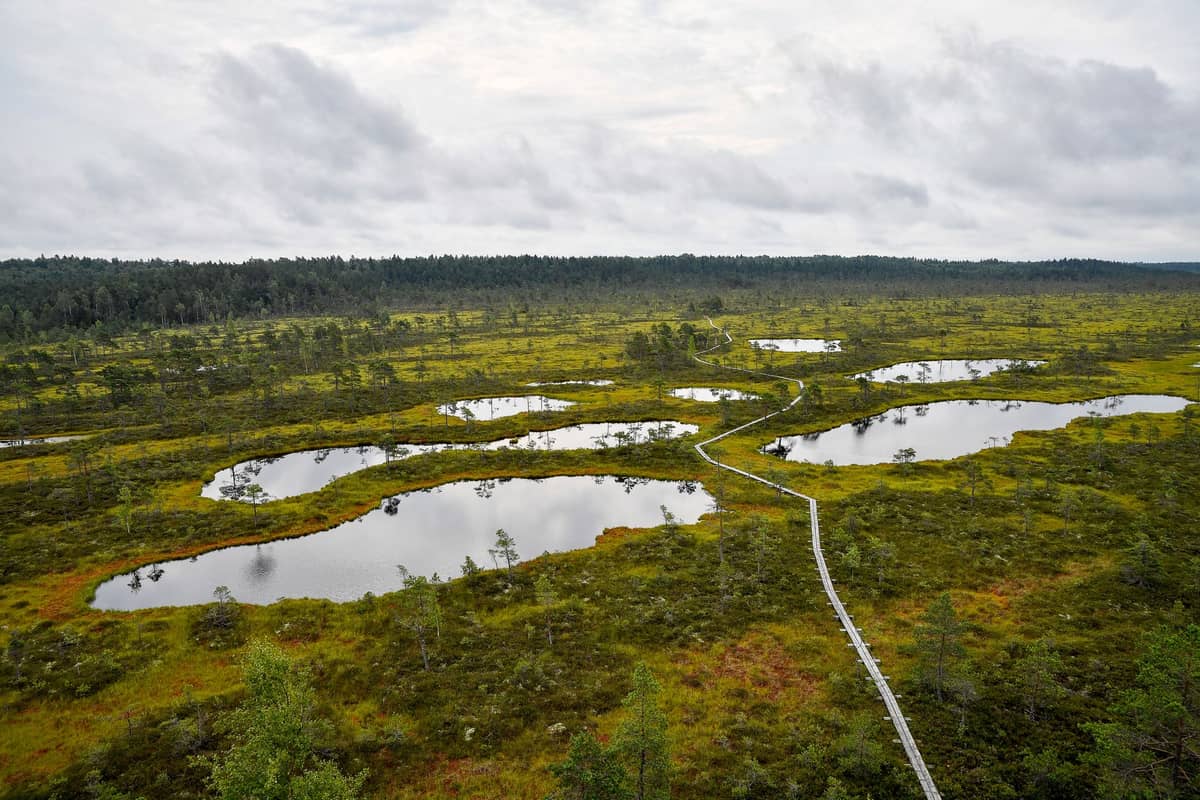
Lahemaa contains several notable raised bogs, including Viru Bog, which sits close to the western edge of the park and is the most visited. Viru Bog has a boardwalk trail roughly 3.5 km long that keeps your feet dry while walking across terrain that looks ancient because it is — some Estonian bogs are over 10,000 years old, accumulating peat at roughly 1 mm per year. In autumn, the bog takes on shades of deep rust and copper that make it visually striking even under overcast skies.
Early morning visits to Viru Bog, particularly in summer between June and August, often produce low-lying mist that sits in the hollows between heather and sphagnum moss. By 10 AM the tour groups arrive from Tallinn. If you are driving independently, arriving before 9 AM makes a measurable difference in what you experience versus what you photograph alongside 40 other people.
⚠️ What to skip
Never step off the boardwalk onto the open bog surface. The peat can be unstable and deceptively deep. Stay on marked paths.
Coastline and Peninsulas
The park's coastline is one of the most dramatic aspects of Lahemaa and the one most likely to be underestimated. The Gulf of Finland shoreline here is not sandy beach — it is a succession of capes and bays, with large erratic boulders, storm-cut cliffs of limestone and dolomite in places, and stretches of dense coastal pine forest that run almost to the waterline. The Käsmu Peninsula, on the western side of the park, is particularly striking: a small fishing village sits at its tip, and a marked trail circles the peninsula through forest and along rocky shoreline.
Käsmu was historically a sea captains' village, and many of the wooden houses date from the late 19th and early 20th centuries. The Village Museum there (hours and fees verify before visiting) tells that maritime history in compact form. On the eastern side of the park, the Pärispea Peninsula offers similar coastal scenery with fewer visitors.
Tickets & tours
Hand-picked options from our booking partner. Prices are indicative; availability and final rates are confirmed when you complete your booking.
Self-guided Discovery Walk of Tallinn city contrasts beyond the medieval walls
From 26 €Instant confirmationFree cancellationTallinn's art and culture tour with a local
From 62 €Instant confirmationFree cancellationHistorical walking tour of Tallinn with a local
From 599 €Instant confirmationFree cancellationIntroductory walking tour of Tallinn with a local guide
From 109 €Instant confirmationFree cancellation
The Manor Estates: Baltic-German History in Decay and Restoration
Lahemaa contains several historic manor estates that were originally built by Baltic-German nobility between the 17th and 19th centuries. Two stand out as essential stops: Palmse Manor and Sagadi Manor.
Palmse Manor is the most extensively restored and the most visited. The main manor house is a late-Baroque building from the late 18th century, surrounded by a landscaped park, a distillery building, stables, and a bathhouse beside a pond. The restoration work, carried out after Estonian independence, is thorough and gives the estate a sense of completeness rare in this part of Europe. Inside, period furnishings and exhibitions document both the Baltic-German aristocracy that built it and the Soviet period that nearly destroyed it. Check current opening hours and admission fees directly with Palmse Manor before visiting, as they vary by season.
Sagadi Manor, a few kilometres east of Palmse, has a different character — slightly less polished, with a forestry museum that reflects the working history of the landscape rather than aristocratic life. The manor grounds are quieter than Palmse on most days and worth the short detour.
Visitors with a strong interest in Estonian history and architecture may want to pair a Lahemaa trip with time in Tallinn's Old Town, where Baltic-German merchant culture left its own architectural mark. The Tallinn medieval history guide provides useful context for understanding the broader Baltic-German legacy you will encounter at Palmse and Sagadi.
When to Visit and How the Park Changes by Season
Lahemaa National Park is open year-round and free to enter. What changes dramatically is the experience.
Late May through September is the warmest window. Days are long — Tallinn is at nearly 60 degrees north latitude, and midsummer nights barely get dark. The forest is dense and green, wildflowers appear in clearings and bog edges, and the coastal trails are walkable without heavy gear. July and August bring the most visitors, and popular spots like Viru Bog and Palmse Manor can feel crowded by late morning on weekends.
Autumn, specifically late September through October, is arguably the most photogenic season. The birch forest turns gold and the bog vegetation goes deep amber. Temperatures drop into single figures Celsius and rain is common, but the light on clear autumn days is extraordinary. Bring waterproof footwear regardless of the forecast.
Winter visits are possible and genuinely atmospheric in a different way: the bog boardwalk can be icy, and some visitor facilities close or reduce hours, but snow in the forest and on the coastal rocks creates a version of Lahemaa most summer tourists never see. Confirm which facilities are open before a winter trip.
For a broader picture of how Tallinn and its surroundings change across the calendar, the best time to visit Tallinn guide covers seasonal considerations for the region.
ℹ️ Good to know
Weather on the northern Estonian coast changes quickly. Mornings can be clear and afternoons overcast and cold. Pack a windproof layer even in summer, especially for coastal sections.
Getting There: Practical Transport Details
The park is located approximately 70 km east of Tallinn. By car, the western edge of the park is reachable in roughly one hour from Tallinn city centre. This is the most practical option for independent travelers who want to cover multiple areas in a single day.
Public buses from Tallinn's Balti jaam (Baltic Station) serve towns near the park, including Loksa and Võsu, but schedules are infrequent and do not connect the main sights conveniently. Checking timetables at tpilet.ee or the bus station directly before planning is essential, as services change seasonally.
Organized day tours from Tallinn are a practical alternative for visitors without a car. Several operators run guided tours that combine Palmse Manor, Viru Bog, and a coastal village in a single day. For getting around Tallinn itself before or after your trip, the getting around Tallinn guide covers public transport and car rental logistics.
What to Bring and Accessibility Notes
Waterproof footwear is not optional — it is genuinely necessary for bog trails and forest paths, even in dry weather. Trail surfaces off the boardwalks are often muddy, particularly in spring and after rain. Light hiking boots are the minimum; trail runners work in summer but will get soaked on wet days.
Accessibility across the park is uneven. The Viru Bog boardwalk is the most accessible feature and is manageable for most visitors, including those with some mobility limitations, as long as the surface is not icy. The coastal trails, forest paths, and manor house interiors vary considerably. Palmse Manor's grounds are largely walkable on gravel paths. For specific accessibility requirements, contacting the park's visitor centre or checking visitlahemaa.com directly is the most reliable approach.
Mosquitoes and horseflies are present in the forest and bog areas from late May through August, particularly near standing water. Insect repellent is worth packing. Ticks are present in Estonian forests and bogs; check yourself after trail walks, especially if you have moved through long grass or undergrowth.
Is Lahemaa Worth a Full Day?
Yes, if you choose your focus before you arrive. Lahemaa is large enough that trying to see everything in one day produces a rushed, unsatisfying experience. A focused day covering Viru Bog in the morning, Palmse Manor over lunch, and a coastal walk at Käsmu in the afternoon gives a coherent picture of the park's three main landscape types without feeling frantic.
Visitors primarily interested in urban history, Old Town architecture, or Tallinn's food and nightlife scene will probably not find Lahemaa compelling. It rewards people who are comfortable with long drives, variable weather, and a landscape that does not announce itself dramatically. There are no mountain peaks, no waterfalls visible from a road, and no single iconic view. The park's appeal is accumulative: the quality of silence in the forest, the age of the bogs, the oddly moving sight of a restored 18th-century manor house surrounded by Soviet-era spruce plantations.
If you are weighing Lahemaa against other day trips from the capital, the Tallinn nature guide compares accessible natural areas around the city and helps prioritize based on travel time and interest.
Insider Tips
- Viru Bog is the park's most visited single feature. Arriving before 9 AM on weekdays means you will likely have the boardwalk to yourself. By 11 AM on summer weekends, tour groups from Tallinn arrive in volume.
- The Käsmu Peninsula loop trail takes roughly 2 to 3 hours at an easy pace and is one of the most satisfying coastal walks in northern Estonia. The village at the start of the trail has a small cafe; hours are seasonal, so do not rely on it being open.
- Palmse Manor has a restaurant in the old stable building that serves Estonian food at reasonable prices. It is a better lunch stop than anything you will find on the road between Tallinn and the park.
- If you are visiting in autumn and want the bog at its most photographic, aim for late September to mid-October. After mid-October the leaves are mostly down and the color contrast drops sharply.
- Lahemaa sits entirely outside the Tallinn Card's coverage — the card provides no discounts at park venues. Budget manor entry fees and guided tour costs separately.
Who Is Lahemaa National Park For?
- Hikers and trail walkers who want marked, well-maintained paths through forest and bog without crowds
- Nature photographers targeting boreal landscapes, coastal granite, and autumn bog colors
- History travelers interested in Baltic-German manor architecture and Soviet-era conservation politics
- Families with older children who can manage 2 to 3 hours of walking on uneven surfaces
- Visitors spending 3 or more days in Tallinn who want a full contrast to the urban Old Town experience
Nearby Attractions
Combine your visit with:
- Aegna Island
Aegna Island sits 14 km off the Tallinn coast in the Bay of Tallinn, reachable in about 30 minutes by boat. The entire island is a protected landscape conservation area, covered in dense forest, glacial boulders, and coastal meadows. Entry to the island is free, making it one of the most rewarding half-day escapes from the city.
- Estonian Open Air Museum
Spread across 72 hectares of coastal forest in Tallinn's Haabersti district, the Estonian Open Air Museum (Eesti Vabaõhumuuseum) reconstructs rural and fishing life from the 18th and 19th centuries. Twelve farmyards, a working tavern, a church, mills, a schoolhouse, a fire station, and net sheds make this Estonia's largest and most immersive open-air history experience.
- Glehn Park
Glehn Park is a free, forested public park in Tallinn's suburban Nõmme district, built around a 19th-century castle by the eccentric Baron Nikolai von Glehn. With natural woodland trails, stone carvings, and a refreshing distance from the Old Town crowds, it rewards visitors who want something genuinely different from the medieval core.
- Jägala Waterfall
Standing 8 metres tall and stretching over 50 metres wide, Jägala Waterfall is Estonia's largest natural waterfall. Located just 25 kilometres east of Tallinn on the Jägala River, it is free to visit year-round and rewards visitors differently in every season, from frozen curtains of ice in winter to a thundering torrent in spring snowmelt.