Krakow Botanical Garden: Poland's Oldest, Hidden in Plain Sight
Founded in 1783 by the Jagiellonian University, Krakow's Botanical Garden is the oldest in Poland and one of the most peaceful spots in the city centre. Spanning 9.6 hectares east of the Old Town, it holds around 9,000 plant taxa, historic greenhouses, and a small but worthwhile museum.
Quick Facts
- Location
- ul. Mikołaja Kopernika 27, Wesoła district (east of Old Town), Kraków
- Getting There
- 15-min walk from Main Market Square; trams to Rondo Mogilskie or Lubicz (multiple lines).
- Time Needed
- 1.5 to 2.5 hours for garden, greenhouses, and museum
- Cost
- 22 PLN standard / 12 PLN concession / 45 PLN family. Children under 4 free. Verify current prices at the official site.
- Best for
- Families, slow travellers, botany enthusiasts, anyone needing a break from cobblestones
- Official website
- ogrod.uj.edu.pl/english
What the Botanical Garden of the Jagiellonian University Actually Is
The Botanical Garden of the Jagiellonian University (Polish: Ogród Botaniczny Uniwersytetu Jagiellońskiego) is not a city park in the casual sense. It is a working scientific institution, Poland's oldest existing botanical garden, established in 1783 under the Jagiellonian University, one of Europe's oldest universities. That dual identity, open to the public but rooted in serious scientific research, shapes everything about the experience. The plant collections are organised with academic purpose, not purely for aesthetics, which makes this place feel distinct from a decorative urban green space.
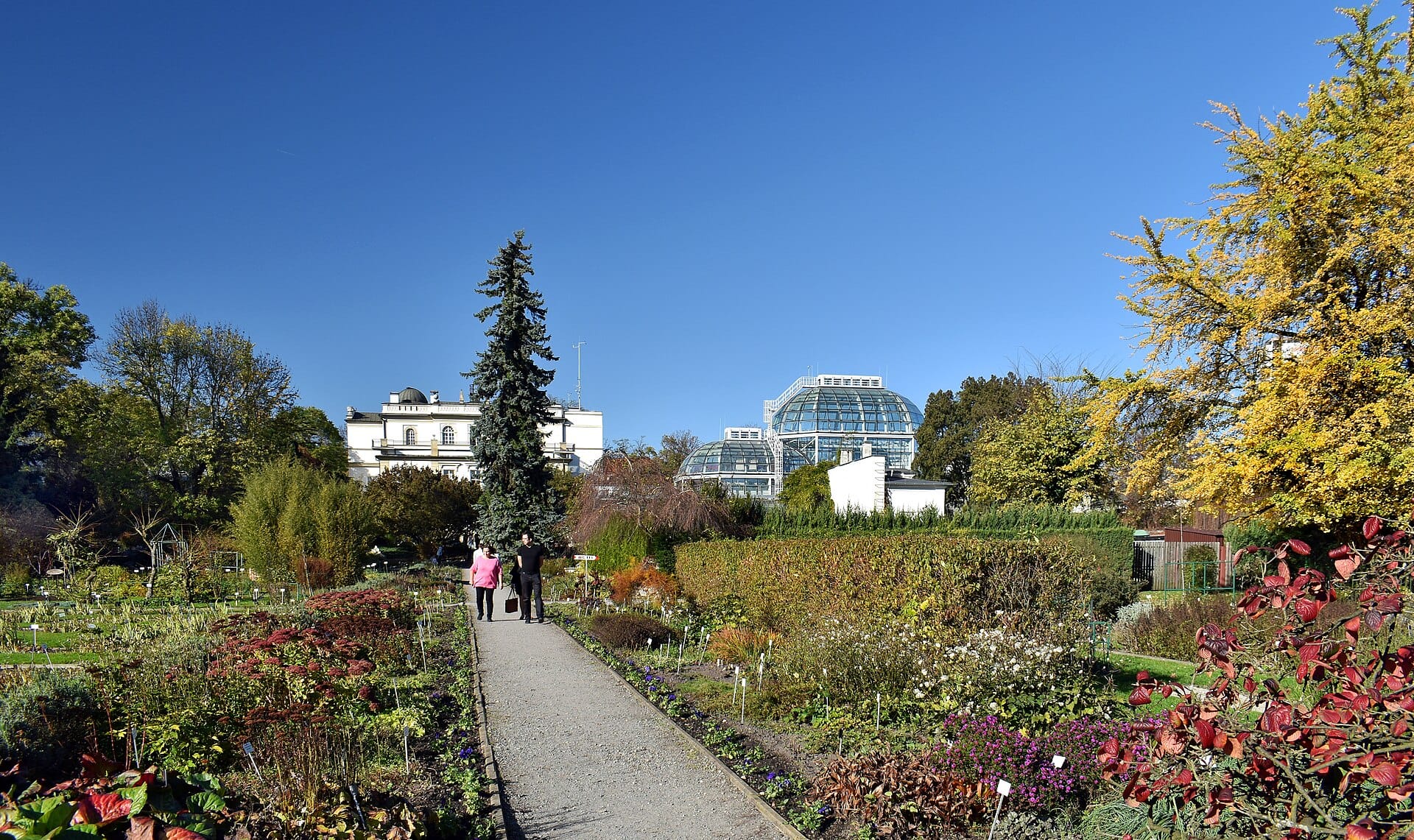
The garden covers approximately 9.6 hectares on ul. Mikołaja Kopernika 27, in the Wesoła neighbourhood just east of Krakow's Old Town. Around 9,000 plant taxa are cultivated here across outdoor beds, shaded alleys, a pond area, and a suite of greenhouses containing tropical and subtropical species. There is also a Botanical Garden Museum housed in the ground floor of Collegium Śniadeckiego, accessible directly from the garden terrace.
ℹ️ Good to know
The greenhouses and museum are closed on Mondays. If your visit falls on a Monday, the outdoor garden is still open and worth the ticket, but plan accordingly if you want the full experience.
The Experience: What You Actually See and Feel
Entering through the main gate on Kopernika Street, the shift in atmosphere is immediate. The sounds of trams and city traffic don't disappear entirely, but they drop to background noise within the first hundred metres. The paths are lined with mature trees, many of them labelled with Latin and Polish names, and in spring the air carries something between damp soil and fresh blossom, a combination that's harder to find in the stone-paved Old Town.
The layout follows a broadly historic arrangement, with systematic plant beds organised by taxonomy near the centre and more naturalistic zones toward the edges. In late April and May, the garden reaches something close to peak colour: lilacs and magnolias are in full flower, the ornamental pond reflects the surrounding greenery, and the lawns are dotted with students from the nearby university campus who use the grounds as a study break. By July, the rose garden comes into its own, and the tropical greenhouse provides an interesting contrast, a pocket of dense, humid warmth that smells of mulch and broad-leafed plants.
By late October, the garden takes on a different character. Fallen leaves accumulate on the gravel paths, the crowds thin noticeably, and the garden shifts toward a quieter, almost melancholy tone that some visitors find more appealing than the peak-season version. This is also when the greenhouse plants become more compelling, as the outdoor sections lose their foliage.
Tickets & tours
Live prices and dates from our booking partner. If you book, we may earn a commission at no extra cost to you.
Pinocchio Garden of Lights exhibition in Krakow
From 10 €Instant confirmationEntrance ticket for the Legends of Krakow robotic show
From 9 €Instant confirmationFree cancellationWieliczka Salt Mine guided tour with hotel pickup from Krakow
From 58 €Instant confirmationFree cancellationWieliczka salt mine guided tour from Krakow
From 60 €Instant confirmationFree cancellation
Time of Day: When to Arrive and Why It Matters
Morning visits, particularly on weekdays, offer the garden at its most tranquil. By 9:00 when the gates open, the only people inside tend to be early walkers and the occasional researcher. The light is softer and lower, useful if you're photographing the greenhouse collections or the ornamental pond. The smell of the greenhouse interiors is strongest in the morning before the heat of the day builds up inside.
Midday on weekends in summer brings the largest crowds, mainly families with young children and school groups. The paths remain wide enough that it rarely feels overcrowded, but the picnic areas fill up and the museum can get a short queue. Arriving after 16:00 in the April-to-August period gives you roughly two to three hours before the ticket office closes, and the late afternoon sun through the tree canopy is good for photography.
💡 Local tip
If you're visiting primarily for the greenhouses, go in the morning. Greenhouse admission closes about 30 minutes before the overall garden closing time, and on busy days they occasionally limit capacity inside.
History and Scientific Significance
The garden was founded in 1783 as part of the reform of the Jagiellonian University, which was itself one of the intellectual centres of 18th-century Central Europe. The original purpose was medical: botanical gardens of that era were primarily pharmaceutical resources, supplying university faculties of medicine with plant specimens for teaching and research. The Krakow garden eventually expanded its scope far beyond medicinal plants, but its connection to the university has never been severed.
This institutional continuity is what makes the garden worth understanding, not just walking through. Some of the tree specimens in the outdoor grounds date to the 19th century, and several are registered as natural monuments. The garden sits in a part of Krakow that was historically the university and medical district, within walking distance of the Collegium Maius, the oldest surviving building of the Jagiellonian University. The botanical garden is, in a sense, one layer of that same intellectual geography.
The Greenhouses and Museum: Worth the Extra Time
The greenhouse complex contains a range of tropical, subtropical, and temperate plants that would not survive outdoors in Krakow's climate. The collections include succulents, palms, orchids, and water plants, arranged in separate sections with varying temperature and humidity. Walking through a warm, plant-dense greenhouse in February, when the outdoor garden is bare and the winter ticket office hours are limited to 9:00–14:15, is one of the more unexpectedly pleasant cold-season experiences the city offers.
The Botanical Garden Museum, located in Collegium Śniadeckiego with entrance from the garden terrace, covers the history of the garden itself and broader themes in the history of botany as a scientific discipline. It is small, and visitors with limited time often skip it. That's understandable, but if you have any interest in the history of science or in how botanical illustration developed as a field, it repays 20-30 minutes of attention.
Getting There and Practical Planning
The garden is roughly a 10-15 minute walk from Rynek Główny (the Main Market Square). The most direct route heads east along ul. Mikołaja Kopernika. If you're combining the visit with Wawel Castle or other Old Town attractions, the walk there and back is a pleasant addition rather than a detour.
By tram, the closest stops are Rondo Mogilskie and Lubicz, served by multiple lines. From either stop it's a short walk to the main gate. The Rondo Mogilskie stop, served by additional lines, is also walkable.
Opening hours are strongly seasonal. In summer (April to August), the garden is open 9:00–19:00, with the ticket office closing at 18:15. In winter (January, February, November, December), hours compress to 9:00–15:00, with the ticket office closing at 14:15. March, September, and October fall in between. Always confirm current hours at the official site before visiting, especially if you're going in the shoulder months when hours change.
⚠️ What to skip
The ticket prices listed online vary between sources. The garden's own site and booking system (bilety.uj.edu.pl) lists standard adult admission at 22 PLN and concession at 12 PLN. Some third-party tourism sites list older, lower figures. Buy at the gate or via the official site, and check current prices before budgeting.
Krakow gets significant rainfall in June and July. The garden is mostly unshaded in its central sections, so a light waterproof layer is sensible in summer. Footwear should be comfortable for gravel and grass paths. For a broader overview of getting around the city, the guide to getting around Krakow covers tram routes and ticketing in more detail.
Who Will Enjoy This, and Who Might Not
The garden works well for families with children old enough to walk a moderate distance without a pushchair, though the paths are generally even enough for buggies. Children who enjoy the greenhouse discovery element, stepping into tropical heat in the middle of a Polish city, tend to find it memorable.
Visitors with a very packed historical itinerary, focused on Wawel, the Old Town monuments, and perhaps a day trip to Auschwitz-Birkenau, may find the garden hard to justify on a short trip. It is not a landmark in the conventional sightseeing sense. It doesn't tell the story of Krakow's dramatic history the way the Old Town does. What it offers is a different quality of experience: slow, quiet, and restorative. Travellers who are already feeling monument fatigue by day two are often the ones who appreciate it most.
People with significant mobility limitations should check directly with the garden about accessible routes, as some sections of the outdoor grounds and the greenhouse complex involve uneven surfaces or steps.
Insider Tips
- The pond area in the northeast section of the garden is quieter than the main paths and draws fewer visitors. It's the best spot for unhurried photography and for watching the garden's resident bird population, which includes coots and mallards.
- If you're visiting in winter, the garden's compressed hours (closing at 15:00) can feel limiting, but the greenhouses in January and February are warm, richly planted, and often nearly empty on a weekday.
- The museum inside Collegium Śniadeckiego has an entrance directly from the garden terrace, which many visitors miss because it doesn't look like a museum entrance from the main paths. Follow the terrace stairs near the historic greenhouse buildings.
- A seasonal pass and annual pass are available and can make sense if you're staying in Krakow for a week or more, or if you plan to return at different times of year; check current pass prices on the official site or at the ticket office.
- The garden is a useful option on days when Krakow's main attractions are at peak capacity, particularly warm Saturday afternoons in summer when Rynek Główny and Wawel Hill are at their most crowded.
Who Is Jagiellonian University Botanical Garden For?
- Families wanting outdoor time without leaving the city centre
- Botany and natural history enthusiasts interested in Poland's oldest scientific garden
- Slow travellers and those on longer stays who want to experience the city beyond its monuments
- Visitors seeking a quiet mid-afternoon break during a multi-day itinerary
- Winter visitors looking for warmth and greenery in the tropical greenhouse sections
Nearby Attractions
Other things to see while in Kraków Old Town (Stare Miasto):
- Cloth Hall (Sukiennice)
Standing at the centre of Rynek Główny since the Middle Ages, Kraków's Cloth Hall is part market, part museum, and part architectural monument. The ground-floor arcade sells amber, linen, and crafts; upstairs, the National Museum's Gallery of Polish Art fills Renaissance rooms with 19th-century masterpieces.
- Collegium Maius
Collegium Maius is the oldest surviving building of the Jagiellonian University, founded in 1364. Housing a museum of rare globes, scientific instruments, and royal regalia beneath a serene Gothic arcade, it offers one of Kraków's most quietly impressive indoor experiences.
- Czartoryski Museum
The Czartoryski Museum holds one of Poland's oldest and most important art collections, anchored by Leonardo da Vinci's Lady with an Ermine. Housed in a historic Old Town complex near the Florian Gate, it combines fine art, antiquities, and decorative arts across several interconnected buildings.
- Florian Gate & City Walls
St. Florian's Gate is the sole surviving medieval gate of the eight that once pierced Kraków's city walls. Standing about 33 metres tall at the northern tip of the Old Town, it anchors the Royal Route that once led from the city entrance down to Wawel Castle. Walking through is free; climbing the wall gallery costs a small fee and pairs naturally with the adjacent Barbican.
Planning a trip? Discover personalized activities with the Nomado app.