Fossil Shell Beach (Susan Hoi): Krabi's Ancient Shell Cemetery
Fossil Shell Beach, known in Thai as Susan Hoi, is It is a geology-focused stop that rewards curious travelers with an unusual perspective on southern Thailand's deep past.
Quick Facts
- Location
- Ban Laem Pho, Sai Thai Subdistrict, Mueang Krabi District — approx. 15–17 km from Krabi Town
- Getting There
- Songthaew or hired vehicle from Krabi Town via Route 4204; no direct public bus. Grab ride-hailing available from town.
- Time Needed
- 45 minutes to 1.5 hours is enough for most visitors
- Cost
- Foreign adults ฿200, foreign children ฿100; Thai adults ฿40, Thai children ฿20 (rates as of Feb 2025 — verify locally)
- Best for
- Geology enthusiasts, families with curious kids, travelers combining with a Krabi Town day
What Is Susan Hoi, Exactly?
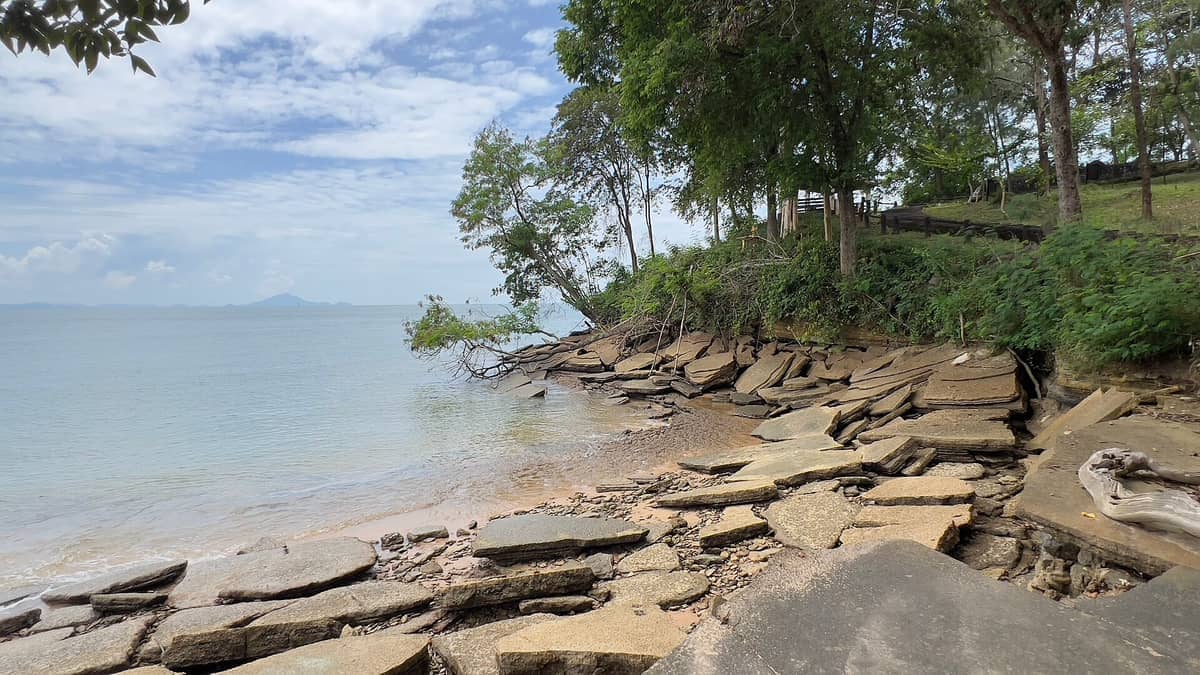
Fossil Shell Beach, or Susan Hoi (สุสานหอย 75 ล้านปี), translates literally as 'shell cemetery' and the name is accurate in a way few tourist labels are. The site consists of The site consists of large, flat slabs of fossilized shells that extend along the shoreline, compressed over tens of millions of years into a kind of natural pavement. The traditional Thai name references 75 million years, though more recent geological assessments suggest the deposits date to roughly 20 to 40 million years ago. Whichever figure is closer to accurate, the result is the same: a beach where the ground itself is ancient.
The site falls under national park administration, which accounts for the admission fee structure and helps explain why the fossil platforms remain relatively intact despite decades of tourism.
ℹ️ Good to know
Admission rates (as of February 2025): foreign adults ฿200, foreign children ฿100, Thai adults ฿40, Thai children ฿20. Hours are listed as 08:00–16:30 daily. Always verify current rates and hours locally before visiting, as national park schedules can change.
What You Actually See on the Ground
The fossil beds sit right at the water's edge, and at first glance they can look like grey concrete — flat, slightly rough underfoot, and unremarkable from a distance. Step closer, and the surface reveals itself: thousands of coiled and spiral shell impressions pressed into stone, some intact enough to trace with a finger, others compressed into faint ridges. The texture is somewhere between rough sandstone and the surface of a coral block.
The setting frames the geology well. Mangrove trees line the waterway beyond the platforms, and the backdrop includes low limestone ridges, giving the site a quiet, removed feeling despite being only a short drive from town. The water here is calm rather than wave-washed, which is part of why the fossil slabs have survived at the surface in such a legible condition.
A covered viewing area and a small information display stand near the entrance, providing basic geological context. The signage is present in both Thai and English, though the depth of explanation is limited. Restrooms and parking are available on site.
Tickets & tours
Live prices and dates from our booking partner. If you book, we may earn a commission at no extra cost to you.
Daily Cooking Class at Thai Cookery School in Krabi
From 42 €Instant confirmationFree cancellation7 islands speedboat excursion from Krabi
From 41 €Instant confirmationFree cancellationSpeedboat Tour to Hong Island Archipelago from Krabi
From 34 €Instant confirmationFree cancellationPhi Phi archipelago and Krabi 4 Islands full‑day speedboat tour
From 0 €Instant confirmationFree cancellation
Time of Day and Atmosphere
Morning visits, particularly before 10:00, offer the most comfortable conditions. Krabi's climate is tropical, with daytime highs regularly reaching 31–34°C, and the fossil platforms offer almost no shade. By mid-morning the exposed stone absorbs heat quickly, and standing on the slabs in sandals at noon is genuinely uncomfortable. Light footwear with some sole protection is more practical than sandals.
The site sees a modest flow of visitors on most days, with the peak arriving mid-morning when day tours from Krabi Town and Ao Nang pass through. Arriving right at opening — around 08:00 — means having the platforms largely to yourself, with soft light that also makes the shell impressions easier to photograph. Late afternoon visits are possible but the site closes at 16:30, and the light by 15:30 can be flat and harsh depending on cloud cover.
💡 Local tip
Arrive before 09:30 for the best combination of soft light, cooler temperatures, and smaller crowds. Bring a water bottle — there is no refreshment stall on the platforms themselves.
Getting to Fossil Shell Beach from Krabi Town
The site is approximately 15 to 17 km from Krabi Town center, in Ban Laem Pho, Sai Thai Subdistrict. The main route follows Road 4204 toward Sai Thai and then Ban Laem Pho; signage for Susan Hoi appears along the way. The road is paved and navigable in a standard vehicle.
There is no direct scheduled public bus to the site. The most practical options are a hired songthaew (shared pickup truck taxi) from Krabi Town, a Grab ride booked from your accommodation, or a motorbike rental for those comfortable with the route. If you plan to combine this stop with other sites in the area, hiring a driver for a half-day is often the most efficient approach.
The drive from Krabi Town takes roughly 25 to 35 minutes depending on traffic. The road passes through local village areas rather than tourist strips, which itself gives a grounded sense of how the region actually functions beyond the beach resorts.
Geological and Cultural Context
The fossils at Susan Hoi are composed primarily of gastropod shells, compressed and lithified over an immense span of time. The formation process requires a specific set of conditions: a low-energy aquatic environment, continuous shell accumulation, and slow burial under sediment. That these conditions produced an exposed, visitable surface is the geological improbability that makes the site significant.
The '75 million years' figure in the Thai name is a longstanding part of the site's identity, though it appears to be an overestimate based on more recent analysis. The updated estimates of 20 to 40 million years place the deposit in the Paleogene period, a time when the region's geography and ecology looked substantially different from today. The discrepancy between name and revised dating is worth knowing about but does not diminish the site's geological interest.
Susan Hoi sits within the broader geological landscape that also produced Krabi's famous limestone karst formations, visible across the province — from the twin hills of Khao Khanab Nam rising from the river near Krabi Town to the towering cliffs around Railay. The fossil beach represents a different chapter of that same long geological story.
Honest Expectations: Is It Worth the Trip?
Susan Hoi is a genuine curiosity rather than a showpiece attraction. Visitors who arrive expecting sweeping scenery or a dramatic beach experience will likely feel the 30-minute drive was more than the site merited. The fossil platforms are relatively compact, the surrounding infrastructure is minimal, and the experience lasts under an hour for most people.
For travelers with a genuine interest in geology, natural history, or simply in seeing something that does not appear on most itineraries, the site delivers clearly. It is also a good option for families with children who like hands-on, tactile learning — the shell impressions in the stone are tangible in a way that photographs cannot fully convey. Crouching down to look at individual fossils up close, tracing the spiral of a shell preserved in rock, is a different kind of experience from anything else Krabi Province offers.
If you are already spending time near Krabi Town rather than basing yourself in Ao Nang or on the islands, folding Susan Hoi into a half-day that also includes the Krabi Town night market or a boat trip on the river makes the logistics much more sensible. It fits naturally as a short morning stop rather than the anchor of a day.
⚠️ What to skip
Do not walk on the fossil beds in bare feet. The stone surface is abrasive and heats up significantly in direct sun. Closed-toe shoes or sturdy sandals with a sole are recommended.
Photography Notes and Accessibility
The fossil patterns photograph best in directional light, when shadows fall at a low angle and reveal the texture of the shell impressions in the stone. Early morning or late afternoon light works better than midday for this reason. A wide-angle shot of the platform extending toward the mangrove waterway captures the scale effectively; close-up macro shots of individual fossil patterns can be striking if you have the right lens or a camera with a decent macro mode.
Accessibility information for visitors with mobility limitations is not well established in the available sources. The path from the entrance to the fossil platforms involves some uneven surfaces, and the stone itself is irregular underfoot. Visitors using wheelchairs or with significant mobility concerns should check locally before making the trip.
Combining Susan Hoi with Other Krabi Stops
The most natural pairing for Susan Hoi is a half-day routed through the Krabi Town area. The twin limestone caves of Khao Khanab Nam are accessible by boat from the Krabi River and make a complementary geology-adjacent stop. Alternatively, Wat Kaew Korawaram in Krabi Town is a 15-minute drive away and rounds out a culturally varied morning without requiring much additional travel.
Travelers interested in the province's broader natural history might also consider the Than Bok Khorani National Park further north, which offers a different kind of landscape encounter. For a wider look at how to structure time in the area, the Krabi 3-day itinerary places Susan Hoi within a realistic sequence of stops.
Insider Tips
- Arrive right at opening (08:00) for the best light and the fewest visitors. Tour groups typically arrive between 09:30 and 11:00.
- The fossil impressions are most visible when wet — if the tide is low or the stone is dry, pouring a small amount of water from your bottle onto the surface dramatically sharpens the detail of the shell patterns.
- Hire a driver for a half-day rather than relying on a single return trip — Susan Hoi works best as one of two or three stops, not as a standalone destination.
- The national park admission fee is paid at the entrance kiosk; have small bills in Thai baht ready, as change for large notes may not be available.
- The road through Sai Thai passes a few local seafood restaurants that are far less tourist-facing than anything in Ao Nang. If you are making a morning of it, this stretch of road is worth exploring for lunch on the way back to town.
Who Is Fossil Shell Beach (Susan Hoi) For?
- Geology and natural history enthusiasts who appreciate rare formations over manicured scenery
- Families with children who learn well through tactile, hands-on encounters with the natural world
- Travelers already based in Krabi Town looking for a short, low-effort morning excursion
- Photographers seeking unusual textures and natural patterns not found elsewhere in the province
- Visitors who prefer quiet, crowd-light sites over high-traffic beach attractions
Nearby Attractions
Other things to see while in Krabi Town:
- Ao Tha Lane & Mangrove Forest
Ao Tha Lane, also listed officially as Tha Lane Bay, is a tidal bay in Khao Thong Subdistrict where dense mangrove forest meets sheer karst cliffs. The only meaningful way to explore it is by kayak, paddling through narrow channels where the canopy closes overhead and the water turns dark green. It is quieter and less commercialized than most of Krabi's headline attractions.
- Huai To Waterfall
Huai To Waterfall (Nam Tok Huai To) is a multi-tiered cascade tucked inside Khao Phanom Bencha National Park, roughly 20 km north of Krabi Town. A short forest walk leads through dense tropical vegetation to a series of pools fed by cool mountain water, making it one of the most accessible natural retreats on the Krabi mainland.
- Khao Khanab Nam Caves
Two sheer limestone towers rising roughly 100 metres above the Krabi River, Khao Khanab Nam is the geological signature of Krabi Town. A short long-tail boat ride from Chao Fah Pier leads into cave chambers that served as a Japanese military camp in World War II and contain fossilised remains estimated to be millions of years old.
- Khao Phanom Bencha National Park
Khao Phanom Bencha National Park is Krabi's inland rainforest reserve, protecting steep limestone peaks, a dramatic five-tier waterfall, and dense jungle habitat roughly 20 km north of Krabi Town. It rewards early risers with cool air, birdsong, and cascading water, but trails beyond the lower falls require preparation and a degree of fitness.
Planning a trip? Discover personalized activities with the Nomado app.