Ao Tha Lane & Mangrove Forest: Kayaking Through Krabi's Limestone Channels
Ao Tha Lane, also listed officially as Tha Lane Bay, is a tidal bay in Khao Thong Subdistrict where dense mangrove forest meets sheer karst cliffs. The only meaningful way to explore it is by kayak, paddling through narrow channels where the canopy closes overhead and the water turns dark green. It is quieter and less commercialized than most of Krabi's headline attractions.
Quick Facts
- Location
- Khao Thong Subdistrict, Mueang Krabi District, Krabi 81000 — roughly 20 km from Ao Nang
- Getting There
- No direct public transit. Taxi, Grab, rental car, or a guided tour with transport are the practical options from Krabi Town or Ao Nang
- Time Needed
- 2–3 hours for a self-guided kayak circuit; half-day if joining a guided tour
- Cost
- Entry is free. Kayak rental reported at around ฿500; guided tours vary — confirm prices locally
- Best for
- Nature lovers, photographers, couples, and anyone wanting calm water after the crowds of Ao Nang
- Official website
- www.thailandtourismdirectory.go.th/en/attraction/2218
What Ao Tha Lane Actually Is
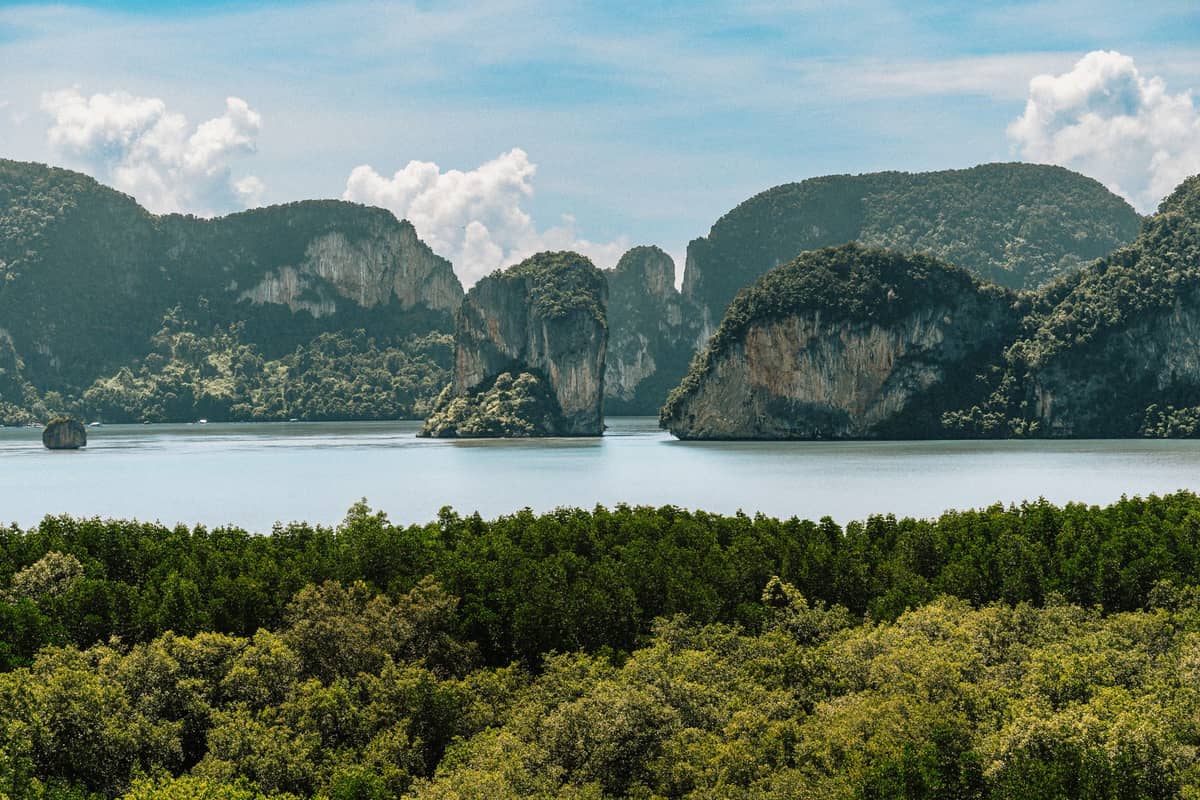
Ao Tha Lane is a sheltered tidal bay a tidal bay in Khao Thong Subdistrict. Vertical limestone karst formations, some rising well over a hundred metres, form the walls of a natural amphitheatre, and between their bases a network of mangrove channels threads through the roots and low branches. The bay is officially listed by the Thai government tourism directory as Tha Lane Bay, written in Thai as อ่าวท่าเลน.
This is not a beach attraction. There is no sand, no snorkelling, and nothing photogenic from the shore itself. The experience is entirely on the water. A kayak lets you push deep into channels where the tidal forest presses in from both sides, the limestone towers appear and disappear through gaps in the canopy, and the loudest sounds are the dip of your paddle and occasional birdcall. For visitors who have spent time at busier spots, the contrast is immediate.
ℹ️ Good to know
Opening hours are listed differently across sources: the Thailand Tourism Directory shows 1:00 AM–10:00 AM, while other listings suggest 8:00–17:00. Confirm current hours with your accommodation or the rental operators on-site before making the trip.
The Kayaking Experience: What to Expect on the Water
The kayak routes include a large loop of about 7 km and a small loop of about 4 km. Single and double kayaks are available for rental at around ฿500, though this is not an official fixed rate. The water in the inner channels is shallow and flat, which makes the paddling accessible even for people with limited experience. There are no significant currents in calm conditions, and the enclosed geography means that even nervous paddlers tend to relax within the first ten minutes.
The mangrove itself is a mature coastal forest of interlocked root systems reaching into brackish water. Prop roots and pneumatophores create a dense, almost architectural structure below the water surface, and the tree canopy in the tightest passages forces you to duck. Mud skippers move across exposed roots at low tide. Monitor lizards are reported here regularly. Kingfishers and herons are common in the quieter reaches early in the morning.
Note on accessibility: the kayaking route is not wheelchair accessible, and getting in and out of a kayak requires a degree of mobility. This is not a site where the full experience can be appreciated from the bank alone.
Tickets & tours
Live prices and dates from our booking partner. If you book, we may earn a commission at no extra cost to you.
Time of Day and Light: When to Come
Early morning is the best time to visit, for two reasons. First, the light is softer and lower, casting long shadows across the cliff faces and illuminating the inner channels through gaps in the canopy. Second, tour groups and day-trippers tend to arrive later in the morning, so the first hour or two after the site opens is noticeably quieter. The water surface in the inner sections is glassy at this hour, which creates strong reflections of the karst towers above.
Guided kayaking tours from Ao Nang and Krabi Town may make the wider channels more populated during operating hours. The experience does not become unpleasant, but the solitude diminishes. Midday heat in Krabi can push daytime highs to around 33–34°C, making the shaded mangrove channels a relief by comparison, though paddling in direct sun across open sections of the bay can be exhausting without sunscreen and a hat.
During the rainy season, roughly May through October, the mangrove is genuinely green and full, and the limestone cliffs often carry thin waterfalls after heavy rain. The trade-off is that access can be disrupted by storms and some tour operators run reduced schedules. For a detailed breakdown of seasonal conditions, the guide to visiting Krabi in the rainy season covers what actually closes and what remains accessible.
Getting There: Logistics from Krabi Town and Ao Nang
Ao Tha Lane sits in Khao Thong Subdistrict and is approximately 20 km from Ao Nang. There is no regular public transport running directly to the bay. The realistic options are: renting a motorbike or car, booking a Grab or metered taxi, or joining a guided tour that includes transport. The last option is the most straightforward if you are not comfortable navigating rural roads independently.
Many guided kayaking day trips that depart from Krabi Town or Ao Nang include Ao Tha Lane as part of a longer itinerary covering multiple points in the estuarine system. These tours typically include equipment, a guide, and return transport, which simplifies the logistics significantly.
💡 Local tip
If you are driving independently, use Google Maps or Maps.me and search for 'Ao Thalane' or 'Tha Lane Bay'. The road in from the main highway is paved but narrows toward the water. Arrive before 9:00 AM to park without difficulty and start paddling before tour groups arrive.
Practical Details: What to Bring and Wear
Dress for water. You will get wet from paddle drip at minimum, and potentially more if you capsize or wade near the entry point. Quick-dry shorts and a lightweight long-sleeve shirt work better than cotton, which stays wet and becomes uncomfortable. Water shoes or sandals with a strap are preferable to flip-flops, which tend to come off in shallow mangrove mud.
- Reef-safe or biodegradable sunscreen — you will be in open water sections
- A hat with a chin strap, since the channels can be breezy and open sections have no shade
- A waterproof bag or dry bag for your phone and valuables
- Plenty of water — dehydration sets in faster than expected in the heat
- Insect repellent if you are visiting at dusk or in the wet season
Photography works well here, but a phone in a standard case is at genuine risk of water damage. A waterproof case or a dedicated action camera makes more sense than trying to manage a phone on open water. The best shots come from inside the narrowest passages where the roots and cliff face frame the image on three sides.
Honest Assessment: Who This Is For, and Who Should Skip It
Ao Tha Lane rewards patience and an interest in natural environments. If you are looking for clear turquoise water, white sand, or the kind of scenery associated with Phra Nang Beach or the Phi Phi islands, this is a different kind of experience entirely. The colour palette here is dark green, grey stone, and brown tidal water. It is not conventionally picturesque in the tropical-beach sense.
Travellers who dislike being on the water in a small boat, who have significant mobility limitations, or who are visiting with young children who cannot kayak independently will find the site difficult to enjoy fully. The mangrove channels are also not suitable for people who are uncomfortable in enclosed, shaded spaces, since the tightest passages feel genuinely tunnel-like.
For active travellers who want to combine this with other nature experiences in the area, Ao Tha Lane pairs well with a visit to the Khao Khanab Nam twin karst caves near Krabi Town, which offer a different perspective on the same limestone geology. The Krabi kayaking guide covers the full range of paddling options across the province if you are comparing routes.
Insider Tips
- Tidal level changes the experience significantly. At low tide the root systems are fully exposed and the channels are shallower, making the forest structure more visible. At high tide the water level rises and some channels become more navigable but lose some of their texture. Check local tide times and, if possible, aim for mid-tide on the way out.
- The outermost section of the bay, before you enter the mangrove proper, gives a clear view of the full karst backdrop across the water. This is where the wide-angle landscape photographs come from. Spend a few minutes here before heading into the channels.
- If you are renting kayaks independently rather than joining a tour, ask the rental operator for a sketch map of the main route. The inner channels fork, and without a rough sense of direction it is easy to paddle into a dead end and have to reverse out.
- Bring more water than you think you need. There are no refreshment vendors inside the mangrove channels, and paddling in tropical heat is more dehydrating than it feels in the moment.
- The return journey can feel different depending on the tide. Check current conditions with the rental operator before setting out, especially if you are tired.
Who Is Ao Tha Lane & Mangrove Forest For?
- Nature travellers who prefer ecological interest over Instagram scenery
- Couples looking for a quieter, more immersive half-day experience away from crowded beaches
- Photographers interested in karst landscapes and tidal forest light conditions
- Active travellers who want low-key paddling without the open-sea exposure of island trips
- Visitors based in Krabi Town who want a nearby natural attraction without a long journey
Nearby Attractions
Other things to see while in Krabi Town:
- Huai To Waterfall
Huai To Waterfall (Nam Tok Huai To) is a multi-tiered cascade tucked inside Khao Phanom Bencha National Park, roughly 20 km north of Krabi Town. A short forest walk leads through dense tropical vegetation to a series of pools fed by cool mountain water, making it one of the most accessible natural retreats on the Krabi mainland.
- Khao Khanab Nam Caves
Two sheer limestone towers rising roughly 100 metres above the Krabi River, Khao Khanab Nam is the geological signature of Krabi Town. A short long-tail boat ride from Chao Fah Pier leads into cave chambers that served as a Japanese military camp in World War II and contain fossilised remains estimated to be millions of years old.
- Khao Phanom Bencha National Park
Khao Phanom Bencha National Park is Krabi's inland rainforest reserve, protecting steep limestone peaks, a dramatic five-tier waterfall, and dense jungle habitat roughly 20 km north of Krabi Town. It rewards early risers with cool air, birdsong, and cascading water, but trails beyond the lower falls require preparation and a degree of fitness.
- Koh Klang Village
Koh Klang Village (Ban Ko Klang) sits on a low-lying island about 10 minutes by longtail boat from Krabi Town, offering a genuine look at southern Thailand's Muslim fishing community culture. It's a slow, unhurried experience: bicycle rides along dirt tracks, handmade batik workshops, and views of mangroves and limestone karsts without the crowds. No admission fee, no scripted performances.
Planning a trip? Discover personalized activities with the Nomado app.