Khao Khanab Nam Caves: Krabi Town's Most Dramatic Landmark
Two sheer limestone towers rising roughly 100 metres above the Krabi River, Khao Khanab Nam is the geological signature of Krabi Town. A short long-tail boat ride from Chao Fah Pier leads into cave chambers that served as a Japanese military camp in World War II and contain fossilised remains estimated to be millions of years old.
Quick Facts
- Location
- Pak Nam Subdistrict, Mueang Krabi District, Krabi Town
- Getting There
- Hire a long-tail boat at Chao Fah Pier, Krabi Town (approx. 15 min by river)
- Time Needed
- 1.5–2.5 hours including boat transfer
- Cost
- Admission is reported as ฿30 per person; boat hire is extra. Confirm at Chao Fah Pier before departing.
- Best for
- History enthusiasts, geology fans, photography, and travellers based in Krabi Town
- Official website
- www.krabipao.go.th/travel_activity/detail/6
What Khao Khanab Nam Actually Is
Khao Khanab Nam (เขาขนาบน้ำ) is a pair of near-vertical limestone karst towers that stand guard at the mouth of the Krabi River, directly opposite Krabi Town. Their silhouette — two jagged grey-white peaks rising roughly 100 metres from the water — is reproduced on tourist maps, tuk-tuks, and hotel lobbies across the province. From the riverside promenade in town, they look almost close enough to wade to; in practice, the only way across is by boat.
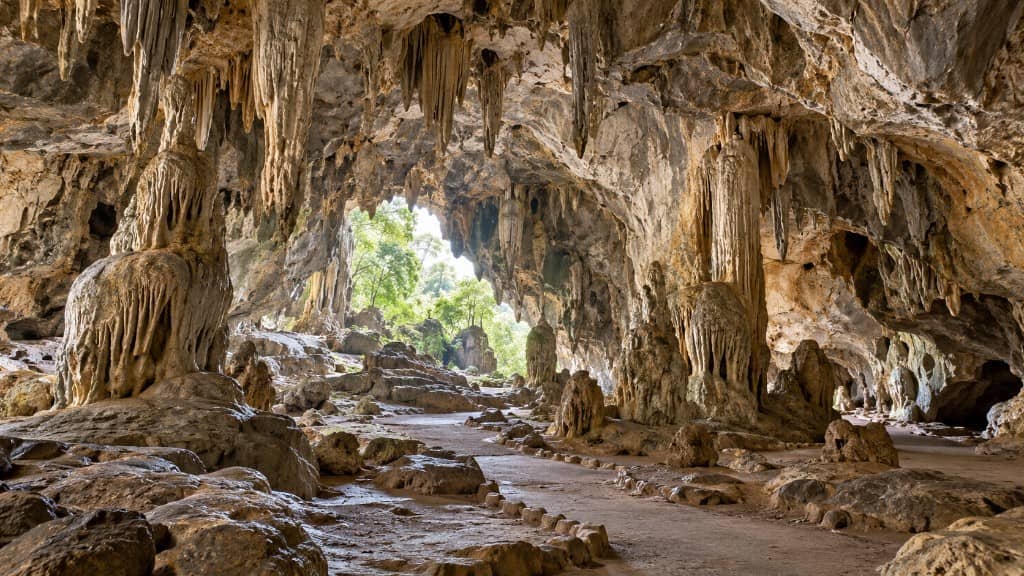
Each tower contains a cave system. The larger cave on the western hill is the one most visitors enter: a network of chambers with stalactites, stalagmites, and ancient fossils embedded in the walls. Archaeologists and geologists have documented the fossilised remains over many decades, and they point to a time when this entire coastline looked very different. The caves also hold a more recent layer of history: during World War II, Japanese forces used the interior as a military camp, a fact that adds an unexpected historical register to what might otherwise be filed as a nature excursion.
⚠️ What to skip
Admission is reported as ฿30 per person; boat hire is charged separately at Chao Fah Pier. Confirm both costs locally before departing, and check current hours — published opening times vary between 08:00–17:30 and 08:30–16:00.
Getting There: The Boat Ride Is Part of the Experience
You hire a long-tail boat at Chao Fah Pier, the main river pier in Krabi Town. The crossing takes roughly 15 minutes each way. In the early morning, the river surface is often mirror-flat, and the limestone towers ahead of you catch the low angle of the sun in a way that turns the pale rock amber. The engine noise is considerable — long-tail boats are not quiet — but the brevity of the crossing makes it easy to tolerate.
Krabi Town itself is worth spending time in before or after the caves. The Krabi Town Night Market and the Wat Kaew Korawaram temple are both within walking distance of Chao Fah Pier, making it straightforward to combine them in a single half-day.
There is no public ferry service to Khao Khanab Nam; it is always a privately hired boat. Negotiate the fare before boarding and clarify whether the price covers waiting time while you explore. Some boat operators will also take you through the mangrove channels nearby, which makes for a pleasant extension if schedules allow.
Tickets & tours
Live prices and dates from our booking partner. If you book, we may earn a commission at no extra cost to you.
Eco-friendly kayaking journey to Khlong Nam Sai Lagoon
From 33 €Instant confirmationFree cancellationDaily Cooking Class at Thai Cookery School in Krabi
From 42 €Instant confirmationFree cancellation7 islands speedboat excursion from Krabi
From 41 €Instant confirmationFree cancellationSpeedboat Tour to Hong Island Archipelago from Krabi
From 34 €Instant confirmationFree cancellation
Inside the Cave: What You Will Actually See
The approach to the cave entrance involves a short walk from the boat landing, followed by stairs cut into the rock. The humidity increases noticeably as you ascend, and the air takes on the cool, faintly mineral smell common to limestone cave systems. Inside, the chambers are lit well enough to move around safely, though the light is dim in places.
The fossil deposits are the geological centrepiece. Fragments of ancient marine organisms are visible in the rock walls — evidence that this karst landscape was once submerged beneath a shallow sea. The stalactites and stalagmites are substantial in some chambers, built up over thousands of years of slow mineral deposition. Touching them is discouraged; the oils from human hands accelerate deterioration.
The WWII history is acknowledged through a small display within the cave. It is not an elaborate museum installation, but the context it provides is worth reading: the idea that these chambers, now visited by tourists in shorts and sandals, once sheltered soldiers is genuinely striking. The cave's natural acoustics amplify even quiet conversations, lending the space an odd intimacy.
💡 Local tip
Bring a small torch or use your phone's flashlight. The cave lighting covers the main route but some alcoves are poorly illuminated. Wear closed shoes with grip — the steps and cave floor can be damp and slippery, especially after rain.
How the Experience Changes by Time of Day
Early morning, between 08:00 and 09:30, is the most rewarding window. Boat traffic on the river is light, the air temperature is manageable, and the towers are at their most photogenic in the morning light. Tour groups from Ao Nang and other coastal areas tend to arrive from mid-morning onwards, so the cave fills up noticeably between 10:00 and 13:00.
Midday visits are the least comfortable: the sun is high, the boat crossing is hot, and the cave itself can feel congested if multiple groups are inside simultaneously. The afternoon hours between 14:00 and closing bring a slight drop in crowds, though the light for photography of the exterior towers is less flattering.
During the rainy season (roughly May through October), the river may run higher and darker with sediment, which changes the colour of the water without fundamentally altering the cave visit. The exterior of the towers looks particularly dramatic against a storm sky, but boat operators may limit trips in heavy weather. If you are visiting during this period, check sea and river conditions in the morning before committing to the excursion.
Geological and Historical Context
Krabi Province's karst landscape is among the most visually dense in Southeast Asia. The limestone towers that define the coastline, the islands, and the inland terrain all formed from ancient marine sediments compressed over hundreds of millions of years, then exposed and sculpted by erosion and sea-level change. Khao Khanab Nam is part of this same geological story, but it sits at the edge of a river mouth rather than rising from open sea, which gives it a slightly different character from the karst islands further offshore.
The caves sit within a broader corridor of geological interest in Krabi Province. The Krabi Fossil Shell Beach, located north of Krabi Town, preserves a 75-million-year-old shell cemetery and offers a complementary perspective on the region's prehistoric marine environment. Together, the two sites sketch a picture of ancient seas that once covered this landscape.
Photography Notes
The twin peaks photograph best from the water, either from the long-tail boat during the crossing or from the opposite bank of the Krabi River. The ideal conditions are early morning with soft directional light and minimal haze. A wide-angle lens or the standard smartphone camera works well for the full exterior view; the towers are large enough that you need distance to frame both peaks together.
Inside the cave, photography is possible but challenging. The combination of dim artificial light and damp rock means phone cameras will struggle without a steady surface or a small tripod. The most photogenic interior feature is the main stalactite cluster in the largest chamber, where the existing lighting is best concentrated.
Practical Notes and Accessibility
The visit involves a boat crossing, an uneven walk from the landing point, and a staircase into the cave. No source confirms wheelchair accessibility, and the physical requirements of the approach suggest it is not suitable for visitors with significant mobility limitations. The stairs can be steep and the cave floor uneven; children who are confident walkers should manage without difficulty, but it requires attentiveness.
Travellers visiting Krabi Town primarily for relaxed sightseeing rather than outdoor activity may find the cave visit a good counterpoint to the beach scene further south along the coast. If you are staying in or near Krabi Town, the excursion fits naturally into a morning itinerary without requiring a vehicle or advance booking.
Visitors who are primarily interested in beach time and island-hopping may find Khao Khanab Nam a detour rather than a priority — it is not on the route to Railay, Ao Nang, or the offshore islands, and the cave itself is relatively compact compared to cave systems elsewhere in Thailand. That said, for anyone spending two or more days based in Krabi Town, it is one of the more distinctive experiences the town offers.
ℹ️ Good to know
Khao Khanab Nam appears prominently in Krabi Town's civic identity — the twin towers are widely used as a symbol of the town on official and commercial materials. The Thai name translates roughly as 'mountain flanking the water', which describes the site's position at the river mouth precisely.
Insider Tips
- Ask your boat operator to slow down or pause mid-river on the return crossing: looking back at the towers from the water gives the best full-framing for photographs, and the few seconds are worth requesting.
- The cave's best light for interior photography is in the mid-morning, when sunlight penetrates the entrance and adds a natural warm tone to the rock formations near the mouth — before tour group traffic peaks.
- Bring small bills in Thai baht for the boat fare. Boat operators at Chao Fah Pier rarely carry change for large notes, and having exact or near-exact cash speeds up negotiations.
- If you want to extend the excursion, ask your boat operator about a mangrove channel detour on the way back. Not all operators offer this, but it is a legitimate add-on for an additional fee and significantly changes the character of the outing.
- Confirm current opening hours with your accommodation or at the pier on the morning of your visit. Published hours from different official sources differ, and local knowledge is more reliable than information printed months earlier.
Who Is Khao Khanab Nam Caves For?
- Travellers based in Krabi Town looking for a focused half-morning excursion without travelling to the coast
- History-minded visitors interested in WWII heritage alongside natural features
- Geology and fossil enthusiasts exploring Krabi Province's karst landscape
- Photographers wanting the river-and-limestone composition at golden hour
- Families with older children who are comfortable with stairs and moderate walking
Nearby Attractions
Other things to see while in Krabi Town:
- Ao Tha Lane & Mangrove Forest
Ao Tha Lane, also listed officially as Tha Lane Bay, is a tidal bay in Khao Thong Subdistrict where dense mangrove forest meets sheer karst cliffs. The only meaningful way to explore it is by kayak, paddling through narrow channels where the canopy closes overhead and the water turns dark green. It is quieter and less commercialized than most of Krabi's headline attractions.
- Huai To Waterfall
Huai To Waterfall (Nam Tok Huai To) is a multi-tiered cascade tucked inside Khao Phanom Bencha National Park, roughly 20 km north of Krabi Town. A short forest walk leads through dense tropical vegetation to a series of pools fed by cool mountain water, making it one of the most accessible natural retreats on the Krabi mainland.
- Khao Phanom Bencha National Park
Khao Phanom Bencha National Park is Krabi's inland rainforest reserve, protecting steep limestone peaks, a dramatic five-tier waterfall, and dense jungle habitat roughly 20 km north of Krabi Town. It rewards early risers with cool air, birdsong, and cascading water, but trails beyond the lower falls require preparation and a degree of fitness.
- Koh Klang Village
Koh Klang Village (Ban Ko Klang) sits on a low-lying island about 10 minutes by longtail boat from Krabi Town, offering a genuine look at southern Thailand's Muslim fishing community culture. It's a slow, unhurried experience: bicycle rides along dirt tracks, handmade batik workshops, and views of mangroves and limestone karsts without the crowds. No admission fee, no scripted performances.
Planning a trip? Discover personalized activities with the Nomado app.