Wat Kaew Korawaram: Krabi Town's Hilltop Temple Worth the Climb
Perched above central Krabi Town on Maharaj Road, Wat Kaew Korawaram is a working Buddhist temple dating to 1887. Free to enter and open daily, it offers ornate southern Thai architecture, a roughly 100-step staircase, and elevated views over the Krabi River valley — a genuinely rewarding detour from the town's market streets.
Quick Facts
- Location
- Maharaj Road (opp. Soi 6), Pak Nam, Mueang Krabi District, Krabi Town
- Getting There
- 10–15 min walk from Krabi Town pier; local tuk-tuk or Grab from most town hotels
- Time Needed
- 45 minutes to 1.5 hours
- Cost
- Free entry (verify locally, as policies can change)
- Best for
- Culture seekers, early risers, travellers with a few hours in Krabi Town
What Is Wat Kaew Korawaram?
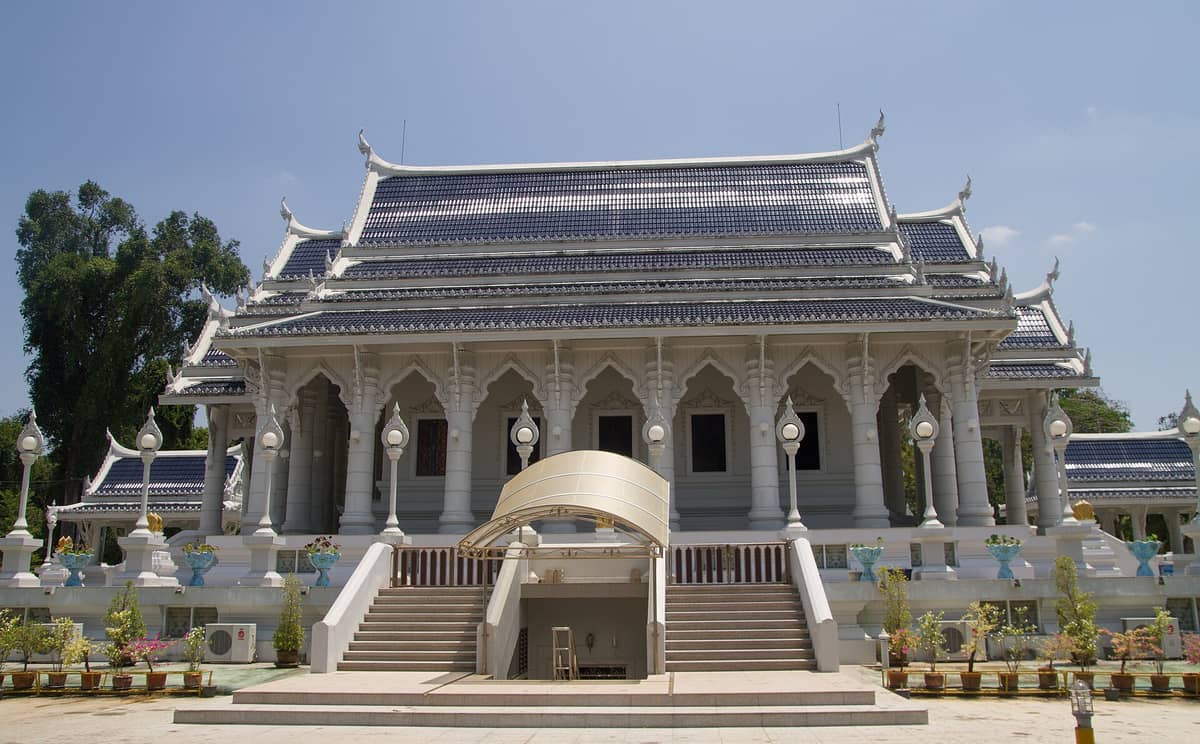
Wat Kaew Korawaram (วัดแก้วโกรวาราม) is the most prominent Buddhist temple in Krabi Town, sitting on a low limestone hill above the commercial centre. Founded in 1887, it is a functioning place of worship used daily by local monks and lay Buddhists, not a heritage display or tourist set piece. That distinction matters: the atmosphere here is quieter and more grounded than at larger, more famous temple complexes elsewhere in Thailand.
The temple grounds include a main ordination hall (ubosot), a chedi, smaller shrines, and monastic residence buildings. The exterior of the main hall is finished in white with gold ornamental detail, following the style common in southern Thai Theravada Buddhism. The roofline is steep and layered, with glazed ceramic finials that catch the light in the morning hours.
ℹ️ Good to know
Dress code is enforced: shoulders and knees must be covered to enter the buildings. If you arrive in shorts or a tank top, some temples offer sarongs at the entrance — but do not count on this. Come prepared.
The Staircase Approach: What the Climb Actually Looks Like
The most common way to reach the temple is via the ceremonial staircase from the town side, near the night market area on Maharaj Road. The staircase runs approximately 100 steps up the hillside and is flanked by naga (serpent) balustrades, a standard feature of Thai Buddhist temple architecture that signals the transition from ordinary space into sacred ground. The nagas here are finished in white, green, and gold mosaic tile.
The climb takes most visitors about five minutes at a moderate pace. The steps are wide and even, but there is no railing at every point, so visitors with balance concerns should take care, particularly if the stone is wet after rain. A vehicle road also accesses the upper grounds, which means visitors with limited mobility may be able to reach parts of the compound by taxi or tuk-tuk, though step-free access to individual temple buildings is not confirmed and should be checked locally.
⚠️ What to skip
The steps can become slippery after afternoon rain showers, which are common from May through October. Wear closed shoes or sandals with grip. Flip-flops on wet stone at this incline are a real hazard.
Tickets & tours
Live prices and dates from our booking partner. If you book, we may earn a commission at no extra cost to you.
Daily Cooking Class at Thai Cookery School in Krabi
From 42 €Instant confirmationFree cancellation7 islands speedboat excursion from Krabi
From 41 €Instant confirmationFree cancellationSpeedboat Tour to Hong Island Archipelago from Krabi
From 34 €Instant confirmationFree cancellationPhi Phi archipelago and Krabi 4 Islands full‑day speedboat tour
From 0 €Instant confirmationFree cancellation
Morning Versus Afternoon: How the Experience Changes
Early morning, roughly between 7:30 and 9:00, is the most atmospheric time to visit. The air is cooler, the light is directional rather than flat, and you may encounter monks moving through their morning routine. The smell of incense is noticeable near the main hall. At this hour the compound is largely quiet, with only a handful of local worshippers present alongside the occasional early-rising traveller.
By mid-morning, tour groups and independent visitors begin arriving, and the site can feel more crowded on the staircase than on the grounds themselves. The upper terrace and gardens absorb visitors reasonably well. Afternoon light hits the white facade of the main hall directly, which works against photography but can give the building an almost luminous quality in person. By 16:00, crowds thin considerably and the late-afternoon calm has a quality of its own.
The temple is reported open daily approximately 08:00 to 17:00, though as a working temple the grounds may be accessible outside those hours. The inner buildings follow their own schedule. Arrive closer to opening time if you want space and cooler conditions.
Views, Architecture, and What to Look At
From the upper terrace, the view looks out over central Krabi Town toward the Krabi River and the limestone karst formations that define this part of the province. It is not a panoramic summit view — the elevation is modest — but the framing of the river and the surrounding tree line gives a clear sense of the town's geography that you cannot get from street level. On clear mornings, the karsts in the distance have a blue-grey tonal quality against the sky.
The architecture rewards close attention. Look at the bot (ordination hall) door panels and the carved wooden details around the eaves. Southern Thai temple craftsmanship often differs from the styles more tourists encounter in Bangkok or Chiang Mai, with distinct regional ornamental traditions. If you are exploring the broader Krabi Town area, combine this visit with a walk down to the Khao Khanab Nam twin limestone caves along the river, which are another window into the local landscape.
Photography is generally permitted on the grounds and exterior. Inside the main hall, follow local custom: observe whether other visitors are photographing before you do, and always ask permission or look for posted signs. Remove shoes before entering any building.
Cultural Context: Why This Temple Matters in Krabi Town
Krabi Town is primarily a transit and service hub — most visitors pass through on the way to Ao Nang, the islands, or Railay. That transit function means the town's own character is often overlooked. Wat Kaew Korawaram is one of the clearest reminders that Krabi Town is a real, functioning community with its own religious and civic life, not just a stopover point.
Founded in 1887, the temple predates the modern tourism economy by nearly a century. It has served the local Buddhist community through the region's transition from a relatively isolated administrative outpost to one of Thailand's major international destinations. Visiting the temple with that context in mind changes the experience: you are not looking at a preserved museum piece, but at a living institution that continues to anchor community life.
If you have an afternoon free in Krabi Town, pairing this visit with the Krabi Town Night Market gives a reasonable cross-section of the town: the temple for cultural context and the market for food, atmosphere, and local commercial life. The two are close enough to walk between.
Who Should Skip This Attraction
Wat Kaew Korawaram is a genuine temple visit, not a spectacle. Travellers hoping for the scale and grandeur of Wat Phra Kaew in Bangkok or the mountainside drama of Tiger Cave Temple in Krabi Province will be underwhelmed. The site is relatively compact, and the views, while pleasant, are not exceptional by regional standards.
Visitors with very limited time in Krabi Province who are prioritising beaches, islands, or boat trips will find better use of their hours elsewhere. The temple works best as a short, purposeful detour rather than a primary destination. Families with young children can visit, but the staircase and the expectation of quiet inside the buildings make it less suited to children under about six or seven than an outdoor attraction like Nopparat Thara Beach would be.
Visitors with significant mobility limitations should note the staircase is the main approach. While road access to the upper compound reportedly exists, step-free entry into temple buildings is unconfirmed. Contact a local guide or your accommodation to clarify before making the trip.
Getting There and Practical Notes
The temple is on Maharaj Road, opposite Soi 6, in central Krabi Town. It is walkable from the town pier, the main market area, and most guesthouses in the centre — roughly 10 to 15 minutes on foot depending on your starting point. Krabi Town has no metro or rail system. Local tuk-tuks and Grab (the regional ride-hailing platform) are practical options if you prefer not to walk. Fares for short town trips are low, but confirm with the driver before departure.
For those arriving in Krabi Province by air, Krabi International Airport (KBV) is approximately 9 km from Krabi Town. See the Krabi airport guide for transport options into the town centre. If you have only a few hours before an evening flight, the temple is a feasible and low-cost way to spend that window, particularly when combined with a meal in the town market area.
💡 Local tip
Carry small bills. While entry is free, donation boxes are present on temple grounds and it is customary to contribute a small amount when visiting a working temple.
Insider Tips
- The staircase naga balustrades photograph best in the first two hours after sunrise, when the light comes from the east and the mosaic tile work shows its colour properly. By midday the light is flat and harsh.
- If the main hall doors are open and a service is in progress, wait quietly at the threshold rather than entering. Monks finish morning chants relatively early; mid-morning is typically more accessible for general visitors.
- The view from the upper terrace is better in the dry season (roughly December to March) when haze is lower and the karst formations in the distance are clearly defined. In the rainy season, low cloud can obscure the background entirely.
- Combine the visit with a walk along the Krabi River waterfront, which is a short distance downhill. The combination takes about two hours total and gives a fuller picture of Krabi Town than either stop alone.
- There are no cafes or facilities on the temple grounds. The nearest options are the street-food stalls and coffee shops in the market area at the base of the hill, a few minutes' walk away.
Who Is Wat Kaew Korawaram For?
- Travellers with a half-day layover in Krabi Town looking for something beyond restaurants and shopping
- Culture-focused visitors interested in southern Thai Buddhist architecture and regional religious practice
- Early risers who want a calm, atmospheric start to the day before beach or island trips
- Photographers interested in ornamental temple architecture and soft morning light
- Travellers building a walking itinerary through Krabi Town's riverside and market districts
Nearby Attractions
Other things to see while in Krabi Town:
- Ao Tha Lane & Mangrove Forest
Ao Tha Lane, also listed officially as Tha Lane Bay, is a tidal bay in Khao Thong Subdistrict where dense mangrove forest meets sheer karst cliffs. The only meaningful way to explore it is by kayak, paddling through narrow channels where the canopy closes overhead and the water turns dark green. It is quieter and less commercialized than most of Krabi's headline attractions.
- Huai To Waterfall
Huai To Waterfall (Nam Tok Huai To) is a multi-tiered cascade tucked inside Khao Phanom Bencha National Park, roughly 20 km north of Krabi Town. A short forest walk leads through dense tropical vegetation to a series of pools fed by cool mountain water, making it one of the most accessible natural retreats on the Krabi mainland.
- Khao Khanab Nam Caves
Two sheer limestone towers rising roughly 100 metres above the Krabi River, Khao Khanab Nam is the geological signature of Krabi Town. A short long-tail boat ride from Chao Fah Pier leads into cave chambers that served as a Japanese military camp in World War II and contain fossilised remains estimated to be millions of years old.
- Khao Phanom Bencha National Park
Khao Phanom Bencha National Park is Krabi's inland rainforest reserve, protecting steep limestone peaks, a dramatic five-tier waterfall, and dense jungle habitat roughly 20 km north of Krabi Town. It rewards early risers with cool air, birdsong, and cascading water, but trails beyond the lower falls require preparation and a degree of fitness.
Planning a trip? Discover personalized activities with the Nomado app.