Than Bok Khorani National Park: Krabi's Freshwater Jungle Wilderness
Than Bok Khorani National Park protects a rare inland landscape of emerald-green lagoons, dripping limestone caves, and dense mangrove channels in Krabi Province. Established in 1998 and covering around 104 km², it rewards visitors who prefer freshwater exploration and quiet forest trails over the province's more crowded beach circuits.
Quick Facts
- Location
- Ao Luek District, Krabi Province — approx. 48 km north of Krabi Town via Highway 4 and Highway 4039
- Getting There
- No bus is listed directly to the park entrance; buses serve the Ao Luek intersection, from where local transport can take you the remaining distance. Renting a scooter or car from Krabi Town or hiring a songthaew are alternatives. Grab is available in Krabi but coverage in Ao Luek is unreliable — confirm before booking.
- Time Needed
- 2–4 hours for the main lagoon and cave trail; half-day or full day if you add kayaking
- Cost
- Foreign adults approx. ฿300, children ฿100–150; Thai adults ฿60, children ฿30. Rates not independently verified — confirm at the gate.
- Best for
- Nature lovers, kayakers, cave explorers, families with older children, travellers seeking an alternative to beach crowds
- Official website
- www.dnp.go.th
What Than Bok Khorani Actually Is
Than Bok Khorani National Park (Thai: อุทยานแห่งชาติธารโบกขรณี) is a protected area in Ao Luek District, Krabi Province, established in 1998. Its roughly 104 km² of territory takes in an unusual combination of inland limestone karst, freshwater springs, multi-tiered waterfalls, mangrove-lined tidal channels, and a system of caves that contain prehistoric rock paintings. This is not a beach park. There is no sea access here, and if you come expecting the turquoise coastline Krabi is famous for, you will be surprised to find shaded forest paths, cool spring-fed pools, and the smell of wet rock and fern instead.
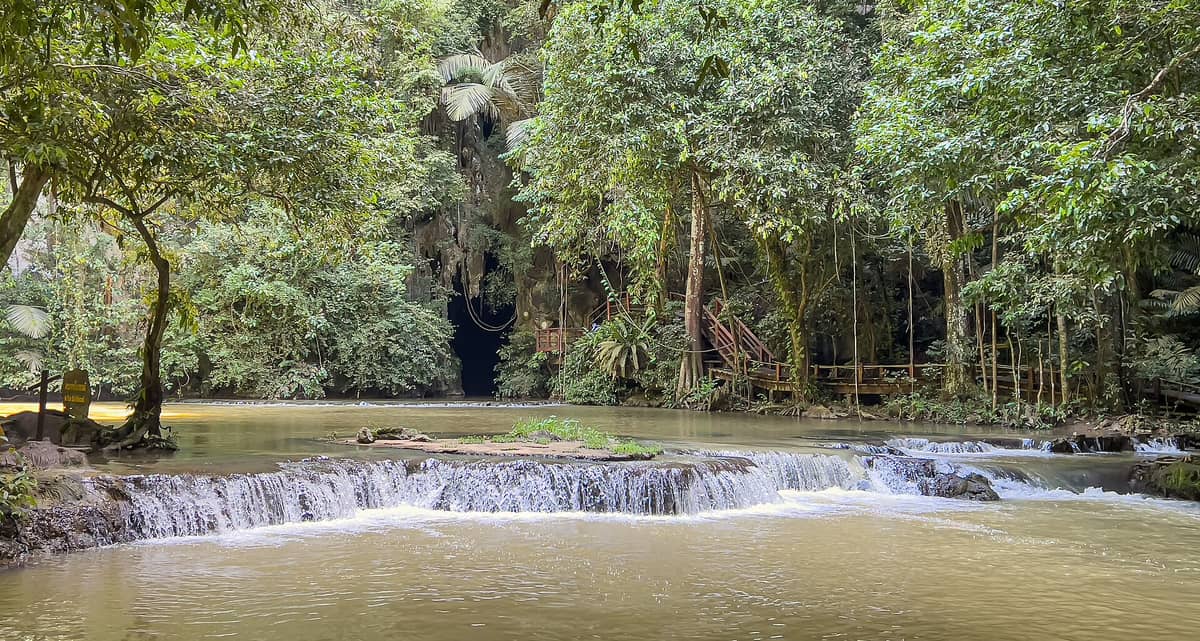
The park's centerpiece is a series of emerald-green ponds fed by natural springs, connected by short wooden walkways and stone paths through thick tropical vegetation. The water is startlingly clear and holds a greenish tint from the limestone minerals and algae. Long-tailed boats and kayaks can be hired at the park entrance to explore the broader waterway system, which opens into mangrove channels that eventually reach the coast.
ℹ️ Good to know
Park hours are commonly listed as 08:00–16:30 daily, but published schedules vary across sources. Arrive by 09:00 at the latest if you want enough time to kayak and walk the cave trail before the afternoon heat peaks.
How the Experience Changes Through the Day
The morning hours, roughly 08:00 to 10:30, are the best window for the ponds and short forest trails. The light filters through the canopy in narrow shafts, the water is at its most mirror-like, and the bird activity is highest — you may catch the flash of a kingfisher or hear the repetitive call of a coucal from the undergrowth. The air temperature is manageable, typically in the low 30s Celsius, and the humidity feels less oppressive than it does by midday.
From around 10:30 onwards, tour groups begin arriving from Ao Nang and Krabi Town, and the main pond area gets crowded enough that quiet contemplation becomes difficult. The wooden walkways narrow in places, and when two groups are moving in opposite directions the flow stalls. If you arrive independently by rental car or scooter, you can avoid this by getting in early. The afternoon, post-14:00, sees crowds thin again, but the light is flat and harsh for photography, and the closing time at 16:30 limits how much you can do.
The park looks and feels substantially different in the rainy season, which runs roughly May through October. The waterfalls gain force and the jungle becomes dramatically green and dense. However, some of the limestone paths become slippery, certain cave routes may be restricted, and kayaking in the channels depends on water levels and visibility. For most visitors, the dry season window of December through March offers the most predictable and comfortable conditions.
For a broader understanding of when to plan your trip, the best time to visit Krabi guide covers seasonal weather patterns across the province in detail.
Tickets & tours
Live prices and dates from our booking partner. If you book, we may earn a commission at no extra cost to you.
Daily Cooking Class at Thai Cookery School in Krabi
From 42 €Instant confirmationFree cancellation7 islands speedboat excursion from Krabi
From 41 €Instant confirmationFree cancellationSpeedboat Tour to Hong Island Archipelago from Krabi
From 34 €Instant confirmationFree cancellationPhi Phi archipelago and Krabi 4 Islands full‑day speedboat tour
From 0 €Instant confirmationFree cancellation
The Main Features: Lagoons, Caves, and Prehistoric Art
The spring-fed ponds near the park entrance are the most-photographed feature. The largest pool sits at the base of a limestone cliff face draped in ferns and mosses, with a constant gentle trickle of water entering from above. The water is cool — noticeably cooler than the surrounding air — and the sound of it moving over rock is audible even when there are other visitors around. Swimming is permitted in designated areas, though the available infrastructure (changing facilities, lockers) is basic.
The caves are a separate proposition. The park contains several limestone caverns, and some are accessible via short hikes along marked trails. The most significant contain ancient rock art: faded pigment drawings attributed to prehistoric inhabitants of the region, believed to date back thousands of years. These are not large, dramatic murals — they are modest markings on cave walls that require careful looking to make out — but the historical significance is real and worth taking seriously. Rangers occasionally lead short explanatory visits, but this is not guaranteed; check at the entrance.
The terrain throughout the park is limestone karst, which means uneven surfaces, exposed rock edges, and sudden changes in gradient. Footwear matters more here than at most Krabi attractions. Sandals are manageable on the flat pond boardwalks but become a liability on the cave trails and steeper forest paths. Closed shoes with grip are the practical choice.
⚠️ What to skip
The park includes steep and uneven limestone terrain. No wheelchair-accessible routes or facilities are confirmed in available sources. Travellers with limited mobility should plan only for the flat boardwalk areas near the main ponds, and even those have some uneven sections.
Kayaking the Mangrove Channels
One of the park's less-known options is kayaking through the tidal mangrove channels that extend from the main waterway. Long-tail boat trips and kayak rentals are available near the park entrance, though availability and pricing should be confirmed on arrival as these are operated by local vendors rather than the park administration directly. The mangrove routes are calm-water paddling, suitable for beginners, and the channels are narrow enough that you pass within arm's reach of the root systems and occasional wildlife.
The mangrove environment here connects to the broader coastal ecology of Krabi Province. Mudskippers move across exposed mud at low tide, monitor lizards occasionally appear on the banks, and the birdlife is different from what you see in the limestone forest above: herons, egrets, and various waders are common. The kayak routes cover a different sensory register than the cave and pond trails, making the combination of both a genuinely full experience of what the park offers.
If kayaking appeals to you as a primary activity, the Krabi kayaking guide covers the province's main paddling routes and operators in depth.
Getting There and Practical Logistics
The park is located at 2/2 Moo 2, Ao Luek Tai, Ao Luek District, Krabi 81110. From Krabi Town, take Highway 4 north in the direction of Ao Luek, then turn onto Highway 4039 approximately 2 km from the Ao Luek junction. The drive from Krabi Town takes around 45 minutes to an hour depending on traffic; the total distance is about 48 km.
There is public bus service to the Ao Luek intersection, but no reliable direct bus to the park entrance. From there, local transport can cover the remaining distance. The most practical options for independent travellers are a rented scooter or car from Krabi Town, or a private songthaew (shared pickup truck taxi) negotiated for a half-day. Grab operates in Krabi Town but coverage in the Ao Luek area is limited and should be confirmed before you depend on it. Some guesthouses in Krabi Town can arrange shared transport or point you toward a reliable driver.
Admission fees reported by multiple sources are approximately ฿300 for foreign adults and ฿100–150 for foreign children, with lower rates for Thai nationals (฿60 adults, ฿30 children). These figures have not been independently verified as current and should be confirmed at the gate. There are basic food stalls and drink vendors near the entrance.
For route planning from Krabi Town and Ao Nang, the getting around Krabi guide covers transport options across the province.
Historical and Ecological Context
Krabi Province is defined geologically by its limestone karst formations, which were shaped over millions of years by the dissolution of marine sediment. Than Bok Khorani sits within this wider karst landscape, and the park's caves, springs, and ponds are direct products of water moving through and dissolving porous limestone over vast timescales. The freshwater springs that feed the main ponds emerge from underground aquifers within the limestone, producing consistently cool, mineral-rich water year-round.
The park was formally gazetted in 1998 as part of Thailand's national park system, administered by the Department of National Parks, Wildlife and Plant Conservation. Its ecological significance lies partly in the connectivity between freshwater and marine habitats — the same waterway system that begins in the limestone interior reaches tidal mangrove forest and eventually the Andaman Sea coast. This transition from inland forest to mangrove to coast within a single protected area is relatively rare in the region.
Than Bok Khorani is one of several protected natural areas in Krabi Province worth building into a longer trip. Khao Phanom Bencha National Park to the north covers higher-elevation rainforest and multi-tiered waterfalls — a different landscape again.
Who This Park Is For — and Who Might Be Disappointed
Than Bok Khorani suits travellers who are looking for something other than the beach-and-boat formula that dominates most Krabi itineraries. The combination of freshwater ponds, cave trails, ancient art, and mangrove kayaking makes it one of the most ecologically diverse single stops in the province. It works well as a day trip from Krabi Town, and it pairs naturally with a visit to Ao Luek itself, which has a modest market and some riverside restaurants.
However, travellers who arrive expecting dramatic scenery comparable to Railay's cliffs or the open water of the island routes may find the park underwhelming. The ponds are beautiful but modest in scale. The cave paintings require patience and guided context to fully appreciate. The trails are not long or strenuous enough to satisfy serious hikers. And without a vehicle, getting here and back independently adds logistical effort that not every short-stay visitor will want to take on. If your Krabi time is limited to three days or fewer and you have not yet seen the main coastal highlights, the beach and island options may deserve priority.
For a structured look at how to sequence Krabi's attractions across a short trip, see the Krabi 3-day itinerary or the 5-day Krabi itinerary for a more relaxed pace that can accommodate inland detours like this one.
Insider Tips
- Arrive at 08:00 when the gates open. The first 90 minutes are dramatically quieter than the rest of the day, and the light on the ponds is at its best before 10:00.
- Bring water shoes or closed sandals with grip. The boardwalks are manageable in flip-flops but the cave trails and stream crossings are not — wet limestone is more slippery than it looks.
- Ask at the entrance gate about ranger-led cave visits. They are not always available or advertised, but when offered they add genuine context to the prehistoric rock art that you would otherwise miss entirely.
- The mangrove kayak routes are worth the extra time and cost if you are not doing a dedicated kayaking trip elsewhere in Krabi. The late-morning window, around 10:00–12:00, tends to coincide with low tide in the channels, which makes wildlife spotting easier.
- Combine the park with a stop in Ao Luek town on the way back. There is a small market and a handful of local restaurants along the riverfront that see very few tourists — a contrast to the heavily touristed eating options near Krabi Town and Ao Nang.
Who Is Than Bok Khorani National Park For?
- Nature travellers seeking an inland alternative to Krabi's beach and island circuit
- Families with older children who can manage uneven terrain and have an interest in caves and wildlife
- Kayakers and paddlers who want calm-water mangrove exploration rather than open-sea routes
- Photography-focused visitors who want reflective water, forest light, and dramatic limestone backdrops
- Travellers on longer Krabi stays (5+ days) who have already covered the main coastal highlights
Nearby Attractions
Other things to see while in Krabi Town:
- Ao Tha Lane & Mangrove Forest
Ao Tha Lane, also listed officially as Tha Lane Bay, is a tidal bay in Khao Thong Subdistrict where dense mangrove forest meets sheer karst cliffs. The only meaningful way to explore it is by kayak, paddling through narrow channels where the canopy closes overhead and the water turns dark green. It is quieter and less commercialized than most of Krabi's headline attractions.
- Huai To Waterfall
Huai To Waterfall (Nam Tok Huai To) is a multi-tiered cascade tucked inside Khao Phanom Bencha National Park, roughly 20 km north of Krabi Town. A short forest walk leads through dense tropical vegetation to a series of pools fed by cool mountain water, making it one of the most accessible natural retreats on the Krabi mainland.
- Khao Khanab Nam Caves
Two sheer limestone towers rising roughly 100 metres above the Krabi River, Khao Khanab Nam is the geological signature of Krabi Town. A short long-tail boat ride from Chao Fah Pier leads into cave chambers that served as a Japanese military camp in World War II and contain fossilised remains estimated to be millions of years old.
- Khao Phanom Bencha National Park
Khao Phanom Bencha National Park is Krabi's inland rainforest reserve, protecting steep limestone peaks, a dramatic five-tier waterfall, and dense jungle habitat roughly 20 km north of Krabi Town. It rewards early risers with cool air, birdsong, and cascading water, but trails beyond the lower falls require preparation and a degree of fitness.
Planning a trip? Discover personalized activities with the Nomado app.