Kerepesi Cemetery (Fiumei úti sírkert): Budapest's Monumental National Graveyard
Founded in 1847, Kerepesi Cemetery is Hungary's most historically layered burial ground, where poets, revolutionaries, statesmen, and Communist-era officials rest side by side across 56 parklike hectares. Free to enter and genuinely uncrowded, it rewards visitors who want Budapest's history without a ticket queue.
Quick Facts
- Location
- Fiumei út 16–18, 1086 Budapest (District VIII, near Keleti Station)
- Getting There
- Metro M2 (red line) to Keleti pályaudvar, then about a 5–10-min walk south; trams 2M and 24 stop near the entrance
- Time Needed
- 1.5–3 hours depending on depth of exploration
- Cost
- Free admission
- Best for
- History lovers, architecture enthusiasts, quiet walkers, and anyone who wants to understand modern Hungary
- Official website
- fiumeiutisirkert.nori.gov.hu
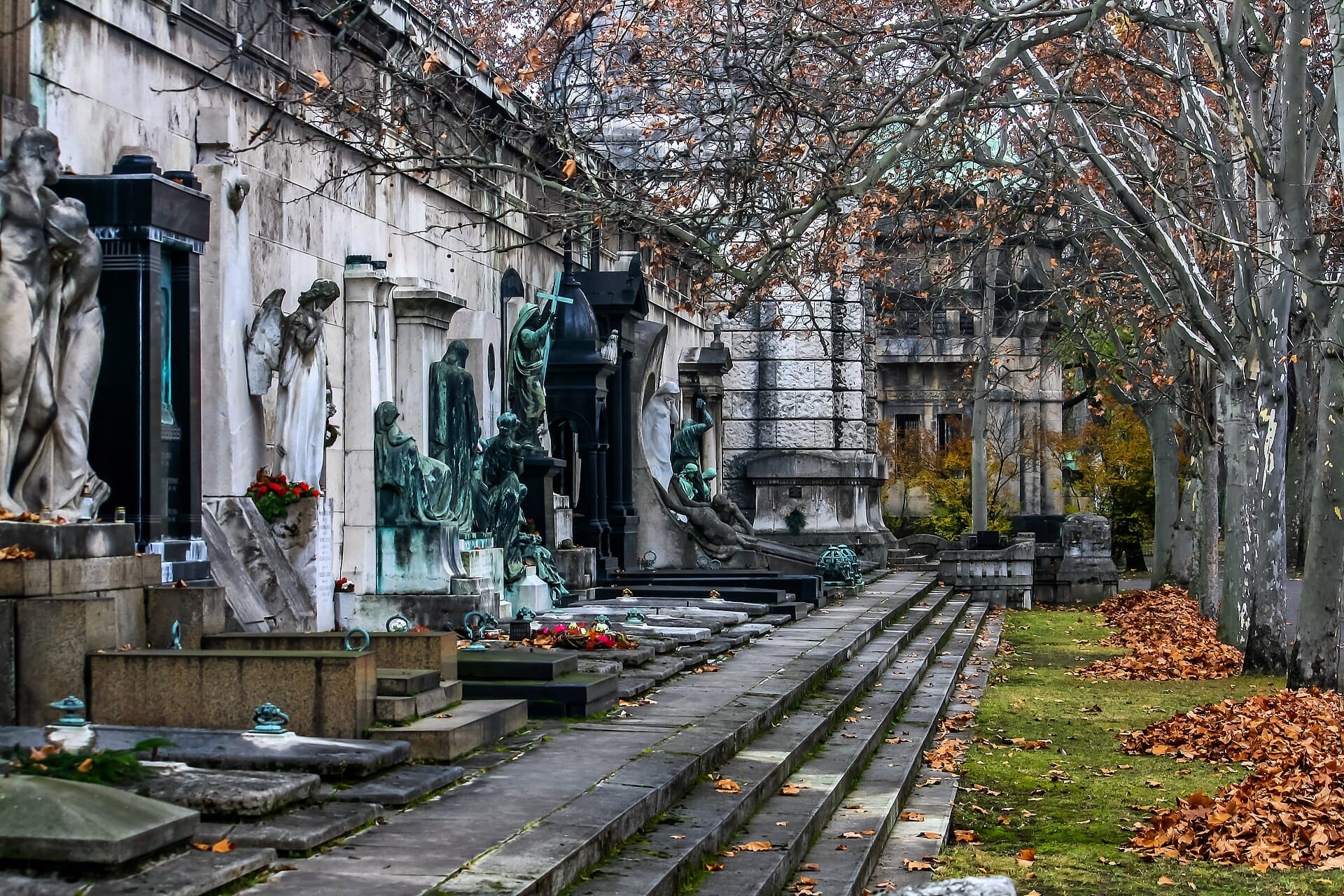
What Kerepesi Cemetery Actually Is
Kerepesi Cemetery, officially the Fiumei úti nemzeti sírkert (Fiume Road National Graveyard), is Hungary's closest equivalent to Paris's Père Lachaise or London's Highgate. Opened in 1847 on the eastern edge of what was then Pest, it became the designated resting place for the country's most significant figures: writers, composers, politicians, scientists, and military leaders. Today it covers roughly 56 hectares (about 138 acres) and remains largely intact as a single historic site, which is increasingly rare for a cemetery of this age in a capital city.
What makes Kerepesi unusual is not just who is buried here, but how the site reflects every major shift in Hungarian political life. Nineteenth-century neoclassical mausoleums sit a short walk from Soviet-era workers' pantheons. Plaques commemorate 1848 revolutionaries a few hundred meters from memorials to Communist Party officials. The tensions of Hungarian history are not smoothed over here — they are geographically present.
💡 Local tip
Pick up a free map at the main entrance on Fiumei út. The cemetery's layout is not intuitive, and without it, finding specific monuments among the tree-lined avenues takes significantly longer.
The Experience by Time of Day
Mornings at Kerepesi are noticeably quiet. The gate on Fiumei út opens at 7:00 in most months (7:30 in winter), and in the first hour or two, the only sounds are birdsong and the distant rumble of trams on the avenue outside. The light in spring and summer filters through plane trees and chestnuts in a way that makes the older sections feel genuinely still. Mist sometimes lingers near the lower ground in autumn, which adds an atmosphere that requires no editorial commentary.
Midday brings a small increase in visitors, mainly local Budapestians on a contemplative walk or researchers with notebooks. The cemetery never gets crowded in the way that Buda Castle or Fisherman's Bastion do. Even in summer, you can spend an hour in the older sections without passing another visitor. This is one of the few large historic sites in Budapest where solitude is reliably available.
Late afternoon light, particularly from around 16:00 in spring and autumn, hits the white stone mausoleums at an angle that makes them glow. Photographers working with natural light will find this the most rewarding window. The cemetery closes anywhere from 17:00 in winter to 20:00 in May through July, so the specific closing time matters if you plan to arrive after work.
Tickets & tours
Live prices and dates from our booking partner. If you book, we may earn a commission at no extra cost to you.
Budapest Guided E-Scooter Tour by Night
From 60 €Instant confirmationFree cancellationHalf-day tour to Princess Sissi's Godollő royal palace from Budapest
From 41 €Instant confirmationFree cancellationHalf-Day Countryside Wine Tour from Budapest
From 95 €Instant confirmationFree cancellation4 Course Dinner cruise with Operetta and Folk show
From 81 €Instant confirmationFree cancellation
Opening Hours by Season
- November–February: 07:30–17:00
- March: 07:00–17:30
- April and August: 07:00–19:00
- May–July: 07:00–20:00
- September: 07:00–18:00
- October: 07:00–17:00
⚠️ What to skip
Hours shift significantly across the year. Confirm current times at fiumeiutisirkert.nori.gov.hu before visiting, especially in shoulder months when the schedule transitions.
History and Cultural Significance
When Kerepesi was founded in 1847, Pest was a rapidly growing city pushing toward the eastern plains, and the existing churchyard cemeteries inside the city were reaching capacity. The Fiumei út site was designed as a modern secular public cemetery on the edge of the city, reflecting the urban planning ideals of mid-nineteenth century European capitals. It was named after the road that leads southeast toward the city of Fiume (now Rijeka, Croatia), then an important Hungarian port.
The cemetery's role as a national pantheon solidified quickly. Lajos Kossuth, the iconic leader of the 1848 Hungarian Revolution against Habsburg rule, was interred here in 1894 after dying in exile in Turin. His mausoleum, a heavy neoclassical structure near the main avenue, remains one of the most visited sites in the cemetery and is decorated with fresh flowers year-round. Ferenc Deák, the architect of the 1867 Austro-Hungarian Compromise, is also buried here, along with poets Mihály Vörösmarty and Ede Szigligeti. Walking between these graves is a compressed lesson in nineteenth-century Hungarian political and cultural life.
The twentieth century added considerably more layers. After 1945, the Communist government used Kerepesi as a site of political legitimization, constructing a substantial Pantheon of the Workers' Movement — a colonnaded monument dedicated to labor movement figures and party officials. It stands in deliberate architectural contrast to the Romantic and neoclassical tombs around it, and its current status is somewhat ambiguous: preserved as a historical monument but no longer ideologically endorsed. For travelers interested in how Budapest has processed its Communist past, this is a useful companion visit to Memento Park, where removed Soviet statues are now displayed on the city's outskirts.
What to Look For: A Practical Walkthrough
The main entrance on Fiumei út opens onto the central avenue, which is lined with mature plane trees. The monumental mausoleums are concentrated along this central axis and the perpendicular avenues branching from it. The Kossuth Mausoleum is directly accessible from the main path and is clearly signposted.
Beyond the central tombs, the cemetery expands into quieter sections where nineteenth-century family plots give way to more modest twentieth-century graves. The older sections in particular have a crumbling, overgrown quality in places — stone crosses listing at angles, inscriptions worn by weather — that no restoration has fully intervened in. This is not neglect so much as a different relationship with historical preservation, and some visitors find it more affecting than the polished mausoleums at the front.
The Pantheon of the Workers' Movement occupies a distinct section and is worth walking through even if Soviet-era architecture is not your primary interest. The scale is imposing and the contrast with surrounding monuments is striking. Nearby, a section commemorates those who died in the 1956 Hungarian Uprising, a political and historical counterpoint that the site holds together with minimal editorial intervention.
If you are building a broader understanding of Budapest's historical landscape, Kerepesi pairs logically with the House of Terror Museum for a structured account of the Communist period, or with the Hungarian National Museum for the longer arc of Hungarian history. The cemetery works well as an outdoor counterpart to both.
Getting There and Practical Logistics
The most straightforward approach is the Metro M2 (red line) to Keleti pályaudvar, Budapest's main international railway station. From the metro exit, walk south along Festetics György utca and then onto Fiumei út; the cemetery gate is about 5–10 minutes on foot. Trams 2M and 24 stop closer to the entrance on Fiumei út if you prefer not to walk from Keleti.
Keleti Station is itself a notable piece of architecture and a good orientation point for this part of the city. If you want to understand how to navigate Budapest's public transport system more broadly, the guide to getting around Budapest covers BKK tickets, transit passes, and route planning in detail.
Comfortable, flat-soled shoes are advisable. The paths are a mix of paved avenues and gravel or compacted earth tracks. Some sections have uneven surfaces from tree roots, and in wet weather the gravel areas can become slippery. There are no cafes or facilities inside the cemetery, so bring water, particularly in summer when the site can be warm and exposed between the tree-lined sections.
ℹ️ Good to know
Accessibility: The main entrance and central avenues are generally level and accessible, but the 56-hectare site requires substantial walking. Visitors with limited mobility should focus on the central monumental section near the entrance, which contains the most significant monuments within a contained area.
Photography Notes and Weather Considerations
Kerepesi is one of the more rewarding photography locations in Budapest for those interested in architecture, funerary sculpture, or atmospheric natural light. The best conditions are overcast days with diffuse light, which reduces harsh shadows on the stone carvings, or the low-angle light of early morning and late afternoon. In full midday summer sun, the white stone mausoleums can be difficult to expose correctly without graduating between shadows and highlights.
Autumn is particularly strong visually: fallen leaves accumulate against the older gravestones, the deciduous canopy turns amber and gold, and the contrast with the grey and white stone produces images with genuine depth. Spring brings blossom to some of the ornamental trees planted near the central avenues. Winter visits are possible but the cemetery closes relatively early (17:00) and the paths can be icy after freezing nights.
Budapest's weather across the year significantly affects the experience of outdoor sites like this. Before planning a visit, the best time to visit Budapest guide covers seasonal conditions in detail, including the shoulder periods in May and September that tend to offer the best combination of mild temperatures and manageable visitor numbers citywide.
Who Should Consider Skipping This
Kerepesi is not an attraction that suits everyone on a short city break. Visitors with only one or two days in Budapest who are prioritizing visual highlights — the Parliament building, the Chain Bridge, the thermal baths, the castle district — may find that a two-hour walk through a cemetery, however historically rich, does not compete for their limited time. The site has no audiovisual displays, no cafe, no gift shop, and almost no interpretive signage in English beyond the maps available at the entrance.
Travelers who prefer structured museum experiences with guided narratives will likely find Kerepesi frustrating without prior research. The monuments are labelled in Hungarian, and understanding the significance of specific figures requires at least some background in Hungarian history. Arriving without that context means walking past one of the most historically dense sites in the city without fully reading it.
Insider Tips
- The map at the entrance marks the most famous graves, but the cemetery's own official website (fiumeiutisirkert.nori.gov.hu) includes a searchable database of burials if you want to locate a specific person before your visit.
- All Souls' Day (November 2) is the one time Kerepesi sees significant crowds. Candles and lanterns are placed on graves across the cemetery, and the effect after dark is extraordinary. The cemetery may extend evening hours on this date — confirm in advance.
- The section immediately to the left of the central avenue after the main entrance contains some of the most elaborate nineteenth-century funerary sculpture in Hungary, including several oversized bronze portrait reliefs. It is easy to walk past if you head directly toward the Kossuth Mausoleum.
- Bicycles are generally not permitted inside the cemetery. Walking is the only way to navigate, and sensible shoes genuinely matter on the gravel paths in the outer sections.
- The cemetery borders the Józsefváros district, which is one of the more architecturally interesting inner-city areas of Pest outside the main tourist circuit. Combining a morning at Kerepesi with an exploratory walk through the surrounding streets gives a different picture of Budapest than the standard itinerary.
Who Is Kerepesi Cemetery (Fiumei úti sírkert) For?
- History and politics enthusiasts who want an outdoor, unmediated encounter with Hungary's national narrative
- Architecture and funerary art lovers drawn to nineteenth-century monumental stonework
- Photographers looking for atmospheric, uncrowded subjects with strong natural light
- Travelers on a return visit to Budapest who have already covered the major landmarks
- Anyone seeking genuine quiet in a city where peaceful outdoor spaces can be hard to find
Nearby Attractions
Combine your visit with:
- Buda Hills & Normafa
Rising to around 477–479 meters above sea level in Budapest's 12th district, Normafa is a free public parkland where locals jog, sled, and picnic within easy reach of the center. The Buda Hills around it offer a network of forest trails, a historic cogwheel railway, and views that stretch across the Danube on clear days.
- Margaret Island
Stretching 2.5 kilometres through the middle of the Danube, Margaret Island is Budapest's primary urban park and the city's most democratic attraction. Entry is free, private cars are banned, and the island rewards visitors with medieval ruins, thermal baths, a musical fountain, and enough green space to lose a half-day without trying.
- Memento Park
Memento Park is Budapest's open-air museum dedicated to the monumental sculptures of Hungary's communist period. Forty-two statues that once dominated public squares across the country now stand together on the outskirts of the city, forming one of Europe's most unusual and thought-provoking collections.
Planning a trip? Discover personalized activities with the Nomado app.