Keila-Joa Waterfall: A Free Day Trip from Tallinn Worth Making
Standing 6 metres tall and stretching up to 60 metres across, Keila-Joa Waterfall is a dramatic manor-park waterfall and one of the most rewarding easy escapes from Tallinn. Set inside a forested river park beside a 19th-century Gothic Revival manor, the site is free to enter and open year-round. It rewards a visit in every season.
Quick Facts
- Location
- Keila-Joa, Harju County — approx. 30–35 km west of Tallinn
- Getting There
- By bus from Tallinn, or about 30 min by car via the route toward Lohusalu
- Time Needed
- 1.5–3 hours depending on how far you walk the park trails
- Cost
- Free (waterfall and park); Keila-Joa Castle has separate paid entry
- Best for
- Nature lovers, photographers, families, and anyone wanting green space beyond the city
- Official website
- visitestonia.com/en/keila-waterfall
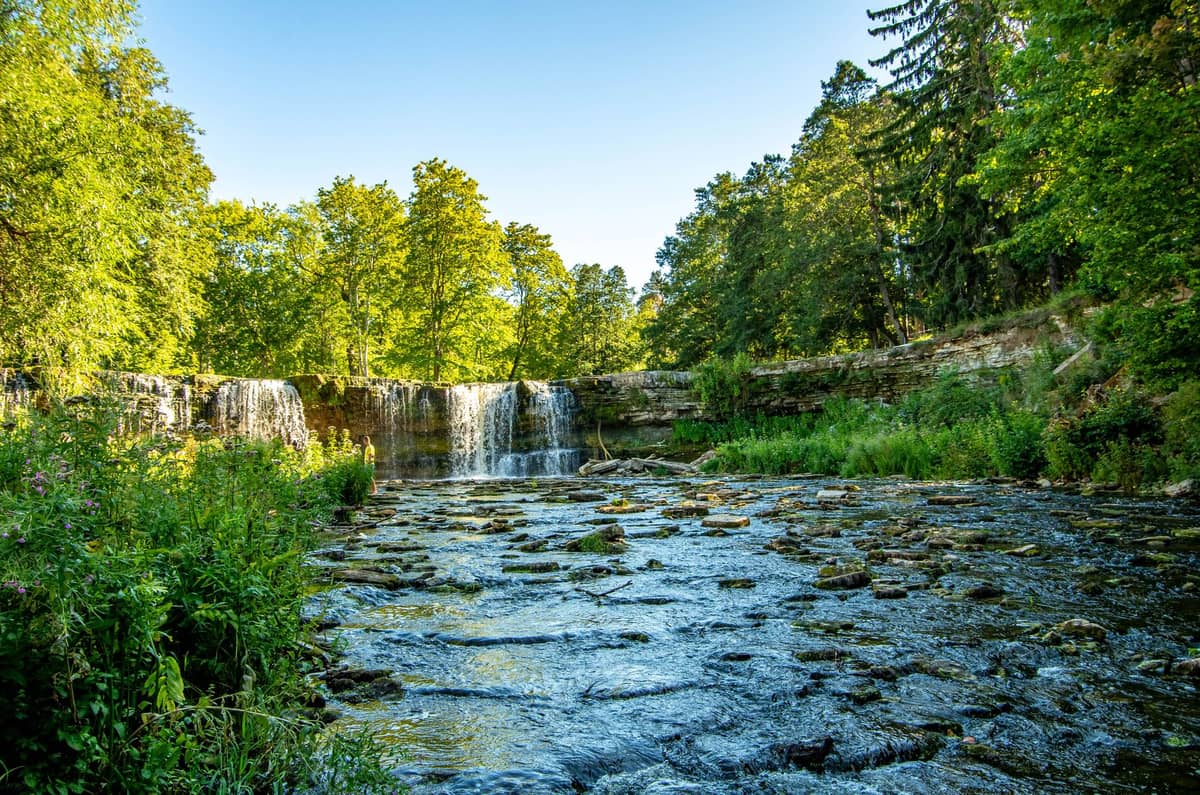
What Keila-Joa Waterfall Actually Is
Keila-Joa Waterfall, known in Estonian as Keila juga, sits on the Keila River in Harju County, roughly 30 kilometres west of Tallinn. It is one of Estonia's most notable waterfalls, and its most striking characteristic is sheer width: the cascade spans about around 60 metres across a stepped limestone ledge, dropping around 6 metres into a frothy green pool below. The sound carries well before the waterfall comes into view.
This is not a vertical plunge-pool spectacle. The water fans out across a broad, broken shelf of Ordovician limestone in a wide curtain that changes character entirely with the season. In spring, snowmelt swells the Keila River and the falls become genuinely loud and forceful. By late summer, the flow narrows and slows, revealing more of the rock face. Both versions have their appeal.
💡 Local tip
Visit in April or May after snowmelt for the most dramatic flow. Late summer can reduce the waterfall to a much quieter trickle — still scenic, but a different experience entirely.
The Landscape Around the Falls
The waterfall sits within Keila-Joa Park, managed by the RMK (Estonia's State Forest Management Centre). The immediate area around the falls is compact — a short walk from the car park brings you to the main viewpoint on the southern bank, where a flat stone platform gives a direct, unobstructed look at the full width of the cascade. The smell here is clean and mineral, with a faint cool spray when the river is high.
A footbridge crosses the river just downstream, allowing you to approach from both banks. The northern side offers a slightly elevated perspective and is noticeably quieter in terms of foot traffic. From here you can look back at the falls with the Gothic Revival silhouette of Keila-Joa Castle visible on the ridge above — a combination that photographs well in morning light.
The park trails extend further along the river through mixed forest. The paths include natural surfaces with some exposed roots and small inclines near the gorge edges. This is manageable for most walkers in reasonable footwear, though the paths are not designed for wheelchairs, particularly near the water.
Tickets & tours
Hand-picked options from our booking partner. Prices are indicative; availability and final rates are confirmed when you complete your booking.
Self-guided Discovery Walk of Tallinn city contrasts beyond the medieval walls
From 26 €Instant confirmationFree cancellationTallinn's art and culture tour with a local
From 62 €Instant confirmationFree cancellationHistorical walking tour of Tallinn with a local
From 599 €Instant confirmationFree cancellationIntroductory walking tour of Tallinn with a local guide
From 109 €Instant confirmationFree cancellation
Keila-Joa Castle: Context You'll Want
Looming above the northern bank is Schloss Fall, better known today as Keila-Joa Castle. It was built in the 1830s in the Gothic Revival style for Count Alexander von Benckendorff. The combination of a dramatic waterfall, a forested river valley, and a carefully positioned castle gives the estate a striking Romantic-era atmosphere.
The castle is privately managed and runs events, weddings, and occasional tours; entry is paid separately and is not required to enjoy the waterfall or park. Even from outside, the building adds an unusual historical dimension to what might otherwise be a straightforward nature stop. Visitors interested in the broader story of Baltic German manor culture will find it worth a closer look.
Keila-Joa fits naturally into the context of Estonia's manor house history. For more on how this architectural legacy plays out across the region, the day trips from Tallinn guide covers other estates and natural sites within easy reach of the city.
How the Experience Changes by Time and Season
Early morning visits, particularly on weekdays, are genuinely quiet. The river mist sits low over the pool below the falls, birds are audible above the water noise, and the light comes in at a low angle through the riverside alders. By midday in summer, day-trippers and local families arrive in numbers, and the flat viewing area can feel crowded.
Autumn is arguably the most visually rewarding time to visit. The surrounding forest turns yellow and copper from mid-September, the tourist numbers drop sharply after the school term begins, and the river level typically rises again after summer lows. The falls look good against fall colour, and the light in October has a warmth that flatters the limestone.
Winter visits are possible and atmospheric — the waterfall rarely freezes completely, but ice builds up on the limestone ledges and the surrounding trees carry frost in cold snaps. The paths can be slippery; waterproof boots with grip are strongly advised between December and February. Daylight is limited, so arriving by noon gives you sufficient light for photography.
⚠️ What to skip
The park paths can be icy in winter. Wear waterproof footwear with good grip between December and March. The main viewpoint platform can be slick even when the trails are clear.
Getting There from Tallinn
By car, the drive from central Tallinn takes around 30 minutes via the Paldiski road heading west. After passing through Keila town, follow signs toward Lohusalu and then Keila-Joa. Once you cross the Keila River, turn into Keila-Joa Park — there is a car park close to the river and the main trailhead.
By public transport, regional bus lines 108, 127, and 237 run from Balti Jaam (Tallinn's main bus and train terminal) and the Estonia 2 stop to Keila-Joa. Journey time is approximately one hour. Check current timetables at peatus.ee before you travel, as frequencies vary by day and season.
There is no need for a hire car if you are comfortable with the bus schedule. However, the last buses back to Tallinn in the evening can be early, particularly outside summer — confirm your return time before setting out so you are not stranded.
ℹ️ Good to know
The Tallinn Card does not cover transport to Keila-Joa or entry to any paid facilities at the castle. Bus fares are paid separately using the standard Tallinn/regional transit system.
Photography and Practical Notes
The main viewpoint faces roughly north, which means the falls are in shade by mid-afternoon in summer. For the best light — soft, even, and without harsh shadows on the water — aim for late morning or overcast days. A polarising filter reduces glare on the water surface significantly. If you have a wide-angle lens, the full breadth of the cascade fits comfortably from the main platform.
The spray zone directly below the falls is minimal unless water levels are very high, but the ground around the pool edges is perpetually damp. Camera bags and footwear will thank you if you keep this in mind.
Keila-Joa makes a logical pairing with the Jägala Waterfall, Estonia's widest natural waterfall (though not its tallest). Both can be done in a single day if you have a car, making for a compelling natural double-bill east and west of Tallinn.
Who Should Skip This Trip
Keila-Joa Waterfall is a natural attraction, not a curated tourist experience. Visitors expecting a maintained visitor centre, on-site cafes, or a structured guided tour will find the site underwhelming. There are no facilities at the waterfall itself — bring water and snacks. The falls are also not accessible by wheelchair or pushchair on the natural terrain paths near the gorge.
Travellers with only a day in Tallinn who prioritise medieval architecture, museums, and urban atmosphere will likely get more value from staying in Tallinn's Old Town or exploring Kadriorg Park. Keila-Joa rewards visitors who specifically want to leave the city and spend time in nature.
Insider Tips
- The footbridge just downstream from the falls is a better photography position than the main platform — it puts the water in front of you rather than at an angle, and you can include the castle ridge in the background.
- If you arrive by bus, the stop is a short walk from the park entrance. The walk from the bus stop to the waterfall takes about 10–15 minutes on a marked path — follow signs for Keila-Joa Park rather than heading toward the castle driveway.
- Bring a waterproof layer regardless of the forecast. The microclimate near the gorge is noticeably cooler and damper than the surrounding countryside, especially in spring when the river runs hard.
- The quietest days are weekday mornings outside June to August. If you visit on a sunny Saturday in summer, expect families and groups — the main platform is small and can feel crowded.
- Combine the visit with a look at the castle exterior even if you do not pay for entry. The view of the manor from the southern bank of the river, framed by the trees, is one of the more distinctive compositions in the area around Tallinn.
Who Is Keila-Joa Waterfall For?
- Nature lovers and hikers wanting to get out of the city without a long journey
- Photographers looking for waterfall and Gothic architecture in a single frame
- Families with children old enough to walk rough paths (roughly 5+)
- Travellers spending several days in Tallinn who have already covered the main city sights
- Anyone visiting in autumn who wants to see Estonian forest colour at its peak
Nearby Attractions
Combine your visit with:
- Aegna Island
Aegna Island sits 14 km off the Tallinn coast in the Bay of Tallinn, reachable in about 30 minutes by boat. The entire island is a protected landscape conservation area, covered in dense forest, glacial boulders, and coastal meadows. Entry to the island is free, making it one of the most rewarding half-day escapes from the city.
- Estonian Open Air Museum
Spread across 72 hectares of coastal forest in Tallinn's Haabersti district, the Estonian Open Air Museum (Eesti Vabaõhumuuseum) reconstructs rural and fishing life from the 18th and 19th centuries. Twelve farmyards, a working tavern, a church, mills, a schoolhouse, a fire station, and net sheds make this Estonia's largest and most immersive open-air history experience.
- Glehn Park
Glehn Park is a free, forested public park in Tallinn's suburban Nõmme district, built around a 19th-century castle by the eccentric Baron Nikolai von Glehn. With natural woodland trails, stone carvings, and a refreshing distance from the Old Town crowds, it rewards visitors who want something genuinely different from the medieval core.
- Jägala Waterfall
Standing 8 metres tall and stretching over 50 metres wide, Jägala Waterfall is Estonia's largest natural waterfall. Located just 25 kilometres east of Tallinn on the Jägala River, it is free to visit year-round and rewards visitors differently in every season, from frozen curtains of ice in winter to a thundering torrent in spring snowmelt.