Balti Jaam Market: Tallinn's Best Covered Market for Food, Vintage, and Local Life
Balti Jaam Market, known in Estonian as Balti Jaama Turg, sits beside Tallinn's central train station in the Kalamaja district. Reopened in 2017, it brings together local food producers, vintage traders, flower sellers, and street food vendors under one roof. Entry is free, and the market runs seven days a week year-round.
Quick Facts
- Location
- Kopli 1, Kalamaja, Tallinn (next to Balti Jaam train station)
- Getting There
- Trams 1, 2, and 5 to Balti Jaam; Telliskivi is also nearby
- Time Needed
- 45 minutes to 2 hours
- Cost
- Free entry; bring cash for vendors
- Best for
- Food lovers, slow mornings, budget travelers, solo explorers
- Official website
- astri.ee/bjt
What Is Balti Jaam Market?
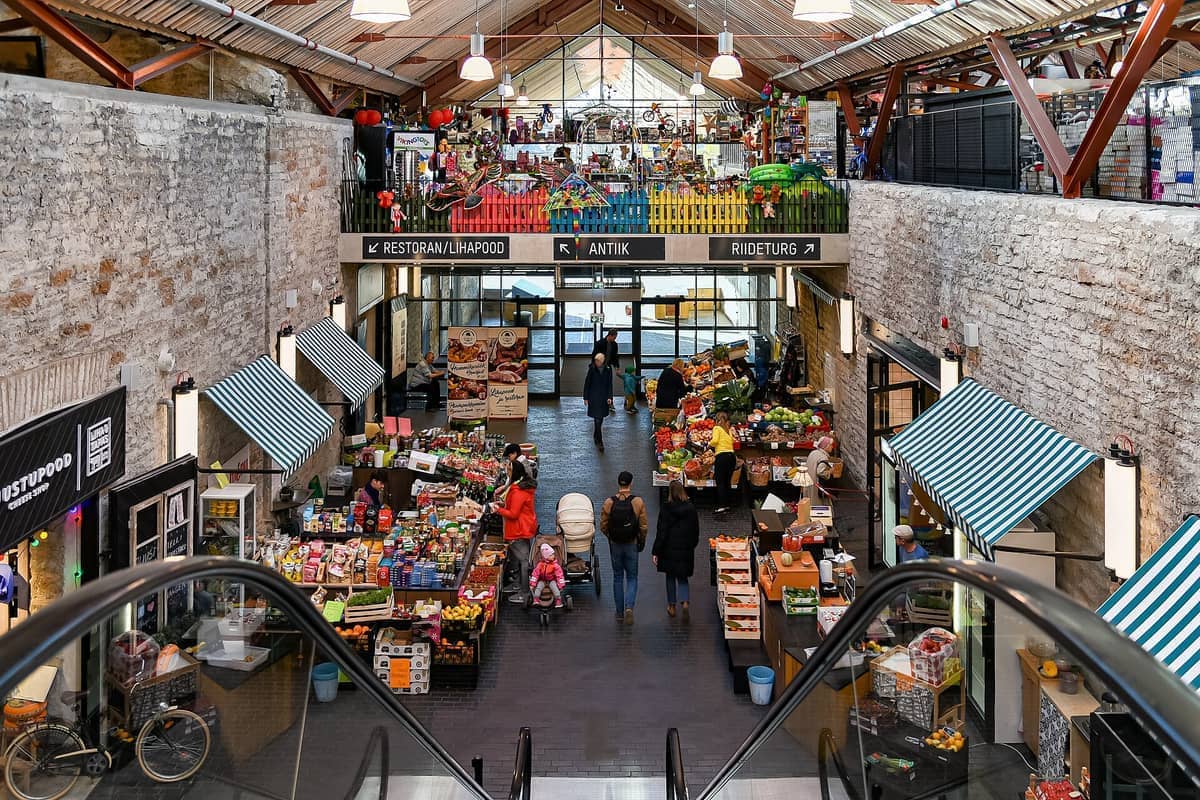
Balti Jaam Market, officially Balti Jaama Turg, is a year-round covered market complex located at Kopli 1, immediately adjacent to Tallinn's central train station. After a full redevelopment completed in 2017, the market trades in a mix of fresh produce, local dairy and meat, flowers, street food, secondhand clothing, Soviet-era collectibles, and household goods. It is not a curated artisan fair or a polished food hall. It is a working market, used by locals for weekly shopping, and that is precisely what makes it worth your time.
The market occupies a large covered structure with both indoor halls and semi-open sections, making it viable in rain, snow, and the biting cold of a Tallinn January. It sits at the edge of the Kalamaja neighborhood, one of Tallinn's most characterful districts, and a short walk from both the Old Town and the creative cluster at Telliskivi.
💡 Local tip
Bring cash. Many vendors, particularly the older produce sellers and secondhand traders, do not take card payments.
The Layout: What You'll Find and Where
The market is organized loosely into zones, though the boundaries blur in practice. The indoor hall closest to the train station side tends to house meat and dairy vendors, pickle sellers, and flower stalls. The air in this section carries the combined scent of fresh dill, smoked fish, and cut blooms. In winter, it is noticeably warmer here than outside, and regulars linger longer over their shopping than they might in summer.
Further into the complex, covered outdoor sections host secondhand clothing, vintage Soviet tableware, tools, books in Estonian and Russian, and the kind of miscellaneous clutter that requires patience to sort through and rewards it occasionally. This area functions more like a classic flea market. Prices are negotiable at many stalls, and sellers are often willing to bargain, particularly later in the day.
The street food section is where the market draws a younger crowd. You will find Georgian khachapuri, local sausages, fresh pastries, and hot drinks at prices well below what cafes in the Old Town charge. There are a handful of benches and standing tables, but seating is limited during peak hours on weekends.
Tickets & tours
Hand-picked options from our booking partner. Prices are indicative; availability and final rates are confirmed when you complete your booking.
Self-guided Discovery Walk of Tallinn city contrasts beyond the medieval walls
From 26 €Instant confirmationFree cancellationTallinn's art and culture tour with a local
From 62 €Instant confirmationFree cancellationHistorical walking tour of Tallinn with a local
From 599 €Instant confirmationFree cancellationIntroductory walking tour of Tallinn with a local guide
From 109 €Instant confirmationFree cancellation
How the Market Changes Through the Day
Arrive before 10:00 on a weekday and the market is at its most local. Older residents do their weekly shopping, vendors set up slowly, and the noise level is low. The produce is freshest at this hour, and the flower stalls are fully stocked. If you want to observe rather than perform, this is the window to do it.
By late morning on Saturday, the dynamic shifts. The food stalls fill up with a mix of locals and visitors, the secondhand section gets more browsers, and the atmosphere becomes noticeably more energetic without becoming overwhelming. This is the most photogenic time, with good light coming through the covered structure and more activity at every stall.
Sunday afternoons are quieter. The market closes at 17:00 on Sundays, and by mid-afternoon some vendors begin packing up early. If your main interest is fresh food, Sunday afternoon is the wrong time to come.
ℹ️ Good to know
Opening hours: Monday to Saturday 09:00–19:00, Sunday 09:00–17:00. The market is open year-round. Entry is free.
Historical and Cultural Context
The site has been a market location since the Soviet era, when open-air trading near the train station served the practical needs of a city where formal retail was limited and informal exchange was essential. The post-Soviet decades saw it continue in a more informal and somewhat rundown state, a characteristic Baltic flea market with the atmosphere of organized improvisation.
The 2017 redevelopment by Astri Grupp modernized the infrastructure without sanitizing the character entirely. The covered halls were rebuilt and the food vendor section was upgraded, but the secondhand and collectibles market was retained, which is an important detail. Many redevelopments of this kind in European cities eliminated the flea market element in favor of more Instagram-friendly food concepts. Balti Jaam kept both, and the result is a market that functions for multiple audiences simultaneously.
The market sits in the broader context of Kalamaja's transformation from a working-class industrial neighborhood into one of Tallinn's most interesting areas for design, food, and independent culture. The Telliskivi Creative City is a five-minute walk away, and together these two spaces give a fair picture of how the neighborhood lives now.
Getting There and Getting Around
The market is genuinely easy to reach by public transport. Trams 1, 2, and 5 all stop at Balti Jaam, a two-minute walk from the market entrance. From Tallinn Old Town, you can reach it on foot in around 12 to 15 minutes, walking northwest along Nunne or Suurtüki street toward the train station.
If you are combining the market with other sights in the area, consider walking the short distance to Telliskivi Creative City afterward, or continuing further into Kalamaja's residential streets to see the wooden house architecture that defines the neighborhood. For a broader look at what to do in this part of Tallinn, the things to do in Tallinn guide covers the full range of options across the city.
Parking is possible near the train station but the area gets congested on Saturday mornings. Public transport or walking is the practical choice for most visitors.
Photography, Weather, and Practical Notes
The covered sections photograph well throughout the year, but natural light is strongest in the semi-open areas on clear mornings. Overcast days flatten the contrast and make the indoor sections feel dim. A phone camera handles most scenarios adequately, though the flower stalls and produce displays reward slightly more attention to framing.
In winter, dress warmly even if you plan to spend most of your time in the indoor hall. The covered outdoor sections are unheated, and temperatures in Tallinn regularly drop below freezing between November and March. Waterproof footwear is practical year-round, as the ground near the outdoor stalls can be wet or muddy in wet weather.
⚠️ What to skip
The secondhand and flea market sections can be hard to navigate with a stroller or wheelchair. The indoor food hall is more accessible, but the market does not appear to have published detailed step-free accessibility information. If this is a concern, consider contacting the market in advance via the official website.
If you are curious about how much you can do in Tallinn without spending heavily, Balti Jaam Market belongs in that conversation. The free things to do in Tallinn guide lists it alongside other no-cost experiences around the city.
Is It Worth Your Time?
Balti Jaam Market is not a showpiece attraction. It does not have a single standout feature that will dominate your photos or anchor a travel story. What it offers is something rarer in a city center: an unperformed version of daily life, where the audience is optional and the activity would continue without you.
Travelers who are primarily interested in medieval architecture, museum collections, or the concentrated highlights of Tallinn's Old Town may find a 30-minute pass-through is enough. Travelers who want to understand how a city actually functions, or who find energy in markets and informal commerce, will find it easy to spend an hour or more without noticing the time.
For first-time visitors to Tallinn, it pairs naturally with a morning in the Kalamaja neighborhood and a walk through Telliskivi. If you are building a broader itinerary, the 2 days in Tallinn guide shows how to structure that kind of visit efficiently.
Insider Tips
- The flower vendors near the entrance often have the best prices in the city for cut flowers, significantly cheaper than florists in the Old Town or shopping centers. If you are staying somewhere with a vase, it is worth picking up a bunch.
- The smoked fish stalls in the indoor hall sell vacuum-packed portions that travel well. If you are heading to Helsinki by ferry, these make a solid edible souvenir that does not require refrigeration for a few hours.
- Weekday mornings between 09:00 and 10:30 are the low-crowd window. You will share the market almost entirely with locals doing their shopping, and vendors are more relaxed and talkative.
- The secondhand book section, tucked toward the back of the outdoor flea area, occasionally has Soviet-era illustrated books and Estonian-language children's books that are unusual and cheap. You do not need to read Estonian for some of them to be worth buying.
- If you want a hot drink while you browse, the coffee options at the food stall section are far better value than anywhere in the Old Town. Expect to pay roughly half the price for a comparable espresso.
Who Is Balti Jaam Market For?
- Food travelers who want to see what Estonians actually buy and eat
- Budget visitors looking for local produce, street food, and secondhand finds without tourist markup
- Photographers interested in candid, unposed market scenes
- Visitors who have already done the Old Town and want to see a different side of Tallinn
- Slow-travel mornings before other sightseeing later in the day
Nearby Attractions
Other things to see while in Kalamaja:
- Fotografiska Tallinn
Part international gallery, part rooftop restaurant, part cultural hub, Fotografiska Tallinn opened in 2019 inside the creative complex at Telliskivi and has become one of the city's most compelling modern attractions. Here is everything you need to plan a worthwhile visit.
- Telliskivi Creative City
Once a Soviet-era railway and electrical engineering factory complex, Telliskivi Creative City has become the cultural and commercial center of Tallinn's Kalamaja district. With free entry, 200+ businesses, open-air markets, and a genuinely local crowd, it offers a compelling contrast to the medieval Old Town.