Kameido Tenjin Shrine: Wisteria, Scholar Gods, and Edo-Era Calm
Kameido Tenjin Shrine is a historic Shinto shrine in Tokyo's Koto Ward, founded in 1646 and dedicated to Sugawara no Michizane, the deity of learning. It draws visitors year-round for its arched bridges, carp-filled ponds, and spectacular wisteria displays each spring.
Quick Facts
- Location
- Kameido 3-6-1, Koto City, Tokyo
- Getting There
- Kameido Station (JR Sobu Line) or Kinshicho Station (JR Sobu / Tokyo Metro Hanzomon Line), both approx. 15 min walk
- Time Needed
- 45–90 minutes
- Cost
- Free admission
- Best for
- Wisteria season, quiet shrine visits, photography, students seeking exam blessings
- Official website
- http://kameidotenjin.or.jp
What Kameido Tenjin Shrine Actually Is
Kameido Tenjin Shrine sits in the eastern residential reaches of Tokyo's Koto Ward, about as far from the tourist trail as you can get while still being within easy reach of the city center. Founded in 1646 during the early Edo period, it was modeled on the famous Dazaifu Tenmangu in Fukuoka, both shrines dedicated to Sugawara no Michizane, the ninth-century Heian scholar and court official who was deified after death as Tenjin, the patron deity of learning, scholarship, and calligraphy. Students across Japan pray at Tenjin shrines before exams, and Kameido is one of the most significant in the Tokyo area.
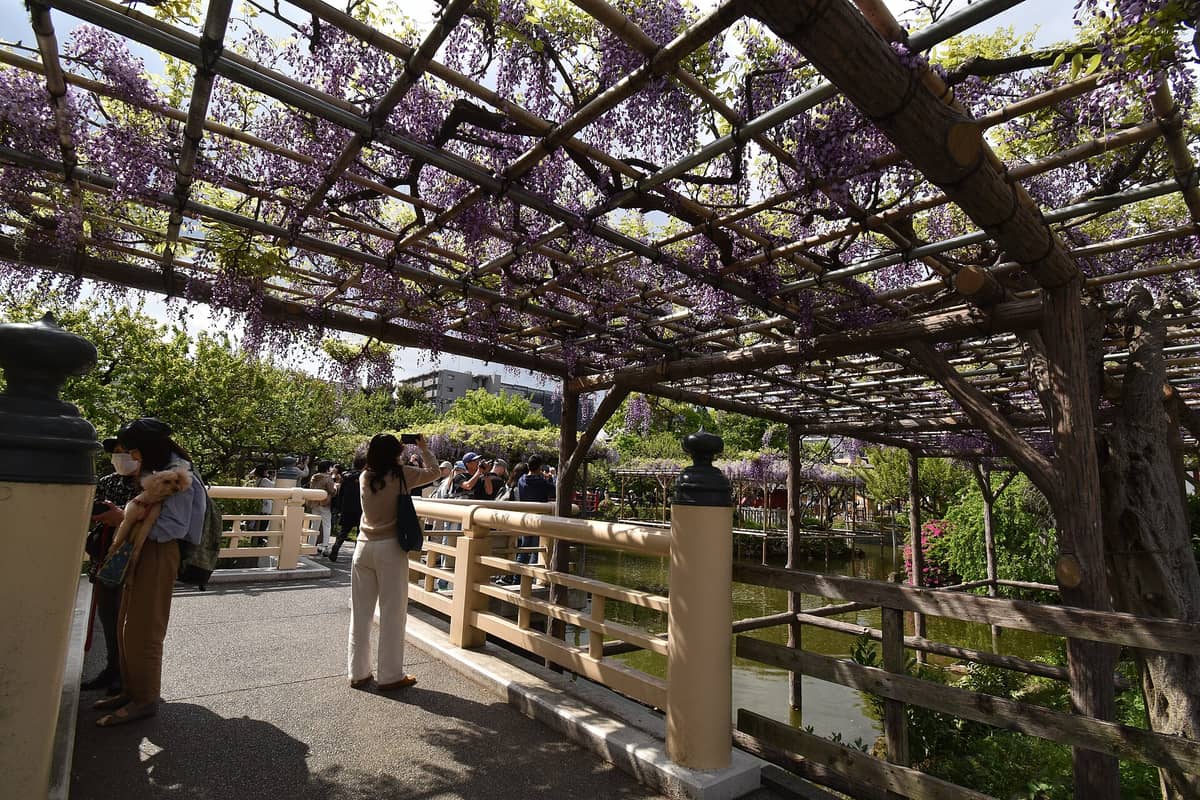
The original wooden structures were destroyed during the 1945 air raids that devastated much of eastern Tokyo. The rebuilt shrine, completed in the latter half of the twentieth century, lacks the architectural age of its Kyushu counterpart, but the grounds retain a sense of considered design that rewards slower attention. The main pond, the arched taiko-bashi (drum bridges), and the rows of wisteria trellises form a cohesive composition that feels far removed from urban Tokyo despite being just fifteen minutes by foot from busy Kinshicho Station.
💡 Local tip
Grounds are open 24 hours, but the main hall and gates open approximately 06:00–17:00. Arriving at opening lets you experience the shrine in near-silence, with mist sometimes rising off the pond before the neighborhood fully wakes up.
The Wisteria: Spectacular but Season-Specific
Kameido Tenjin's wisteria (fuji) is what draws most visitors, and the display genuinely earns its reputation. Roughly fifty wisteria plants drape over low wooden trellises on either side of the main walkway and around the central pond, creating cascading curtains of purple, violet, and white blooms that hang at eye level and below. At peak bloom, typically in late April to early May, the floral canopy is dense enough to filter the light, casting the whole approach in soft purple shadow. The scent on a still morning is intense and sweet, something between honey and grape, and the sound of bees working through the flowers adds a constant low hum.
The shrine holds an official Wisteria Festival (Fuji Matsuri) during peak bloom, and evening illuminations extend viewing hours well past the usual gates-closed time. During this period, the grounds are lit dramatically from below, which transforms the hanging clusters into something genuinely photogenic after dark. Crowds are heavier than usual during the festival, but manageable by Tokyo standards: early morning visits (before 08:00) remain relatively calm even during peak wisteria weeks.
⚠️ What to skip
Wisteria bloom timing shifts year to year depending on winter and spring temperatures. It typically falls between mid-April and early May, but can be earlier or later by a week or more. Check the shrine's official website or local bloom trackers in the weeks before your visit rather than relying on fixed dates.
If you are planning a spring visit to Tokyo around cherry blossom and flower season, the Tokyo in spring guide covers bloom timing across multiple sites and neighborhoods, which helps with scheduling around Kameido.
Tickets & tours
Hand-picked options from our booking partner. Prices are indicative; availability and final rates are confirmed when you complete your booking.
Nikko UNESCO Shrine and Nature View 1-Day Tour from Tokyo
From 78 €Instant confirmationFree cancellationMeiji Shrine, Imperial Palace, Asakusa and Tokyo Skytree Entry
From 34 €Instant confirmationFree cancellationTrip to Mt. Fuji 5th Station or Arakura Shrine, Oshino Hakkai, Onsen
From 51 €Instant confirmationFree cancellationNoh Performance, Overnight Stay, and Afuri Shrine Pilgrimage
From 429 €Instant confirmationFree cancellation
The Grounds Beyond Wisteria Season
Outside of late April and early May, Kameido Tenjin is a genuinely pleasant place to spend an hour without the crowds or the pressure of peak-season logistics. The central pond is stocked with large koi carp in orange, white, and black, which congregate near the banks with shameless expectation whenever visitors approach. The drum bridges, steep enough that ascending them requires holding the handrail, offer a clear view across the water toward the main hall. Tokyo Skytree is visible from parts of the grounds, rising above the low surrounding rooftops, which makes for an interesting visual counterpoint: Edo-period shrine geometry in the foreground, twenty-first-century broadcasting tower behind.
In autumn, the grounds shift to red and gold as maple and ginkgo trees along the perimeter change color. Winter mornings can be sharp and cold here, with frost occasionally forming on the bridge railings, but the shrine sees few visitors and the atmosphere is contemplative. Early spring brings plum blossoms before the wisteria arrives, another brief window of color worth catching if you happen to be in Tokyo in late February or early March.
For a broader look at Tokyo's Shinto shrines and how Kameido fits into the city's religious landscape, the guide to Tokyo's best temples and shrines provides useful context and helps prioritize if time is limited.
Sugawara no Michizane and the Tenjin Cult
Understanding why this shrine exists helps make it more than a pleasant garden walk. Sugawara no Michizane (845–903) was one of the most accomplished scholars of the Heian court, rising to become Minister of the Right before court rivals engineered his exile to Kyushu, where he died. A series of natural disasters and deaths among his enemies were attributed to his vengeful spirit, and the imperial court eventually enshrined him as Tenjin to appease that spirit. Over centuries, Tenjin evolved from a wrathful ghost into the benevolent deity of learning that students petition today.
The connection to wisteria is indirect but deliberate in shrine design. Kameido specifically echoes Dazaifu Tenmangu, where Michizane is said to have particularly loved plum blossoms. Kameido's founders chose wisteria as the signature plant, giving the shrine its own distinct seasonal identity while maintaining the Tenjin lineage. The wooden votive tablets (ema) sold at the shrine office are a mix of wisteria imagery and learning-focused designs, primarily purchased by students before university entrance examinations, which in Japan are high-stakes enough to generate considerable shrine traffic each winter and spring.
How to Get There and When to Go
The most straightforward route is the JR Sobu Line to Kameido Station, using the North Exit, then a fifteen-minute walk south through a quietly commercial neighborhood of small restaurants, convenience stores, and local shops. The walk itself is unremarkable but not unpleasant, passing through the kind of everyday Tokyo that most visitors never see. Alternatively, Kinshicho Station (accessible via both the JR Sobu Line and the Tokyo Metro Hanzomon Line) puts you at a similar fifteen-minute walk from the shrine, which may suit itineraries that include other stops along the Hanzomon Line.
For orientation across Tokyo's train and subway network, the getting around Tokyo guide explains how to navigate the JR, metro, and private rail systems without confusion.
In terms of time of day, early morning is the clearest recommendation regardless of season. The shrine faces east, which means the main hall and pond receive direct light in the first hours after sunrise, the bridges and lanterns photograph cleanly, and foot traffic is negligible. Midday is workable outside of wisteria festival weeks. Late afternoon is pleasant for the warm light but note the main hall closes around 17:00. The shrine grounds remain open all night, though there is little reason to visit after dark outside of festival illumination periods.
ℹ️ Good to know
Accessibility note: The shrine grounds are generally level, but the taiko-bashi drum bridges are steep with steps. Wheelchair users can view much of the garden and the pond, but the bridges are not fully accessible. Contact the shrine in advance if mobility access is a priority.
Photography and Practical Details
Kameido Tenjin rewards photographers who arrive with intention rather than those expecting instant compositions. The best single shot is from the bank opposite the main hall, with the arched bridge in the foreground and the hall behind, ideally with the Skytree visible just above the roofline to the northwest. During wisteria season, a longer lens lets you compress the hanging clusters against the hall's roof. A wide-angle lens works better for capturing the tunnel effect of the wisteria trellises at eye level along the main walkway.
No tripod restrictions are posted for general visitors, but the bridges and narrow pathways become crowded quickly during festival periods, making tripod use impractical during busy hours. As with all Japanese shrines, photograph respectfully around people engaged in prayer or ritual, and avoid photographing inside the main hall.
Admission is free. There is no charge to enter the grounds or the main hall during open hours. Visitors may purchase ofuda (amulets), ema (votive tablets), or omikuji (fortune slips) from the shrine office. There is no on-site cafe or food vendor, but the streets between the shrine and Kameido Station have several small local restaurants and a well-stocked konbini for coffee and snacks.
If you are combining Kameido with the broader east Tokyo circuit, Tokyo Skytree is a logical pairing, visible from the shrine grounds and reachable in about twenty minutes by train from Kinshicho Station.
Insider Tips
- The drum bridges are steeper than they look from photographs. Wear shoes with grip, especially if the stone is wet from rain or morning dew.
- During the Wisteria Festival illuminations, the shrine is at its most photogenic in the first thirty minutes after lights-on, before the crowd density makes clean compositions difficult.
- The neighborhood around Kameido Station has a cluster of gyoza restaurants that claim regional fame. If you are timing your visit around a meal, research the local gyoza scene before heading out.
- Ema votive tablets with wisteria or Tenjin motifs make considered, lightweight souvenirs that are specific to this shrine rather than generic Tokyo merchandise.
- Combining Kameido Tenjin with a visit to the nearby Kameido Daishi (Enjoji Temple) takes barely fifteen additional minutes on foot and gives a useful contrast between the two different religious traditions side by side in the same neighborhood.
Who Is Kameido Tenjin Shrine For?
- Photographers chasing wisteria compositions without the extreme crowds of more central Tokyo spots
- Travelers interested in Shinto religious traditions and Japanese scholar culture
- Students or parents visiting on behalf of academic prayers and exam blessings
- Visitors who want a slow, residential-Tokyo morning away from the standard tourist circuit
- Anyone building a spring flower itinerary who wants a wisteria counterpoint to cherry blossom season
Nearby Attractions
Combine your visit with:
- Akasaka Palace (State Guest House)
The State Guest House, Akasaka Palace is Japan's principal diplomatic residence and one of the few Western-style palaces in Asia open to the public. Built in neo-baroque style for the Crown Prince in the early 20th century, it now receives heads of state and, on select days, ordinary visitors. The combination of ornate gilded interiors, formal French gardens, and a Japanese-style annex makes it one of the most architecturally unusual stops in Tokyo.
- Edo-Tokyo Open Air Architectural Museum
Spread across the grounds of Koganei Park, the Edo-Tokyo Open-Air Architectural Museum rescues and reassembles more than 30 historic structures spanning the Edo period through the early 20th century. From a dismantled farmhouse to a reconstruction of a Showa-era Tokyo streetscape, it is one of the most thoughtful and undervisited cultural sites in the metropolitan area.
- Enoshima
A small island off the Shonan coast of Kanagawa Prefecture, Enoshima packs a surprising amount into a short walk: a three-part Shinto shrine, ancient sea caves, a hilltop botanical garden, a lighthouse observation tower, and seafood stalls lining a stone-paved shopping street. It works as a half-day excursion or a full day if you combine it with nearby Kamakura.
- Gotokuji Temple
Gotokuji Temple in Setagaya is a working Soto Zen Buddhist temple that happens to be one of the claimed birthplaces of the maneki-neko, Japan's iconic beckoning cat. Hundreds of white ceramic cats line the shelves of a dedicated shrine, creating one of Tokyo's most quietly striking visual spectacles. Entry is free, crowds are manageable, and the surrounding grounds offer genuine calm.