Johnny Cash Museum: The Definitive Visitor Guide to Nashville's Best Music Museum
The Johnny Cash Museum in downtown Nashville holds the world's largest collection of Johnny Cash artifacts and memorabilia, spanning his Arkansas childhood through his final recordings. Located in the SoBro district steps from Broadway, it rewards music fans with genuine depth, not just nostalgia.
Quick Facts
- Location
- 119 3rd Ave S, Nashville, TN 37201 (SoBro, Downtown Nashville)
- Getting There
- Walkable from Broadway honky-tonks (5 min); WeGo Route 18 stops nearby; rideshare drop-off on 3rd Ave S
- Time Needed
- 1.5 to 2.5 hours for a thorough visit
- Cost
- Adults $27.95 + tax; Youth (6–15) $23.95 + tax; Under 5 free. $1 off for AAA, military, seniors, and students (in-person only). Closed Thanksgiving and Christmas.
- Best for
- Country and rock music fans, American history enthusiasts, serious collectors, and first-time Nashville visitors
- Official website
- www.johnnycashmuseum.com
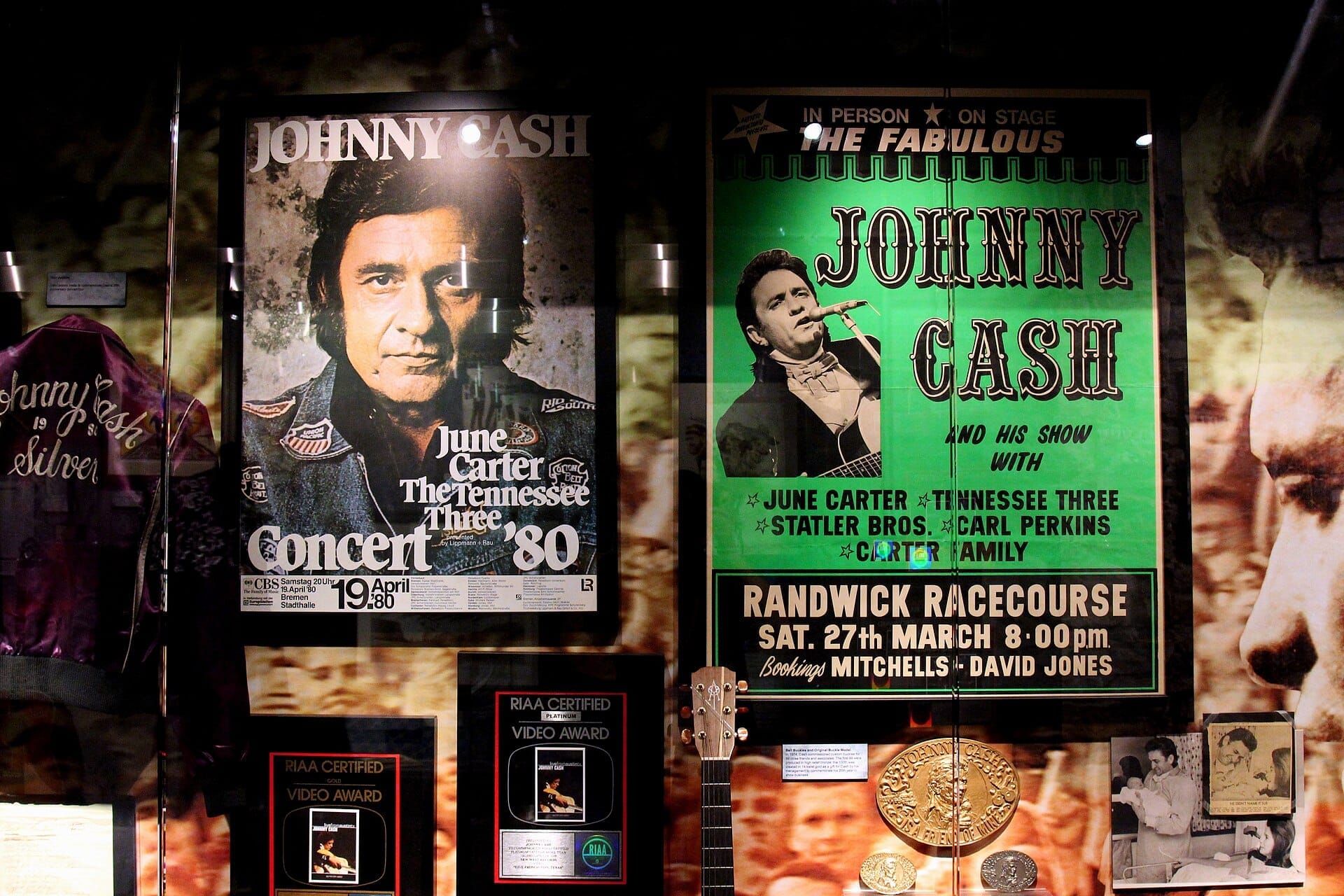
What the Johnny Cash Museum Actually Is
The Johnny Cash Museum opened in May 2013 and has since established itself as one of the most substantive single-artist museums in the United States. Located at 119 3rd Ave S in Nashville's SoBro (South of Broadway) district, the museum houses the world's largest collection of Johnny Cash artifacts, assembled by collector and founder Bill Miller over several decades. This is not a themed merchandise shop with a few framed photos. It is a serious archive: stage costumes worn during specific tours, handwritten song lyrics, original recording contracts, personal correspondence, and instruments used on landmark recordings.
The collection covers Cash's full life arc, from his childhood in Kingsland, Arkansas, through his Air Force years, the Sun Records era with Sam Phillips in Memphis, his commercial peak at Columbia, his artistic reinvention via the American Recordings series with producer Rick Rubin in the 1990s, and finally his last years. The curation is chronological and detailed enough that visitors with only passing familiarity with Cash come away understanding why he occupies such an unusual position in American culture: a country artist embraced by rock audiences, a Christian who wrote unflinchingly about darkness, a man who performed at Folsom Prison before it was fashionable to care about prison reform.
💡 Local tip
Buy tickets online in advance at johnnycashmuseum.com to avoid the ticket line during peak midday hours, especially on weekends. In-person purchases qualify for $1 off with AAA, military, senior, or student ID.
The Collection: What You Will Actually See
The exhibits are organized across multiple rooms on two floors, and the density of objects is high enough that casual browsers and deep readers experience the space at very different speeds. On the first floor, early display cases contain items from Cash's childhood and military service, including personal letters and photographs that establish him as a real person before the mythology takes over. This grounding in biography is one of the museum's strengths.
Further in, the Sun Records section displays original pressings, contracts, and photographs from Cash's sessions alongside Elvis Presley, Jerry Lee Lewis, and Carl Perkins. The original black suit costume is represented across multiple eras, with exhibition notes that trace how the iconic image became both a deliberate choice and a media invention. Stage costumes from specific concert periods are labeled with tour dates, so you understand the object's context rather than just admiring the fabric.
The American Recordings section near the end of the museum is particularly well done. It documents the Rubin collaboration with candor, including the physical and creative challenges Cash faced in his final years and the critical reception of those records. For visitors who know Cash primarily through the 'Hurt' music video, this section reframes the entire narrative. There is also a dedicated area covering June Carter Cash, which avoids the trap of treating her solely as a supporting character.
Fans of Nashville's broader music history will find useful cross-references throughout the displays. Cash's story intersects directly with the history documented at the Country Music Hall of Fame, which sits about a five-minute walk from the museum, and the two institutions complement each other without being redundant. The Cash museum goes deeper on one artist; the Hall of Fame goes wider across the genre.
Tickets & tours
Live prices and dates from our booking partner. If you book, we may earn a commission at no extra cost to you.
Old Town trolley tour of Nashville
From 54 €Instant confirmationFree cancellationHatch Show Print guided tour
From 21 €Instant confirmationFree cancellationDowntown walking tour of Nashville
From 21 €Instant confirmationFree cancellationNashville Downtown Underground Donut Tour
From 46 €Instant confirmationFree cancellation
Visiting by Time of Day: When to Go and What to Expect
The museum opens at 9:00 AM daily, and the first hour is consistently the quietest. The rooms are small and the exhibition text is detailed, so crowd density matters. At 9:00 AM, you can linger in front of display cases without people reaching around you or waiting for audio panels. The lighting inside is deliberately low throughout most of the museum to protect the artifacts, which means your eyes need a minute to adjust from the bright SoBro streetscape outside.
By 11:00 AM on weekends and during peak tourist season (late spring through summer), the main corridor fills noticeably. The bottleneck tends to form around the stage costume displays and the interactive audio stations, where visitors play clips of recordings. If you are sensitive to noise overlap from multiple audio sources running simultaneously, the late morning surge can make focused listening difficult. Arriving before 10:00 AM or after 4:00 PM solves this problem. The museum currently stays open until 7:00 PM, and late afternoon visits after the main tourist wave has moved on toward Broadway are genuinely pleasant.
⚠️ What to skip
The museum is closed on Thanksgiving and Christmas. Verify current hours at johnnycashmuseum.com before visiting on other holidays, as hours can shift seasonally.
Location and Getting There
The museum sits on 3rd Avenue South in the SoBro district, roughly halfway between Broadway and Demonbreun Street. This is one of the most walkable blocks in downtown Nashville. From the Lower Broadway honky-tonk strip, it is about a five-minute walk south. The Country Music Hall of Fame and Museum, the Schermerhorn Symphony Center, and the Music City Center convention complex are all within three blocks.
If you are coming from outside downtown, WeGo Public Transit Route 18 connects Nashville International Airport (BNA) to downtown, and most downtown bus routes converge at Music City Central on 5th Avenue. Rideshare is reliable in this area; 3rd Avenue South has easy drop-off space. Driving is possible but parking in SoBro on weekends can be expensive and congested. For a broader understanding of getting around the city, the getting around Nashville guide covers all your options in detail.
The museum is wheelchair accessible. The building has elevator access between floors, and the display areas are navigable by wheelchair. Restrooms are available on site.
Historical and Cultural Context: Why Cash Still Matters Here
Johnny Cash recorded his first sessions at Sun Studio in Memphis in 1955, initially releasing records under Sam Phillips. His early work was not straightforwardly country, and Nashville's Music Row establishment was often uneasy with him throughout his career. The paradox is that Cash is now one of the central figures in Nashville's cultural identity, celebrated by a city whose industry sometimes resisted him.
Understanding Cash's place in Nashville music history is easier with some background on the city's recording industry. Nashville's music history involves more tension and reinvention than the polished tourist narrative suggests, and the Cash museum engages with that tension honestly. His relationship with the industry, his outspoken political positions, his personal struggles with addiction, and his advocacy for prison reform are not glossed over.
The museum also situates Cash within American social history more broadly. The Folsom Prison Blues recording (1956) and the live At Folsom Prison album (1968) are given significant display space, with context about the political climate of the late 1960s. For visitors interested in Nashville's civil rights and social history alongside its music history, the museum provides more serious cultural engagement than most of the entertainment-focused attractions on Broadway.
Photography, the Gift Shop, and Practical Notes
Personal photography is permitted throughout most of the museum for non-commercial use. The low ambient lighting in the artifact rooms means smartphone cameras struggle without flash, and flash is prohibited near fragile paper documents and costumes. For the best results, use your camera's portrait or low-light mode and accept that some shots will be atmospheric rather than sharp. The museum does not prohibit social media posting of photographs taken inside.
The gift shop at the exit is well-stocked and relatively restrained by tourist attraction standards. It carries official Cash merchandise, vinyl records including reissues of the American Recordings series, books on Cash and related artists, and some exclusive museum items. It is possible to exit without walking through the gift shop, though the layout nudges you toward it.
The museum is located steps from several of Nashville's most significant music landmarks. After your visit, Hatch Show Print is a short walk away and offers a complementary perspective on Nashville's music industry through its letterpress printing history. The combination of the two makes a strong half-day itinerary for serious music history visitors.
Is It Worth the Ticket Price?
At $27.95 for adults, the Johnny Cash Museum is not cheap for a single-floor attraction that takes under three hours to cover thoroughly. The honest answer is that it depends almost entirely on your level of interest in Cash specifically, and in American music history more broadly. For fans, the depth and authenticity of the collection justify the price without question. The objects are real, the curation is careful, and there is enough material that repeat visits on different trips can yield new details.
Casual visitors who have only a surface familiarity with Cash may find the ticket price high relative to the experience. The museum does not have the scale or multi-genre breadth of the Country Music Hall of Fame, and it does not stage live performances. If you are working with a limited budget in Nashville, it makes sense to prioritize based on your genuine interest in the subject.
For those managing costs carefully, the Nashville on a budget guide outlines which attractions offer the best value and which free alternatives exist around the city. The museum does not offer free admission days, but the in-person discount for AAA, military, senior, and student visitors reduces the cost by $1.
Insider Tips
- Arrive at 9:00 AM when the museum opens. The first 45 minutes are dramatically quieter than peak midday hours, and you can read every exhibition panel without anyone crowding the display cases.
- The museum shares a block with several food and drink options. If you plan to visit the Country Music Hall of Fame the same day, start at the Cash museum in the morning and move to the Hall of Fame after lunch, since they are within easy walking distance and cover complementary material without duplicating each other.
- If you qualify for the AAA, military, senior, or student discount, you must purchase your ticket in person at the box office to apply it. Online tickets do not include these discounts.
- The American Recordings section near the end of the museum tends to get overlooked by visitors who run out of steam. Budget time specifically for it if you know Cash's later work, because the display of Rubin-era materials and the documentation of Cash's final recording sessions is the most emotionally resonant part of the collection.
- The museum's gift shop carries vinyl reissues of Cash's albums, including the American Recordings series, which can be hard to find at standard retail. If you are a record collector, factor this into your visit.
Who Is Johnny Cash Museum For?
- Country, rock, and Americana music fans with genuine interest in Cash's full career
- American history and cultural history enthusiasts, particularly those interested in mid-20th-century social themes
- First-time Nashville visitors who want depth beyond the Broadway bar strip
- Music industry professionals or students interested in the business history of American recording
- Couples or small groups looking for a focused, substantive half-day activity that is not centered on alcohol or nightlife
Nearby Attractions
Other things to see while in Downtown Nashville:
- 3rd & Lindsley
Since 1991, 3rd & Lindsley has been the venue where Nashville musicians play when they want to be heard, not just seen. Located half a mile south of Broadway in the SoBro district, it is an intimate, no-frills room that draws touring acts, local legends, and serious audiences in equal measure.
- Acme Feed & Seed
Housed in a landmark 1943 building at the corner of 1st Avenue and Broadway, Acme Feed & Seed is a multi-level bar, restaurant, and music venue with a rooftop overlooking the Cumberland River. It offers a more layered experience than the typical honky-tonk strip, with a rooftop that earns its reputation for views and a ground floor that still delivers the Broadway energy.
- Adventure Science Center
Adventure Science Center is Nashville's premier interactive science museum, offering 44,000 square feet of hands-on exhibits, a 75-foot adventure tower, and a 63-foot dome planetarium. It has served the city since 1945 and remains one of the most engaging family destinations near downtown Nashville.
- Bicentennial Capitol Mall State Park
Bicentennial Capitol Mall State Park is a free, 19-acre outdoor park in downtown Nashville built to commemorate Tennessee's 200th anniversary of statehood. Anchored by a 200-foot granite map of the state, a 95-bell carillon, and the Rivers of Tennessee Fountains, it doubles as one of the most informative and peaceful green spaces in the city center.
Planning a trip? Discover personalized activities with the Nomado app.