Japan Center Malls: The Heart of San Francisco's Japantown
Opened in 1968 as the Japanese Cultural and Trade Center, Japan Center Malls is a 5-acre complex in San Francisco's Japantown offering Japanese bookstores, restaurants, beauty shops, gift stores, and cultural events — all free to enter. It is part of one of the few remaining large-scale Japantown commercial districts in the United States.
Quick Facts
- Location
- 1737 Post Street, San Francisco, CA 94115 (Japantown neighborhood)
- Getting There
- Muni bus lines 2 Clement, 22 Fillmore, or 38/38R Geary to surrounding stops
- Time Needed
- 1.5 to 3 hours for browsing, longer if dining
- Cost
- Free entry; individual shops and restaurants priced separately in USD
- Best for
- Japanese culture, specialty shopping, ramen and boba, rainy-day exploring
- Official website
- www.japancentersf.com
What Japan Center Malls Actually Is
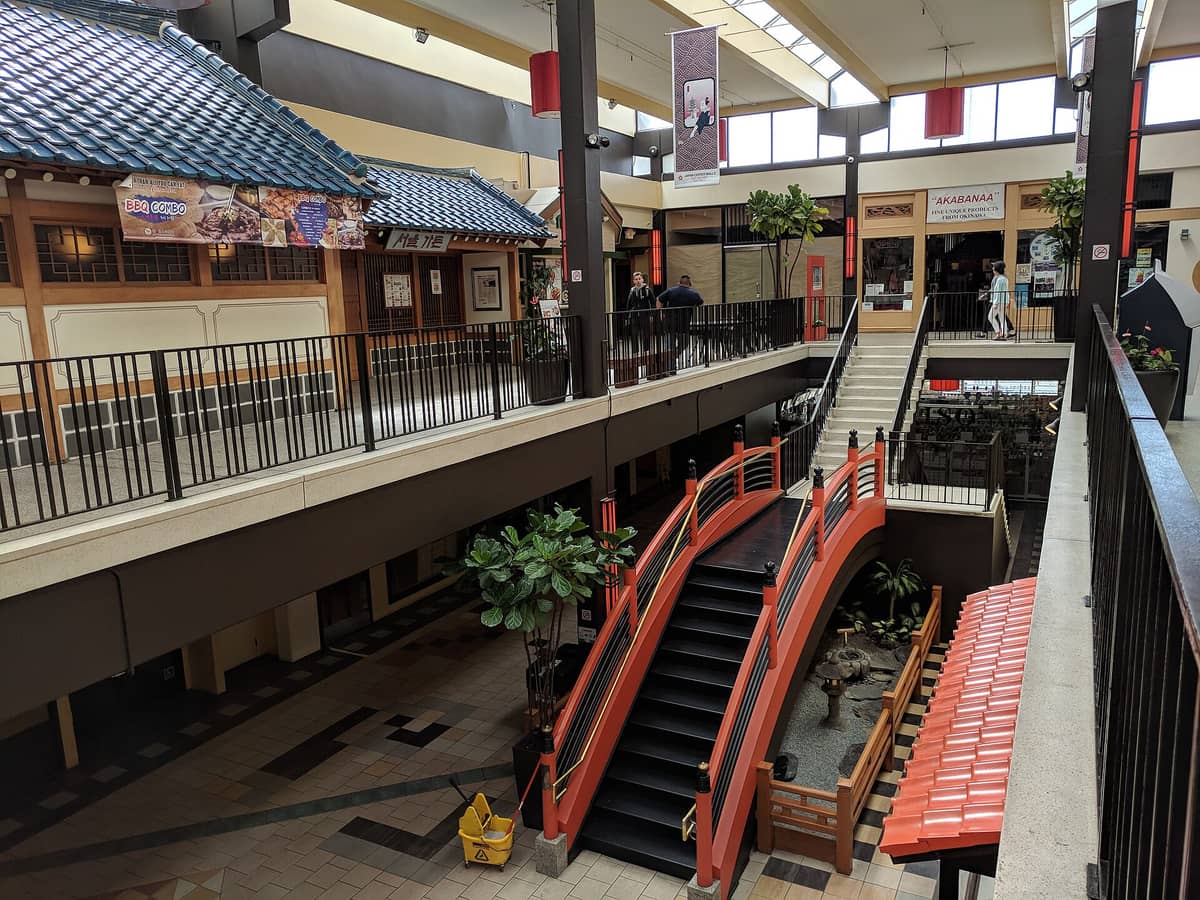
Japan Center Malls is not a typical American shopping mall. It is a multi-building, interconnected complex spanning roughly 5 acres in the heart of San Francisco's Japantown, bounded by Geary Boulevard to the south, Post Street to the north, Fillmore Street to the west, and Laguna Street to the east. Opened in March 1968 under its original name, the Japanese Cultural and Trade Center, it was conceived as both a commercial hub and a cultural anchor for one of the last major Japantown communities in the United States.
The complex comprises several connected structures, including the Kinokuniya Building, the Kintetsu (West) Mall, and the Miyako (East) Mall adjacent to Peace Plaza. What connects them is a series of indoor corridors lined with small independent shops, Japanese restaurants, beauty counters, bookstores, and specialty importers. The atmosphere is low-key and unhurried, a distinct contrast to the tourist intensity of Fisherman's Wharf or Union Square a few miles away.
ℹ️ Good to know
Mall public areas are open daily, Monday through Sunday, 8:30 am to 10:00 pm. Individual merchant hours vary, so check ahead if you have a specific shop or restaurant in mind.
The Layout: How to Navigate the Complex
First-time visitors often feel mildly disoriented. Japan Center Malls is not organized around a single atrium or obvious main entrance. Instead, it unfolds across interconnected buildings with multiple street-level access points from both Post Street and Peace Plaza. The most practical approach is to enter from Post Street, which puts you directly into the Kinokuniya Building, home to the well-stocked Kinokuniya Bookstore — a two-floor Japanese and English-language bookstore that anchors the complex and serves as a reliable internal landmark.
From there, the Kintetsu Mall corridor runs east-west, lined with shops selling everything from Japanese stationery and anime merchandise to traditional ceramics, skincare imports, and taiyaki. The Miyako (East) Mall, reachable through the interior passageways, opens onto Peace Plaza, where the five-tiered Peace Pagoda stands in the open courtyard. If you lose your bearings, walking toward the pagoda and reorienting from there works reliably.
The Peace Pagoda itself is worth a brief pause. It was gifted to San Francisco by the city of Osaka, Japan, in 1968, and was designed by architect Yoshiro Taniguchi. For a deeper look at the architectural and cultural context of the broader Japantown area, see the Peace Plaza Pagoda guide.
Tickets & tours
Live prices and dates from our booking partner. If you book, we may earn a commission at no extra cost to you.
San Francisco's Japantown self-guided audio tour
From 6 €Instant confirmationSan Francisco small group guided city tour with a stop at Alcatraz
From 158 €Instant confirmationFree cancellationSan Francisco small group guided city tour
From 119 €Instant confirmationFree cancellationSonoma and Napa Valley wine tour from San Francisco
From 127 €Instant confirmationFree cancellation
What to Expect at Different Times of Day
Weekday mornings are the quietest window. The corridors are largely empty before 11 am, which makes it genuinely pleasant for browsing the bookstore or picking up groceries at one of the Japanese food importers without competition for space. The light inside the malls at this hour is softer and the smell of freshly brewed green tea drifts out from a handful of tea shops and cafe counters.
By midday on weekends, foot traffic picks up noticeably. The ramen restaurants and Japanese curry counters develop lines, and the wider corridors around the food stalls become animated with the sound of Japanese-language conversation, children choosing from rows of ramune soda bottles, and the faint electronic sound effects from arcade crane machines near the mall entrance. This is the most lively version of Japan Center Malls, and for many visitors it is the most interesting.
Evenings, particularly Friday and Saturday, bring a younger crowd. Boba tea shops and dessert counters stay busy until close to 9 pm. The bookstore remains a draw late into the evening, especially its manga and graphic novel section. If you want the place essentially to yourself, aim for a Tuesday or Wednesday morning.
💡 Local tip
Weekend afternoons (Saturday in particular) draw the largest crowds and the longest restaurant waits. If you plan to have a sit-down meal inside the malls, arrive before noon or after 2 pm to avoid the peak rush.
What to See and Buy Inside
Kinokuniya Bookstore is the standout destination within the complex. It carries a serious selection of Japanese-language books, manga, art books, stationery, and a curated English-language section covering Japanese culture, design, cooking, and literature. Even if you do not read Japanese, the stationery and paper goods section alone is worth a long browse: high-quality washi tape, Midori notebooks, and illustrated postcards line the shelves with a precision that speaks to the Japanese retail sensibility.
Beyond the bookstore, the malls contain specialty food importers where you can find Japanese snacks, condiments, wagashi (traditional sweets), and pantry items unavailable in standard American supermarkets. Beauty and skincare shops stock Japanese cosmetics brands at reasonable prices. Several shops specialize in Japanese tableware, including lacquerware, chopsticks, and ceramics ranging from affordable souvenirs to genuinely fine pieces.
For food, options inside the malls run from quick takoyaki and taiyaki counters to full-service ramen shops, sushi restaurants, Japanese curry houses, and a shabu-shabu option. The quality across these restaurants is generally solid; Japan Center Malls restaurants serve a largely Japanese-American local clientele, not just tourists, which helps keep standards high.
Historical and Cultural Context
San Francisco's Japantown is one of only three remaining large Japantown commercial districts in the United States — the others are in Los Angeles and San Jose. At its peak before World War II, the neighborhood housed a population of around 5,000 Japanese Americans. The forced removal and incarceration of Japanese Americans beginning in 1942 devastated the community; most did not return after the war, and subsequent urban renewal programs in the 1960s displaced many who had come back.
Japan Center was built in this context, partially as an attempt to stabilize Japantown and give it a commercial and cultural anchor. That history gives the complex a weight that goes beyond retail. The community organizations, Japanese language schools, and Buddhist temples that still operate in the surrounding blocks are the living continuation of a neighborhood that survived a great deal. Shopping here carries a different meaning than shopping in a generic mall.
For broader context on San Francisco's Japanese-American community and its history, the Japantown neighborhood guide covers the surrounding area in detail.
Getting There and Practical Notes
Japan Center Malls sits in the Western Addition area of San Francisco, roughly midway between Downtown and the western neighborhoods. By public transit, Muni bus lines 2, 22, and 38/38R all stop within a short walk of the complex. The 22 Fillmore line runs along Fillmore Street, dropping passengers at the western edge of the center; the 38/38R Geary line serves Geary Boulevard along the southern boundary. From Union Square, the 38 Geary is a straightforward ride of about 15 minutes.
Parking is available in the Japan Center garage beneath the complex, accessible from Post Street. Street parking in the surrounding blocks is possible but competitive on weekends. Cyclists will find the Fillmore Street corridor has some bike infrastructure, and the neighborhood is reasonably bike-friendly by San Francisco standards.
The interior corridors are flat and accessible by stroller and wheelchair, though the complex has multiple levels in some sections. Elevator availability is not specified in public-facing materials; visitors with specific accessibility needs are advised to contact the mall office directly before visiting. Signage inside is bilingual in English and Japanese throughout.
💡 Local tip
If you are combining Japan Center with a broader Japantown walk, the surrounding streets, particularly Buchanan Street's pedestrian mall and the blocks north toward Sutter Street, have additional independent Japanese restaurants, a Buddhist temple, and small specialty shops that do not appear inside the malls.
Photography and Weather Considerations
Japan Center Malls is an indoor attraction, which makes it genuinely useful on San Francisco's gray, foggy days. The city's summers are cooler and cloudier than most visitors expect, with marine fog common from June through August. An afternoon inside the malls, followed by a meal, is a comfortable way to fill a cold or overcast day without feeling like you have wasted it.
Photography inside the mall corridors is generally unrestricted in public areas, though individual shop owners may prefer you ask before photographing their merchandise. The Peace Plaza courtyard outside the East Mall is a better photography setting, particularly in the morning when the pagoda catches clear light and the plaza is not yet crowded.
San Francisco's fog patterns and seasonal weather are covered in detail in the best time to visit San Francisco guide, which is useful if you are planning around outdoor activities alongside your Japantown visit.
Who Should Skip This Attraction
Japan Center Malls is a low-key, commercial space with cultural depth — but it is still a shopping center. Visitors expecting a traditional cultural institution with guided exhibits, dramatic architecture, or cinematic spectacle will find it underwhelming. The corridors are functional rather than beautiful, and some sections of the complex show their age. If your interest is primarily in Japanese history and culture rather than retail, the surrounding neighborhood and its temples and community organizations will be more rewarding.
Visitors with a strong interest in Japanese-American history specifically may find the context offered by neighborhood institutions more meaningful than the malls themselves. Consider pairing the visit with a walk through the surrounding Japantown streets for a more complete picture.
Insider Tips
- The Kinokuniya Bookstore on the upper level of its building stocks a rotating selection of Japanese-language art and design books that are significantly cheaper than importing the same titles — worth a look even if you cannot read Japanese, purely for the visual content.
- Several of the Japanese grocery and snack importers inside the malls sell individual Japanese snack items and onigiri that work well as a cheap, high-quality lunch if you do not want a sit-down restaurant. Look for the food counters near the Post Street entrance.
- The Japan Center garage below the complex offers validated parking through some restaurants, making a longer lunch visit more economical if you are driving. Ask your restaurant when you pay.
- The AMC Kabuki movie theater, directly adjacent to the Japan Center complex at 1881 Post Street, regularly screens Japanese films and has hosted San Francisco International Film Festival events. Check its listings if you are visiting on an evening when the malls themselves feel quiet.
- The Nihonmachi Street Fair, held annually in early August in the surrounding blocks, and the Cherry Blossom Festival in April both significantly alter the feel of the area and draw large crowds. These are excellent times to visit for cultural programming, but expect limited parking and busier restaurants.
Who Is Japan Center Malls For?
- Travelers with an interest in Japanese culture, food, and everyday retail beyond tourist-facing souvenirs
- Rainy or foggy day visitors looking for an indoor destination with genuine substance
- Families who want a browsable, low-pressure space with food options for varied tastes
- Shoppers seeking Japanese stationery, books, cosmetics, or tableware not available in mainstream US stores
- First-time San Francisco visitors who want a neighborhood experience distinct from the waterfront tourist circuit
Nearby Attractions
Other things to see while in Japantown:
- Japantown Peace Plaza & Pagoda
The San Francisco Peace Pagoda stands five tiers tall at the heart of Japantown, a reinforced concrete stupa gifted by Osaka in 1968 and designed by architect Yoshiro Taniguchi. The surrounding Peace Plaza is a free, open-air public space connecting the Japan Center malls and serving as the cultural anchor of one of the oldest Japantown communities in the United States.
Planning a trip? Discover personalized activities with the Nomado app.