Japantown Peace Plaza & Pagoda: San Francisco's Concrete Symbol of Friendship
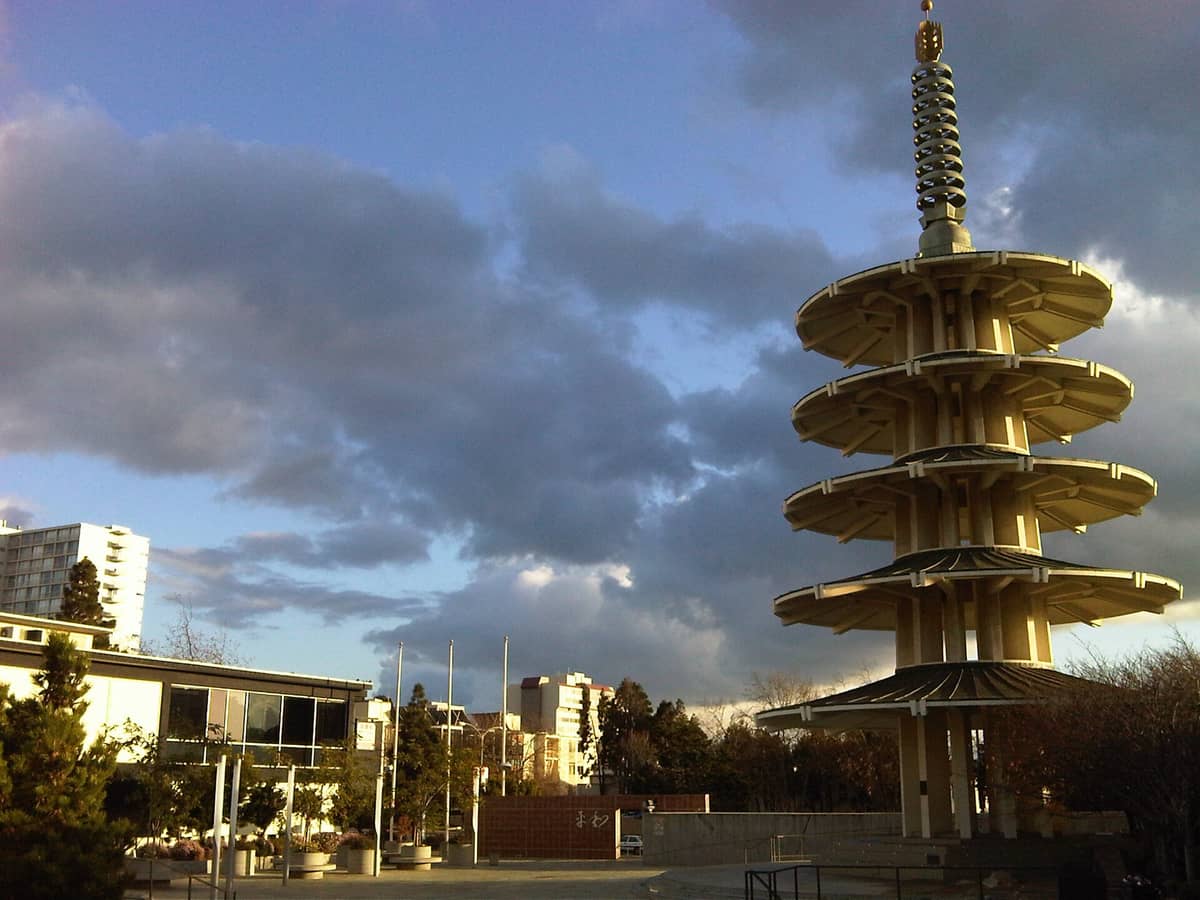
The San Francisco Peace Pagoda stands five tiers tall at the heart of Japantown, a reinforced concrete stupa gifted by Osaka in 1968 and designed by architect Yoshiro Taniguchi. The surrounding Peace Plaza is a free, open-air public space connecting the Japan Center malls and serving as the cultural anchor of one of the oldest Japantown communities in the United States.
Quick Facts
- Location
- 1610 Geary Blvd, San Francisco, CA 94115 (Japantown, between Post St & Geary Blvd along Buchanan St)
- Getting There
- Muni buses along Geary Blvd serve the area; no direct BART or Metro stop
- Time Needed
- 20–45 minutes for the plaza and pagoda; longer if exploring the Japan Center malls
- Cost
- Free — public city plaza, no admission fee
- Best for
- Architecture enthusiasts, cultural travelers, photography, quiet midday pauses
- Official website
- sfrecpark.org/1154/Japantown-Peace-Plaza-Renovation-Project
What the Peace Plaza Actually Is
The Japantown Peace Plaza and its centerpiece, the San Francisco Peace Pagoda, occupy an open-air courtyard between the two wings of Japan Center along Buchanan Street. At roughly 100 feet tall and built in reinforced concrete, the five-tier pagoda is not a religious structure in active use but a civic monument: a stupa form drawn from Buddhist architectural tradition, reinterpreted in modernist materials. It was designed by Japanese architect Yoshiro Taniguchi, formally presented to San Francisco by its sister city Osaka, and dedicated on March 28, 1968, the same day Japan Center itself opened.
The plaza functions as the living room of San Francisco's Japantown. On weekday mornings it is genuinely quiet. A handful of people cut through on their way to the malls, a few older residents sit on benches reading, and the pagoda catches whatever light is breaking through the marine layer. On weekends, especially during festivals like the Cherry Blossom Festival (typically held in April) and Nihonmachi Street Fair (August), the plaza fills with food stalls, taiko drumming, and several thousand people. The contrast between these two versions of the space is dramatic.
⚠️ What to skip
Renovation in progress: The Peace Plaza is currently undergoing a renovation and seismic retrofitting project by the San Francisco Recreation & Parks Department. Confirm current access status at sfrecpark.org before visiting.
The Architecture and the Gift Behind It
Yoshiro Taniguchi was one of Japan's most respected modernist architects in the mid-twentieth century, known for work that translated traditional Japanese spatial concepts into contemporary forms. His pagoda for San Francisco does not replicate any specific historic stupa. Instead it abstracts the layered silhouette of classical Buddhist architecture into smooth, stacked concrete rings that read differently depending on the light and the angle. Seen from Geary Boulevard looking south, the pagoda rises above the low mall rooflines with a spare, almost severe presence. Seen from inside the plaza, framed by the mall corridors on either side, it feels more intimate.
The gift from Osaka was not just ceremonial. San Francisco and Osaka established their sister city relationship in 1957, and the Peace Pagoda was the culmination of over a decade of cultural diplomacy between the two cities. The word 'peace' is deliberate, carrying weight in a country that had been at war with Japan only two decades earlier. The Japanese American community in San Francisco, which had endured forced incarceration during World War II, was still rebuilding its presence in the neighborhood when the plaza opened. The pagoda's dedication was part of that rebuilding.
For travelers interested in the broader architectural character of San Francisco, the pagoda represents an interesting counterpoint to the city's Victorian and Edwardian building stock. The San Francisco architecture guide covers both the city's signature painted Victorians and landmarks like this one that reflect mid-century international exchange.
Tickets & tours
Live prices and dates from our booking partner. If you book, we may earn a commission at no extra cost to you.
Sonoma and Napa Valley wine tour from San Francisco
From 127 €Instant confirmationFree cancellationGo City | San Francisco Explorer Pass
From 76 €Instant confirmationFree cancellationMuir Woods and Sausalito guided tour with transportation
From 82 €Instant confirmationFree cancellationSan Francisco CityPASS
From 77 €Instant confirmationFree cancellation
How the Experience Changes by Time of Day
Early morning, before 9am, is when the plaza most clearly belongs to the neighborhood. The smell of miso, grilled fish, and fresh baked goods occasionally drifts from the small restaurants and shops along Buchanan Street and inside Japan Center. The concrete of the pagoda is cool and slightly rough to the touch. Pigeons work the perimeter. If you want to photograph the pagoda without other visitors in frame, arrive between 7:30am and 8:30am.
Midday on weekdays brings a moderate lunchtime crowd from nearby offices and the mall shops. This is the most relaxed window for simply sitting and observing the neighborhood: the mix of older Nisei and Sansei residents running errands, younger families, and the occasional tourist group. The plaza's open sky becomes an asset here; Japantown's low-rise building height means you get actual sunlight, unlike the shadowed pedestrian streets of denser neighborhoods.
Weekend afternoons, especially in spring and summer, can be genuinely crowded. If you are sensitive to noise and crowds, Saturday afternoon during festival season is the version of this place to avoid, not seek out. The scale of the plaza, designed for civic gathering, handles crowds well logistically, but the contemplative quality disappears entirely.
Japantown as Context: Why the Neighborhood Matters
San Francisco's Japantown, known locally as Nihonmachi, is one of only three remaining Japantowns in the United States. At its peak before World War II, the Japanese American community here numbered around 5,000 people concentrated across about 30 blocks. Forced removal and incarceration during the war hollowed out the neighborhood almost entirely, and subsequent urban redevelopment in the 1960s, which produced Japan Center and the current plaza, displaced much of the lower-income Black community that had moved into the area during the war years. The plaza and pagoda thus sit on layered, complicated history. Understanding that context makes the Peace Pagoda more meaningful, not less. The Japantown neighborhood guide covers the community's history and current character in detail.
The Japan Center malls that frame the plaza house a mix of Japanese restaurants, tea shops, bookstores, import shops, and beauty businesses. Many are small, family-run operations that have occupied the same spaces for decades. The building itself, a 1968 complex designed by Minoru Yamasaki (the architect who also designed the original World Trade Center towers in New York), has a Brutalist quality that polarizes architectural opinion, but it creates a remarkably coherent cultural enclave within the city grid.
Getting There and Getting Around
The plaza is at 1610 Geary Boulevard, accessible from both Post Street and Geary. Muni bus lines run along Geary Boulevard and provide reasonably direct service from downtown and the Embarcadero. There is no dedicated BART or Muni Metro stop in Japantown; the closest BART is Civic Center, which is a 15-minute walk or short bus ride. Parking garages are located within the Japan Center complex with entrances on Geary and Post.
If you are visiting as part of a broader Japantown exploration, allow at least two to three hours to walk the malls, have tea or lunch, and visit the Japan Center Malls. The whole neighborhood is compact and walkable; most of what Japantown has to offer is within a four-block radius of the plaza.
The plaza is an open public space with ground-level access at both the Post Street and Geary Boulevard approaches. The current renovation includes seismic retrofitting and accessibility upgrades; specific details on ramps, tactile paving, and other accommodations after reopening should be confirmed with San Francisco Recreation & Parks.
Photography Notes and Practical Details
The pagoda's concrete finish reads best in indirect or overcast light, which San Francisco provides abundantly from June through August. Direct midday sun in September and October can bleach the texture of the concrete and create harsh shadows between the tiers. Morning golden hour in late summer and autumn is the most photogenic window. The pagoda photographs cleanest from the north end of the plaza looking south, with the Post Street entrance framing the shot. A wide-angle lens captures the full five tiers; a short telephoto isolates the upper tiers against the sky.
Bring layers regardless of the season. Even in September and October, San Francisco's warmest months statistically, the temperature can drop noticeably in the late afternoon as the marine layer pushes inland from the Pacific. The plaza is exposed and catches the wind. A light jacket in the bag is the single most useful practical precaution for any outdoor time in this city.
ℹ️ Good to know
San Francisco's warmest and clearest months are September and October, based on meteorological averages. Summer (June–August) is typically cooler and foggier than many visitors expect. Plan outdoor visits, including plaza time, accordingly.
Who Should Skip This
Travelers whose primary interests are waterfront views, Victorian architecture, or the city's famous hills will not find the Peace Plaza particularly rewarding on its own. It is not a dramatic viewpoint, not a hiking destination, and not a beach. If your San Francisco time is very limited and you are working through a tight itinerary, the plaza is better experienced as part of a Japantown afternoon than as a standalone destination. Visitors expecting an immersive traditional Japanese garden aesthetic will also be surprised: this is a modernist concrete plaza, not a landscape garden. For something closer to that experience, the nearby Japanese Tea Garden in Golden Gate Park is a different proposition entirely.
The plaza is also currently closed for renovation until fall 2026. If you are visiting before then, check with San Francisco's first-time visitor resources for current alternatives and what is accessible in Japantown during the construction period.
Insider Tips
- Arrive on a weekday before 9am for the cleanest photographs and the most authentic neighborhood atmosphere. The plaza is essentially empty at this hour and the pagoda is yours to observe at your own pace.
- Japantown still has excellent Japanese confectionery and tea shops in and around Japan Center, even after the closure of longtime Buchanan Street institution Benkyodo in 2022. Ask locals or mall staff for current mochi and manju recommendations; popular flavors still sell out by midday on weekends.
- During the Cherry Blossom Festival in April, the plaza hosts taiko drum performances that you can feel as much as hear. The deep percussion resonates against the concrete mall walls. Arrive 30 minutes early for a viewing position close to the stage.
- The Japan Center Malls connect directly to the plaza on both sides. If you are exploring on a cold or foggy day, you can spend significant time in Japantown entirely indoors, moving between the Kinokuniya bookstore, the food court, and the import shops without going back outside.
- Post Street, running along the north side of the complex, has some of the neighborhood's best small restaurants. Avoid the chain-adjacent spots inside the mall food court and look instead at the independent ramen and tonkatsu counters tucked into the building's street-level storefronts.
Who Is Japantown Peace Plaza & Pagoda For?
- Architecture and design travelers who appreciate mid-century modernist civic structures
- Cultural history visitors interested in Japanese American history and the postwar rebuilding of Nihonmachi
- Photographers looking for a concrete landmark that rewards early morning visits
- Travelers building a half-day Japantown itinerary around shopping, eating, and exploring the Japan Center
- Families with children during festival season, when the plaza hosts accessible, free outdoor performances
Nearby Attractions
Other things to see while in Japantown:
- Japan Center Malls
Opened in 1968 as the Japanese Cultural and Trade Center, Japan Center Malls is a 5-acre complex in San Francisco's Japantown offering Japanese bookstores, restaurants, beauty shops, gift stores, and cultural events — all free to enter. It is part of one of the few remaining large-scale Japantown commercial districts in the United States.
Planning a trip? Discover personalized activities with the Nomado app.