Im Viadukt: Zurich's Railway Arches Reimagined as a Market Street
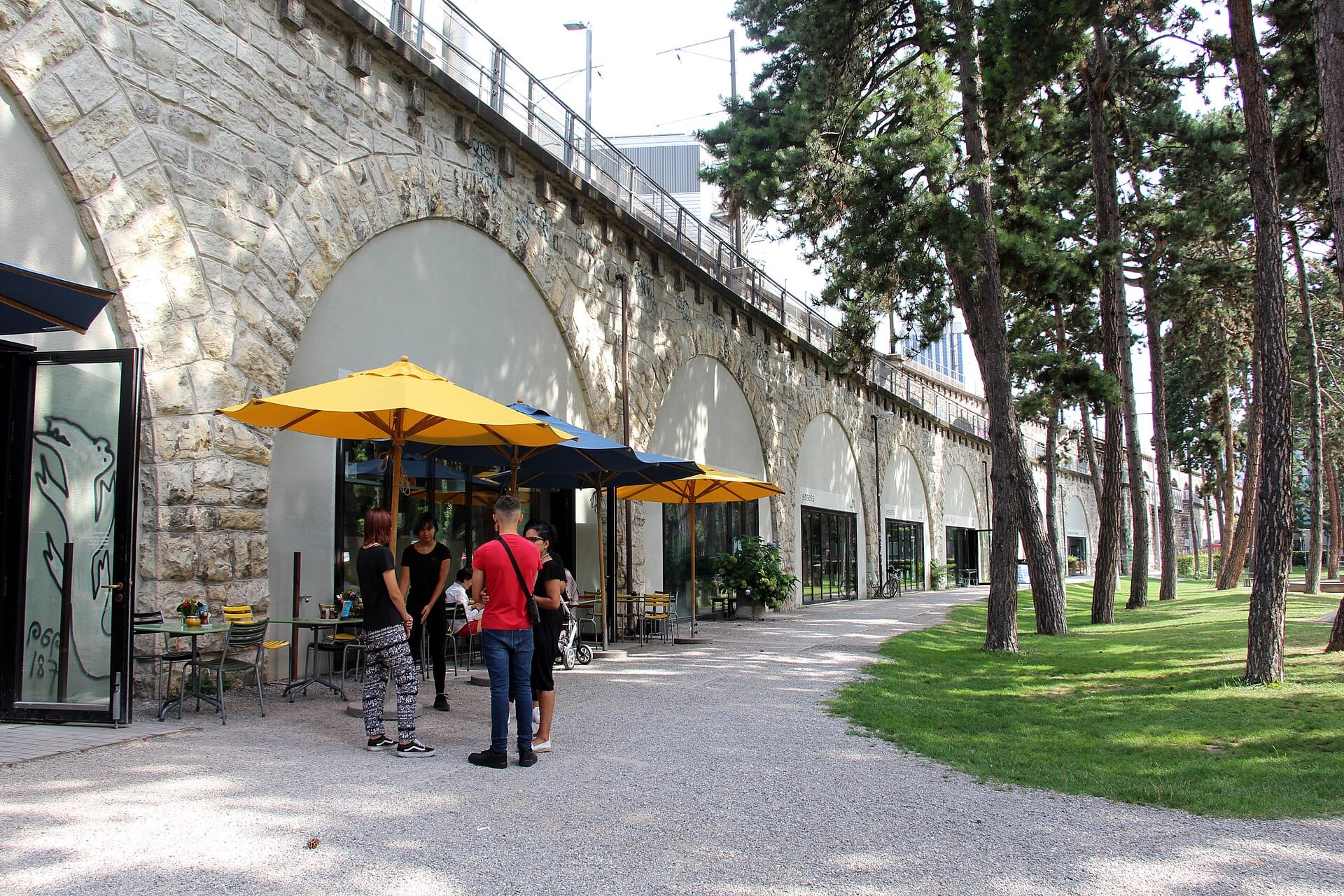
Built into the stone arches of an 1894 railway viaduct in Zurich-West, Im Viadukt stretches 500 metres through 36 arch-shaped units housing independent shops, a covered market hall, studios, and restaurants. Entry is free, the atmosphere is low-key, and it offers a grounded alternative to the city's more polished retail strips.
Quick Facts
- Location
- Viaduktstrasse 21/97, 8005 Zürich (Zurich-West / Industriequartier)
- Getting There
- Tram 4, 13, 17 to Löwenbräu; S-Bahn S3/S5/S6/S7/S9/S11/S12/S15/S16 to Zürich Hardbrücke
- Time Needed
- 45 minutes to 2 hours depending on how much you browse
- Cost
- Free to enter; individual shops and eateries priced in CHF
- Best for
- Architecture lovers, local food shoppers, design browsers, curious walkers
- Official website
- www.im-viadukt.ch/en/home/?lang=set
What Im Viadukt Actually Is
Im Viadukt is a 500-metre strip of commercial and cultural space built into the stone arches of the Aussersihler railway viaduct in Zurich-West. The viaduct itself opened on 18 August 1894, originally as industrial infrastructure carrying suburban rail lines over the Industriequartier. For over a century, the arches sat underused. The conversion, completed in the early 2010s under the management of Stiftung PWG (a Zurich housing and urban development foundation), turned approximately 36 arch-shaped units into a linear market street: independent retailers, a covered produce market, design studios, galleries, and food spots occupying spaces that are, quite literally, built into the base of an active railway bridge.
What makes this worth visiting is not the shops alone. It is the combination of raw industrial architecture, a walkable format, and an atmosphere that has stayed closer to neighbourhood convenience than tourist spectacle. Trains still run overhead. You can hear them.
ℹ️ Good to know
Opening hours for the Im Viadukt complex and market hall are Monday to Saturday, 09:00–20:00. The complex is closed on Sundays. Individual shop and restaurant hours may vary — check directly with specific outlets before visiting. Major public holidays may also mean closures.
The Architecture: Stone Arches and Active Rail
The Aussersihler viaduct is a late 19th-century masonry structure, and the arches themselves define everything about the experience of Im Viadukt. Each unit opens through a rounded stone arch, roughly uniform in width but fitted out differently by each tenant. Some shops have left the brick interior largely exposed; others have installed minimal modern fittings that contrast with the curved ceiling above. The floor plan of every unit is essentially the same: a narrow wedge running back from the arch opening, widening slightly as it goes deeper.
Standing at one end of Viaduktstrasse and looking down the length of it, the repetition of arches creates a visual rhythm that is genuinely striking. The promenade between the arch frontages and the street edge is roughly level, which makes the whole 500-metre stretch accessible without steps along the main walkway. Above, trains pass with a low rumble that fades quickly — it is background noise rather than intrusion, and it keeps reminding you that this is working infrastructure, not a heritage set piece.
The conversion is a useful reference point for anyone interested in Zurich-West's broader industrial-to-urban trajectory. The same neighbourhood contains the Schiffbau cultural venue and the former Puls 5 gas container, now repurposed as a shopping and residential complex. For context on how this district fits into the wider city, the Zurich-West neighbourhood guide covers the area's evolution in more detail.
Tickets & tours
Live prices and dates from our booking partner. If you book, we may earn a commission at no extra cost to you.
Mount Titlis snow fun for first-time skiers from Zurich
From 212 €Instant confirmationFree cancellationSwiss ski experience from Zurich
From 321 €Instant confirmationFree cancellationBest intro tour of Zurich with a local
From 116 €Instant confirmationFree cancellationZurich Old Town guided walking tour
From 27 €Instant confirmationFree cancellation
The Market Hall: The Strongest Reason to Come
The covered market hall (Markthalle) sits within the arches and is the most concentrated draw for people who live in the area. Produce stalls, cheese vendors, butchers, bakers, and specialty food sellers occupy the interior space. The selection is weighted toward quality: regional Swiss products, organic and artisan goods, and ingredients that are harder to find in a standard supermarket. Prices reflect that positioning.
Saturday mornings bring the highest foot traffic to the market hall. By around 10:00, the space fills with local shoppers who treat this as a weekly routine rather than a destination. You will hear Swiss German conversations alongside a mix of other languages, which reflects the neighbourhood's demographics. The smell at that hour is a combination of fresh bread, aged cheese, and coffee from the adjacent counters. If you want space to browse without being jostled, arriving at opening on a weekday gives a quieter version of the same goods.
💡 Local tip
If you are combining Im Viadukt with a wider Zurich-West walk, aim for a Saturday morning. The market hall is at its best, and the surrounding neighbourhood — including nearby bars and the Hardbrücke area — has a relaxed weekend pace that suits a longer stroll.
The Shops and Studios: Independent and Uneven
The retail along the arches spans a wide range. Design shops, fashion boutiques, a bicycle workshop, florists, artisan goods, and smaller studios occupy different units. The tenant mix has been deliberately kept away from chain retail, which gives the strip its character but also means quality and interest vary considerably from arch to arch. Some units are genuinely compelling: well-curated independent shops with a clear point of view. Others are modest local services that happen to be in an interesting building.
This is worth stating plainly: Im Viadukt is not a tightly edited retail concept. It is a long street of independent businesses under a railway bridge. If you arrive expecting a perfectly curated design market, the reality is more ordinary. The architecture is the consistent element; the shops themselves are as hit-or-miss as any neighbourhood high street.
Browsers with an interest in Swiss design and independent retail may also find value in the Zurich shopping guide, which covers Im Viadukt alongside other areas of the city with different retail characters.
How It Changes Through the Day
Weekday mornings before 10:00 are the quietest window. The market hall is open but uncrowded, the coffee spots are doing a slow morning trade, and the arch promenade has a calm, almost residential feel. This is when the space reads most clearly as a neighbourhood facility rather than an attraction.
Lunchtime on weekdays draws office workers from the surrounding Zurich-West district, particularly to the food vendors and the small restaurants tucked into the arches. The promenade becomes noticeably busier between roughly 12:00 and 13:30, then quiets again through the afternoon. Late afternoon on weekdays, from around 17:00 until closing at 20:00, sees another moderate surge as people stop in on the way home.
Saturdays are the most animated day across all hours from opening to mid-afternoon. After about 15:00 on Saturdays, crowd density drops and the atmosphere becomes more relaxed. Note that Sunday closures are firm — the entire complex, market hall included, is shut.
Getting There and Moving Around
The most straightforward public transport options from central Zurich are tram lines 4, 13, and 17 to the Löwenbräu stop, which places you directly adjacent to the viaduct. From Zürich Hardbrücke S-Bahn station (served by a large number of suburban rail lines including S3, S5, S6, S7, S9, S11, S12, S15, and S16), Im Viadukt is a short walk of around five to seven minutes. Bus lines 33 and 72 serve the Schiffbau and Hardbrücke stops nearby.
Walking from Zürich Hauptbahnhof is feasible and takes approximately 20 to 25 minutes on foot. The official route follows Sihlquai, Zollstrasse, Hafnerstrasse, and Josefstrasse. An alternative path goes via the Landesmuseum, along the Limmat and through Lettenviadukt — a route that adds interest if you are not in a hurry.
If this is your first time navigating Zurich by public transport, the guide to getting around Zurich explains the ZVV fare zone system and how to buy the right ticket.
The main promenade along Viaduktstrasse is level throughout, which makes the principal route through Im Viadukt step-free. Accessibility within individual arch units depends on each business's own setup and is not centrally documented. Visitors with specific mobility requirements are advised to contact the managing foundation via the official website before visiting.
Photography and Practical Notes
The arch repetition makes for a strong geometric photograph from either end of Viaduktstrasse, particularly in flat morning light when shadows are softer. The interior of the market hall is dimmer and works better with a camera that handles mixed lighting reasonably well. Individual arch frontages, with their stone surrounds and varied shopfronts, reward slower, closer photography rather than wide shots.
There is no dress code or specific gear required. Comfortable walking shoes are sensible if you are combining Im Viadukt with a longer walk through Zurich-West. In winter, the promenade is outdoors and exposed to wind along parts of its length; the market hall interior provides cover. In summer, the stone arches provide shade along the frontages, which makes the midday visit more comfortable than it might be on a fully open street.
Im Viadukt fits naturally into a half-day or full-day circuit through Zurich-West. The area around it is also covered in the guide to Zurich's less-visited spots, which includes other corners of the district that reward exploration.
Insider Tips
- The market hall at Im Viadukt is at its fullest and most atmospheric on Saturday mornings, but if you want to actually talk to vendors and browse without pressure, a Tuesday or Wednesday morning visit gives you much the same selection with a fraction of the crowd.
- Walk the full 500 metres from one end to the other before doubling back to enter the shops that caught your eye. The overall layout and the rhythm of the arches read better when you see the whole strip first rather than ducking into the first open door.
- Some of the most interesting tenants are the studios and workshops that are not primarily retail-focused. Look for units where someone is visibly working inside — these are often open to the public and willing to explain what they do.
- The Löwenbräu tram stop puts you at roughly the midpoint of Im Viadukt. If you arrive by S-Bahn at Hardbrücke, you approach from the north end. Knowing which end you are starting from helps orient you along the strip.
- Sunday is a complete closure — no exceptions have been noted for the complex as a whole. If your Zurich itinerary only allows a Sunday visit to Zurich-West, plan around other venues in the neighbourhood and skip Im Viadukt for another day.
Who Is Im Viadukt For?
- Travellers who want to see how Zurich-West has reinvented its industrial past without going to a gallery or museum
- Food shoppers looking for regional Swiss produce, artisan cheese, and fresh market goods in a non-supermarket setting
- Architecture and urban design enthusiasts interested in adaptive reuse of 19th-century infrastructure
- Independent browsing without the pressure or polish of the city's main shopping streets
- Those building a half-day walk through Zurich-West who want a natural anchor point with places to eat and stop
Nearby Attractions
Other things to see while in Zurich West:
- Langstrasse
Langstrasse is the street and quarter in Zurich's district 4 that refuses to be polished. Bars, independent shops, immigrant-run restaurants, and nightclubs line a strip that looks rough by day and comes alive after dark. It costs nothing to walk and rewards curiosity.
- Museum für Gestaltung (Design Museum)
Founded in 1875, the Museum für Gestaltung Zürich is one of Europe's most significant design museums, with a collection of over 500,000 objects across applied arts, graphic design, and posters. Split across two locations in Zurich-West, it rewards anyone with a serious interest in how objects and images shape everyday life.
- Flussbad Oberer Letten
Flussbad Oberer Letten is a 400-metre open-air river swimming channel cut into the Limmat near Zurich West, free to enter and open from May through September. Built in 1952, it draws everyone from early-morning lap swimmers to after-work sunbathers, and remains one of the most authentic summer experiences the city offers.
Planning a trip? Discover personalized activities with the Nomado app.