Howick Historical Village: Auckland's Living Window into Colonial New Zealand
Howick Historical Village in Pakuranga transports visitors into the world of Auckland's early colonial settlers, with original and faithfully reconstructed 19th-century buildings, costumed interpreters, and hands-on demonstrations. It is one of the most thoughtfully presented open-air museums in New Zealand, suited to families, history enthusiasts, and anyone curious about how the city's first European settlers actually lived.
Quick Facts
- Location
- 75 Bells Road, Lloyd Elsmore Park, Pakuranga, Auckland 2010
- Getting There
- Nearby bus stops in Pakuranga; check Auckland Transport for current routes. Car parking available on site.
- Time Needed
- 2–3 hours for a thorough visit; allow more on days with demonstrations or events
- Cost
- Adult NZD $16 | Child (5–15) $8 | Under 5 free | Senior (NZ citizen, 65+) $14 | Student (NZ ID) $14 | Family (2 adults + 2 children) $44. Special events may differ.
- Best for
- Families with school-age children, colonial history enthusiasts, rainy-day outings
- Official website
- www.historicalvillage.org.nz
What Howick Historical Village Actually Is
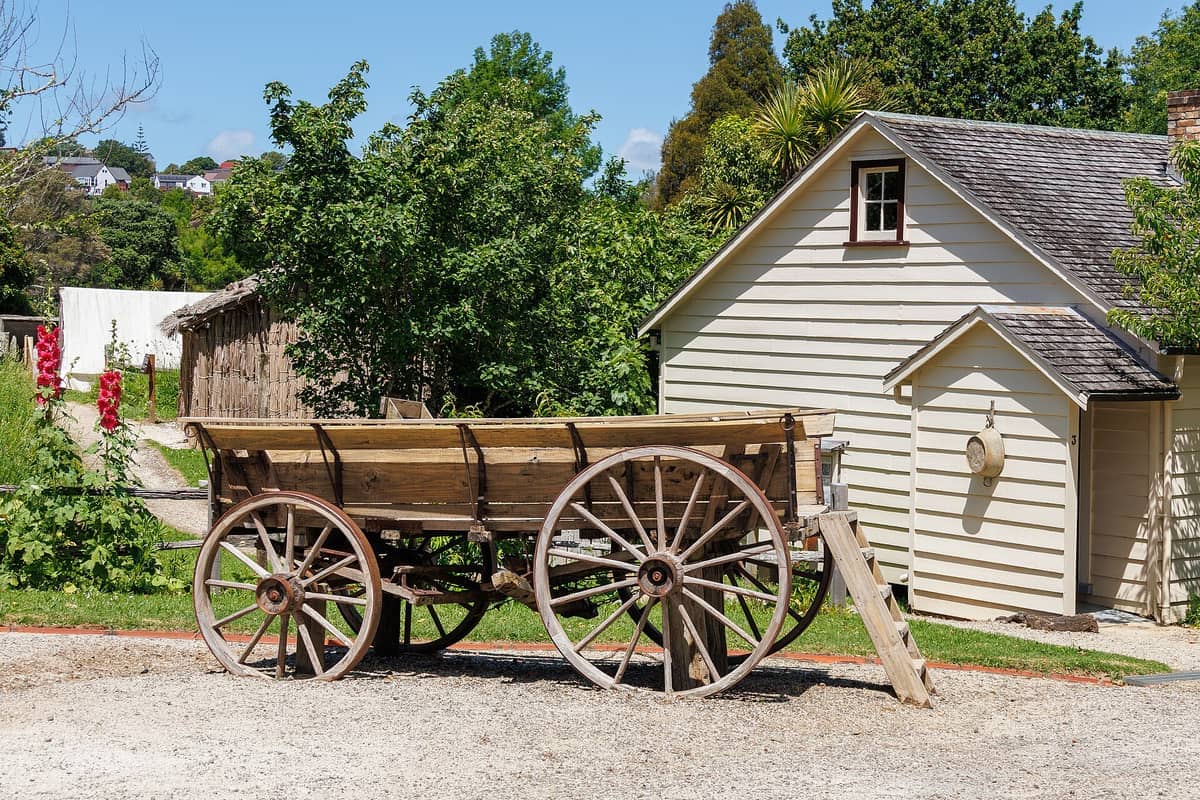
Howick Historical Village is an open-air living history museum in Pakuranga, on Auckland's eastern edge. It recreates daily life in the Fencible settlements of the 1840s through the 1880s: the period when British imperial authorities brought soldier-settlers and their families to the Auckland region to protect the early colonial town. The village occupies a green site within Lloyd Elsmore Park, and from the moment you pass through the entrance, the streetscape shifts convincingly away from the 21st century.
Unlike a conventional museum where objects sit behind glass, Howick Historical Village operates as a working environment. Buildings are furnished as they would have been used, costumed interpreters move through the grounds, and periodic demonstrations bring trades, domestic tasks, and social rituals to life. The result is a place that rewards slow, curious visitors rather than those rushing through for a quick overview.
ℹ️ Good to know
Opening hours: Tuesday to Sunday, 10 am – 4 pm. Last admission is at 3 pm. The village is closed on Mondays, Good Friday, ANZAC Day until 1 pm, Christmas Eve through Boxing Day, and New Year’s Day. Always confirm current hours at historicalvillage.org.nz before visiting.
The Fencible Settlement: Historical Context
To understand what you are looking at, it helps to know who the Fencibles were. Between 1847 and 1854, the British government recruited around 2,500 discharged soldiers and their families, offering them a cottage and an acre of land in exchange for a seven-year term of service., offering them small land grants in exchange for settling in the Auckland region and remaining available for military service when needed. These men were called Fencibles, a term for soldiers enlisted for local defensive duty rather than overseas campaigns. Four stockades were established: Howick, Onehunga, Otahuhu, and Panmure.
The Howick settlement was the largest. These were not wealthy colonists; they were working-class men and women who arrived with modest means and built a community from timber, clay, and determination. Their cottages were small, their medical resources limited, and their daily lives shaped by physical labour and close community ties. The village interprets this specific stratum of colonial society rather than the lives of the wealthy or the powerful.
This context matters when you walk through the site. The cramped interiors of the cottages are not a design choice; they reflect what ordinary Fencible families actually occupied. The kitchen gardens, the smithy, and the schoolhouse all speak to a community that was simultaneously militarised and deeply domestic.
Tickets & tours
Live prices and dates from our booking partner. If you book, we may earn a commission at no extra cost to you.
Luggage Storage in Auckland
From 5 €Instant confirmationFree cancellationNew Zealand West Coast discovery tour
From 100 €Instant confirmationFree cancellation13,000ft skydiving experience in Auckland
From 195 €Instant confirmationFree cancellationDiscover Auckland City Tour
From 88 €Instant confirmationFree cancellation
Walking Through the Village: What You Will See
The village contains a collection of original period buildings relocated to the site, alongside carefully constructed replicas. Interiors are dressed with period-appropriate furniture, tools, and household objects. The effect is convincing: the smell of old timber, the low ceilings, and the absence of modern conveniences make the scale of early colonial life immediately apparent.
Notable structures include a colonial-era church, a schoolroom, a smithy with working demonstrations on selected days, and several Fencible cottages fitted out to different periods within the 19th century. Moving between them, you get a genuine sense of how life and material culture shifted across a few decades, even within this one community.
Grounds are well maintained and pleasant to walk. There is enough open space between buildings for children to move freely, and the layout is legible enough that you do not need a map to navigate, though one is provided. On quieter days, you might find yourself alone in a cottage interior for several minutes, which gives a reflective quality the site rarely gets credit for.
💡 Local tip
Arrive closer to opening time on weekdays for the calmest experience. Weekends, especially with school groups and family events, are noticeably livelier. Both have their appeal, but the atmosphere differs considerably.
Costumed Interpretation: How It Works in Practice
The costumed guides are central to what makes Howick Historical Village more than a display of old furniture. Staff and volunteers dress in period clothing and are prepared to discuss the history of specific buildings, the daily routines of the families who lived in them, and the broader context of the Fencible era. Quality of engagement can vary depending on who you encounter and how much you prompt, but at its best the interpretation adds layers that no sign panel can replicate.
Children tend to respond well to this format. Being spoken to in a character voice by someone dressed as a 19th-century settler is more memorable than reading a caption. Parents should note that some of the historical realities discussed, such as infant mortality, colonial land conflict, and corporal punishment in schools, are handled with appropriate gravity rather than being sanitised away entirely.
Practical Walkthrough: Getting There and Getting Around
The village is located at 75 Bells Road within Lloyd Elsmore Park in Pakuranga. If you are driving, accessible parking is available in the café and visitor car parks, about 10 metres from the museum entrance. Public transport is possible via bus stops in the Pakuranga area; check getting around Auckland by public transport and use the Auckland Transport journey planner for current routes and schedules, as services can change.
The site is partially accessible. Dedicated accessible pathways and bathrooms are provided, and a wheelchair is available at no charge (booking in advance is recommended). However, some heritage buildings have steps, uneven floors, or narrow doorways that limit full access, and terrain across parts of the grounds is not entirely flat. Accompanying carers receive complimentary general admission. If mobility is a significant concern, contact the village directly before visiting so staff can advise on which areas are most navigable.
There is an on-site café where you can take a break without leaving the grounds. The surrounding Lloyd Elsmore Park provides additional green space if you want to extend time outdoors after the village itself.
Photography and Weather Considerations
The village photographs well at almost any time of day, but the warm, low-angle light of morning suits the wooden exteriors and interior window shots particularly well. Overcast conditions, which are common in Auckland's maritime climate, actually work in your favour here: diffused light reduces harsh shadows inside the cottages and on the facades of darker-toned buildings.
Rain does not make a visit impossible, and in some ways the quiet of a wet weekday adds atmosphere. That said, some outdoor demonstration areas are less enjoyable in heavy rain, and the grounds do get muddy in places. Waterproof footwear is a reasonable precaution if the forecast is uncertain.
⚠️ What to skip
Auckland's weather can shift quickly. If demonstrations or outdoor events are a specific reason for your visit, check the village's website or contact them in advance to confirm programming on your intended date.
Who Will Enjoy This, and Who Might Not
Howick Historical Village works best for people who are willing to slow down and engage. Families with primary school-age children often find it genuinely captivating, especially when demonstrations are running. History enthusiasts interested in colonial New Zealand, 19th-century social history, or architectural heritage will find plenty to examine. For those planning a wider Auckland itinerary, it pairs logically with other heritage and cultural sites; the Auckland War Memorial Museum covers a broader sweep of New Zealand history and makes a natural companion visit on a separate day.
Visitors who prefer large-scale contemporary attractions, a fast-paced schedule, or who have little prior interest in colonial history may find the pace too slow. It is not the kind of place that works on spectacle alone. Travellers with very limited time in Auckland should weigh it against the city's central waterfront and iconic viewpoints; the 3-day Auckland itinerary offers a useful framework for prioritising. Howick Historical Village is a rewarding choice if history is genuinely on your agenda, but it is not the highest-return option for a single half-day in the city.
The site is also not suited to visitors with significant mobility limitations who want full access to all buildings, given the authentic physical constraints of heritage structures. Contact the village in advance for specific accessibility guidance.
Insider Tips
- Last admission is at 3 pm, but the village closes at 4 pm. A 3 pm arrival gives you just enough time for a rushed overview; plan to arrive by 11 am or noon if you want a relaxed visit with time to explore interiors properly.
- The on-site café is a genuine pause point, not just a convenience. It is worth planning your visit around a mid-morning or lunch stop there rather than treating it as an afterthought at the end.
- Special event days, such as seasonal celebrations and school holiday programming, offer demonstrations that are not running on a typical Tuesday. Check the events calendar on the official website before booking; these days are noticeably more immersive.
- The smithy demonstrations are among the most engaging for visitors of all ages when they are running. Ask staff at the entrance which demonstrations are scheduled for your visit day so you can time your walk around the site accordingly.
- If you are travelling with seniors who hold New Zealand citizenship, If you are travelling with seniors over 65 who hold New Zealand citizenship, the discounted senior rate applies. Check with the village about acceptable proof if needed.
Who Is Howick Historical Village For?
- Families with primary school-age children looking for an educational and interactive outing
- Colonial and Victorian social history enthusiasts
- Travellers who want to understand Auckland's European settlement history beyond the CBD
- Photographers interested in heritage architecture and period interiors
- Rainy-day visitors seeking an indoor-outdoor attraction with genuine depth
Nearby Attractions
Combine your visit with:
- Auckland Botanic Gardens
Spread across 64 hectares in Manurewa, the Auckland Botanic Gardens offer free entry every day of the year, with themed garden collections, 10 hectares of native forest, and a visitor centre on site. It sits south of the city centre and rewards a longer visit than most people initially plan for.
- Auckland Zoo
Auckland Zoo has been part of the city's fabric since 1922, sitting in the Western Springs precinct with a collection that spans native New Zealand wildlife and international species. This guide covers everything from ticket prices and transit options to the best time of day to arrive and which exhibits deliver the most.
- Bastion Point (Takaparawhau)
Takaparawhau, known widely as Bastion Point, is a grassy headland in Ōrākei where Māori history, colonial conflict, and sweeping Waitematā Harbour views converge. It costs nothing to visit, carries centuries of significance, and rewards visitors who take time to understand what they are standing on.
- Bethells Beach (Te Henga)
Bethells Beach, officially Te Henga (Bethells Beach), is a raw, dramatic stretch of black-sand coastline about 45 minutes west of central Auckland. With rolling dunes, a freshwater lagoon, strong surf, and zero phone coverage, it delivers a genuine wilderness experience rare for a city of 1.6 million people.
Planning a trip? Discover personalized activities with the Nomado app.