Holy Name Cathedral: Chicago's Gothic Heart on State Street
Rising above the Gold Coast at 735 North State Street, Holy Name Cathedral has anchored Chicago's Catholic life since 1875. Free to enter, rich in history, and strikingly beautiful inside, it rewards both the devout and the architecturally curious.
Quick Facts
- Location
- 735 North State Street, Chicago, IL 60654
- Getting There
- CTA Red Line to Chicago Station (at Chicago and State)
- Time Needed
- 30–60 minutes for a self-guided visit
- Cost
- Free admission; voluntary offerings during Mass
- Best for
- Architecture lovers, history buffs, quiet reflection mid-city
- Official website
- holynamecathedral.org
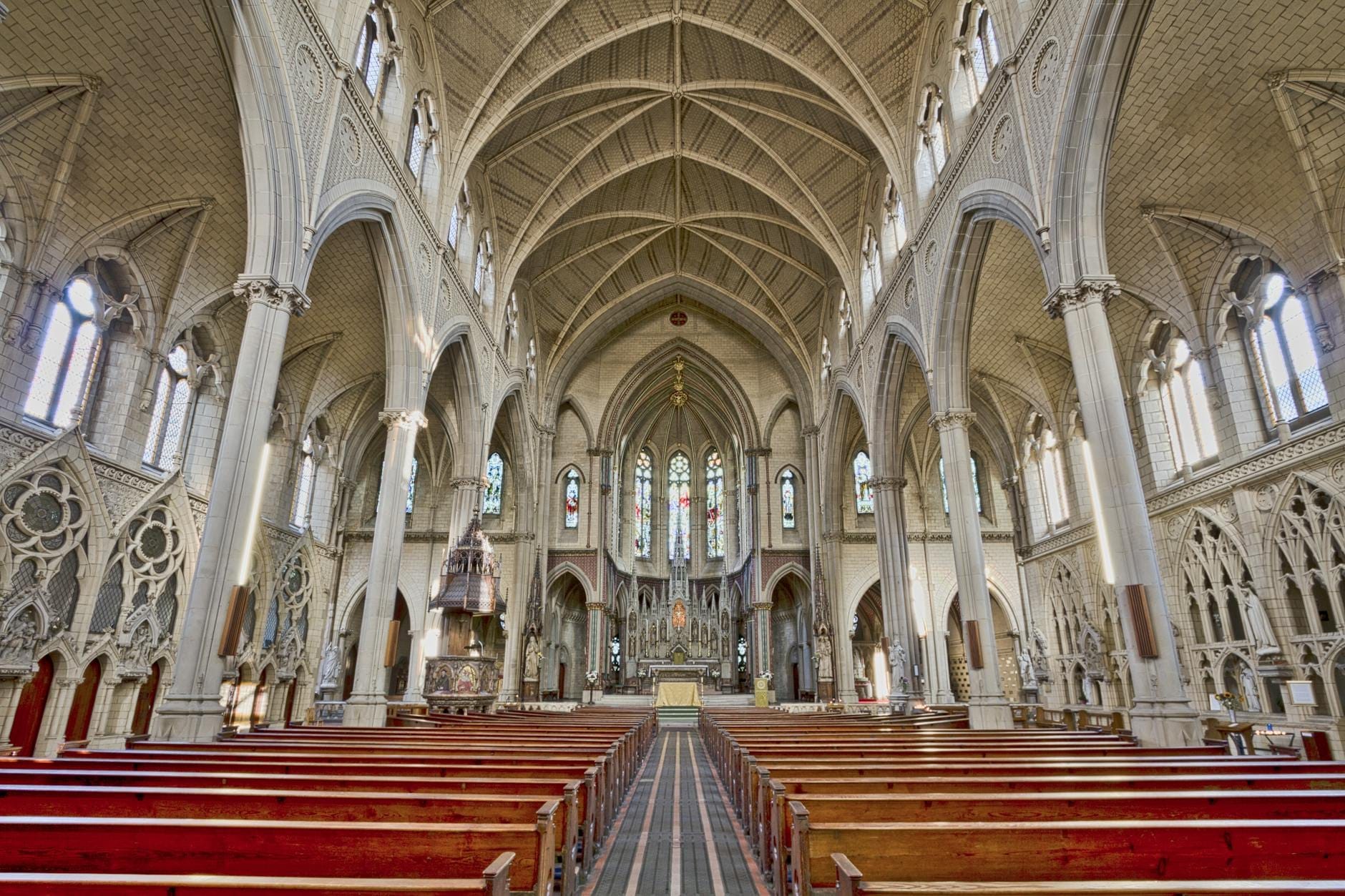
What You're Looking At
Holy Name Cathedral stands at the corner of State Street and Superior Street as one of the most architecturally commanding religious buildings in Chicago. The Gothic Revival structure, designed by architect Patrick Charles Keely, was dedicated in 1875, just four years after the Great Chicago Fire consumed its predecessor on the same site. The current building is not merely a replacement. It is a statement of institutional permanence made in stone and stained glass at a moment when the city itself was still deciding what it wanted to become.
From the street, the cathedral reads as a vertical interruption in a neighborhood otherwise defined by horizontal movement: pedestrians on the Magnificent Mile, taxis turning off Michigan Avenue, delivery trucks threading through River North. The brownstone facade, the pointed lancet windows, and the bronze doors all signal a different register of time and purpose. Step inside, and the shift is immediate. The nave is long, the ceiling vaults high, and the ambient sound of the city drops to near-silence within a few feet of the threshold.
💡 Local tip
The cathedral is an active parish, not a museum. If you arrive during or just before a scheduled Mass, wait quietly in a rear pew rather than walking the nave. The space is open to all, but the congregation takes priority during services.
The Architecture Up Close
Patrick Charles Keely was among the most prolific Catholic church architects of 19th-century America, responsible for hundreds of parishes across the northeastern United States. Holy Name Cathedral, with its cornerstone laid in 1874, represents his work at a major institutional scale. The building holds approximately 1,100 people, and on a weekday morning with only a handful of visitors present, that spatial volume becomes viscerally apparent. The nave stretches ahead of you like an invitation to slow down.
The stained glass windows are the interior's defining visual feature. Light quality changes substantially with the time of day. Morning visits, particularly on sunny days, reward visitors with warm color gradients across the stone columns as eastern light pushes through. By afternoon the effect softens, and the interior takes on a more uniform, contemplative dimness. If you have any flexibility in timing, a mid-morning visit on a clear day shows the space at its most dramatic.
The cathedral also holds a place in Chicago's architectural story more broadly. It sits within a city where religious buildings often get overshadowed by commercial towers, but Holy Name predates most of the skyline around it. For context on how this building fits into Chicago's wider built environment, the Chicago architecture guide covers the full arc from the 1871 fire rebuilding through the modernist era and beyond.
Tickets & tours
Hand-picked options from our booking partner. Prices are indicative; availability and final rates are confirmed when you complete your booking.
Go City | Chicago All-Inclusive Pass
From 127 €Instant confirmationFree cancellationiFLY Chicago Lincoln Park indoor skydiving experience
From 126 €Instant confirmationFree cancellationiFLY Chicago Rosemont indoor skydiving tickets
From 117 €Instant confirmationFree cancellationChicago lakefront neighbourhood bike tour
From 18 €Instant confirmationFree cancellation
History and Cultural Weight
The original Church of the Holy Name was a casualty of the Great Chicago Fire of October 1871, which destroyed roughly 17,000 buildings across the city. The decision to rebuild on the same site, quickly and at cathedral scale, reflected the position of the Catholic Church in post-fire Chicago: a major institutional actor in a city that was, simultaneously, the largest Catholic archdiocese in the United States by the late 19th century.
Holy Name Cathedral serves as the mother church of the Archdiocese of Chicago, meaning it functions as the seat of the Archbishop. That institutional role has made it the site of significant events in local and national Catholic life for 150 years. The cathedral celebrated its 150th anniversary in 2025, a milestone that underscores how much of the city's religious and cultural history has passed through these doors. The building has witnessed everything from immigrant parish life in the late 19th century to nationally covered ecclesiastical events in the 20th.
The surrounding Gold Coast neighborhood adds another layer of context. The area developed in the 1880s and 1890s as Chicago's wealthiest enclave, and the cathedral has stood at its edge throughout that entire period. The Gold Coast today is a mix of high-end residences, boutiques, and cultural institutions, but Holy Name Cathedral remains its most historically continuous landmark.
Planning Your Visit: Timing, Access, and What to Expect
The cathedral is generally open from 9:00 AM to 5:00 PM Monday through Friday, with Saturday hours from 8:30 AM to 6:30 PM. Sunday hours open early to accommodate the full Mass schedule. Because this is an active parish with multiple daily services, your experience will differ depending on when you arrive. Outside of Mass times, the nave is quiet and you can walk freely, sit in the pews, and observe the architecture at your own pace.
Weekday Mass times run at 7:00 AM, 8:00 AM, and 12:00 PM, with an additional 5:15 PM service on Wednesdays. Saturday Mass is at 9:00 AM, with a Vigil Mass at 5:15 PM. Sunday Masses are scheduled at 7:00 AM, 8:30 AM, 10:30 AM, 12:30 PM, and 5:15 PM. The 10:30 AM Sunday service tends to draw the largest congregation and is the most ceremonially elaborate. Arriving at 10:00 AM on a Sunday gives you a short window for quiet observation before the church fills.
ℹ️ Good to know
Hours and schedules can change on holy days and during special liturgical events. Confirm current times directly at holynamecathedral.org or call the Rectory at +1 (312) 787-8040 before visiting on a major holiday.
Getting here is straightforward. The CTA Red Line stops at Chicago Station, which puts you right at Chicago and State. From the Magnificent Mile, the cathedral is a short walk west on Superior or Chicago Avenue. Paid street parking and garages exist in the area, but traffic on State Street itself can be slow during peak hours. Transit is the cleaner option.
If you are combining this stop with other nearby architecture, the Chicago Architecture Center is a short walk south and east, near the river. It offers guided context for anyone who wants to understand the structural and stylistic decisions behind buildings like Holy Name Cathedral.
The Sensory Experience Inside
Walking into Holy Name Cathedral from State Street involves a brief transitional space before the full nave opens up. The smell is what many visitors register first: candle wax, old stone, and the faint residue of incense from recent services. These are not unpleasant smells. They are the olfactory markers of a building used continuously for worship for 150 years, and they do something that no museum exhibit can replicate: they situate you in an ongoing human practice.
The acoustic environment is equally distinctive. The stone surfaces reflect sound in ways that make even quiet footsteps audible across the nave. Whispered conversation carries farther than expected. During services, the choir and organ fill the space completely. On a quiet Tuesday morning, you might hear nothing but the faint sound of traffic muffled by the thick walls, and an occasional cough from another visitor three rows ahead. That stillness, in a city this loud, is genuinely unusual.
Photography is possible but should be handled with discretion. The interior is dim enough that you will need to raise your ISO or use a slow shutter speed. A wide-angle lens captures the nave length effectively. Avoid flash photography at all times. The stained glass photographs best when backlit by direct sunlight, which typically means morning visits on the east-facing windows and afternoon for the west.
Honest Assessment: Who Will Love This, and Who Might Not
Holy Name Cathedral is not a spectacle. It will not produce the same immediate visual impact as, say, looking down from a glass-floored observation deck or watching the kinetic energy of a major festival. What it offers is subtler: a sense of scale and continuity, an interior that rewards attention, and a piece of Chicago history that is genuinely free, genuinely accessible, and genuinely worth 30 minutes of your time.
Travelers who are primarily interested in secular sightseeing and have limited time in the city may find that other stops take priority. If you are working through a tight one-day schedule, the cathedral is best treated as an add-on to a walk along the nearby Magnificent Mile rather than a standalone destination requiring a special trip.
Visitors who are uncomfortable in religious spaces, or who arrive during a service expecting a museum experience, may feel out of place. The cathedral is open and welcoming, but it is an active church first. That distinction matters practically. Conversely, visitors who appreciate religious architecture, have an interest in 19th-century Chicago history, or simply want 20 minutes of quiet in a beautiful building will find it more rewarding than its relatively low profile on tourist itineraries might suggest.
⚠️ What to skip
Dress modestly when visiting. There is no enforced dress code, but shoulders and knees covered is appropriate out of respect for the active congregation. Loud conversation and phone calls should be avoided inside the nave.
Insider Tips
- The 12:00 PM weekday Mass draws a mixed crowd of downtown office workers, neighborhood regulars, and occasional tourists. Arriving at 11:45 AM on a weekday gives you a few minutes of relative quiet in the nave before the midday congregation arrives, then the option to stay for the service itself.
- The bronze doors at the main entrance are worth close inspection before you step inside. The detailing rewards the kind of slow looking that most visitors skip in their hurry to reach the interior.
- If you visit on a clear morning between roughly 9:00 AM and 11:00 AM, position yourself midway down the left side of the nave and look back toward the entrance. The light from the upper west windows creates a glow that photographs and reads in person at its best during this window.
- The cathedral is one block from the Red Line Chicago stop, making it an easy addition to a walking route that begins at the Magnificent Mile and continues south toward the Loop. Factor in 30 minutes and it adds historical depth to what might otherwise be a purely commercial stretch.
- For specific accessibility questions (wheelchair access, hearing loop availability, accessible restrooms), call the Rectory directly at +1 (312) 787-8040 before your visit rather than assuming. The cathedral's website does not publish detailed accessibility information.
Who Is Holy Name Cathedral For?
- Architecture and design enthusiasts interested in 19th-century Gothic Revival work
- History-focused travelers exploring post-Great Fire Chicago
- Visitors who want a free, quiet counterpoint to the commercial energy of the Magnificent Mile
- Catholic travelers who want to attend Mass in the seat of the Archdiocese of Chicago
- Photographers looking for dramatic interior light and stained glass
Nearby Attractions
Other things to see while in Gold Coast:
- Charnley-Persky House
Built in 1891-1892 and designed by Louis Sullivan with a young Frank Lloyd Wright, the Charnley-Persky House is one of the most consequential small buildings in American architectural history. Now the headquarters of the Society of Architectural Historians, this National Historic Landmark in Chicago's Gold Coast opens its doors for docent-led tours twice a week.
- Oak Street Beach
Oak Street Beach is one of Chicago's most centrally located public beaches, sitting at the foot of the Gold Coast with unobstructed views of the downtown skyline across the water. Free to enter and accessible by CTA, it draws everyone from early-morning swimmers to sunset-watchers well into the evening.
- Richard H. Driehaus Museum
Housed in the 1883 Samuel M. Nickerson Mansion two blocks west of the Magnificent Mile, the Richard H. Driehaus Museum is Chicago's most immersive window into Gilded Age domestic life. Ornate carved stone, stained glass, and room after room of period-authentic decorative arts create an experience that goes far beyond a typical house museum.