Hie Shrine: Tokyo's Hilltop Sanctuary in the Shadow of Parliament
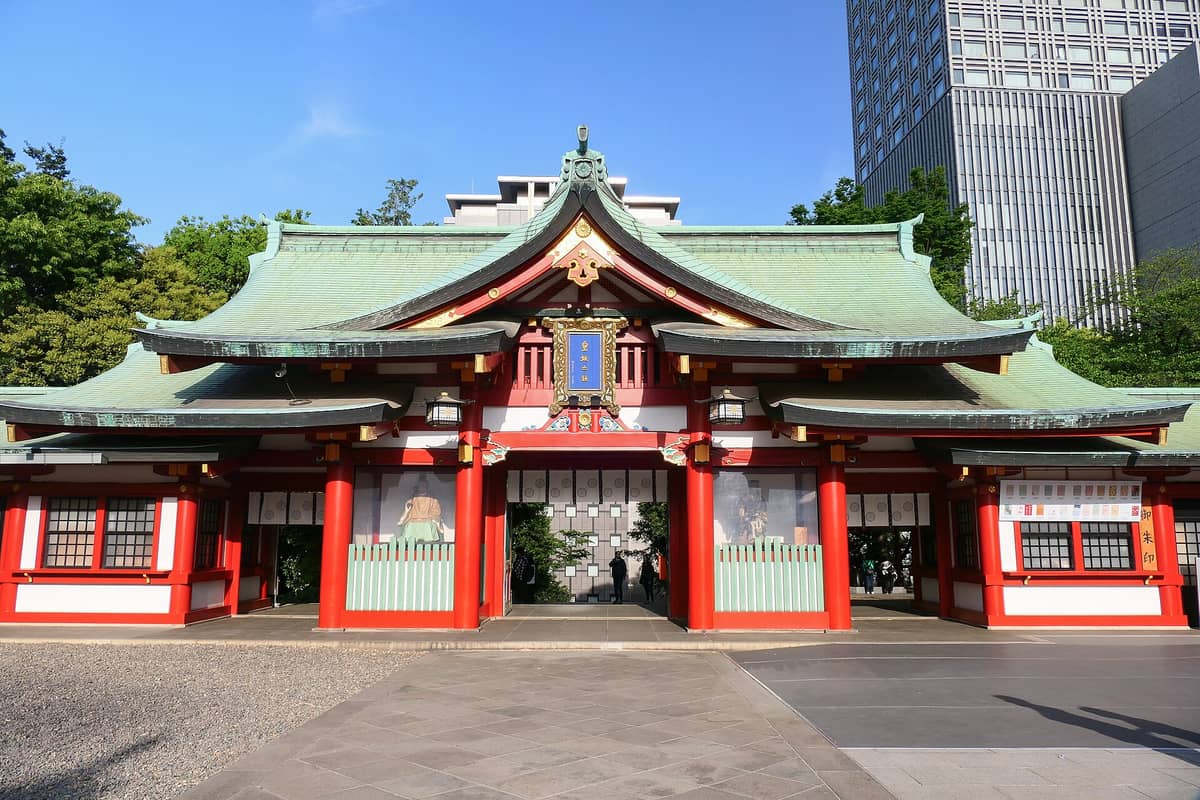
Hie Shrine (Hie Jinja) is a Shinto shrine in Nagatacho, Chiyoda, tucked between Japan's National Diet Building and the hotels of Akasaka. Its forested hillside, dramatic rows of torii gates, and free admission make it one of the most rewarding shrine visits in central Tokyo, particularly for travelers who want atmosphere without the crowds of Meiji Jingu.
Quick Facts
- Location
- 2-10-5 Nagatacho, Chiyoda-ku, Tokyo
- Getting There
- Kokkaigijidomae Station (Chiyoda Line), approx. 5 min walk; Akasakamitsuke Station (Ginza/Marunouchi Lines), approx. 8 min walk
- Time Needed
- 30–60 minutes
- Cost
- Free (shrine grounds and treasure hall; separate fees apply for prayers and rituals)
- Best for
- Shinto culture, quiet reflection, torii gate photography, escaping the business district
- Official website
- www.hiejinja.net
What Hie Shrine Is, and Why It Matters
Hie Jinja sits on a low wooded hill in Nagatacho, one of Tokyo's most politically charged districts. The National Diet Building stands within walking distance. Cabinet offices and foreign embassies line the surrounding streets. In the middle of all that concrete authority, the shrine's mossy stone steps, towering cedar trees, and the smell of incense feel genuinely startling.
The shrine is dedicated to Oyamakui-no-kami, a deity associated with mountain protection and, by extension, the protection of the capital and those who govern it. Historically, it served as the tutelary shrine of Edo Castle, which meant the Tokugawa shogunate maintained close ties with it. That political dimension is still tangible: you'll often see suited officials passing through on their lunch hour, pausing to clap twice before the main hall. It's a small but striking reminder that Shinto practice is woven into daily life in ways that go well beyond tourism.
The shrine was founded in 1478 and was relocated to its current hilltop site in the Edo period, cementing its role as a protector of the city. For context on how shrines like this fit into Tokyo's religious landscape, the guide to Tokyo's best temples and shrines is a useful reference.
The Torii Tunnel: What You're Actually Seeing
The feature most visitors photograph is the sen-bon torii, a covered walkway of close-set vermilion torii gates that lines the escalator approach on the eastern side of the hill. The gates are smaller than those at Kyoto's Fushimi Inari, but the effect is similar: a tunnel of red-orange wood that compresses perspective and filters afternoon light into something otherworldly.
Each gate in the passage was donated by a business or individual, with the donor's name carved into the base in black characters. This practice reflects the deeply practical side of Shinto devotion: offerings in exchange for blessings, a transaction that has continued here for centuries. The escalator running alongside the torii is a more recent addition, installed to make the hilltop accessible from the Sanno Park Tower side. It's useful but slightly surreal, a hydraulic escalator rising beneath arches of red wood.
💡 Local tip
The torii tunnel photographs best in the morning, when slanted light cuts through the gaps between gates. By noon, the light flattens. The escalator runs during regular opening hours but check the eastern entrance before relying on it.
Note on accessibility: the main stone staircase approach is steep and uneven, and is not suitable for wheelchair users or those with limited mobility. The escalator route offers an alternative, but the shrine's own signage and at least one accessibility guide note that the torii-gate area itself may still present challenges. If mobility is a concern, check current conditions before visiting.
Tickets & tours
Hand-picked options from our booking partner. Prices are indicative; availability and final rates are confirmed when you complete your booking.
Nikko UNESCO Shrine and Nature View 1-Day Tour from Tokyo
From 78 €Instant confirmationFree cancellationMeiji Shrine, Imperial Palace, Asakusa and Tokyo Skytree Entry
From 34 €Instant confirmationFree cancellationTrip to Mt. Fuji 5th Station or Arakura Shrine, Oshino Hakkai, Onsen
From 51 €Instant confirmationFree cancellationNoh Performance, Overnight Stay, and Afuri Shrine Pilgrimage
From 429 €Instant confirmationFree cancellation
The Main Grounds: Layout and Atmosphere
The shrine's upper compound is compact but well-organized. The haiden (oratory) and honden (main hall) sit at the top of the main stone staircase, framed by a pair of monkey figures rather than the more common komainu lion-dogs. Monkeys are considered messengers of this shrine's deity, and you'll spot them repeatedly across the grounds: carved into stone, painted on ema votive boards, and hanging as small wooden charms at the prayer hall.
The main hall itself is a post-World War II reconstruction, rebuilt in 1958 after the original was destroyed in the 1945 air raids. The architecture follows the traditional Gongen-zukuri style, with the oratory and sanctuary connected under a single unified roof, finished in copper that has weathered to a green-grey patina. It's not as visually dramatic as some of Kyoto's great shrine halls, but the proportions are clean, and the surrounding trees give it a calm that larger, more tourist-heavy shrines often lack.
Hie Shrine is also the home of the Sanno Matsuri, traditionally counted as one of the three great festivals of Edo and one of Tokyo's most significant recurring events. Held in mid-June in even-numbered years, it features a procession of portable mikoshi shrines and costumed participants that winds through the streets of central Tokyo. If your visit falls in June, check whether the festival is scheduled. The Tokyo summer festival guide has further detail on timing and routes.
How the Experience Changes by Time of Day
Early morning, from opening at 6:00 until around 8:00, the shrine has a quality that is hard to find elsewhere in central Tokyo. Salarimen in dark suits stop to pray on their way to Nagatacho offices. An elderly woman sweeps fallen leaves from the stone path with a bamboo broom. The incense smoke from the prayer hall hangs low in cool air. There are rarely more than a handful of visitors at this hour, and the contrast between the absolute stillness inside the compound and the city waking up just beyond the trees is striking.
By mid-morning, particularly on weekends, tourist numbers increase. The torii escalator entrance sees the most traffic. Weekend afternoons can feel genuinely crowded near the photography spots, though the grounds are large enough that you can usually find a quieter corner near the back of the compound. Weekday afternoons are noticeably quieter, with clusters of tourists arriving from the nearby Akasaka and Nagatacho hotel district.
ℹ️ Good to know
The shrine opens daily at 6:00 and closes at 17:00. The shrine office operates on separate hours (approximately 8:00–16:00), and the treasure hall is generally open 9:00–16:00. Grounds admission is free throughout the year.
Getting There and the Walk from the Station
The closest single station is Kokkaigijidomae on the Chiyoda Line, from which the shrine is about a 5-minute walk. The Ginza and Marunouchi lines both stop at Akasakamitsuke, roughly 8 minutes away on foot. From Akasaka Station on the Chiyoda Line, the walk is also around 8 minutes. Nagatacho Station on the Yurakucho and Hanzomon lines is accessible but typically requires about 10 minutes of walking.
The walk from Akasakamitsuke takes you through the outer edges of Akasaka, past a mix of convenience stores, small ramen shops, and the back entrances of large hotels. It gives a useful sense of the neighborhood's dual identity as a luxury hotel district and a practical commuter zone. Coming from Kokkaigijidomae, you pass directly below the Diet Building grounds, which adds a specific kind of atmosphere to the approach, particularly if you're interested in Tokyo's political geography.
Hie Shrine fits naturally into a half-day that also takes in the Imperial Palace grounds, which are about 15 minutes on foot through Nagatacho. The two sites together offer a concentrated look at the intersection of political and religious authority in Japan.
Photography, Practical Details, and What to Bring
The torii tunnel is the most photographed element, and it works best when largely empty. That means arriving before 8:30 on weekdays or well before 9:00 on weekends. A wide-angle lens or the standard setting on a smartphone captures the compression effect reasonably well. The approach stairs leading up from the main south entrance are also worth photographing: lined with stone lanterns, flanked by trees, they have the classic appearance of a major Edo-period shrine without the crowds of Naritasan or Ueno's Toshogu.
There are no food or drink vendors inside the grounds. The nearest convenience stores are back toward Akasakamitsuke Station. Restrooms are available inside the compound. Dress code is not enforced at the entrance, but the same respectful norms that apply at any Shinto shrine are appropriate: bow slightly when passing through a torii gate, do not touch the main hall doors, and follow the handwashing protocol at the temizuya ablution fountain if you choose to use it.
If you want to extend the day into a broader exploration of Tokyo's shrine culture, the Tokyo walking tour routes include several itineraries that connect Chiyoda shrines with the surrounding garden districts.
Who Might Not Enjoy This Shrine
Travelers looking for the scale and drama of Meiji Jingu, or the historic weight of Senso-ji in Asakusa, may find Hie Shrine modest by comparison. The main hall is a postwar reconstruction, the grounds are not large, and there is no surrounding garden or extended forested path. If your primary interest is architectural grandeur or immersive natural scenery, other Tokyo shrines will serve you better.
The steep staircase approach is a real barrier for anyone with mobility difficulties, and while the escalator provides an alternative, it is not a complete substitute for full access across the grounds. Visitors should assess this before making the trip specifically for the torii tunnel, which requires some steps to navigate properly.
Insider Tips
- The monkey motif is easy to miss if you arrive focused on the torii gates. Look for the koma-saru (carved monkey guardians) flanking the main hall steps instead of the usual lion-dogs. They're one of the most distinctive features of the shrine and most visitors walk past without noticing.
- The escalator on the eastern hillside approach is free and open during shrine hours. If you're visiting with someone who has difficulty with stairs, this is the practical entrance route. It deposits you near the top of the torii passage rather than the bottom, so the visual effect runs in reverse.
- Sanno Matsuri, held in mid-June during even-numbered years, is one of Tokyo's oldest procession festivals. The routes and scale are significantly larger than most visitors expect from a shrine of this size. Arriving a day early to see the preparations is worth the effort.
- The ema votive boards near the prayer hall are painted with monkey imagery specific to this shrine. They make a more distinctive souvenir or photograph than the generic ema boards sold at larger tourist shrines.
- Combining Hie Shrine with the nearby Akasaka district in the evening makes for an efficient itinerary. The shrine closes at 17:00, and Akasaka's restaurants and izakayas are well placed for a meal immediately after. The two areas are close enough that you won't lose time in transit.
Who Is Hie Shrine For?
- Travelers interested in Shinto culture who want a real neighborhood shrine experience rather than a tourist-oriented one
- Photographers looking for torii gate imagery without the crowds of Fushimi Inari or the distances involved in leaving central Tokyo
- Anyone combining a visit to the Imperial Palace area or Diet Building with a cultural detour
- Early risers who want a meditative start to the day before the city's noise takes over
- Visitors exploring Tokyo's political and historical geography, where sacred and governmental space overlap
Nearby Attractions
Combine your visit with:
- Akasaka Palace (State Guest House)
The State Guest House, Akasaka Palace is Japan's principal diplomatic residence and one of the few Western-style palaces in Asia open to the public. Built in neo-baroque style for the Crown Prince in the early 20th century, it now receives heads of state and, on select days, ordinary visitors. The combination of ornate gilded interiors, formal French gardens, and a Japanese-style annex makes it one of the most architecturally unusual stops in Tokyo.
- Edo-Tokyo Open Air Architectural Museum
Spread across the grounds of Koganei Park, the Edo-Tokyo Open-Air Architectural Museum rescues and reassembles more than 30 historic structures spanning the Edo period through the early 20th century. From a dismantled farmhouse to a reconstruction of a Showa-era Tokyo streetscape, it is one of the most thoughtful and undervisited cultural sites in the metropolitan area.
- Enoshima
A small island off the Shonan coast of Kanagawa Prefecture, Enoshima packs a surprising amount into a short walk: a three-part Shinto shrine, ancient sea caves, a hilltop botanical garden, a lighthouse observation tower, and seafood stalls lining a stone-paved shopping street. It works as a half-day excursion or a full day if you combine it with nearby Kamakura.
- Gotokuji Temple
Gotokuji Temple in Setagaya is a working Soto Zen Buddhist temple that happens to be one of the claimed birthplaces of the maneki-neko, Japan's iconic beckoning cat. Hundreds of white ceramic cats line the shelves of a dedicated shrine, creating one of Tokyo's most quietly striking visual spectacles. Entry is free, crowds are manageable, and the surrounding grounds offer genuine calm.