Hallerbos: Inside Belgium's Famous Blue Forest
Hallerbos, known informally as the Blue Forest, is a 555-hectare ancient woodland roughly 20 km south of Brussels. Each spring, a carpet of wild bluebells transforms the forest floor into an electric violet-blue display that draws photographers and walkers from across Europe. Outside bluebell season, the forest remains open year-round as a free, quiet escape from the city.
Quick Facts
- Location
- Hogebermweg (P1), 1500 Halle, Belgium — approx. 20 km south of Brussels city centre
- Getting There
- Train to Halle station (SNCB/NMBS from Brussels-Midi), then approx. 3 km on foot or by bike; car access via Ring R0/E19, Exit 21 (Halle)
- Time Needed
- 2–4 hours for a full walk; half a day if combining with the forest museum
- Cost
- Free admission; parking fees may apply at designated car parks
- Best for
- Spring nature photography, family walks, seasonal day trips from Brussels
- Official website
- www.hallerbos.be/en
What Hallerbos Actually Is
Hallerbos is a managed public forest of nearly 555 hectares in the municipality of Halle, about 20 km south of Brussels in the Belgian province of Flemish Brabant. The Brussels-Capital Region ends well before the forest begins, but for most visitors arriving from the city, Hallerbos functions as the most accessible large ancient woodland in the wider Brussels area.
The forest is divided into multiple management zones: roughly 100 hectares are designated as a formal forest reserve, and a separate 5-hectare parcel, De Duling, is protected as a nature reserve. The remainder is managed by the Flemish Agency for Nature and Forest (ANB).
The forest is famous for one thing above all others: the annual flowering of wild common bluebells (Hyacinthoides non-scripta) that carpet the forest floor, typically in April and early May. This spectacle has made Hallerbos internationally recognizable, and during peak bloom it draws serious crowds. If you are visiting Brussels in late April and have any interest in the natural world, combining a visit to Hallerbos with a walk through the Forêt de Soignes closer to the city gives a strong sense of the green belt surrounding the Belgian capital.
ℹ️ Good to know
The bluebell bloom window is narrow — typically 2 to 3 weeks in April, occasionally extending into early May. Exact timing shifts depending on winter temperatures. Check the official Hallerbos website (hallerbos.be) in March for bloom forecasts before planning your visit.
The Bluebell Season: What to Expect
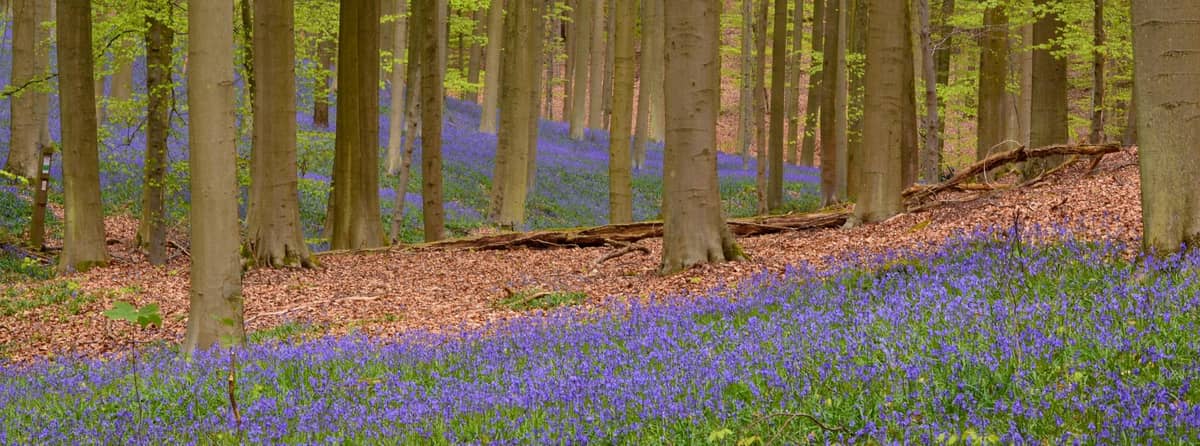
When the bluebells are at full bloom, the visual effect is genuinely striking. Under a high beech canopy whose leaves are just beginning to unfurl, the forest floor turns a dense, almost luminous violet-blue from ground level to as far as you can see between the trunks. The smell is sweet and faintly floral but not overwhelming. Underfoot, the path is typically soft and slightly damp, with leaf litter and exposed beech roots requiring some care.
On weekday mornings, particularly early, the atmosphere is calm. By 10 or 11 am on weekends during peak bloom, the main trails fill up noticeably. By early afternoon on a sunny Saturday, the parking areas and popular path junctions are genuinely congested. If you want the forest to yourself, arrive before 8:30 am on a weekday, ideally mid-week. Photographers often arrive at dawn to catch low light filtering through the beeches.
The official site notes that during bluebell season, Vlasmarktdreef is closed to traffic and Parking 2 is not accessible by car. The recommended car parks are 1a and 1b. Parking 4 is reserved exclusively for visitors holding a disabled person's card. These restrictions are enforced and the approach roads can back up significantly on weekends.
⚠️ What to skip
Stay on marked paths during bluebell season. The fragile root network of bluebells is easily damaged by foot traffic, and trampling the flowers to get a better photograph destroys the very display you came to see. Wardens are present during peak periods.
Tickets & tours
Hand-picked options from our booking partner. Prices are indicative; availability and final rates are confirmed when you complete your booking.
Ghent tour from Brussels
From 43 €Instant confirmationFree cancellationTablet Workshop at Choco-Story Brussels
From 45 €Instant confirmationShared tour of Delft and the Keukenhof Estate from Brussels
From 86 €Instant confirmationFree cancellationOrigins of Brussels exploration game and tour
From 10 €Instant confirmationFree cancellation
Hallerbos Outside Bluebell Season
The bluebell spectacle gets all the attention, but Hallerbos is worth visiting at other times of year if you want a quieter walk in mature woodland without the crowds. The beech trees, some of considerable age, create a dense green canopy from late spring through summer. In autumn, the forest floor turns amber and copper, and the light through the beeches in October is genuinely good for photography of a different kind.
In winter, the forest is bare and very quiet. Paths can be muddy after rain, and the absence of leaf cover reveals the underlying structure of the woodland more clearly. Birdwatchers find winter useful for spotting species that are harder to see when foliage is dense. There are no facilities to speak of beyond the parking areas and the forest museum, so come prepared with food and water regardless of season.
For day-trip planning from Brussels, Hallerbos pairs well with a visit to the nearby town of Halle and its Gothic basilica, or you can extend the day by exploring other green spaces around the Belgian capital. The Bois de la Cambre in Brussels itself offers a very different experience — manicured and urban rather than wild — but gives a sense of the contrast between city parkland and genuine ancient forest.
Getting There from Brussels
By car, Hallerbos is the most straightforward option for families or groups. Take the Ring Road (R0) or E19 motorway and exit at Junction 21 (Halle). From there, follow signposting to the Hallerbos car parks. The drive from central Brussels is around 25 to 35 minutes under normal traffic, longer on weekend mornings during peak season when approach roads slow considerably.
Without a car, the most practical public transport option is the SNCB/NMBS train from Brussels-Midi station to Halle. From Halle station, the forest is accessible by bus to the official entrances: TEC bus 114 to Vlasmarkt, De Lijn bus 2 to Lembeek Congo, or De Lijn bus R55 to Hallerbosstraat. Renting a bike locally or bringing a foldable one is a practical approach for visitors not renting a car.
💡 Local tip
If you plan to drive during peak bluebell season, check the official Hallerbos website the night before for parking and access updates. Roads to the forest can back up by 9 am on sunny weekends in late April. An early weekday visit avoids nearly all of these issues.
Trails, the Forest Museum, and Practical Walkthrough
Multiple marked walking routes thread through Hallerbos, ranging from short loops of around 3 km to longer circuits covering 8 km or more. There is no single 'main trail,' but the routes from Parking 1a and 1b lead directly into the densest sections of bluebell growth. The forest floor terrain is mostly flat to gently undulating, making it accessible for most walkers in reasonable footwear.
The Forest Museum (Bosmuseum) at Vlasmarktdreef 4 provides context on the ecology and management history of Hallerbos. It is worth a stop if you have children with you or want a deeper understanding of why this forest developed its unusual bluebell density, which is linked to the ancient and relatively undisturbed nature of the soil and root systems here.
An ecoduct crosses the E19 motorway and connects the forest across the road divide. The official site confirms this crossing is accessible to both walkers and cyclists, which extends the navigable area of the forest considerably. Bring a printed or downloaded trail map; mobile coverage can be patchy in the denser sections of the woodland.
Hallerbos sits within a broader region of notable day trips accessible from Brussels. If you are exploring the green countryside south of the city, Gaasbeek Castle and its parkland is approximately 10 km to the northeast and makes a logical combination for a full day out.
Photography Tips and Practical Details
The most photogenic light in Hallerbos during bluebell season is in the first two hours after sunrise, when low-angle rays filter horizontally between beech trunks and the bluebells catch the light from the side. Overcast days actually serve photography well here: diffuse light prevents harsh shadows and allows the blue-violet color to render more accurately on camera than in direct midday sun, which pushes the hues toward a cooler, washed-out tone.
Wear waterproof footwear regardless of forecast, especially in April. The forest floor retains moisture and morning dew makes even well-maintained paths slippery in places. Layers are advisable: early mornings can be cold under the canopy even when the day warms up significantly by afternoon.
There are no food stalls, cafes, or facilities within the forest itself. A few vendors sometimes operate near the parking areas during peak season, but this cannot be relied upon. Bring sufficient water and snacks, particularly if walking with children.
Hallerbos is an appealing addition to a broader Brussels nature and day-trip itinerary. For context on what else the wider region offers, the day trips from Brussels guide covers a range of half-day and full-day options including Hallerbos alongside other destinations south and west of the city.
Who Should and Should Not Visit
Hallerbos during bluebell season is genuinely worth the trip from Brussels for anyone with an interest in landscape photography, natural ecology, or simply spending time in one of the most visually dramatic woodland settings in northwest Europe. It is also very good for families with children who can walk a few kilometers: the flat terrain and visual spectacle keep young visitors engaged.
If you are visiting Brussels outside of late April to early May and have limited time, Hallerbos is harder to prioritize. The forest is pleasant but not exceptional in summer or winter compared to other accessible green spaces. Similarly, visitors with limited mobility should note that while some paths are firm and relatively even, the forest is not uniformly accessible and the disabled parking restriction during peak season requires specific card documentation.
Those who dislike crowds should approach with realistic expectations during the peak bluebell window. On a sunny weekend in late April, Hallerbos is popular with bus tour groups, large families, and organized photography groups simultaneously. It is not a quiet retreat on those days, whatever the Instagram posts suggest.
Insider Tips
- Check the bloom forecast on hallerbos.be in the first week of April before committing to travel dates. The peak window can shift by up to two weeks depending on spring temperatures, and visiting a week too early or too late means you may see very little color at all.
- The ecoduct over the E19 motorway is underused by most visitors who stick to the main parking areas. Crossing it extends your walk into a quieter section of the forest that sees significantly less foot traffic, even at peak times.
- Arrive by 8 am on weekdays during peak season if you want path junctions to yourself. By 10 am, the most photogenic sections near Parking 1a fill with visitors. The difference in experience between early morning and late morning is dramatic.
- A foldable bicycle brought on the Halle train makes the forest far more accessible without a car and lets you loop through multiple sections efficiently. Cycling within the forest on permitted paths also means you can visit two or three distinct bluebell clearings in the time most visitors spend on a single circuit.
- The forest museum at Vlasmarktdreef 4 is closed to car access during bluebell season as the road is restricted to traffic. Factor this into your route planning if you want to include it, and check current access arrangements on the official website before visiting.
Who Is Hallerbos Forest (Blue Forest) For?
- Spring nature and landscape photographers seeking a dramatic seasonal subject within easy reach of Brussels
- Families with young children looking for a manageable, free half-day walk in genuine woodland
- Hikers and cyclists based in Brussels who want to combine public transport with an outdoor day trip
- Visitors to Brussels in late April who want a contrast to the city's urban and architectural attractions
- Birdwatchers and wildlife enthusiasts, particularly in winter when the bare forest makes observation easier
Nearby Attractions
Combine your visit with:
- AfricaMuseum Tervuren
Set in a grand neoclassical palace 14 km east of Brussels, the AfricaMuseum is one of Europe's largest museums dedicated to Central Africa. Reopened in 2018 after a five-year renovation, it now confronts its own colonial past head-on while housing world-class natural history, ethnographic, and art collections.
- Basilica of the Sacred Heart (Koekelberg)
The National Basilica of the Sacred Heart in Koekelberg is one of the largest Art Deco religious buildings in the world, its green copper dome rising 89 metres above Brussels. Entry to the basilica is free; a paid climb to the dome platform delivers one of the city's most underrated panoramas.
- Cantillon Brewery (Brasserie Cantillon)
Cantillon Brewery (Brasserie Cantillon) is one of the few remaining traditional lambic breweries in Brussels, doubling as the Brussels Museum of the Gueuze since 1978. Located a short walk from Gare du Midi in Anderlecht, it is a working industrial site and a serious destination for anyone wanting to understand why Belgian beer culture earned UNESCO recognition.
- Comic Strip Route (Mural Trail)
Brussels' Parcours BD is a free, self-guided trail of more than sixty large-scale comic murals painted on building walls across the city. Created in 1991, it turns the streets themselves into an open-air gallery celebrating Belgium's most distinctive art form. No ticket required, no opening hours to check.