H'ART Museum Amsterdam: World-Class Exhibitions in a 17th-Century Landmark
Housed in the historic Amstelhof on the Amstel river, H'ART Museum brings major international exhibitions to Amsterdam's Plantage district. Formerly Hermitage Amsterdam, it reinvented itself in 2023 as an independent venue partnering with institutions across the globe.
Quick Facts
- Location
- Amstel 51, Plantage, Amsterdam
- Getting There
- Tram 14 or Metro 51/53/54 to Waterlooplein, exit Waterlooplein
- Time Needed
- 1.5 to 2.5 hours depending on the exhibition
- Cost
- Adults €22.50 | Under 18 free | CJP/Student €15 | I amsterdam City Card: free
- Best for
- Art lovers, architecture fans, and travelers with a serious museum agenda
- Official website
- www.hartmuseum.nl/en
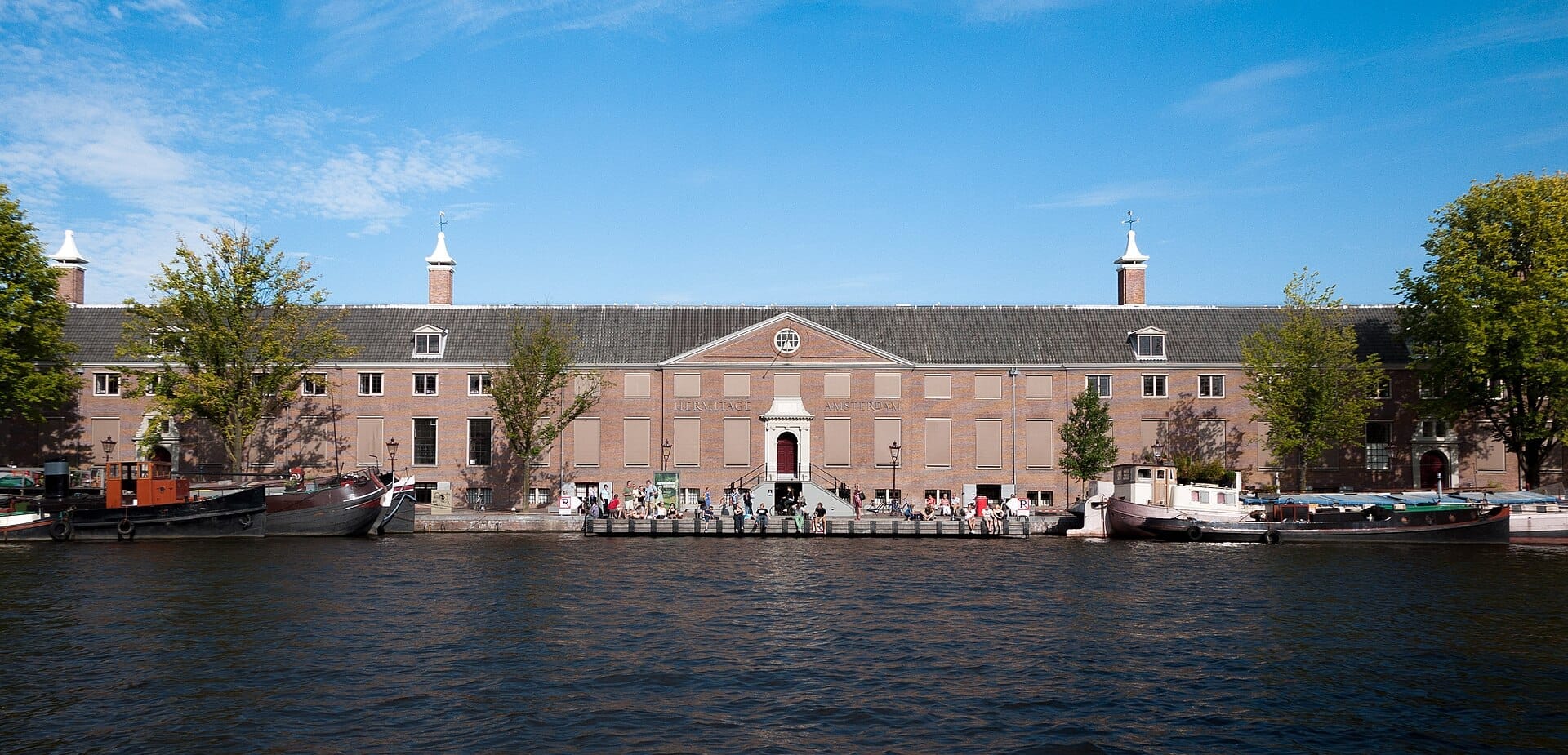
What Is H'ART Museum?
H'ART Museum occupies one of the most historically charged buildings on the Amstel river. The Amstelhof, a 17th-century almshouse originally built to shelter elderly women, spent three centuries as a care institution before being repurposed as a cultural venue. When it opened in 2009 under the name Hermitage Amsterdam, it operated as a satellite of the State Hermitage Museum in St. Petersburg, staging loan exhibitions from that collection. After Russia's invasion of Ukraine in February 2022, the partnership was severed, and the museum later relaunched under its current identity: H'ART Museum, an independent Amsterdam institution that now builds collaborations with major cultural organizations worldwide, including the Centre Pompidou in Paris.
The name is deliberate. The 'H' references both the building's history and the city, while 'ART' signals the new mission. The apostrophe connects them. It is a rebranding with a genuine philosophical shift: instead of drawing from one partner collection, H'ART now assembles thematic exhibitions from multiple sources, combining works from different institutions around a single curatorial idea. The result is programming that feels genuinely international and, exhibition by exhibition, unpredictable in the best way.
ℹ️ Good to know
H'ART Museum is open daily 10:00–17:00. The museum is closed on Kingsday (27 April).
The Building: Amstelhof and What Makes It Unusual
The Amstelhof was constructed in the 1680s as a hofje, a courtyard complex funded by the city and private donors to house and care for elderly Calvinist women. Its scale is exceptional for a building of that type: the complex extends around an enormous interior courtyard, and the Amstel-facing facade stretches across a significant length of the riverbank. From across the water, particularly in the early morning before tourist traffic builds, the building reads as one of the most imposing 17th-century structures in Amsterdam's city centre.
Inside, the proportions feel deliberate and serious. High ceilings, plain Dutch brick, and large windows create a calm that works well as an exhibition space. The architecture does not compete with the art. Exhibition galleries occupy former residential wings, and the central courtyard, enclosed and glassed over in the modern renovation, provides an atrium that serves as the social heart of the museum: a place to pause between galleries, consult the exhibition map, or simply sit.
Travelers with an interest in Amsterdam's architectural layers should note that the Amstelhof is one of the few buildings in the city where you can read the original hofje typology at large scale. For context on the city's wider architectural story, the Amsterdam architecture guide covers how this period of civic building shaped the urban fabric.
Tickets & tours
Live prices and dates from our booking partner. If you book, we may earn a commission at no extra cost to you.
Jewish Museum and Portuguese Synagogue entrance ticket
From 20 €Instant confirmationFree cancellationAdmission ticket for Artis Royal Zoo and Micropia
From 39 €Instant confirmationFree cancellationUltimate Red Light District party pub crawl
From 25 €Instant confirmationFree cancellationJewish Cultural Quarter and House of Gassan tour
From 23 €Instant confirmationFree cancellation
What to Expect Inside: Exhibitions and Experience
H'ART does not maintain a permanent collection in the conventional sense. Every exhibition is temporary, built around loans and partnerships. This means the experience on any given visit depends entirely on what is showing. Before you go, check the current program on the official website. Some exhibitions are survey-scale, covering a major artist or movement across multiple rooms. Others are more focused, pairing works from two or three institutions around a shared theme. Both formats have appeared since the relaunch.
The galleries are spacious, and crowd density rarely becomes uncomfortable except on weekend afternoons. On weekday mornings, particularly between 10:00 and 12:00, the building is notably quiet. Natural light enters through the courtyard glass and through gallery windows, which changes the quality of the viewing experience across the day. Works that appear flat and cool in morning light can read quite differently by mid-afternoon. If the exhibition includes light-sensitive works, some rooms may have controlled dimming regardless of the time.
💡 Local tip
Visit on a weekday morning for the most comfortable experience. Weekend afternoons bring school groups and organized tours that can slow circulation through smaller gallery rooms.
The museum's audio guides and exhibition texts are available in Dutch and English, and the quality of interpretation is generally high. Curatorial texts avoid the jargon that can make contemporary art venues feel exclusionary. If you want depth, the texts reward careful reading. If you prefer to move through intuitively, the spatial sequencing of the galleries usually provides enough visual logic to follow without text.
Getting There and Navigating the Neighborhood
The museum sits on the east bank of the Amstel at Amstel 51, a short walk from Waterlooplein. Tram 14 and Metro lines 51, 53, and 54 all stop at Waterlooplein; use the Hortusplantsoen exit. From the stop, the walk to the museum entrance takes roughly five minutes along the river. The route is flat and straightforward.
Arriving by bicycle is entirely practical. The area has standard Amsterdam cycling infrastructure, and the museum is reachable from most central neighborhoods in under fifteen minutes. Nearby parking garages for visitors arriving by car include Stadhuis/Muziektheater, Waterlooplein, and Markenhoven. Disabled parking spaces are available and can be reserved in advance by contacting the museum with a valid disability parking permit.
The surrounding Plantage district rewards time on foot before or after a museum visit. The Hortus Botanicus is within easy walking distance, as is the Artis Amsterdam Royal Zoo. The area has a quieter character than the canal ring, and the streets along the Nieuwe Herengracht and the Plantage Middenlaan are genuinely pleasant to walk.
Accessibility and Practical Details
H'ART Museum is fully wheelchair accessible. All exhibition rooms and public facilities are on accessible routes, the building has three public elevators, and there are three accessible toilets. Wheelchairs and walkers can be reserved in advance by email. Two reserved disabled parking spaces are available near the entrance; booking requires a valid disability parking permit and prior contact with the museum.
The museum accepts the I amsterdam City Card, the Amsterdam City Card via Go City, the Museum Pass (Museumkaart), the VriendenLoterij VIP-KAART, Uitpas, Stadspas, and ICOM membership for free or discounted entry. If you are planning a multi-museum day in Amsterdam, the Museumkaart in particular pays for itself quickly.
For visitors considering which card to use across a broader Amsterdam itinerary, the Amsterdam City Card guide compares the main passes against typical museum admission costs.
Photography, Timing, and What the Visit Actually Feels Like
Photography policies vary by exhibition and depend on the loan agreements in place for individual works. As a general rule, personal photography without flash is permitted in most H'ART exhibitions, but specific rooms or works may be restricted. Signage inside the galleries is clear on this. The courtyard atrium is always available for photography and provides good natural light for architectural shots.
The museum's cafe is located in or adjacent to the courtyard and is a reasonable place to break between exhibition sections. The shop near the exit carries catalog editions tied to current exhibitions, which are sometimes produced in partnership with the lending institutions and not easily found elsewhere.
Who might not enjoy this museum: travelers looking for a permanent collection they can return to across multiple visits will find the format frustrating, since there is no fixed reference point. Similarly, visitors expecting a survey of Dutch Golden Age painting or specifically Amsterdam-focused history will not find it here. Those needs are better served by the Rijksmuseum or the Amsterdam Museum. H'ART is for visitors who are interested in international contemporary and modern art and are comfortable with a program that changes completely every few months.
If you are building a broader museum day in Amsterdam, the best museums in Amsterdam guide can help you sequence visits efficiently across the city.
Insider Tips
- Check the museum website before booking tickets: H'ART sometimes runs extended evening hours or special events around major exhibition openings that are not reflected in the standard schedule.
- The interior courtyard atrium is accessible even when you are between galleries. It is one of the few spaces in Amsterdam where you can sit inside a 17th-century civic building and actually feel its scale without a crowd pressing around you.
- If you are a student or under 30 with a CJP card, the reduced rate of €15 is significantly cheaper than the adult price. Always carry the card; it is checked at the door.
- Combine H'ART with Hortus Botanicus on the same afternoon. Both are within easy walking distance, the Hortus closes at 17:00 in most seasons, and the combination makes for a full but unhurried half-day in the Plantage district.
- The museum's exhibition catalogs are worth picking up if the current show interests you. Some are co-produced with international lending institutions and contain scholarly essays not available in the free gallery texts.
Who Is H'ART Museum For?
- Art lovers who follow international exhibitions and want to see major institutional loans outside of Paris or London
- Architecture-minded visitors interested in 17th-century Dutch civic buildings at large scale
- Travelers using the Museumkaart or I amsterdam City Card who want to maximize value across a museum-heavy itinerary
- Adults traveling without children who prefer a calm, low-noise museum environment
- Visitors who have already covered Amsterdam's permanent collections and want something with a different curatorial perspective
Nearby Attractions
Other things to see while in Plantage & Jewish Quarter:
- ARTIS Amsterdam Royal Zoo
Founded in 1838, ARTIS Amsterdam Royal Zoo is the oldest zoo in the Netherlands and the fifth oldest zoo in the world still in operation. Set across landscaped grounds in the Plantage neighborhood, it blends wildlife, botanical gardens, and 19th-century heritage architecture into a single half-day destination that works for families, history enthusiasts, and curious solo travelers alike.
- Brouwerij 't IJ
Brouwerij 't IJ is Amsterdam's most distinctive craft brewery, operating inside an early-20th-century bathhouse at the foot of the De Gooyer windmill. The tasting room is free to enter, pours a rotating lineup of house-brewed beers, and offers short brewery tours on weekends. It is one of the few places in the city where industrial heritage, local brewing culture, and canal-side atmosphere converge in a single address.
- De Gooyer Windmill
Standing 26.6 metres tall on the eastern edge of the city, De Gooyer is widely described as the tallest wooden windmill in the Netherlands and one of Amsterdam's most photogenic historic structures. The mill itself is private, but the exterior is free to visit, and the craft brewery in the former bathhouse beside it is reason enough to linger.
- Dutch Resistance Museum
The Dutch Resistance Museum (Verzetsmuseum Amsterdam) tells the story of the Nazi occupation of the Netherlands through the choices ordinary people made: those who resisted, those who complied, and those who stood between. Located in the Plantage district, it is one of the most thoughtfully curated war museums in Europe.
Planning a trip? Discover personalized activities with the Nomado app.