Grotta del Fico, Baunei: Inside Sardinia's Most Spectacular Sea Cave
Grotta del Fico (Fig Tree Cave) is a limestone sea cave carved into the cliffs of the Gulf of Orosei, accessible only by boat between Cala Mariolu and Cala Biriala, with visitor access via a staircase entrance about 15 metres above sea level. First opened to the public in August 2003 by the Baunese Speleological Society, it spans levels from about 15 metres below sea level up to nearly 70 metres high, with a visitor route covering around 800 metres of a roughly 4‑kilometre explored system whose oldest parts formed about 800,000 years ago.
Quick Facts
- Location
- Baunei (NU), Gulf of Orosei, East Sardinia — cliff face between Cala Mariolu and Cala Biriala
- Getting There
- Accessible by boat only; shuttles depart from Santa Maria Navarrese, Arbatax, Cala Gonone, and Orosei
- Time Needed
- about 1 hour guided tour inside the cave, plus boat travel time (typically 30–60 min each way)
- Cost
- Cave entry: adults €10, children (6–12) €5, children under 6 free. Boat transport sold separately by boat operators.
- Best for
- Geology enthusiasts, families with older children, travellers combining a cave visit with a beach day at Cala Mariolu
- Official website
- www.grottadelfico.it/en/home-2/
What Is Grotta del Fico?
Grotta del Fico — officially Grotta del Fico in Italian, sometimes translated as Fig Tree Cave or Fico Cave in English — is a show cave cut into the Jurassic limestone cliffs of the Baunei coastline on Sardinia's eastern shore. Its entrance sits roughly 15 metres above the waterline, tucked into the cliff face between the beaches of Cala Mariolu and Cala Biriala, and it can only be reached by sea. That inaccessibility is precisely what has kept it in such remarkable condition.
The cave system extends for around 4 kilometres in total, but about 800 metres of that are open to visitors via lit walkways and boardwalks. The scale is surprising: the cave spans elevations from 15 metres below sea level all the way up to chambers nearly 70 metres high. Geologists estimate the oldest sections formed around 800,000 years ago, shaped over millennia by karst processes linked to an ancient river system before the sea reclaimed the lower levels.
Despite being known to local fishermen since the early twentieth century, systematic speleological exploration only began in earnest in the early 1960s. The cave did not open to the public until August 2003, when the Gulf of Orosei-based Società Speleologica Baunese (Baunese Speleological Society) completed the infrastructure needed for guided visits. That same society manages it today.
⚠️ What to skip
The cave closes when seas are rough, because the boat landing at the base of the cliff becomes unsafe. Always check conditions with your boat operator on the morning of your visit. There is no road access — no boat, no cave.
The Experience: What You See and Hear Inside
You arrive by boat along a coastline of near-vertical limestone cliffs, the kind of landscape that makes conversation stop. The boat moors at the foot of the cliff, and you climb an external staircase — around 10 metres of elevation gain — cut directly into the rock face. The smell of the sea drops away quickly as you move upward, replaced by the mineral damp of cave air that sits at roughly 18 degrees Celsius year-round, cool enough to feel cold if you've come straight off a sun-warmed deck.
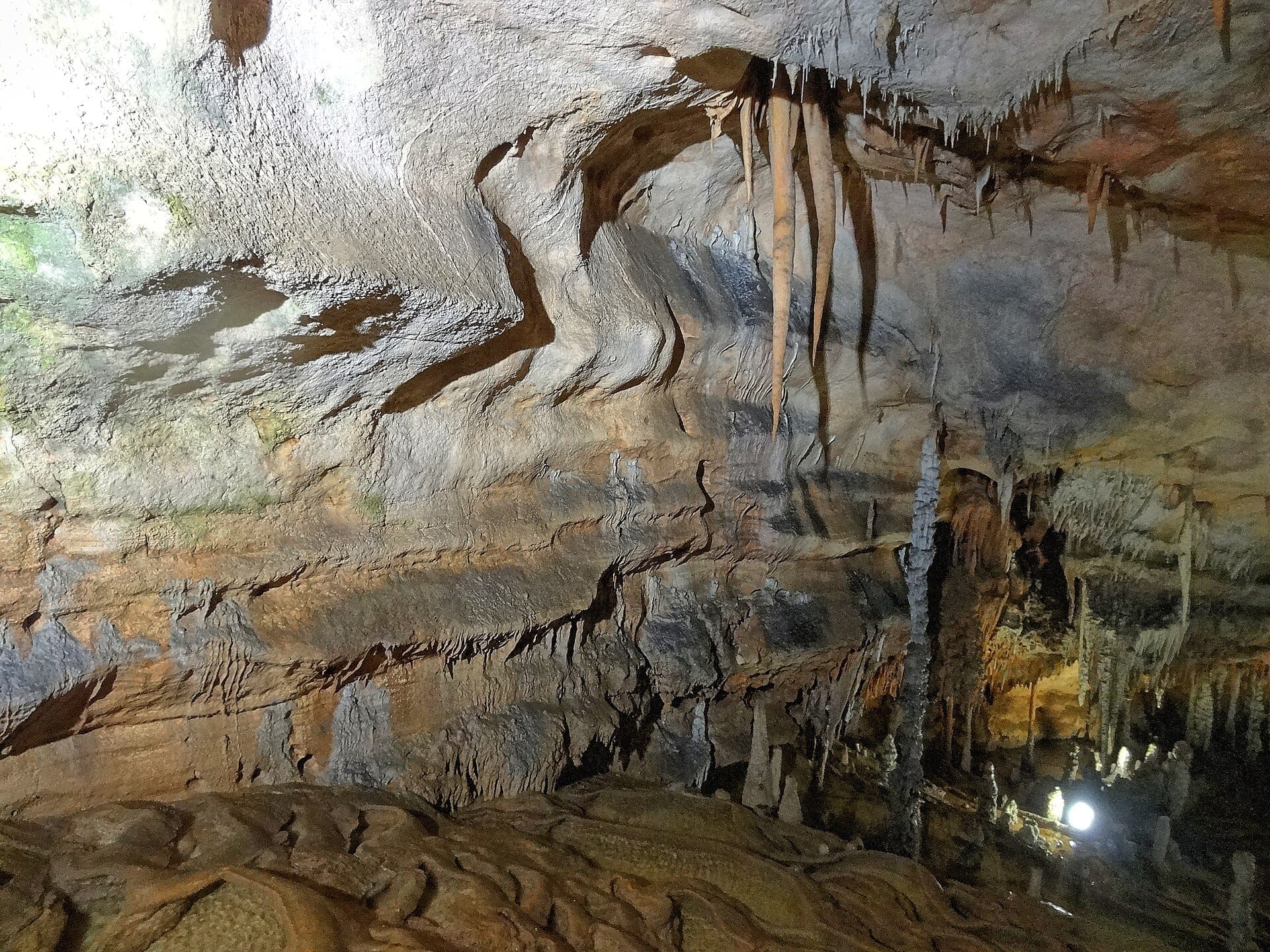
Inside, the guided route follows the path of the ancient fossil riverbed, crossing it on boardwalks and descending through chambers of varying scale. The lighting is measured: strategically placed to pick out specific speleothem formations without flooding the cave in artificial brightness. Stalactites hang in white and amber columns, and in places the formations crowd so densely that the ceiling looks like a frozen waterfall. The largest chambers produce a faint dripping sound and an acoustic depth that amplifies whispers.
One of the most visually striking features is the contrast between the dry upper chambers, which show the full complexity of mineral deposits built up over hundreds of thousands of years, and the lower sections where the cave floor meets water — a reminder that part of this system sits below sea level. The tour guide (available in multiple languages) explains the geological history and points out specific formations, keeping the visit coherent rather than just a walk through darkness.
Tickets & tours
Hand-picked options from our booking partner. Prices are indicative; availability and final rates are confirmed when you complete your booking.
Cala Goloritze, Mariolu, Gabbiani, Biriala, Grotta del Fico boat tour
From 69 €Instant confirmationFree cancellationGuided Tasting of Sardinian Food and Drink Delicacies
From 48 €Instant confirmationFree cancellationSanta Teresa di Gallura hiking tour of Valle della Luna
From 30 €Instant confirmationFree cancellationCagliari small-group boat escape to Sella del Diavolo with swim stops
From 0 €Instant confirmationFree cancellation
How the Visit Changes Through the Day
The cave itself does not change with the time of day — it is always the same temperature and the same darkness beyond the installed lighting. But the experience around it changes considerably depending on when you go.
Morning departures from Santa Maria Navarrese or Cala Gonone reach the cave in calmer sea conditions, before afternoon thermal winds build along the coast. The boat ride itself is more comfortable, and the anchorage at the cliff base is quieter. By mid-morning in July and August, a queue of boats may already be waiting, and tour groups cycle through the cave entrance in close succession. The cave only processes visitors in guided groups, so during peak summer hours there can be a wait at the cliff landing.
Visiting in June, September, or October reduces those waits substantially and keeps the boat journey more pleasant. In those shoulder months the sea is typically still calm enough for daily trips, and the cave is generally open, sea conditions permitting. Avoid planning the visit for a day following heavy rain or strong scirocco winds — boat operators cancel trips and conditions can make the cliff landing dangerous.
💡 Local tip
Bring a light layer — a long-sleeved shirt or thin fleece is enough. The cave sits at around 16–18°C regardless of the summer heat outside, and standing still for an hour after a hot boat ride can feel surprisingly chilly.
Getting There: The Boat Journey
Grotta del Fico has no road access. The only way in is by sea, and this is not a formality — the boat journey is part of the visit. From Santa Maria Navarrese, a common departure point, the journey along the cliff coast takes around 30 to 40 minutes each way. From Cala Gonone to the north, the trip is longer, roughly 50 to 60 minutes, but it passes more of the dramatic Gulf of Orosei coastline, including views toward Cala Luna and Cala Biriola.
Boat departures are available from Santa Maria Navarrese, Arbatax, Cala Gonone, Orosei, and La Caletta. Most operators sell combined tickets that pair the cave visit with a stop at one of the nearby beaches — Cala Mariolu is the most common combination, and it makes good practical sense: you visit the cave first, then swim while the afternoon holds its warmth. Boat tickets are priced separately from the cave entry fee, so confirm the total cost before booking.
There is no fixed timetable available centrally for all operators; each boat company runs its own schedule. It is worth booking a day ahead in July and August, when popular morning departures sell out. Operators in Santa Maria Navarrese are generally the most convenient starting point if you are based in Baunei municipality.
Geological and Historical Context
The Gulf of Orosei coast sits within one of the most geologically complex zones of Sardinia's eastern flank. The limestone that forms these cliffs is Jurassic in origin, and karstification — the dissolution of rock by slightly acidic groundwater — has been active here for hundreds of thousands of years. Grotta del Fico formed primarily through the action of a fossil river system that no longer flows above ground; the cave essentially preserves a record of that ancient drainage network.
The cave's history as a publicly known site is relatively recent. Fishermen from Baunei and nearby towns were aware of the opening in the cliff face in the early twentieth century, but systematic exploration only came with the growth of Italian speleology in the postwar decades. The first formal explorations in the early 1960s revealed the full scale of the system. For four more decades the cave remained accessible only to specialists, until the Società Speleologica Baunese invested in walkways, lighting, and safety infrastructure and opened it to the public in 2003. The combination of managed tourism and community stewardship has kept the cave in significantly better condition than many Italian show caves of comparable age. For broader context on Sardinia's prehistoric and geological heritage, the guide to Sardinia's most significant sites covers the island's deep history.
Photography Tips and Practical Details
Photography inside the cave is permitted, but the installed lighting is low and highly directional, which makes handheld shots at slow shutter speeds difficult. A camera with good high-ISO performance will handle the conditions far better than a phone camera, though modern phones in night mode do manage the brighter sections reasonably well. Flash photography disrupts other visitors and tends to flatten the formations, so it is worth learning to shoot with the ambient light.
Wear closed-toe shoes with grip — the walkways are damp and the surface can be slippery. Sandals and flip-flops are unsuitable. Leave large bags on the boat if possible; the route is narrow in places and a bulky daypack becomes a liability.
Accessibility is limited. The external staircase up the cliff face and the stairs inside the cave make this site unsuitable for visitors with significant mobility impairments or those using wheelchairs. There is no alternative access route. Families with young children should note that the boat landing and cliff stairs require some physical confidence; the cave itself is suitable for children aged around six and above.
Combining Grotta del Fico With the Surrounding Coastline
Most visitors combine the cave with a full day on the water. The obvious pairing is Cala Mariolu, the beach immediately adjacent to the cave. The water there is exceptionally clear and the pebble-and-rock shoreline means the sea stays transparent to considerable depth. Many boat operators build a Cala Mariolu stop into their cave excursion packages.
The broader Golfo di Orosei coastline rewards a longer stay. Cala Luna to the north is larger and less crowded mid-week, and the sea route between the two passes some of the most dramatic cliff scenery in the Mediterranean. If you have a second day and reasonable fitness, the hiking trail Selvaggio Blu traces the same coastal ridge on foot, though that is a multi-day commitment for experienced trekkers.
Those travelling along the east coast should also consider the boat trips guide for Sardinia, which covers the full range of sea excursion options across the island, including day trips that combine multiple bays with the cave visit.
Who Should Skip This
Grotta del Fico is worth the effort for anyone with an interest in geology, cave formations, or unusual landscapes, but it is not for everyone. Travellers who are prone to seasickness should factor in a boat journey of at least an hour each way, potentially in choppy summer conditions. Those with a strong fear of enclosed spaces will find sections of the cave uncomfortable, particularly the lower galleries where the ceiling descends close to the walkway.
Visitors expecting a beach holiday with a quick cave add-on should also calibrate their expectations: the logistics require a half-day commitment at minimum, and the cave itself is a serious geological site, not a novelty attraction. Anyone who has visited the Grotte di Nettuno near Alghero may find Grotta del Fico feels comparable in scale but more remote and less infrastructure-heavy — which is either a selling point or a deterrent depending on your preferences.
Insider Tips
- Book the earliest available morning departure in summer. Sea conditions are calmest before noon, and the queue at the cave entrance is shorter. By early afternoon in August, boats can stack up waiting to land at the cliff.
- Ask your boat operator specifically whether the Cala Mariolu stop is included or an optional add-on. Some operators bundle it; others quote the cave alone and charge extra for the beach stop. Confirming this upfront avoids surprises on the return trip.
- The cave temperature holds at roughly 16 to 18°C year-round. If you have been on a boat in 30°C summer heat and then stand still for an hour in a damp cave, that gap feels large. A lightweight long-sleeved layer takes up no space and makes a real difference.
- For photography, scout the larger chambers early in the tour rather than waiting until the end when the group has moved on. The guide typically pauses at the main stalactite halls for explanation — use that time to get stable shots rather than trying to shoot while moving.
- Visiting in September rather than August gives you essentially the same cave in dramatically better conditions: shorter or no queues at the cliff, smoother sea crossings, and sea water that is still warm enough for a swim at Cala Mariolu afterward.
Who Is Grotte del Fico (Baunei) For?
- Geology and cave enthusiasts who want to understand what they're looking at, not just walk through it
- Families with children aged 6 and above who want something different from another beach day
- Travellers already spending time in Baunei or Santa Maria Navarrese who can combine the visit with a full coastal day by boat
- Photographers looking for a cave environment that is lit with some care and not overrun with visitor infrastructure
- Anyone doing a broader exploration of the Gulf of Orosei coastline who wants to understand the geology beneath the cliff scenery
Nearby Attractions
Other things to see while in Golfo di Orosei:
- Cala Goloritzè
Cala Goloritzè is a protected natural monument on Sardinia's eastern coast, where a limestone pinnacle of about 143–148 metres towers over a pebble beach and crystalline water. Accessible only by a moderately strenuous hike or by sea, it rewards the effort with scenery that few coves in the Mediterranean can match.
- Cala Gonone
Cala Gonone is a small seaside town tucked beneath limestone cliffs on Sardinia's eastern coast, serving as the main launch point for the Golfo di Orosei's famous sea caves, secluded coves, and dramatic hiking routes. Whether you arrive by boat, bus, or car, this is where the real adventure begins.
- Cala Luna
Cala Luna is an 800-metre crescent of pale pink-tinged sand framed by limestone cliffs that rise up to 300 metres above the waterline. Straddling the municipal boundary between Baunei and Dorgali in the Gulf of Orosei, it has no road access and only minimal seasonal beach infrastructure — which is precisely why it looks the way it does.
- Cala Mariolu
Tucked beneath the limestone cliffs of Costa di Baunei, Cala Mariolu is one of the eastern Sardinian coast's most extraordinary beaches. Famous for its white pebble shore, improbably clear water, and sheer rock walls rising hundreds of metres, it demands effort to reach but rewards accordingly. This guide covers every access route, the new reservation system recently introduced to manage visitor numbers, and what first-time visitors consistently get wrong.