Green-Wood Cemetery: Brooklyn's Most Extraordinary Landscape
Founded in 1838 and designated a National Historic Landmark, Green-Wood Cemetery spans 478 acres of rolling hills in Brooklyn, holding the remains of over 570,000 people including artists, politicians, and Civil War generals. The grounds are free to enter year-round and reward visitors with panoramic views, Gothic Revival architecture, and some of the quietest hours available anywhere in New York City.
Quick Facts
- Location
- 500 25th Street, Brooklyn, NY 11232. Main entrance at Fifth Avenue & 25th Street, Greenwood Heights.
- Getting There
- Subway R/W to 25th St (one block from main gate). Multiple MTA bus routes also serve the area. Check the official site for current transit details.
- Time Needed
- 2 to 4 hours for a thorough walk; at least 90 minutes to cover the main landmarks at a relaxed pace.
- Cost
- Free to enter the grounds. Ticketed walking and trolley tours available; check green-wood.com for current pricing and schedules.
- Best for
- History enthusiasts, architecture lovers, birdwatchers, photographers, and anyone looking for genuine quiet in New York City.
- Official website
- www.green-wood.com
What Green-Wood Cemetery Actually Is
Green-Wood Cemetery is not a park that happens to have graves. It is a fully functioning, privately managed cemetery that has been open to public visitors since its founding in 1838. At 478 acres, it covers more ground than most of Brooklyn's residential neighborhoods combined, spreading across a series of glacial drumlins that give it one of the most dramatic topographies in the entire borough. The highest point, Battle Hill, stands at roughly 216 feet above sea level and offers unobstructed views of the Manhattan skyline, the harbor, and the Statue of Liberty on clear days.
The place was designated a National Historic Landmark in 2006, a recognition that reflects both its landscape design significance and the sheer weight of history buried within it. Over 570,000 people are interred here, including Civil War generals, Tammany Hall politicians, newspaper editors, musicians, and visual artists. But the cemetery is also a living institution, hosting lectures, concerts, and art installations throughout the year, making it genuinely active in ways that purely memorial sites rarely are.
ℹ️ Good to know
The grounds are open 365 days a year. Seasonal gate hours vary, so check the official Hours page at green-wood.com before you visit, particularly if you plan an early morning or late afternoon arrival.
The Gothic Gate and First Impressions
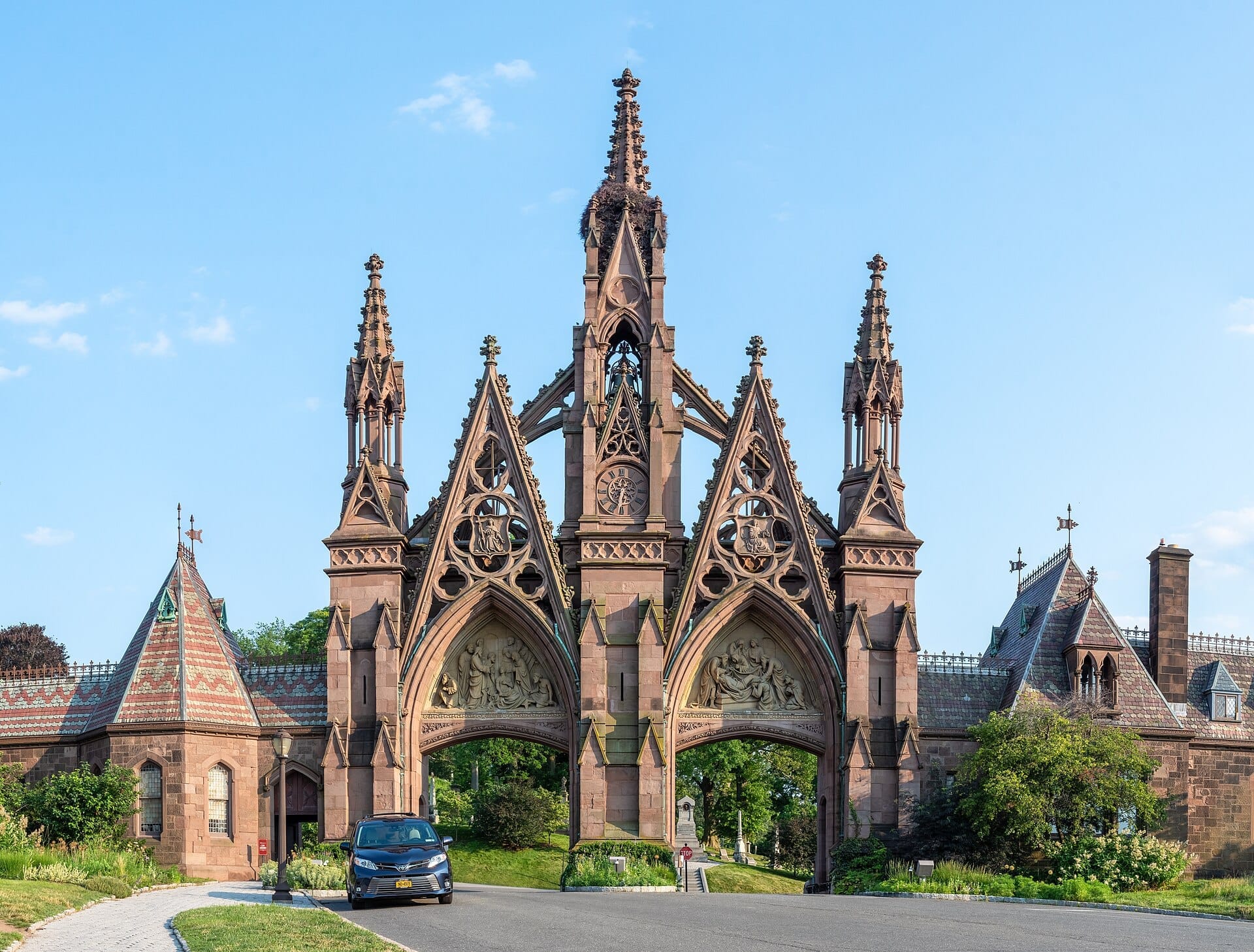
The main entrance on Fifth Avenue at 25th Street is one of the most underappreciated pieces of architecture in Brooklyn. The Gothic Revival brownstone gate, begun in 1861 and completed in the mid-1860s and designed by Richard Upjohn, who also designed Trinity Church in Lower Manhattan, frames the entrance with four arched portals that read almost ecclesiastical from the street. If you arrive by the R or W train at the 25th Street station, you will literally walk off the platform and see the spires rising above the roofline less than a block ahead.
Look up when you pass through the gate. The carved limestone tympanum above the central arch depicts a Biblical resurrection scene, and a colony of monk parakeets has nested in the towers for decades. Bright green parrots in a Gothic gateway in Brooklyn is not something you will see in a guidebook photograph, but it is one of the most reliably strange and delightful sights on the grounds. The birds are loud and visible year-round.
For more on Brooklyn's architectural landscape and how Green-Wood fits into it, the New York City architecture guide covers the borough's major historic structures and design heritage.
Tickets & tours
Hand-picked options from our booking partner. Prices are indicative; availability and final rates are confirmed when you complete your booking.
Greenwich Village food tour
From 93 €Instant confirmationFree cancellationGreenwhich Village Food and Historic walking tour
From 106 €Instant confirmationFree cancellationGreenwich Village guided walking tour
From 33 €Instant confirmationFree cancellationNew York LGBTQ+ Greenwich Village Walking Tour
From 42 €Instant confirmationFree cancellation
Navigating the Grounds: What You Will See
The interior of Green-Wood feels nothing like the grid of streets outside its walls. Roads curve along the contours of the hills, passing kettle ponds, wooded ravines, and open meadows that shift character with the seasons. In early spring, the cherry trees along the main paths bloom before most of the rest of Brooklyn catches up. In autumn, the hardwood canopy turns gold and amber, and the light through the leaves in the late afternoon is remarkable. Summer brings dense shade but also humidity trapped between the hills, so bring water.
The cemetery map, available at the gate entrance or on the official website, is genuinely useful. Without it, the road system is disorienting. Key landmarks to orient yourself include the Dell Water, a landscaped pond roughly central to the grounds; the Catacombs, a hillside vault structure whose arched brick facade is worth finding even if you only pass by it; and Battle Hill, which is marked and worth the walk for the views alone.
The monuments themselves range from modest headstones to elaborate mausoleums with stained glass, bronze doors, and carved figures. The range of Victorian funerary iconography on display across a single afternoon walk is considerable. Broken columns, draped urns, sleeping lambs, and weeping angels appear block after block, each one an artifact of how 19th-century Americans understood public mourning.
💡 Local tip
Pick up a printed map at the main gate. The paths branch frequently and the hills can confuse your sense of direction. The map also marks notable gravesites and landscape features that you would otherwise miss entirely.
Historical and Cultural Significance
Green-Wood was founded in 1838 as part of a national movement toward rural cemeteries, a direct response to overcrowded urban burial grounds. The designers drew on the English landscape garden tradition, creating a deliberate contrast to the noise and density of city life. Before Central Park opened in 1858, Green-Wood was one of the most popular leisure destinations in New York, attracting tens of thousands of visitors annually who came specifically to walk the grounds.
The historical record buried here runs across American political, artistic, and social life in ways that are difficult to overstate. Leonard Bernstein is here. So is Jean-Michel Basquiat. Boss Tweed is here, along with numerous figures who prosecuted or resisted him. The cemetery holds the graves of soldiers from the Revolutionary War, the War of 1812, and the Civil War, including veterans from both the Union and Confederate sides. The New York Monuments section, near the main road system, clusters several historically significant plots in a way that rewards deliberate exploration.
Green-Wood sits within walking distance of Park Slope and is a natural complement to a day that also includes the Brooklyn Museum and the Brooklyn Botanic Garden, both of which are roughly a mile northeast.
Time of Day and Seasonal Differences
Weekday mornings before 10 AM are when the cemetery most closely resembles the retreat it was designed to be. The roads are quiet enough to hear birds clearly, foot traffic is minimal, and the early light hits the stone monuments at a low angle that makes the carvings read sharply. This is the best window for photography of architectural details.
Weekend afternoons bring a different but still pleasant crowd: families, people walking dogs, history enthusiasts consulting maps, and small groups taking guided tours. The atmosphere is closer to a relaxed public park than a solemn place of mourning, which reflects how the cemetery has positioned itself publicly. Funerals do still take place regularly, particularly on weekday mornings, so visitors should exercise obvious discretion when passing active burial services.
Spring and autumn are the strongest seasons for a visit. Spring brings blooming trees and returning migratory birds, while autumn provides color and cooler temperatures that make the hilly terrain easier to walk. Winter visits are perfectly feasible on clear days and offer stripped-back views through the leafless canopy, but the cold on exposed hilltops like Battle Hill can be cutting. Summer is the least ideal season, particularly on humid afternoons, though the full leaf canopy provides real shade.
⚠️ What to skip
Green-Wood is a working cemetery, not a park. Active funeral services take place regularly. Keep voices low when near services, yield to funeral processions, and stay on designated paths around active burial areas.
Tours, Programs, and Events
Green-Wood runs a substantial events program throughout the year. Ticketed tours include walking tours focused on historical figures or architectural themes, trolley tours for visitors who prefer not to walk the full terrain, and occasional evening events that include music performed inside the historic chapel. The chapel itself, a Gothic Revival structure on the interior grounds, is used for concerts and lectures and is worth seeing even on a general visit if it happens to be open.
The cemetery also hosts an annual program of contemporary art installations placed on the grounds, which tend to be subtle and site-specific rather than conspicuous. Dates, ticket prices, and program details are listed on the official events calendar at green-wood.com, and the schedule changes seasonally. If you are visiting specifically for a tour or event, booking in advance is advisable as popular programs do sell out.
If you are building a full Brooklyn itinerary around Green-Wood, the Brooklyn neighborhood guide covers the surrounding areas, transit connections, and where to eat in the nearby streets.
Practical Information for Your Visit
The R subway line stops at 25th Street, placing you about half a block from the main Fifth Avenue gate. This is the most direct public transit option from most of Manhattan. The ride from Midtown takes roughly 30 to 40 minutes depending on your origin point. Several MTA bus routes also serve the surrounding streets; consult the official visiting page or the MTA trip planner for current route details.
Wear shoes you can walk comfortably in on uneven terrain. The hills are real, several paths are unpaved or made of older cobblestone, and the grounds cover enough distance that a thorough visit involves significant walking. There is no food or coffee available inside the cemetery, so bring water and anything else you need before you enter. The nearest cafes and restaurants are on Fifth Avenue and in the surrounding Greenwood Heights and Park Slope streets.
Regarding accessibility, the combination of steep hills, older road surfaces, and the general scale of the grounds makes parts of Green-Wood difficult for visitors with limited mobility. Some roads are paved and navigable, but the hillier sections and off-road paths are not. The cemetery office can be contacted directly for current accessibility information, and the trolley tours can provide a way to cover more ground with less walking.
For visitors combining Green-Wood with other Brooklyn sights on a single day, the Prospect Park is about a 15-minute walk east and offers a natural continuation of the green-space experience before or after your visit.
Insider Tips
- The monk parakeet colony in the main gate towers is easiest to observe in the morning when the birds are most active. Look and listen for them before you even step inside.
- Battle Hill is marked on the map but is easy to underestimate as a destination. The view from the top takes in the Manhattan skyline, New York Harbor, and on clear days the Verrazzano-Narrows Bridge. Allow extra time to walk up here rather than treating it as a quick detour.
- The cemetery's events calendar frequently includes free or low-cost programs that are not widely publicized outside the grounds. Checking the calendar a few days before your visit can surface lectures or tours you would otherwise miss.
- Birdwatchers should bring binoculars. Green-Wood sits on a major Atlantic flyway corridor, and during spring and autumn migration it hosts significant numbers of warblers and other species. The Dell Water pond area is particularly productive.
- If you want to find a specific grave, the cemetery's online search tool at green-wood.com allows you to look up interments by name and then locate the section on the map. Coming with one or two names you want to find turns the visit into a more directed experience.
Who Is Green-Wood Cemetery For?
- History and genealogy enthusiasts who want to walk through 180 years of New York City's social and political history.
- Architecture and design travelers interested in Gothic Revival gateways, Victorian funerary monuments, and 19th-century landscape design.
- Photographers working in natural light, particularly on weekday mornings when foot traffic is low.
- Birdwatchers, especially during spring and autumn migration when the grounds attract species unusual elsewhere in Brooklyn.
- Visitors who want genuine urban quiet without leaving the city and who find the combination of landscape, history, and solitude more interesting than conventional tourist sites.
Nearby Attractions
Other things to see while in Prospect Park & Park Slope:
- Brooklyn Botanic Garden
Spread across 52 acres in central Brooklyn, the Brooklyn Botanic Garden is one of the most carefully curated urban gardens in the United States. From the world-famous Japanese Hill-and-Pond Garden to the fragrant Rose Garden, it rewards visitors in every season — though timing your visit right makes a significant difference.
- Brooklyn Museum
The Brooklyn Museum is one of the largest and most encyclopedic art institutions in the United States, housed in a monumental Beaux-Arts building on Eastern Parkway. With a permanent collection spanning ancient Egyptian artifacts to contemporary feminist art, it rewards repeat visits and first-timers equally.
- Prospect Park
Prospect Park is Brooklyn's 526-acre centerpiece, designed by the same duo behind Central Park and free to enter year-round. From its Long Meadow to its forested Ravine, it rewards visitors who slow down and explore beyond the main loop.