Fòrum Barcelona & Diagonal Mar Beach: Barcelona's Quieter Seafront Edge
Parc del Fòrum sits at the northeastern tip of Barcelona's coastline, where a vast concrete esplanade, striking modernist architecture, and calmer, less-crowded beaches meet the open sea. Created for the 2004 Universal Forum of Cultures, it is one of the city's most undervisited public spaces and one of its most architecturally surprising.
Quick Facts
- Location
- northeastern seafront, Sant Adrià del Besòs border, 08019 Barcelona (northeastern seafront)
- Getting There
- Metro L4 to El Maresme–Fòrum (3-min walk) or Besòs Mar (6-min walk)
- Time Needed
- 1.5 to 3 hours depending on pace and beach time
- Cost
- Free. Open 24 hours, 7 days a week.
- Best for
- Architecture enthusiasts, locals seeking quieter beaches, evening walkers
What Is Parc del Fòrum?
Parc del Fòrum is a 30-hectare public park and events campus on Barcelona's northeastern waterfront, created in 2004 to host the Universal Forum of Cultures, a UNESCO-backed international gathering focused on dialogue, sustainability, and cultural diversity. The event itself was controversial, drawing criticism for displacing residents from the Poblenou and La Mina neighborhoods, but the infrastructure it left behind has aged into something genuinely interesting: a wide-open waterfront space that most tourists never reach.
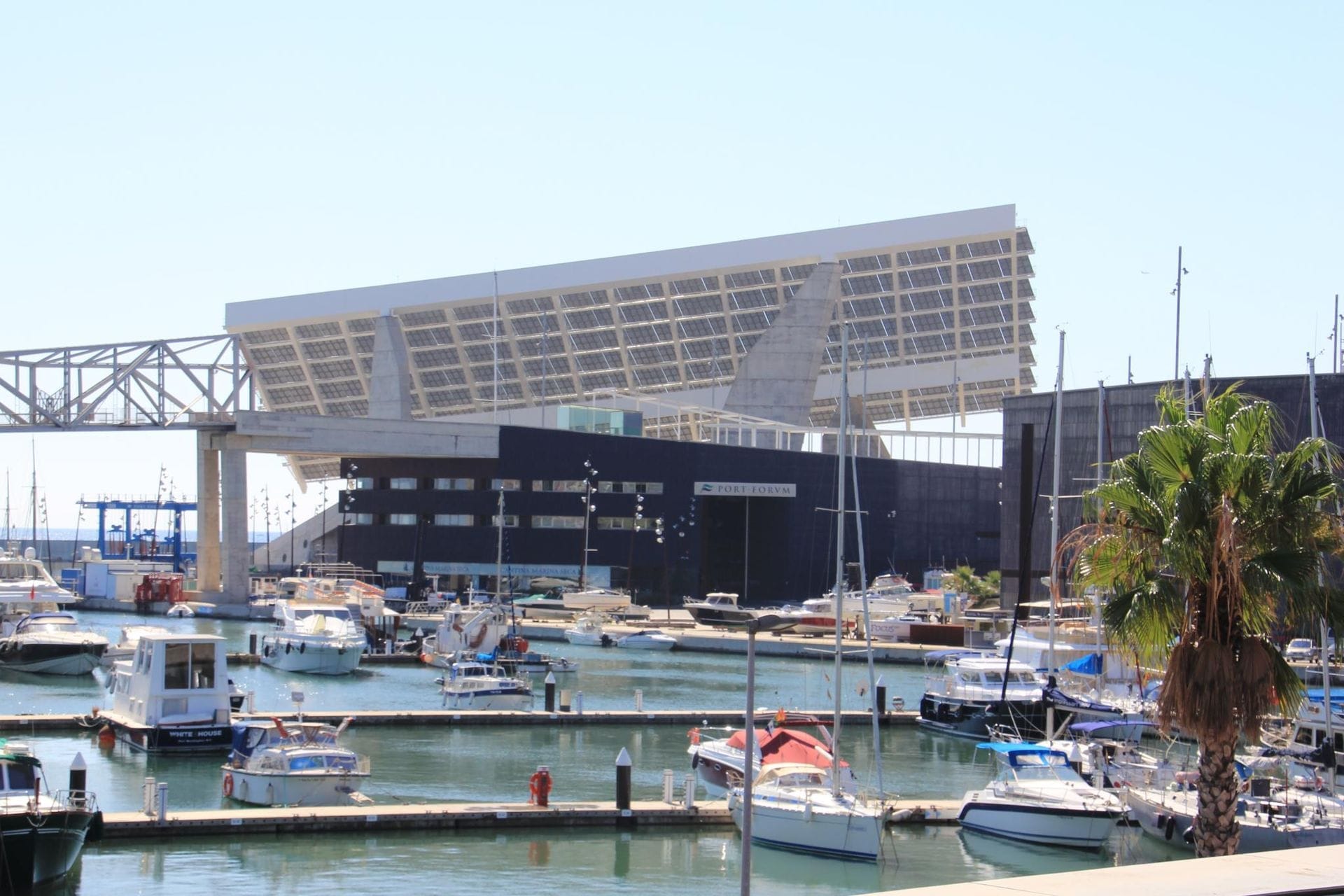
The centerpiece is a 16-hectare esplanade, one of Europe's largest flat public spaces, anchored by the Forum Building, a bold photovoltaic canopy structure designed by Swiss architects Herzog & de Meuron. The park also includes the Zona de Banys, a sheltered seawater bathing area with non-sand access, and connects directly to the Nova Mar Bella and Mar Bella beaches, which are noticeably quieter than Barceloneta.
ℹ️ Good to know
Parc del Fòrum is free and open 24 hours a day. No tickets, no queues. The esplanade and beach areas are always accessible, though individual event venues within the park have their own schedules.
The Architecture: Concrete, Scale, and Photovoltaic Canopies
The Forum Building is the defining structure. Its triangular blue-grey mass, hovering on narrow supports above a corner of the esplanade, houses large conference and concert spaces inside. The underside of the building is covered in mosaic, visible as you walk beneath it. The roof is fitted with solar panels, making it one of the largest photovoltaic installations on a single building in Spain at the time of construction.
Across the esplanade, a large photovoltaic pergola extends over a section of the park. On a sunny afternoon, the light filtering through the solar panels casts an unusual pattern across the ground below, and the scale of the structure, easily 100 meters across, gives the space a quality closer to infrastructure than park furniture. That deliberate ambiguity between civic plaza, industrial port, and leisure space is what makes the Fòrum genuinely unusual.
For travelers interested in how cities look when they try to reinvent themselves through major events, this area tells a specific story. Compare it mentally to what happened with London's Olympic Park or Lisbon's Parque das Nações (built for Expo 98): the Forum left fewer residential traces but more raw public space. The area around it is still developing, with new towers rising along the Diagonal Mar district.
The broader neighborhood this sits within is Poblenou, a former industrial district that has become one of Barcelona's most architecturally layered neighborhoods. A short walk inland reveals a very different texture from the open seafront plaza.
Tickets & tours
Live prices and dates from our booking partner. If you book, we may earn a commission at no extra cost to you.
Vermouth time and sailing experience in Barcelona
From 36 €Instant confirmationFree cancellationOne-day tour to Andorra and France from Barcelona
From 109 €Instant confirmationFree cancellationBest of Gaudi private walking tour in Barcelona with a local guide
From 90 €Instant confirmationFree cancellationInteractive Spanish cooking experience in Barcelona
From 65 €Instant confirmationFree cancellation
The Beaches: Why They Are Worth the Extra Metro Stop
Nova Mar Bella and Mar Bella beaches, directly adjacent to Parc del Fòrum, are among the calmer options along Barcelona's coastline. Mar Bella in particular has a designated naturist section and tends to attract a younger, more local crowd. The sand is kept clean, the water quality is generally good, and the relative distance from the city center means it draws fewer day-trippers.
The Zona de Banys (Bathing Zone) inside the Fòrum park itself is a purpose-built seawater pool connected to the sea, enclosed by concrete breakwaters. It lacks beach sand, so bring a towel or mat if you plan to lounge. The water is calm even when the open sea is choppy, and it is popular with older locals and families with young children for exactly that reason.
For comparison, Barceloneta Beach is better positioned for restaurants and people-watching, but the trade-off is significant: it is far more crowded from June through August. If you are visiting in peak summer and want to actually swim rather than navigate towels, the Fòrum beaches give you a much more practical option.
💡 Local tip
Arrive at the Zona de Banys before 10am in summer to claim a good spot. By midday, the sheltered bathing area fills quickly with local families, especially on weekends.
Time of Day: How the Space Changes
Early morning is the most rewarding time to visit the esplanade. The scale of the empty plaza, the light coming off the water, and the near-total absence of crowds gives the space a contemplative quality that midday crowds, skateboarders, and food trucks later disrupt. Joggers trace the perimeter from around 7am onward, and the photovoltaic canopy casts long shadows across the concrete.
Midday in summer brings the beach crowd and occasional food stalls near the Zona de Banys. The esplanade itself can become very hot, with limited shade. A hat, water, and sunscreen are not optional here. The Forum Building's overhang provides some relief near its base.
Evenings are arguably the best time to visit if beaches are not your priority. The light over the sea turns orange and pink, the esplanade cools quickly, and the Forum Building takes on a completely different character at dusk. In summer months, the park hosts open-air concerts and festivals, some of which are free or low-cost. Check the official park calendar before your visit.
⚠️ What to skip
The esplanade offers almost no shade during daytime hours. In July and August, midday temperatures can exceed 30°C on the exposed concrete. Avoid this stretch between 12pm and 4pm unless you are heading directly to the water.
Getting There and Getting Around
The most direct route is Metro Line 4 (yellow line) to El Maresme–Fòrum, which deposits you about 3 minutes on foot from the esplanade entrance. Besòs Mar station, also on Line 4, is slightly further at around 6 minutes walking. Both are well-signed.
The Fòrum sits at the far northeastern end of the seafront, beyond the Barceloneta district. If you enjoy long coastal walks, it is possible to walk the entire seafront from Barceloneta to the Fòrum in roughly 40 to 50 minutes. The path is flat, paved, and well-lit. Cycling the same route via the seafront bike lane takes around 15 minutes.
There is no parking lot at the park entrance, though street parking exists in the surrounding streets. For most visitors, the metro is faster and more practical. Taxis and ride-hailing apps (Uber, Bolt, Cabify) can drop you directly at the Avinguda Diagonal entrance.
Events, Concerts, and the Living Park
Since 2004, the Fòrum has become one of Barcelona's main outdoor event venues. Primavera Sound, one of Europe's most respected independent music festivals, was held here for many years before relocating, and the park continues to host large-scale concerts, electronic music events, and cultural festivals throughout the year, particularly in summer.
The official park website lists current programming. On event nights, the area transforms significantly: the esplanade fills, temporary bars and stages appear, and the Metro runs extended hours. If you happen to be in Barcelona during an event at the Fòrum, it is worth checking the lineup, even casually. The combination of the open-air setting and the scale of the space makes large concerts here feel distinctive.
If the Fòrum's contemporary-civic aesthetic appeals, consider visiting CaixaForum Barcelona for a different register of 21st-century cultural architecture in the city, or exploring MACBA, Barcelona's contemporary art museum, whose Richard Meier-designed building occupies a similarly bold public plaza.
Honest Assessment: Who Should Come and Who Can Skip It
The Fòrum is not a conventional sightseeing stop. There is no single monument to photograph, no entry fee to justify, and no organized experience guiding you through it. What it offers is space, scale, and a perspective on how Barcelona has evolved beyond its historic core, which is genuinely interesting if you have already spent time in the Gothic Quarter or Eixample and want to understand the city's contemporary ambitions.
Travelers who want picturesque lanes, Gaudí facades, or concentrated cultural experiences should prioritize their limited time elsewhere. The Fòrum rewards curiosity rather than destination-driven tourism. For architecture enthusiasts, urban planners, people looking for a functional beach, or anyone who finds oversized public spaces philosophically interesting, it is time well spent.
For a fuller picture of Barcelona's coastline from south to north, the Barcelona beaches guide covers every major beach in sequence with practical notes on facilities and crowd levels.
Insider Tips
- The photovoltaic pergola in the center of the esplanade is one of the best skateboarding spots in Barcelona on weekdays, though it is often occupied by skaters from late afternoon onward. If you are there for quiet photos, go before noon.
- The Zona de Banys fills quickly on hot weekends. If it is full, walk 5 minutes north along the coast to the beginning of Nova Mar Bella beach, which has actual sand and almost always has space.
- During major events at the Fòrum, Metro Line 4 can be extremely crowded after midnight. If you are leaving late after a concert, walking along the seafront to Ciutadella or Barceloneta and picking up the metro there is sometimes faster.
- The Forum Building's exterior mosaic underside is best seen in afternoon light when the sun hits the southern face directly. Most visitors walk past it without looking up.
- If you visit in late May or early September, check whether any outdoor festivals are scheduled. Some events include free daytime access to open stages, which is not always advertised prominently.
Who Is Fòrum Barcelona & Diagonal Mar Beach For?
- Architecture and urban design enthusiasts who want to see Barcelona beyond Modernisme
- Travelers looking for less-crowded beaches within easy metro distance of the city center
- Evening walkers and sunset seekers who prefer open seafront spaces over busy promenades
- Families with young children who want a calm, sheltered bathing area rather than open-water beaches
- Festival and concert-goers visiting Barcelona during summer event season
Nearby Attractions
Combine your visit with:
- CosmoCaixa
CosmoCaixa is Barcelona's flagship science museum, housed in a century-old Modernista building expanded to nine floors and 30,000 square metres. From a living slice of the Amazon to geological fault demonstrations and a full planetarium, it rewards curiosity at every age. Entry starts at just €4, making it one of the city's best-value cultural stops.
- Tibidabo Amusement Park & Church
Perched at 512 metres on the Collserola range, Tibidabo offers a rare combination of vintage fairground rides dating to 1901, panoramic views stretching across Barcelona to the sea, and the towering Temple Expiatori del Sagrat Cor. It rewards visitors who plan ahead but punishes those who show up on a cloudy day or without checking the seasonal schedule.
Planning a trip? Discover personalized activities with the Nomado app.