Tibidabo: Barcelona's Hilltop Amusement Park and Sacred Heart Church
Perched at 512 metres on the Collserola range, Tibidabo offers a rare combination of vintage fairground rides dating to 1901, panoramic views stretching across Barcelona to the sea, and the towering Temple Expiatori del Sagrat Cor. It rewards visitors who plan ahead but punishes those who show up on a cloudy day or without checking the seasonal schedule.
Quick Facts
- Location
- Tibidabo Mountain, Collserola Range, 512m above Barcelona
- Getting There
- FGC to Peu del Funicular, then Funicular de Tibidabo to summit
- Time Needed
- 3–5 hours for the full park; 1–2 hours for panoramic area and church only
- Cost
- Emblematic attractions pass available (verify current price at tibidabo.cat); Panoramic Area is free
- Best for
- Families, architecture enthusiasts, view-seekers, and anyone curious about early 20th-century fairground culture
- Official website
- tibidabo.cat/en
What Tibidabo Actually Is
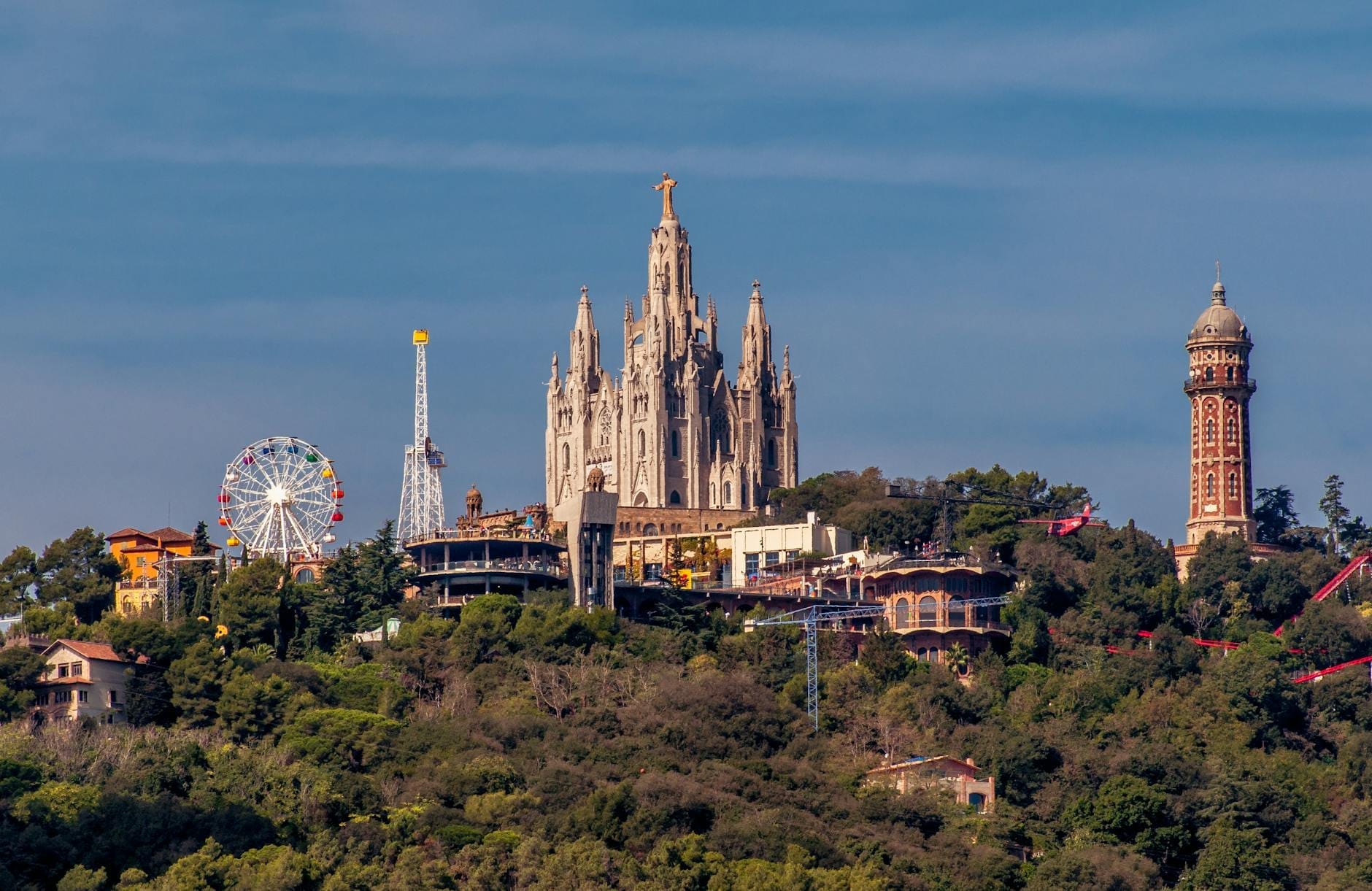
The Parc d'Atraccions Tibidabo is the oldest amusement park in Spain and one of the oldest still-operating in the world, having welcomed its first visitors in 1901. It sits at the summit of Tibidabo mountain, the highest point of the Collserola range at 512 metres, and the ride up to it, via a historic blue tram and a funicular, is itself part of the experience. Sharing the hilltop is the Temple Expiatori del Sagrat Cor, a neo-Gothic and neo-Romanesque church topped by a bronze statue of Christ that serves as one of Barcelona's most recognisable skyline features from almost anywhere in the city.
The park operates seasonally with a schedule that changes year to year. It is not open every day, and some months it only opens on weekends. Checking the official calendar at tibidabo.cat before planning any trip is not optional; it is essential. The park has been known to close mid-week even in summer.
⚠️ What to skip
Tibidabo operates a seasonal schedule and is frequently closed on weekdays outside peak summer. Always confirm opening dates at tibidabo.cat before travelling up the mountain. The park is also sensitive to wind and bad weather, which can affect ride availability at altitude.
The Journey Up: Tram, Funicular, and First Impressions
Getting to Tibidabo is a layered journey that starts well below the summit. You take the FGC suburban rail line to Peu del Funicular, then board the Funicular del Tibidabo, a rack railway that has been climbing the steep hillside since 1901. Before the funicular, the historic Tramvia Blau, a classic blue tram, runs from Plaça Doctor Andreu up to the funicular station, though its operation has been intermittent in recent years; confirm its current status before counting on it.
As the funicular crests the hill, the skyline of Barcelona appears below you in a way that feels genuinely surprising, even if you have been told to expect it. The Eixample grid, the distant glint of the Mediterranean, and the outline of the Sagrada Família tower against the lower city all snap into focus at once. The air is noticeably cooler and cleaner up here, and on days when the city below is wrapped in summer haze, the summit can feel like a separate world entirely.
The approach to the park entrance is flanked by mature pines from the Parc Natural de Collserola, the large forested park that wraps around the mountain. If you have time before or after your Tibidabo visit, the Collserola trails are worth exploring, particularly for those following a tour of Barcelona's best viewpoints.
Tickets & tours
Live prices and dates from our booking partner. If you book, we may earn a commission at no extra cost to you.
Inside the Park: Old Rides, Clockwork Automata, and Vertiginous Views
The park contains more than 30 attractions spread across different areas of the hilltop. What makes Tibidabo different from a generic theme park is the preservation of its original early-20th-century rides. The Avió, a replica biplane that swings out over the Barcelona skyline, dates to 1928. The Museu d'Autòmats, one of the most unusual collections in the park, houses clockwork automata and coin-operated machines from the late 19th and early 20th centuries, including fortune tellers, miniature orchestras, and mechanical dioramas. The collection is genuinely strange and worth at least 20 minutes.
The Giradabo and the Talaia offer elevated platforms from which the views are dizzying in the best possible sense. The Talaia, a tower attraction, places you at a height where the entire Barcelona coastline and the port are visible without obstruction. Photography from these rides requires stabilisation given the movement and wind; a phone mount or camera strap is advisable.
For visitors not purchasing an attractions pass, the Tibidabo Panoramic Area is accessible for free and includes access to the esplanade in front of the church, where the views are broadly equivalent to anything you get from inside the paid attractions. This is the part most worth knowing if you are visiting on a tight budget or with elderly relatives.
💡 Local tip
The Panoramic Area, offering the main hilltop views and access to the church exterior, is free. If the queue for the funicular looks long on the way down, the walk through Collserola to lower transport connections is scenic and takes roughly 30–45 minutes for a fit walker.
The Church: Temple Expiatori del Sagrat Cor
The Temple Expiatori del Sagrat Cor dominates the hilltop physically and visually. Construction began in 1902 under architect Enric Sagnier and continued under his son Josep Maria Sagnier, who completed the upper church. The building was consecrated in 1952, though elements of the complex were still being finished into the 1960s. The result is a layered structure: a lower neo-Romanesque crypt sits beneath a more Gothic-influenced upper church, all crowned by a bronze sculpture of the Sacred Heart of Jesus by Frederic Marès.
The church is visible from almost everywhere in Barcelona below, which was part of its purpose. Like the Sacré-Coeur in Paris, with which it is often compared, it was conceived as a religious monument with strong symbolic and territorial presence over the city. Entering the lower crypt requires passing through a heavy wooden door into a cool, dim interior decorated with mosaics and stained glass. The atmosphere shifts markedly from the noise of the fairground just outside.
The upper terrace of the church, accessible via lift or stairs, provides arguably the highest publicly accessible viewpoint in Barcelona, slightly above the park's own tower attractions. For a systematic exploration of how Tibidabo compares with other elevated viewpoints across the city, the Bunkers del Carmel offers a very different but comparably dramatic perspective from a lower elevation on the other side of the city.
How the Experience Changes by Time of Day
Morning arrivals, especially on weekdays when the park is open, face significantly shorter queues at the funicular and at the park gate. The light in the first two hours after opening is cooler and cleaner for photography, with fewer shadows on the city below. The church interior is quieter before 11am.
Midday and early afternoon is when families with young children tend to concentrate inside the park, and the main ride queues peak. The esplanade in front of the church, however, remains open and is a reasonable place to eat a packed lunch with the city spread below you.
Late afternoon, roughly from 5pm onward on days the park stays open into the evening, offers some of the best conditions of the day. The light turns golden and falls across the city at a low angle, the crowds inside the park begin to thin, and the silhouette of the Christ statue against a fading sky is genuinely worth waiting for. Summer evenings at Tibidabo have a particular quality, warm enough to stay outside comfortably but clear in a way the midday haze rarely allows.
Practical Information for Getting There and Getting the Most from the Visit
The most reliable route from the city centre is FGC Line S1 or S2 from Plaça de Catalunya or Gràcia to Peu del Funicular station, then the Funicular de Tibidabo to the top. The total journey takes roughly 30–40 minutes from the centre. The T-Casual (10-trip card) or T-Usual card covering zones 1 and 2 covers the FGC leg; the funicular has a separate fare. Confirm current ticketing at tibidabo.cat or at the funicular station.
Driving and parking near the summit exists but is limited, and the roads are narrow. For most visitors, public transport is the sensible choice. The guide to getting around Barcelona covers transport options across the city in more detail.
What to wear and bring: temperatures at 512 metres are consistently 3–5 degrees cooler than in the city below, and wind on the exposed summit can make it feel colder still. Even in summer, a light layer is worth packing. In autumn and spring, the weather on the hilltop can change quickly; a waterproof jacket is sensible. Walking shoes are preferable to sandals given the uneven stone paths around the church and the hillside trails.
ℹ️ Good to know
Accessibility at Tibidabo is uneven. Some areas of the park are on steep slopes with steps. Visitors with mobility limitations should focus on the main esplanade and lower church areas, which are more accessible. Contact the park directly before visiting to confirm current provision.
Families planning a Barcelona trip with children may want to compare Tibidabo with other family-suitable attractions. The Barcelona with kids guide covers how Tibidabo fits alongside options like the Aquarium and Parc de la Ciutadella.
Who Will Love It and Who Might Not
Tibidabo rewards visitors with patience and a genuine interest in its unusual combination of cultural layers. The views alone justify the journey on a clear day. The preserved historic rides and the automata museum give it a character that modern theme parks lack entirely. Families with children aged 4 to 12 will find a full day's worth of entertainment at a pace that suits younger visitors.
That said, visitors expecting a contemporary theme park with major thrill rides will likely be underwhelmed. The park does not have roller coasters or large-scale water attractions of the kind found in dedicated resort parks. Visitors primarily motivated by adrenaline should recalibrate expectations. Similarly, anyone visiting on a misty or overcast day loses the main draw of the views; the park experience without the panorama is considerably thinner.
For those focused on architecture and cultural heritage rather than rides, the church and its surroundings are the real reason to make the ascent. Barcelona's architectural riches are concentrated elsewhere in the city, particularly in the Eixample district around Sagrada Família and along Passeig de Gràcia, but Tibidabo's church occupies its own singular position, literally and symbolically, above all of it.
Insider Tips
- Check the park's official calendar at tibidabo.cat at least a week before your planned visit. The seasonal schedule means the park is often closed mid-week, even in the warmer months, and nothing about the summit signals this once you are on your way up.
- The Panoramic Area is free. If rides are not your priority, you can reach the hilltop, see the church, and take in the full view over Barcelona without paying park admission. This makes Tibidabo a realistic option even on a tight budget.
- Wind is a real factor at the summit. On days with a strong tramuntana or marine wind, some elevated rides are suspended for safety. Check weather at the summit specifically, not just city-level forecasts, before building your day around specific attractions.
- The Museu d'Autòmats often has shorter queues than the outdoor rides and is underrated by visitors focused on thrill attractions. The collection of coin-operated mechanical figures from the late 1800s onward is one of the most genuinely unusual things you can see in Barcelona.
- If the Tramvia Blau is running during your visit, take it rather than the bus alternative. The vintage tram running up the residential streets of the upper city adds meaningful atmosphere to the approach and is itself a period piece worth experiencing.
Who Is Tibidabo Amusement Park & Church For?
- Families with children aged 4–12 looking for a full day out away from the main tourist circuit
- Architecture and history enthusiasts interested in early 20th-century ecclesiastical and industrial heritage
- View-seekers and photographers wanting the highest panoramic point in Barcelona on a clear day
- Visitors with an interest in unusual museum collections, particularly the clockwork automata
- Anyone wanting a complete change of pace from the dense urban centre, with fresh air and forested surroundings
Nearby Attractions
Combine your visit with:
- CosmoCaixa
CosmoCaixa is Barcelona's flagship science museum, housed in a century-old Modernista building expanded to nine floors and 30,000 square metres. From a living slice of the Amazon to geological fault demonstrations and a full planetarium, it rewards curiosity at every age. Entry starts at just €4, making it one of the city's best-value cultural stops.
- Fòrum Barcelona & Diagonal Mar Beach
Parc del Fòrum sits at the northeastern tip of Barcelona's coastline, where a vast concrete esplanade, striking modernist architecture, and calmer, less-crowded beaches meet the open sea. Created for the 2004 Universal Forum of Cultures, it is one of the city's most undervisited public spaces and one of its most architecturally surprising.
Planning a trip? Discover personalized activities with the Nomado app.