Flinders Chase National Park: Kangaroo Island's Wild Western Frontier
Flinders Chase National Park is located at the western end of Kangaroo Island and protects some of the most dramatic coastal scenery in South Australia. From the granite boulders of Remarkable Rocks to the limestone arch of Admirals Arch, this park, first declared in 1919, rewards travellers who make the long drive with landscapes unlike anything on the Australian mainland.
Quick Facts
- Location
- 8125 South Coast Road, Karatta SA 5223 — western end of Kangaroo Island, approx. 110 km from Kingscote
- Getting There
- Ferry or flight to Kangaroo Island, then drive west via Playford and West End Highways or South Coast Road; no public transport within the park
- Time Needed
- Half day minimum; full day recommended to reach both Remarkable Rocks and Admirals Arch comfortably
- Cost
- Park entry fees apply; current rates vary by ticket category, with adult site entry listed at A$22.40 and day-trip tickets starting at A$13 — confirm the rate at parks.sa.gov.au before visiting
- Best for
- Wildlife spotters, coastal photography, geology enthusiasts, and travellers who want solitude in a genuinely remote landscape
- Official website
- www.parks.sa.gov.au/parks/flinders-chase-national-park
What Flinders Chase National Park Actually Is
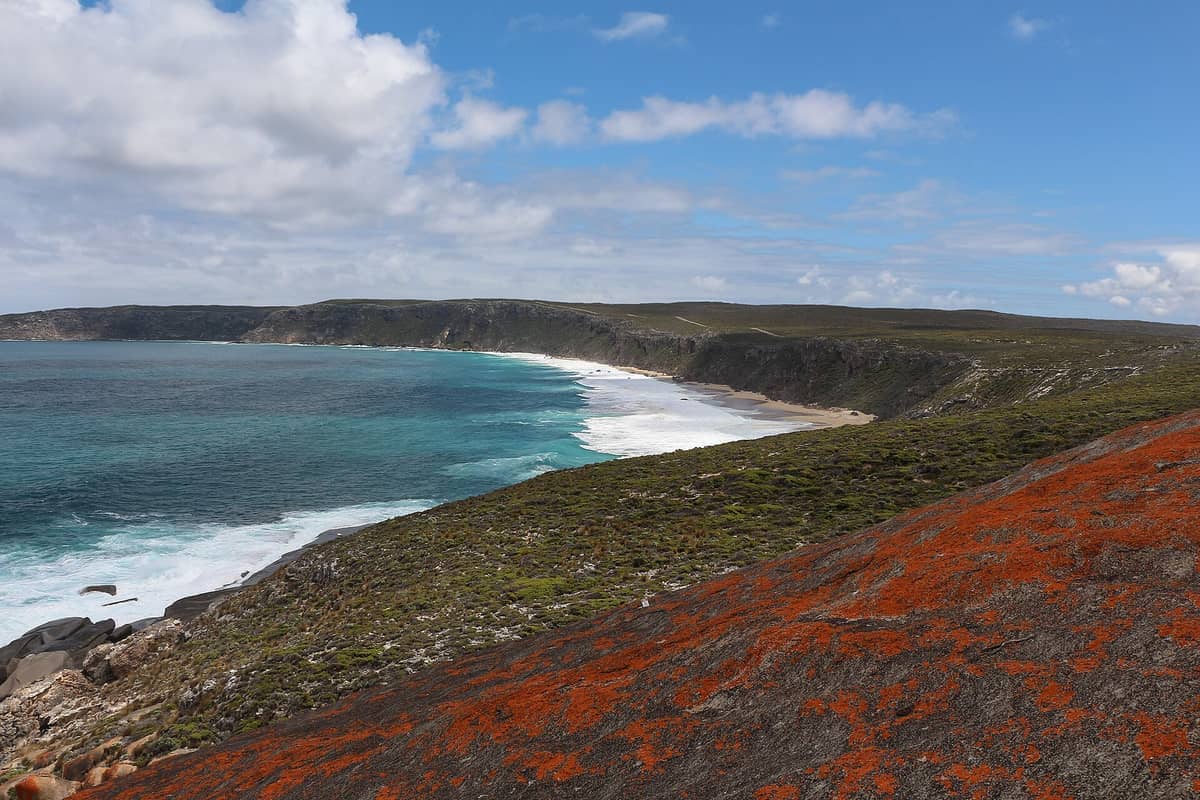
Flinders Chase National Park is not a manicured reserve with colour-coded walking trails and a café at every turn. It is a genuinely wild national park at the western end of Kangaroo Island, first declared in 1919 and expanded over the following century to protect coastal heath, stringybark eucalypt forest, deep river gorges, and exposed sea cliffs in South Australia. About 96% of the park was burned in the 2019–20 Kangaroo Island bushfires, and it has since undergone significant regrowth. The sheer scale of the place — and its distance from the island's main settlements — is the first thing that catches many visitors off guard.
The park's two headline attractions, Remarkable Rocks and Admirals Arch, are about a 20-minute drive apart within the park. Most day visitors see both, but the drive between them, the coastal heath in between, and the chance encounters with wildlife along the way are as much a part of the experience as the rocks themselves.
ℹ️ Good to know
The visitor centre at 8125 South Coast Road, Karatta is your first stop for maps and condition updates. It is outside the park; staff are available daily from 9am to 5pm, and The Rocks Café is on site. Check Parks SA for closures before making the long drive from Kingscote.
The Drive In: Setting Expectations Early
The journey from Kingscote to the park takes roughly 90 minutes on sealed roads via the Playford Highway and then either the West End Highway or the South Coast Road. Most areas of the park are accessible by regular passenger vehicle, though Parks SA recommends 4WD for reaching all corners of the park. The drive itself is part of the experience: the landscape shifts from farmland to low coastal scrub, the road narrows, traffic thins to almost nothing, and by the time the park boundary appears, the sense of remoteness is already fully established.
Fuel up before you leave Kingscote or Parndana. There are no petrol stations inside the park. The visitor centre has The Rocks Café, which serves food and drinks. Carrying extra water is equally important, particularly between November and March when temperatures on the exposed western cape can climb quickly.
⚠️ What to skip
Phone signal drops in and out west of Parndana and is unreliable within much of the park. Download offline maps and the Parks SA trail information before you leave Kingscote.
Tickets & tours
Live prices and dates from our booking partner. If you book, we may earn a commission at no extra cost to you.
Ultimate Adelaide and Hahndorf full-day tour
From 94 €Instant confirmationFree cancellationHalf-day Lofty Descents tour by bike
From 89 €Instant confirmationFree cancellationAdelaide kayak tour with expert instructors
From 51 €Instant confirmationFree cancellationTrue Crime Tour in Adelaide
From 21 €Instant confirmationFree cancellation
Remarkable Rocks: Geology That Earns Its Name
Remarkable Rocks sit on a smooth granite dome that slopes directly into the Southern Ocean at Kirkpatrick Point. The rocks themselves are a cluster of enormous boulders, some weighing hundreds of tonnes, sculpted over millennia by wind, salt spray, and the slow chemistry of lichen growth. Up close, the surface textures are extraordinary: orange, grey, and black lichen patterns coat the granite in broad irregular patches, and the wind-carved hollows in some boulders are deep enough to crouch inside.
An accessible boardwalk leads from the car park down toward the dome, making the main viewpoint reachable by wheelchair and pushchair. The boardwalk ends before the rocks themselves; the final section requires walking across the smooth granite, which is wet and genuinely slippery after rain or heavy morning dew. Closed-toe shoes with grip are strongly advised.
Timing matters enormously here. At sunrise, the low light rakes across the granite and the lichen blazes amber and gold against a pink sky. In the middle of the day, harsh overhead light flattens the textures and the rocks look ordinary in photographs. Sunset is also spectacular, with the boulders silhouetted against the Southern Ocean, but it requires staying in the area into the evening and accounting for the drive back to accommodation in low light. If you can only visit once, go early or late.
Photographers planning to capture the rocks at their best should read the broader guide to best viewpoints around Adelaide and South Australia for context on how Flinders Chase compares to other iconic South Australian vantage points.
Admirals Arch: Where the Land Ends
About 10 kilometres from Remarkable Rocks, the road ends at the Cape du Couedic lighthouse precinct. From the car park, a loop trail descends through coastal heath to Admirals Arch, a natural rock arch carved by the Southern Ocean into the base of the cape's limestone cliffs. The boardwalk winds steeply down to a viewing platform inside and beside the arch, where the scale becomes clear: the opening is large enough for a small building, and through it you can watch swells rolling in from Antarctica, broken into white foam on the jagged rocks below.
New Zealand fur seals have colonised the rocks beneath the arch and the surrounding platform in significant numbers. At almost any time of year you can expect to see dozens of them hauled out and sleeping, barking, or moving between the water and the rocks. The smell is unmistakable well before you reach the platform. At close range, through binoculars from the viewing area, the colony is genuinely absorbing: pups play in rock pools, bulls posture for position, and individuals slide with surprising grace from dry rock into breaking waves.
The hike down and back takes around 45 minutes at a comfortable pace. The descent is moderately steep with some uneven surfaces. The boardwalk itself is wide and well maintained, but the return climb is more demanding than it looks, particularly in warm weather.
Wildlife in the Park: What to Expect
Flinders Chase is one of the best places in Australia to see wildlife at close range without a tour operator or a fenced enclosure. The Kangaroo Island kangaroo subspecies, smaller and darker than their mainland relatives, graze near the visitor centre and along roadsides, particularly at dawn and dusk. Echidnas cross the park roads at their own pace, entirely indifferent to waiting cars. Rosenberg's goannas move through the undergrowth during warmer parts of the day, and the Kangaroo Island glossy black cockatoo, a critically endangered bird found almost nowhere else, can sometimes be spotted feeding in the park's stringybark forests.
Wildlife activity is highest in the early morning and late afternoon. Visitors who arrive at the park gate when it opens have consistently better wildlife encounters than those arriving mid-morning. If seeing native animals in a natural setting is a priority, the broader Adelaide region wildlife guide covers how Flinders Chase compares to options like Cleland Wildlife Park for hands-on encounters.
⚠️ What to skip
Do not feed any wildlife in the park. Kangaroos and birds that are fed by visitors lose their natural foraging behaviour and can become aggressive. Keep at least one metre from all animals and do not attempt to handle echidnas.
Practical Planning: Getting the Most from Your Visit
A half day technically covers both Remarkable Rocks and Admirals Arch, but that assumes you spend no more than 30 minutes at each site and stop nowhere else. A full day is far more satisfying: it allows time at the visitor centre, a relaxed walk at both major sites, lunch, and some exploration of the park roads without feeling rushed. Visitors on a tight Kangaroo Island itinerary sometimes try to combine Flinders Chase with Seal Bay Conservation Park in a single day — this is possible if you leave Kingscote by 7am, but it makes for a long and tiring day.
Entry fees apply and are payable at the park. Official Parks SA pages list fees between A$13 and A$22.40 per person across different pages, so confirm the current rate at parks.sa.gov.au before your visit. The park is open daily from dawn to dusk. Seasonal closures can apply after bushfire or extreme weather events, which have affected parts of the island in recent years.
The best months to visit are March through May and September through November. Summer (December through February) brings fire risk, strong winds off the Southern Ocean, and the possibility of extreme heat on the exposed western cape. Winter is cool and sometimes wet, but the park is quieter and the light quality on overcast days can be outstanding for photography. The rocks look different in every season.
Flinders Chase is one anchor of most Kangaroo Island itineraries. If you are planning a full island visit, the Kangaroo Island from Adelaide guide covers ferry options, recommended bases, and how to structure multiple days across the island's key sites.
Who Should Reconsider This Trip
Flinders Chase is not the right choice for every traveller. The distance from Adelaide, the ferry crossing, and the long drive across the island mean a round trip from the city requires at least one overnight stay on Kangaroo Island to do the park properly. Day-trippers who fly or take the early ferry and return the same evening often find the park rushed and exhausting. If your time in South Australia is limited to two or three days and you haven't yet seen the Adelaide Hills, the Barossa Valley, or the city's core attractions, the logistics of reaching Flinders Chase may not be the best use of that time.
Travellers with limited mobility should note that while the Remarkable Rocks boardwalk is accessible, many other park trails are not. The descent to Admirals Arch involves uneven surfaces and a steep return climb. The park's terrain is inherently rugged and not suitable for pushchairs beyond the designated accessible areas.
Young children generally enjoy the wildlife encounters and the scale of the rocks, but parents should be aware that there are no playgrounds, limited shade at the major sites, and the drive between attractions is long. Bring more snacks, sunscreen, and water than you think you need.
Insider Tips
- Arrive at Remarkable Rocks within 30 minutes of sunrise. The light turns the lichen a deep copper-orange that photographs cannot fully capture, and you will almost certainly have the site to yourself. By 9am on any clear morning, tour buses from Kingscote begin arriving.
- The car park at the Rocky River area near the visitor centre is one of the most reliable places on the island to see echidnas foraging in the early morning. Slow your speed and scan the grass verges carefully as you approach.
- Pack a proper picnic. Pack a proper picnic if you want flexibility. The Rocks Café at the visitor centre serves food and drinks, but should not be relied upon for a full meal. The picnic area near the Rocky River bridge is sheltered and pleasant for lunch.
- Check Parks SA for road conditions before visiting. Some internal park tracks are unsealed and may be closed after rain. Check Parks SA for road conditions before visiting. Some internal park tracks are unsealed and may be closed after rain. Most sections are accessible by regular vehicle in normal conditions; 4WD is recommended to explore the entire park.
- If you are visiting in shoulder season (April–May or September–October), watch for whales off Cape du Couedic. Southern right whales and humpbacks pass through the strait, and the cliff-top vantage points offer some of the most elevated whale-watching on the island.
Who Is Flinders Chase National Park For?
- Nature and wildlife travellers who want authentic encounters without fences or feeding programs
- Landscape and coastal photographers willing to plan around sunrise and sunset lighting
- Geology enthusiasts drawn to unusual granite and limestone coastal formations
- Hikers looking for manageable half-day coastal walks in a genuinely remote setting
- Kangaroo Island visitors building a multi-day itinerary around the island's western highlights
Nearby Attractions
Other things to see while in Kangaroo Island:
- Admirals Arch
Admirals Arch is a massive natural rock arch at Cape du Couedic on Kangaroo Island's rugged southwestern tip, sculpted by millennia of Southern Ocean erosion. A steep boardwalk descends through windswept scrub to a viewing platform where New Zealand fur seals sprawl across the rocks below, framed by hanging stalactites and crashing surf.
- Remarkable Rocks
Perched on a granite dome that plunges 75 metres toward the Southern Ocean, Remarkable Rocks is one of Australia's most photographed geological sites. Wind, salt spray, and half a billion years of erosion have carved these boulders into shapes that look borrowed from another planet — and the light changes everything depending on when you arrive.
- Seal Bay Conservation Park
Seal Bay Conservation Park protects one of Australia's third-largest colonies of Australian sea lions, a species found nowhere else on Earth. A 900-metre return boardwalk places visitors within metres of animals resting, nursing pups, and hauling themselves up from the surf on the park's remote southern beach.
Planning a trip? Discover personalized activities with the Nomado app.