Seal Bay Conservation Park: Walking Among Australia's Rarest Sea Lions
Seal Bay Conservation Park protects one of Australia's third-largest colonies of Australian sea lions, a species found nowhere else on Earth. A 900-metre return boardwalk places visitors within metres of animals resting, nursing pups, and hauling themselves up from the surf on the park's remote southern beach.
Quick Facts
- Location
- Seal Bay Road, Kangaroo Island SA 5221 — approx. 45 min drive from Kingscote
- Getting There
- Private vehicle or tour operator on Kangaroo Island; no public transit. Reach the island via Sealink Ferry from Cape Jervis or direct flights to Kingscote Airport
- Time Needed
- 1–2 hours including the boardwalk and Visitor Centre
- Cost
- Self-guided boardwalk: check current prices with the park
- Best for
- Wildlife encounters, families, photographers, nature travellers
- Official website
- www.parks.sa.gov.au/experiences/seal-bay
What Seal Bay Actually Is
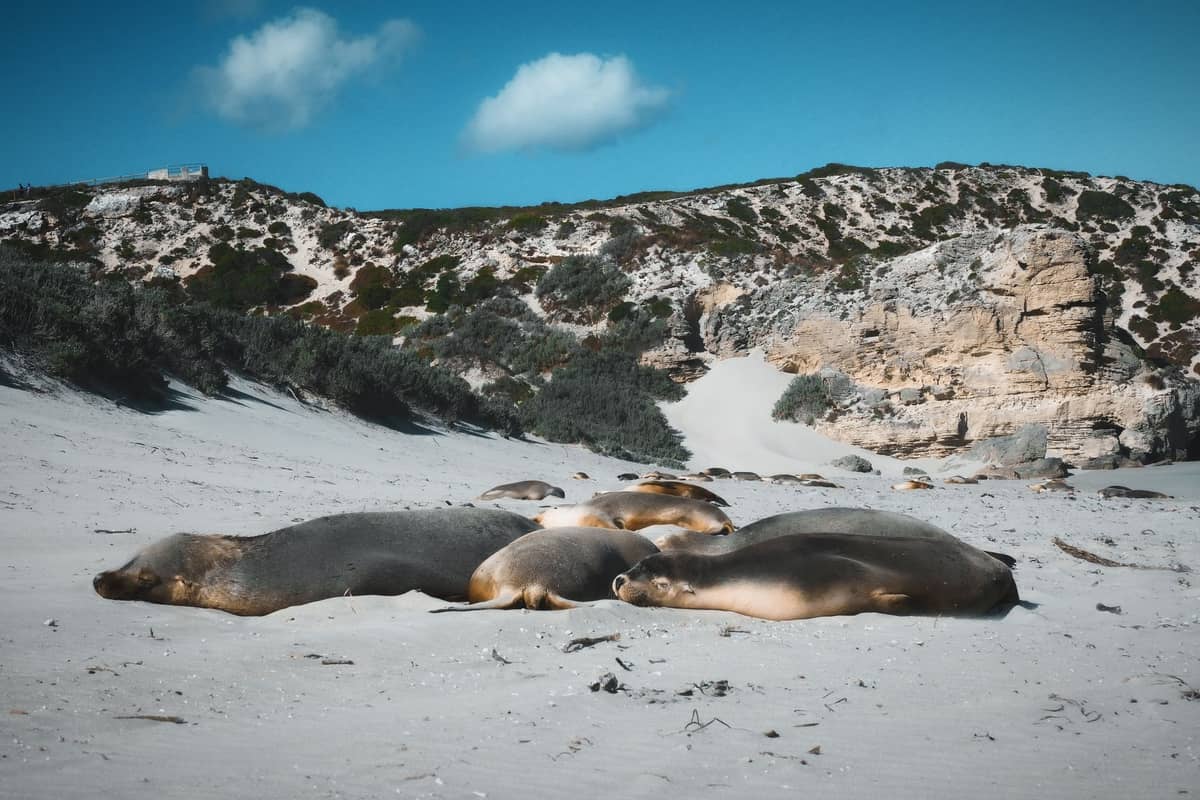
Seal Bay Conservation Park sits on the southern coast of Kangaroo Island, and it protects one of the largest breeding colonies of Australian sea lions in existence. The Australian sea lion is endemic to South Australia and Western Australia and is listed as endangered, making this population genuinely significant rather than merely scenic. The Seal Bay colony numbers more than 800 animals, though the number visible on the beach at any one time varies with their movements between feeding trips at sea.
The park is managed by the National Parks and Wildlife Service South Australia. Visitors access the beach area via a 900-metre return boardwalk that descends from the Visitor Centre down through coastal scrub to elevated viewing platforms above the sand. The boardwalk keeps people at a respectful distance from the animals while still allowing remarkably close views, often just a few metres between you and a sleeping bull or a mother nursing her pup.
ℹ️ Good to know
Beach access is currently paused to protect the colony. All viewing is from the boardwalk and platforms. Verify current access conditions at parks.sa.gov.au before your visit, as management arrangements can change.
The Experience on the Boardwalk
The walk itself is short, but it rarely feels rushed. The scrub on either side of the boardwalk is dense and aromatic, thick with native coastal plants whose salt-adapted foliage brushes the rails in places. Then the vegetation opens, and you're looking down at a broad pale beach where sea lions are arranged across the sand in various states of exhaustion or mild irritation. The animals return from multi-day oceanic feeding trips and collapse on the beach to recover, which is why they look so deeply, comically asleep.
Up close, Australian sea lions are larger than most visitors expect. Adult males can weigh over 200 kilograms and carry heavy scarring from territorial battles. Females are smaller and considerably more mobile, often seen repositioning pups or hauling themselves into the shallow shore break and back out again. Pups range from jet-black newborns to larger juveniles with coats transitioning to silver-grey. The colony does not follow a single breeding season, which means pups of different ages are often present simultaneously.
The sounds are worth preparing for: deep, resonant barking from bulls, the higher-pitched yelping of pups, and the wet, heavy breathing of animals moving across sand. On warmer days, the smell of the colony carries on the breeze well before the beach comes into view. These are not incidental details; they are part of what makes Seal Bay feel like a genuine wildlife encounter rather than a managed zoo experience.
Tickets & tours
Live prices and dates from our booking partner. If you book, we may earn a commission at no extra cost to you.
Ultimate Adelaide and Hahndorf full-day tour
From 94 €Instant confirmationFree cancellationHalf-day Lofty Descents tour by bike
From 89 €Instant confirmationFree cancellationAdelaide kayak tour with expert instructors
From 51 €Instant confirmationFree cancellationTrue Crime Tour in Adelaide
From 21 €Instant confirmationFree cancellation
Morning vs Afternoon: When to Visit
The park is open daily from 9 am to 5 pm, with last entry at 4 pm. The number of sea lions visible varies with the natural rhythms of the colony rather than the time of day, so there is no single hour that guarantees a fuller beach. That said, visiting in the morning tends to offer softer photographic light and slightly cooler temperatures, which matters on Kangaroo Island's summer days when the exposed coastal scrub provides little shade.
Mid-morning arrival, around 9:30 to 10:30 am, also helps you avoid the overlap with large afternoon tour groups that tend to arrive in convoys after lunch. The boardwalk platforms have limited standing space, and busy periods can make it harder to settle quietly and watch without distraction. If you are travelling independently by hire car, arriving close to opening gives you the most relaxed experience.
💡 Local tip
Tickets are purchased at the Visitor Centre on arrival. There is no online pre-booking shown on the official site, so plan for a short queue during peak visitor periods in January and April school holidays.
Historical and Conservation Context
Australian sea lions were heavily hunted by sealers throughout the 19th century, and the species never fully recovered. Current estimates suggest a national population of fewer than 12,000 animals, and numbers have been declining. The Seal Bay colony is one of the more stable populations, which is partly attributable to the protections put in place by the South Australian government over many decades. The park was formally established as a conservation zone long before wildlife tourism became a standard part of the Kangaroo Island visitor economy.
The 2019–20 bushfires that devastated large areas of Kangaroo Island affected parts of the island's road network and visitor infrastructure, but Seal Bay itself and the sea lion colony were not directly impacted. The island has been progressively rebuilding its tourism infrastructure since then. If you want broader context on visiting the island, the guide to Kangaroo Island from Adelaide covers ferry access, driving distances, and recommended itineraries.
The management approach at Seal Bay reflects genuine conservation priorities rather than visitor comfort. Boardwalk positioning, platform heights, and the current pause on direct beach access all reflect decisions made to reduce disturbance to the colony. Visitors who come expecting a petting-zoo dynamic will be disappointed; visitors who come to observe wild animals behaving naturally will leave satisfied.
Getting to Seal Bay
Kangaroo Island is reached either by the Sealink Ferry from Cape Jervis, roughly two hours south of Adelaide, or by regional flights into Kingscote Airport. The ferry crossing takes approximately 45 minutes. From Kingscote, Seal Bay is about 45 minutes by road; a hire car is the practical standard for independent travellers, as there is no public bus service connecting island townships to the park.
Several Adelaide-based tour operators offer day trips or multi-day packages that include Seal Bay as a scheduled stop. These typically depart early to allow time at the park before the midday heat. For planning your broader time on the island and the south coast, the day trips from Adelaide guide outlines realistic timelines. Free parking is available at the park; the sealed access road off the South Coast Road is straightforward.
Photography and Practical Preparation
The boardwalk platforms offer elevated sightlines across the beach, which is useful for photography. A zoom lens in the 70–200mm range lets you isolate individual animals without needing to crop heavily; wider shots of the full beach work well with anything from 24mm upward. Morning light comes from the east and hits the beach at a low angle before 10 am, producing warm tones on the animals' coats. Afternoon light from the west can be harsh and create strong shadows across the sand.
Sun protection is non-negotiable. The coastal scrub provides very little shade along the boardwalk, and Kangaroo Island's southern latitude does not reduce UV intensity as much as visitors from cooler climates might assume. Bring water, a hat, and sunscreen regardless of the season. Closed shoes with grip are advisable; the boardwalk is solid and flat, but sandy paths near the Visitor Centre can be loose.
The Visitor Centre has accessible toilets and a small interpretive display explaining the life cycle and conservation status of Australian sea lions. The 900-metre return boardwalk and viewing platforms are wheelchair accessible. For a sense of how Seal Bay fits into the broader Kangaroo Island wildlife picture, the Adelaide wildlife guide covers comparable experiences across the South Australian region.
Who Should Reconsider
Seal Bay is not the right choice for visitors who want guaranteed, close, interactive contact with wildlife. The animals are wild, and on days when the colony is between feeding trips, only a handful of individuals may be on the beach. There is no feeding, no handling, and no structured performance. If that sounds underwhelming, the experience will likely feel underwhelming.
The A$20.70 adult admission is reasonable for what it provides, but travellers on a tight budget who are already paying ferry fares and Kangaroo Island hire-car costs should weigh whether the park fits their budget overall. The Adelaide on a budget guide has broader cost-planning context. Visitors with significant mobility limitations beyond wheelchair use should check current boardwalk conditions with the park directly, as the descent from the Visitor Centre involves some gradient.
Insider Tips
- Arrive as close to 9 am as your schedule allows. The colony's activity on the beach is unpredictable, but you will have the platforms largely to yourself and better light for photography.
- Watch the surf line from the platforms: sea lions returning from feeding trips haul themselves through the shore break and up the beach in a sequence that takes several minutes. Catching this is far more dramatic than watching a stationary sleeping animal.
- The Visitor Centre interpretive displays are brief but genuinely informative about the breeding cycle. Knowing that females travel offshore to feed and may be away for days at a time reframes what you are seeing on the beach.
- Kangaroo Island's southern coast is exposed to prevailing swells from the Southern Ocean, and wind can be sharp even in summer. A light jacket in a daypack is worth the space.
- If you have a flexible itinerary, check the Seal Bay social media or call ahead: park rangers sometimes note when the beach is particularly full, though the colony does not follow a schedule.
Who Is Seal Bay Conservation Park For?
- Wildlife photographers who want elevated, unobstructed sightlines of large marine mammals in a natural setting
- Families with children old enough to walk 900 metres and follow boardwalk rules without touching the fence rails
- Nature-focused travellers who prioritise genuine conservation experiences over curated animal encounters
- Kangaroo Island day-trippers building an itinerary around the island's wildlife highlights
- Travellers with reduced mobility who want accessible wildlife viewing without rough terrain
Nearby Attractions
Other things to see while in Kangaroo Island:
- Admirals Arch
Admirals Arch is a massive natural rock arch at Cape du Couedic on Kangaroo Island's rugged southwestern tip, sculpted by millennia of Southern Ocean erosion. A steep boardwalk descends through windswept scrub to a viewing platform where New Zealand fur seals sprawl across the rocks below, framed by hanging stalactites and crashing surf.
- Flinders Chase National Park
Flinders Chase National Park is located at the western end of Kangaroo Island and protects some of the most dramatic coastal scenery in South Australia. From the granite boulders of Remarkable Rocks to the limestone arch of Admirals Arch, this park, first declared in 1919, rewards travellers who make the long drive with landscapes unlike anything on the Australian mainland.
- Remarkable Rocks
Perched on a granite dome that plunges 75 metres toward the Southern Ocean, Remarkable Rocks is one of Australia's most photographed geological sites. Wind, salt spray, and half a billion years of erosion have carved these boulders into shapes that look borrowed from another planet — and the light changes everything depending on when you arrive.
Planning a trip? Discover personalized activities with the Nomado app.