Remarkable Rocks: Kangaroo Island's Ancient Granite Formations
Perched on a granite dome that plunges 75 metres toward the Southern Ocean, Remarkable Rocks is one of Australia's most photographed geological sites. Wind, salt spray, and half a billion years of erosion have carved these boulders into shapes that look borrowed from another planet — and the light changes everything depending on when you arrive.
Quick Facts
- Location
- Boxer Drive, Flinders Chase National Park, Kangaroo Island SA 5223
- Getting There
- Self-drive only; approx. 110 km west of Kingscote via South Coast Road. No public transit serves the site.
- Time Needed
- 45 minutes to 1.5 hours at the rocks; allow a full day from Kingscote
- Cost
- Flinders Chase National Park entry: A$14.90 adult, A$8.70 child (4–15), A$11.80 concession, A$40 family (verify before visiting)
- Best for
- Geology lovers, photographers, hikers, wildlife watchers
What Are Remarkable Rocks?
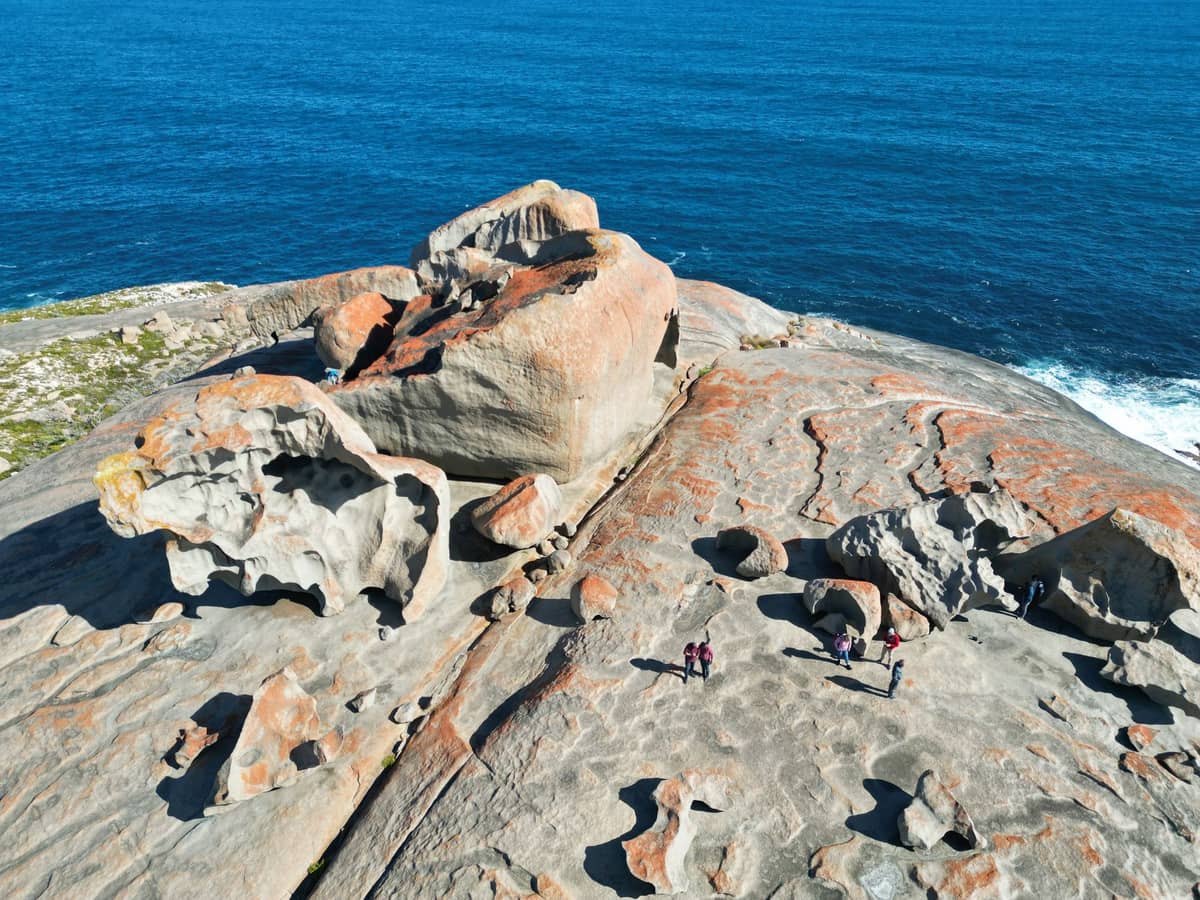
Remarkable Rocks is a cluster of enormous granite boulders sitting atop a smooth dome of exposed rock at the southwestern tip of Kangaroo Island, within Flinders Chase National Park. The formations have been shaped by approximately 500 million years of wind erosion, salt-laden sea spray, and the relentless grinding of the Southern Ocean climate. The result is a collection of boulders whose hollowed-out faces, arching overhangs, and peculiar silhouettes look less like geology and more like sculpture — the kind that no human hand could replicate at this scale.
The granite dome itself descends roughly 75 metres from the crest down toward the sea, so as you walk across it, the ocean appears to rise up to meet the rock. The boulders range from the size of a small car to structures large enough to walk through or crouch beneath. Some are stained vivid orange by lichen — a slow-growing crust that takes decades to reach even thumbnail size, offering a quiet reminder of the timescales at work here.
ℹ️ Good to know
Park entry fees apply to Flinders Chase National Park. As of the most recent published rates: A$14.90 adult, A$8.70 child (ages 4–15), A$11.80 concession, A$40 family. Always confirm current fees with the South Australian National Parks booking system before your visit, as prices are subject to change.
How the Experience Changes Through the Day
The quality of light at Remarkable Rocks is transformative. Early morning arrivals, particularly in the hour after sunrise, are rewarded with warm orange and gold tones that make the lichen-covered surfaces glow. The shadows are long, emphasizing the sculpted contours of each boulder, and the site is typically quieter before tour groups arrive mid-morning. The combination of low light and cooler temperatures also makes early starts more comfortable, especially in summer when midday temperatures can become intense on the exposed dome.
By late afternoon, the light shifts to deep amber and red tones as the sun drops toward the Southern Ocean. Sunset visits are popular for photography, and on clear evenings the rocks take on an almost cinematic quality as the sky turns above them. That said, dusk visits require careful timing: the walk back from the dome to the car park in failing light on uneven rock is something to plan for, and the park recommends visitors plan their departure accordingly.
Midday visits are perfectly workable but offer the flattest light for photography and the largest tour group presence. If you are visiting in summer (December through February), the exposed dome offers no shade, and the granite surface absorbs heat significantly. Bring water regardless of season — the wind can dehydrate faster than expected on this exposed coastal headland.
⚠️ What to skip
The granite dome is exposed and unshaded. Wind can be strong enough to affect balance near the edges, and the rock surface becomes slippery when wet. Closed-toe shoes with grip are strongly recommended. Stay within the designated walking area and respect barrier fencing near the cliff edge.
Tickets & tours
Live prices and dates from our booking partner. If you book, we may earn a commission at no extra cost to you.
Ultimate Adelaide and Hahndorf full-day tour
From 94 €Instant confirmationFree cancellationHalf-day Lofty Descents tour by bike
From 89 €Instant confirmationFree cancellationAdelaide kayak tour with expert instructors
From 51 €Instant confirmationFree cancellationTrue Crime Tour in Adelaide
From 21 €Instant confirmationFree cancellation
The Geology: 500 Million Years, Compressed
The granite at Flinders Chase began forming deep underground during the Cambrian period, roughly 500 million years ago. Magma cooled slowly beneath the surface, forming the coarse-grained crystalline rock that is now exposed at the surface. Over geological time, overlying rock eroded away, releasing pressure and allowing the granite to expand and crack along natural fracture lines. Wind-driven sand and salt then worked into those cracks, rounding edges, hollowing cores, and sculpting the irregular shapes visible today.
The orange coloring is not paint or staining in the conventional sense. It is primarily the work of crustose lichen, a symbiotic organism combining algae and fungi that attaches directly to the rock surface. Some patches of lichen on these rocks are estimated to be hundreds of years old. The grey-green patches you will notice alongside the orange are different lichen species, and together they form a living record of the surface's exposure history.
Remarkable Rocks is part of Flinders Chase National Park, which covers the western third of Kangaroo Island and protects one of South Australia's most intact native ecosystems. The park's isolation has made it a stronghold for species that have been lost or reduced elsewhere, including the Kangaroo Island dunnart and the glossy black cockatoo.
Practical Walkthrough: Arriving and Moving Around the Site
From the car park, a boardwalk leads to the edge of the granite dome. The boardwalk is a short flat walk suitable for most visitors, and a viewing platform near the start of the route provides a vantage point with accessibility provisions for visitors who cannot traverse the uneven dome surface. Beyond the platform, the experience involves walking directly on the granite, which is irregular and sloping in places.
Once on the dome, there is no single prescribed route. Most visitors naturally move between the major boulder formations, circling them, ducking under overhangs, and working toward the ocean-facing edge for views of the cliffs and sea. Allow at least 45 minutes to take this in without rushing, or up to 90 minutes if you want to photograph the rocks thoroughly from multiple angles at different points on the dome.
Remarkable Rocks is typically combined with a visit to Admirals Arch, another striking geological formation about 11 kilometres away within the same national park. The two sites together form a natural half-day loop in the western end of the island. A stop at Cape du Couedic Lodge or the nearby lighthouse is also worth considering if time allows.
Getting to Remarkable Rocks
Kangaroo Island is reached by ferry from Cape Jervis on the Fleurieu Peninsula, or by a short flight from Adelaide Airport. The Sealink ferry crossing takes approximately 45 minutes and operates multiple services daily, though bookings are strongly recommended, especially in peak season. From the island's main town, Kingscote, Remarkable Rocks is approximately 110 kilometres west via South Coast Road. The road is sealed for most of the route and manageable in a standard vehicle, though the last section into the park traverses quiet rural roads.
There is no public transport serving Remarkable Rocks or Flinders Chase National Park. Self-driving is the only practical option for independent travellers. Organized day tours from Adelaide and Kingscote are available and can simplify logistics considerably. For broader context on planning a trip to the island, the Kangaroo Island from Adelaide guide covers ferry options, driving routes, and recommended itineraries.
💡 Local tip
Fill your fuel tank in Kingscote or Parndana before heading west. Fuel availability near Flinders Chase is limited. Also check the official South Australian National Parks website for any park alerts or temporary closures before departure — fire risk closures can occur during extreme weather periods.
Photography Tips and What to Expect from the Views
The rocks photograph best in directional light, which means early morning or late afternoon. At both ends of the day, the low sun rakes across the surface textures and makes the lichen colors saturate to deep orange and burnt sienna. A wide-angle lens captures the scale of the dome and ocean backdrop together. A telephoto lens, on the other hand, allows you to compress the distance between boulders and coastline, which produces a different and equally strong result.
For scale, include a person in the frame. The boulders are large enough that without a human reference point, photographs often fail to communicate just how massive the individual rocks are. The most dramatic single image most visitors take is the view looking back from the ocean-facing edge of the dome, with boulders in the foreground and the Southern Ocean behind.
Wildlife sightings around the dome are common. Kangaroo Island is home to the Kangaroo Island kangaroo (a distinct subspecies) and short-beaked echidnas, both of which may be encountered near the car park or on the approach walk. For more on island wildlife, the Seal Bay Conservation Park on the island's southern coast is one of the few places in the world where you can walk among a colony of Australian sea lions at close range.
Who Will Get the Most — and Least — Out of This Visit
Remarkable Rocks rewards visitors who are willing to slow down. Those who arrive, take a few photos from the boardwalk platform, and leave in fifteen minutes will have ticked the box but missed the point. The full experience comes from spending time on the dome, watching how shadows shift across the rock faces, noticing the texture of the granite up close, and sitting with the view of the ocean long enough for the scale of the place to register.
Visitors with significant mobility limitations should note that the boardwalk and viewing platform are accessible, but the main dome area involves uneven granite walking that is not wheelchair-friendly. Families with young children will find the site manageable, though supervision close to the cliff-facing edges is essential. Travellers who expect manicured infrastructure or interpretive museum-style experiences may find the site sparse — there are no cafes, no sheltered picnic areas at the rocks themselves, and limited interpretive signage. The value here is entirely geological and visual. If that is not your travel mode, the broader Kangaroo Island itinerary includes alternatives across the island to suit different interests.
Insider Tips
- Arrive at or just after sunrise if you are staying on the western end of Kangaroo Island. The car park is small and fills quickly once tour buses start arriving around 9–10 AM. An early visit means the dome largely to yourself and the best photographic light of the day.
- Dress in more layers than you think you need. The Southern Ocean wind on the exposed dome is consistent and often cold even on warm days inland. A wind layer takes up almost no space and makes an enormous difference to comfort.
- Walk to the far ocean-facing edge of the dome, not just the first cluster of boulders near the boardwalk. The views back toward the rocks with the coastline beneath them are the most dramatic in the whole site and most short-visit tourists never reach them.
- Check the South Australian National Parks fire danger and park closure alerts in the days before your visit, particularly in summer. Flinders Chase suffered severe bushfire damage in the 2019–2020 fire season and access conditions have changed; conditions continue to evolve as the park recovers.
- Combine this stop with Admirals Arch as a single morning, then head east toward Vivonne Bay for lunch. This routing avoids driving the same road twice and gives you three distinct Kangaroo Island landscapes in one half-day.
Who Is Remarkable Rocks For?
- Geology and landscape photography enthusiasts looking for a genuinely unusual natural subject
- Nature travellers who want to experience Kangaroo Island's wild southwestern coastline beyond the beaches
- Families with older children who can manage uneven terrain and will appreciate the hands-on scale of the formations
- Visitors on a multi-day Kangaroo Island itinerary with time to explore Flinders Chase National Park properly
- Early risers who can arrive at dawn for golden light and near-solitude on the dome
Nearby Attractions
Other things to see while in Kangaroo Island:
- Admirals Arch
Admirals Arch is a massive natural rock arch at Cape du Couedic on Kangaroo Island's rugged southwestern tip, sculpted by millennia of Southern Ocean erosion. A steep boardwalk descends through windswept scrub to a viewing platform where New Zealand fur seals sprawl across the rocks below, framed by hanging stalactites and crashing surf.
- Flinders Chase National Park
Flinders Chase National Park is located at the western end of Kangaroo Island and protects some of the most dramatic coastal scenery in South Australia. From the granite boulders of Remarkable Rocks to the limestone arch of Admirals Arch, this park, first declared in 1919, rewards travellers who make the long drive with landscapes unlike anything on the Australian mainland.
- Seal Bay Conservation Park
Seal Bay Conservation Park protects one of Australia's third-largest colonies of Australian sea lions, a species found nowhere else on Earth. A 900-metre return boardwalk places visitors within metres of animals resting, nursing pups, and hauling themselves up from the surf on the park's remote southern beach.
Planning a trip? Discover personalized activities with the Nomado app.