Củ Chi Tunnels: Underground History That Changes How You See the War
The Củ Chi Tunnels are one of the most viscerally affecting historical sites in Southeast Asia. Stretching across Củ Chi District roughly 40 to 70 kilometers northwest of Ho Chi Minh City depending on the visitor site, this network of wartime passages forces you to confront the scale of human endurance in a way that no museum can replicate. Whether you crawl through a reconstructed tunnel section or simply stand at the forest entrance listening to a guide describe life underground, the experience stays with you.
Quick Facts
- Location
- Provincial Road 15, Phu Hiep Hamlet, Phu My Hung Commune, Củ Chi District, Ho Chi Minh City (~40km northwest of city center)
- Getting There
- Grab or taxi from HCMC (approx. 400,000–600,000 VND, 1.5–2 hours); organized day tours widely available from District 1
- Time Needed
- 3–5 hours on-site; full day if combining with Mekong Delta or nearby stops
- Cost
- Admission fees apply (exact VND rates vary by site and change seasonally; confirm via vietnamtourism.gov.vn before visiting)
- Best for
- History travelers, war memorial visitors, and anyone who wants physical context for the Vietnam War
What the Củ Chi Tunnels Actually Are
The Củ Chi Tunnels (Địa đạo Củ Chi) are a network of hand-dug underground passages that once stretched for approximately 250 kilometers beneath the jungle and rice paddies of Củ Chi District. Today, small sections of the original tunnel network have been widened and opened for visitors at two main sites, both designated as national historical landmarks. Construction began in the 1940s during resistance against French colonial forces and expanded dramatically through the 1960s during the Vietnam War, when the tunnels served as a critical base of operations for fighters operating close to the American military command in Saigon.
The system was not simply a series of passages. It was an underground city, with three levels reaching between 3 meters and 12 meters below the surface. Within the network there were field hospitals, arms factories, sleeping quarters, kitchens, and meeting rooms, all connected by narrow tunnels that a slender adult must crouch or crawl through. The scale of this engineering, accomplished with hand tools under active bombardment, is the detail that most visitors struggle to absorb at first.
ℹ️ Good to know
There are two main visitor sites: Bến Đình, closer to the city (~40 km), with reconstructed tunnel sections designed for tourist access; and Bến Dược, farther out (~70 km), considered the more historically significant and atmospheric of the two. Most organized tours go to Bến Đình. If you have a private vehicle and extra time, Bến Dược rewards the effort.
Arriving and Orienting Yourself
The drive out from Ho Chi Minh City is itself informative. You pass through increasingly rural landscape along QL22, watching the density of the city give way to nurseries, rice fields, and roadside workshops. By the time you reach the site entrance, the contrast with central Saigon is complete. The air smells of red laterite soil, warm rubber trees, and distant wood smoke. The surrounding forest is secondary growth, nothing like the jungle that covered this area during the war, but it is dense enough to evoke the right sense of concealment.
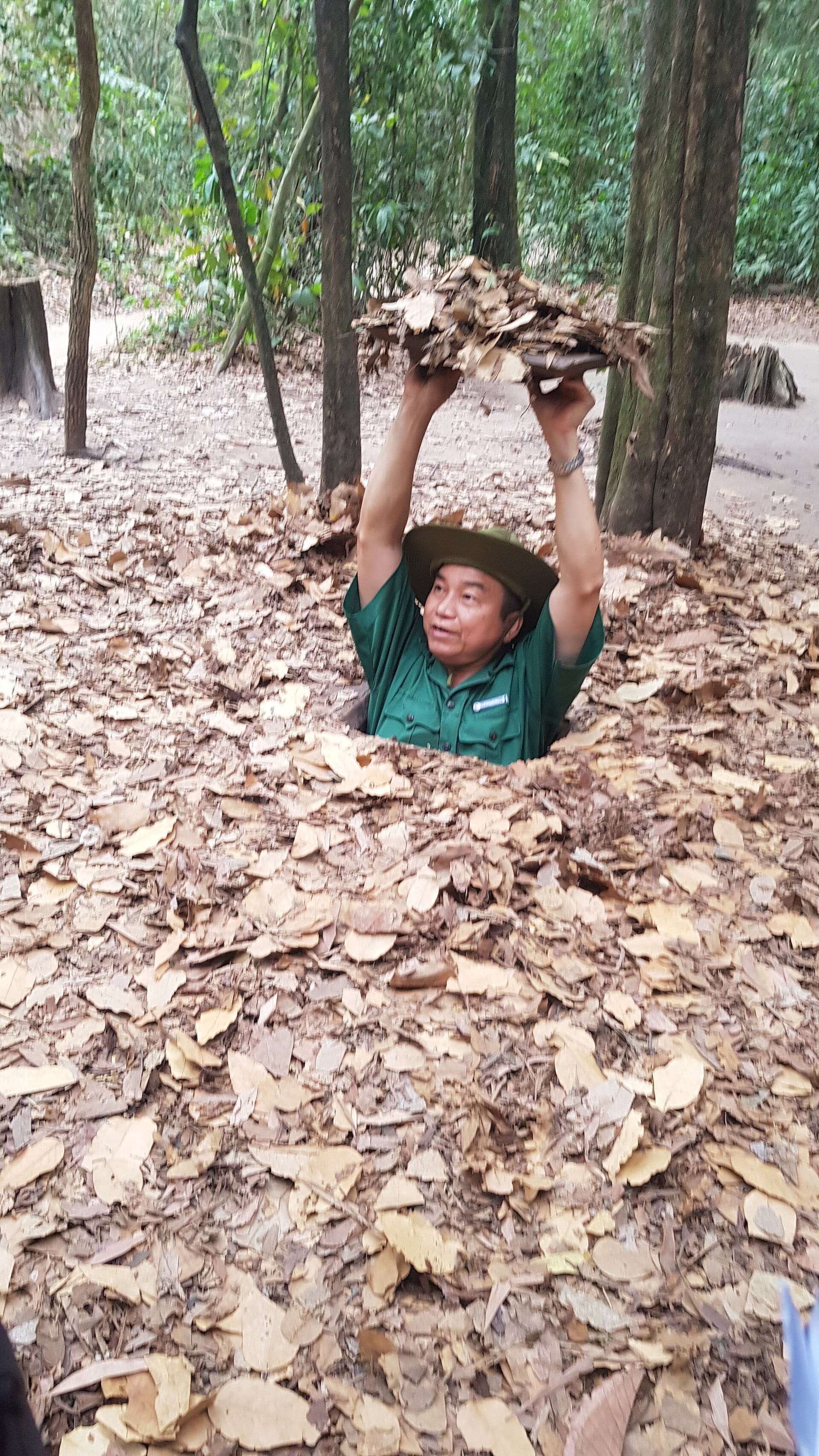
At the entrance, you will typically watch a short documentary film, produced in a style that reflects its Soviet-era origins, before joining a guided tour of the grounds. The narration can feel heavy-handed by Western standards, but the underlying facts speak for themselves. A guide will walk you through the tunnel complex, pointing out trapdoors camouflaged by leaves, ventilation holes disguised as termite mounds, and the various booby trap demonstrations that have become a standard part of the tour route.
Tickets & tours
Live prices and dates from our booking partner. If you book, we may earn a commission at no extra cost to you.
Cu Chi tunnels guided experience from Ho Chi Minh City
From 33 €Instant confirmationFree cancellationHalf-day Cu Chi Tunnels guided tour from Ho Chi Minh City
From 21 €Instant confirmationFree cancellationGuided tour of Cu Chi Tunnels and Mekong Delta in a small group
From 40 €Instant confirmationPremium Cu Chi Tunnels Tour Exploring Vietnam's History From HCM
From 15 €Instant confirmationFree cancellation
Going Underground: What the Crawl Actually Feels Like
The reconstructed tunnel sections at Bến Đình have been widened to accommodate the average build of an international visitor, which means they are still extremely tight. You move in a low crouch, palms on the packed earth walls when the passage narrows, the ceiling brushing your back. The temperature drops perceptibly within the first few meters, which feels like relief in the midday heat until the confinement registers. The darkness is genuine in stretches, broken only by occasional low-watt bulbs. Most people complete the 20 to 40 meter tourist sections without difficulty. Those with claustrophobia should know in advance that there is no comfortable way to turn back mid-tunnel.
The original tunnels that fighters used during the war were significantly narrower than what visitors experience today, a fact that the guides make clear and that is almost impossible to fully visualize until you are inside. The physical restriction is the most instructive part of the entire experience. No exhibition panel can communicate what months of living in that confinement would mean.
💡 Local tip
Wear dark, close-fitting clothing you do not mind getting dusty. Loose shirts catch on tunnel walls. Light-colored clothes will show the red clay immediately and the staining is difficult to wash out. Closed-toe shoes with grip are essential, as the ground can be slippery inside.
The Above-Ground Experience
The tunnel crawl gets most of the attention, but the above-ground portions of the site carry equal weight. The grounds include reconstructed living quarters and workshop spaces, where guides explain how entire communities cooked underground using smoke-dispersal systems designed to release exhaust hundreds of meters away from the actual cooking fires. There are displays of weaponry, ordnance, and everyday objects recovered from the site, as well as scale models showing the full three-level structure of the tunnel system.
One addition that many visitors find jarring is the shooting range, where tourists can pay to fire replica wartime weapons including M16s and AK-47s. The sound of gunfire echoes across the site throughout the day. Whether you find this an experiential detail or a tone-deaf offering depends entirely on your own sensibility. It is worth knowing about in advance.
The site also borders the Saigon River in parts, and the wider Củ Chi area connects to broader wartime history across the region. If you are building a multi-day itinerary, the War Remnants Museum in District 1 provides essential contextual grounding before or after the tunnel visit, presenting photographic and material evidence of the conflict from multiple perspectives.
Best Time to Visit and How the Experience Shifts
Morning visits, arriving before 9am if possible, offer the site in relative quiet. The forest holds the cool of the night longer in the first hours, and the tour groups from central Ho Chi Minh City typically arrive between 9:30am and 11am. By midday, the heat in the open sections becomes significant: Củ Chi is inland and less affected by coastal breezes, and the laterite soil radiates heat intensely through the afternoon. If you are visiting independently rather than on an organized tour, an early start by private car or Grab is strongly recommended.
Dry season, roughly November through April, makes the ground conditions more comfortable and the jungle paths easier to walk. During the wet season, the red soil becomes deeply muddy, which actually adds a layer of realism to the visit but can make footing difficult. For general timing advice about Ho Chi Minh City's climate and how it affects outdoor sites, see the best time to visit Ho Chi Minh City guide.
Getting There: Your Practical Options
The most straightforward approach for independent travelers is to book a half-day or full-day organized tour from the backpacker hub around Phạm Ngũ Lão. These tours typically include transport and a guide and cost considerably less than arranging private transport. The trade-off is a fixed pace and the social density of a group tour.
Traveling independently by Grab or pre-arranged taxi costs approximately 400,000 to 600,000 VND each way and takes between 90 minutes and two hours depending on traffic leaving the city. The route follows QL22 northwest out of Ho Chi Minh City. There is no practical public bus connection that most international visitors would find manageable. For a broader overview of transport options across the city, the getting around Ho Chi Minh City guide covers the key options and realistic costs.
Some visitors combine the Củ Chi Tunnels with a Mekong Delta day trip, though this makes for a genuinely exhausting day. Both sites are worthwhile on their own terms and reward more time than a rushed combination allows.
Honest Assessment: Is It Worth the Journey?
The Củ Chi Tunnels are not a comfortable attraction. The drive is long, the heat is real, the site's interpretive tone is one-sided by academic standards, and the shooting range creates an odd atmosphere. None of that diminishes what the site communicates. The physical act of entering even a widened, lit, tourist-safe tunnel section produces an understanding of the war that no amount of reading achieves. For that reason alone, the visit earns its place on any serious itinerary.
Travelers who prefer climate-controlled museums with balanced curatorial voices will find elements here that grate. Travelers with significant mobility limitations should be aware that the tunnel sections require crouching, and the grounds involve uneven paths through a forest site. Children old enough to understand the historical context and physically capable of the crawl tend to find the experience memorable in the best sense. Very young children may find the overall atmosphere, including the recorded narration and darkness underground, more distressing than illuminating.
For those building a fuller picture of Ho Chi Minh City's wartime history, a visit pairs naturally with the Reunification Palace in District 1, which presents the other side of the same conflict from inside the former South Vietnamese government headquarters.
Insider Tips
- Request Bến Dược specifically if you are traveling independently. Most organized tours default to Bến Đình because it is closer to the city, but Bến Dược sits within a larger forested area and feels significantly less curated.
- Bring cash in Vietnamese Dong. The site entrance, any food stalls, and the shooting range do not reliably accept card payments.
- The tapioca and sweet potato served at the site are the same basic foods that tunnel inhabitants ate during the war. Trying them is one of the few moments where you can make a direct sensory connection to that period, and they are genuinely good.
- If the tunnel crawl triggers unexpected claustrophobia, you can exit at designated points, and no guide will pressure you to continue. Know before you enter that there is no fast reverse option, only forward to the next exit.
- Carry a small flashlight or use your phone torch even when the tunnel sections have lighting. The lights can be unreliable and the difference between dim and dark underground is significant.
Who Is Củ Chi Tunnels For?
- History travelers with a specific interest in the Vietnam War and its logistics
- Physically active visitors who want an experiential rather than passive historical encounter
- Travelers pairing HCMC urban history with a rural, outdoors context
- School-age children and older who can handle enclosed spaces and sobering subject matter
- Anyone who has already visited the War Remnants Museum and wants physical context to accompany the photographic record
Planning a trip? Discover personalized activities with the Nomado app.