Saat Kulesi (Clock Tower): Antalya's Ottoman Timekeeper in the Heart of Kaleici
Standing at the edge of Antalya's ancient walls, the Saat Kulesi is a 14-metre Ottoman clock tower built in 1901 with a pentagonal stone base dating back to the 9th century. Free to visit at any hour, it marks the gateway between the modern city and the cobbled lanes of Kaleici's old quarter.
Quick Facts
- Location
- Tuzcular Street, Cumhuriyet Square, Muratpasa district, Antalya (Kaleici old town)
- Getting There
- Walk from Hadrian's Gate (approx. 400m); accessible by city bus or taxi to Kaleici
- Time Needed
- 15-30 minutes at the tower; pair with a 1-2 hour Kaleici walk
- Cost
- Free — exterior landmark, no tickets required
- Best for
- History lovers, architecture fans, evening walkers, photography
What Is the Saat Kulesi?
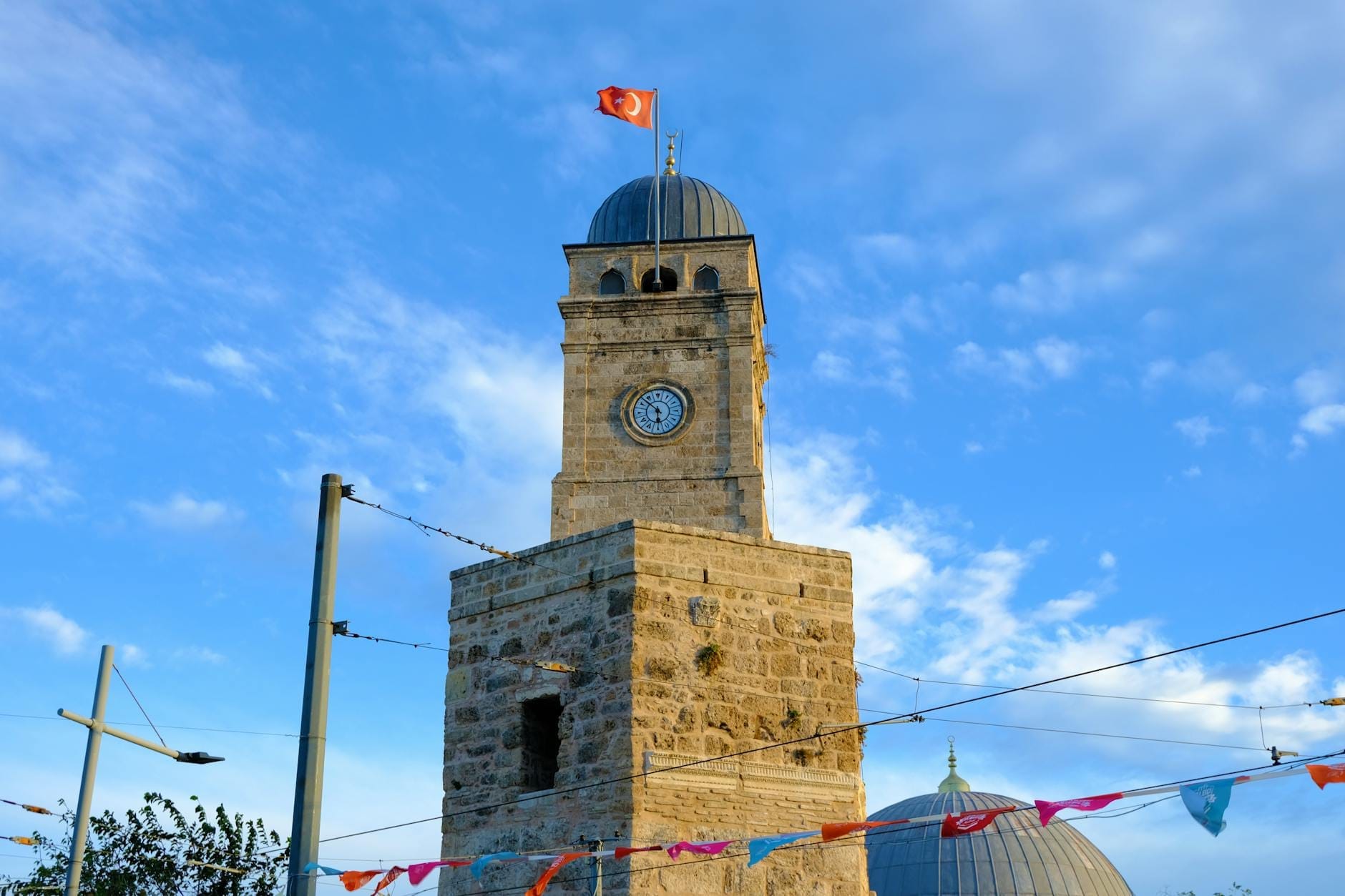
The Saat Kulesi, which translates directly as 'Clock Tower', stands on the edge of Antalya's historic city walls at Cumhuriyet Square, marking the threshold between the modern city centre and the layered alleys of Kaleici. It is one of the most photographed structures in Antalya, not because it is grand in scale, but because it is unexpectedly precise: four clock faces, one on each side of the tower, keeping time over a district that has been continuously inhabited for more than two thousand years.
At 14 metres total height, the tower is compact by any standard, but its proportions feel deliberate. Eight metres of it rise above the old Roman-Byzantine walls, with the remaining six metres forming the upper clock section. The base is pentagonal, adapting to the irregular contours of the ancient defensive wall it sits upon. The rough-cut stone, Arabic-style arched windows, and crenellated parapet give it a texture quite different from the polished heritage restorations common elsewhere in Turkey.
ℹ️ Good to know
The tower is an exterior landmark only. There is no interior to enter, no ticket booth, and no opening hours to worry about. It is accessible around the clock, every day of the year.
Layers of History: Byzantine Bastion to Ottoman Timepiece
The Saat Kulesi has a pentagonal stone base dating back to the 9th century at this corner of the city walls. For centuries, that bastion served a purely military function, reinforcing the wall circuit that enclosed the ancient city overlooking the harbour.
The transformation into a clock tower came in 1901, when Grand Vizier Kucuk Sait Pasha commissioned its conversion to mark the 25th year of Sultan Abdulhamid II's reign. Clock towers were a common gesture of modernisation across the Ottoman Empire during this period, serving as public symbols of administration, order, and the empire's engagement with European civic culture. Antalya's version is modest compared to the towers in Izmir or Dolmabahce, but it carries the same political intent.
The original dome was lost sometime in the 1940s. For decades, the tower stood without it, which subtly changed its silhouette against the sky. The dome has been altered over time, restoring the tower closer to its early 20th-century appearance. The clocks on all four faces continue to function, which remains a small, underappreciated detail for a structure this old.
The Saat Kulesi sits along the same wall circuit as Hadrian's Gate, the triumphal arch built for the Roman Emperor Hadrian's visit to the city around 130 AD. Both are within easy walking distance and together form the most photographed sequence of monuments in the old town.
Tickets & tours
Hand-picked options from our booking partner. Prices are indicative; availability and final rates are confirmed when you complete your booking.
Antalya guided city tour with lunch
From 45 €Instant confirmationFree cancellationTraditional Turkish bath experience in Antalya
From 45 €Instant confirmationFree cancellationPamukkale and Hierapolis day trip from Antalya-Kemer with meals
From 40 €Instant confirmationFree cancellationMevlana Museum and Whirling Dervishes Show from Antalya, Belek, Side
From 109 €Instant confirmationFree cancellation
What It Feels Like to Be There
The area around the tower is rarely quiet. Cumhuriyet Square acts as a circulation hub: tourists consulting maps, locals crossing between the bazaar and the old town, tea vendors nearby, the persistent sound of heels on cobblestone. The tower itself sits slightly elevated on the wall platform, so you look up at it rather than across to it, which makes it read larger than its dimensions suggest.
In the morning, around 8 to 9am, the light hits the stone from an easterly angle, drawing out the texture of the rough-cut blocks and throwing the Arabic-style arch details into clear relief. This is also before the organised tour groups arrive from hotels in Lara and Konyaalti, which makes it the calmest hour to photograph the tower without other people in frame.
By midday in summer, the square is at its most crowded and the heat reflecting off the pale stone is considerable. There is little shade directly around the tower. Late afternoon brings the crowd back but with better golden-hour light on the western faces. At night, the tower is illuminated, and the warm lighting against the dark stone gives it a presence that daytime crowds actually diminish. An evening visit, combined with a walk through the lantern-lit lanes of Kaleici, is the most atmospheric option.
💡 Local tip
For the cleanest photographs, arrive before 9am. The low eastern light picks out the stonework, and tour groups have not yet gathered at the square.
Architecture Up Close
The tower is built in a style that blends Ottoman civic architecture with older structural logic. The square upper section sits on a pentagonal base, a pragmatic response to the irregular geometry of the ancient wall below it. The stones are large, roughly coursed, with visible mortar joints that contrast with the more refined stonework of Ottoman imperial buildings elsewhere in Turkey.
The Arabic-style arched openings on each face frame the clock dials, which are white-faced with black numerals. The crenellations along the parapet echo the battlements of the wall itself, giving the impression that the tower was always part of the fortification rather than added to it. The 2022 renovation restored the dome above the clock section, a small ribbed cap that rounds off the silhouette without dominating it.
There is no plaque at eye level explaining the tower's history in English, which is a gap worth noting. Context comes from guidebooks or personal research rather than on-site interpretation. If you are the type of traveller who appreciates understanding what you are looking at, read up before you arrive.
How to Fit It Into Your Kaleici Visit
The Saat Kulesi works best as part of a broader walking loop through the old town rather than as a standalone destination. From the tower, Hadrian's Gate is about 400 metres along the wall. The old bazaar lanes begin just inside the walls. The Yivli Minaret, Antalya's most recognisabla silhouette urbaine element, is a short walk further into Kaleici.
A full loop covering the clock tower, Hadrian's Gate, Yivli Minaret, and the old bazaar in Kaleici takes roughly two to three hours at a relaxed pace. Add time if you stop for tea or browse the shops along the covered bazaar street.
For a structured route, the Antalya old town walking tour guide covers the full sequence of monuments and provides practical navigation between them.
The streets immediately around the tower include a mix of souvenir shops, small cafes, and the entrance to the covered bazaar. Prices here are tourist-oriented. If you want a tea without the markup, walk two streets deeper into the residential part of Kaleici where the cafes cater more to locals.
⚠️ What to skip
The cobblestone pavement around the tower is uneven in places. Footwear with grip is more practical than sandals, especially after rain when the stones become slippery.
Is It Worth Your Time?
The Saat Kulesi is not a monument that rewards a dedicated trip from across the city. It is a five-minute stop that rewards attention if you are already in the neighbourhood. The historical depth is real: a structure built on 9th-century Byzantine foundations, converted for an Ottoman sultan's jubilee, damaged and then restored over a century, still functioning as a timepiece. That accumulation of use is genuinely interesting.
Travellers who prefer museums with extensive exhibits, or landmarks with interior access and guided interpretation, may find the tower underwhelming as a standalone sight. There is nothing to go inside, no audio guide, no contextual signage. The experience is purely visual and spatial.
If your time in Antalya is limited, the tower is worth including as part of the Kaleici circuit but should not displace time at the Antalya Museum or the natural attractions outside the city centre. For a broader picture of how to prioritise your time, the things to do in Antalya guide is a useful starting point.
Insider Tips
- The tower's north face clock is often slightly out of sync with the other three. It is a small imperfection that has persisted across multiple restorations and makes for an oddly charming detail to notice.
- The best vantage point for photographing the tower in full is from the opposite side of Cumhuriyet Square, roughly 30 metres back. From here you get the tower above the wall with a strip of the old bazaar arcade visible to one side.
- At night, the illumination is warm-toned and relatively even across all four faces. Bring a wide-angle lens or shoot in portrait orientation to capture both the dome and the base of the wall in a single frame.
- The tea house just inside the bazaar entrance, about 50 metres from the tower, is considerably cheaper than the cafes facing the square. Locals use it as a midday stop.
- The dome has been restored over time but also cleaned the stone, so the tower currently looks slightly lighter in colour than in older photographs. This may mellow as the stone weathers again over time.
Who Is Clock Tower For?
- History and architecture travellers building a Kaleici walking circuit
- Photographers working the old town at golden hour or after dark
- First-time visitors to Antalya orienting themselves in the old quarter
- Budget travellers: the tower is free and surrounded by other free landmarks
- Families with older children who can appreciate Ottoman and Byzantine history in a short, accessible stop
Nearby Attractions
Other things to see while in Kaleiçi (Old Town):
- Antalya Marina
Kaleiçi Yat Limanı, known to visitors as Antalya Marina, is a semi-circular harbor carved into the limestone cliffs of the old town. Built during the Hellenistic period and used continuously through Roman, Byzantine, Seljuk, and Ottoman times, it now anchors a strip of seafood restaurants, craft shops, and boat tour operators. Admission is free, and the harbor is open around the clock.
- Antalya Boat Tours
Departing from the ancient Kaleiçi Marina, Antalya boat tours take you along dramatic limestone cliffs and into clear turquoise bays. Whether you want a full-day swim-and-lunch cruise or a shorter evening sail, here is everything you need to decide if it is worth your time.
- Hadrian's Gate
Built in 130 CE to honor Emperor Hadrian's visit to the ancient city of Attaleia, Hadrian's Gate is a triple-arched Roman triumphal monument in white marble and granite. Free to enter at any hour, it marks the main threshold between Atatürk Boulevard and the winding lanes of Kaleiçi old town.
- Hıdırlık Tower
Standing at the southern tip of Kaleiçi where ancient city walls meet the Gulf of Antalya, Hıdırlık Tower is a 2nd-century Roman structure that has served as lighthouse, fortification, and landmark for nearly two millennia. Entry is free, the exterior is always accessible, and the surrounding park makes it one of the most rewarding short stops in the old town.