Hadrian's Gate Antalya: The Roman Arch That Still Stands After 1,900 Years
Built in 130 CE to honor Emperor Hadrian's visit to the ancient city of Attaleia, Hadrian's Gate is a triple-arched Roman triumphal monument in white marble and granite. Free to enter at any hour, it marks the main threshold between Atatürk Boulevard and the winding lanes of Kaleiçi old town.
Quick Facts
- Location
- Barbaros, Muratpaşa, Antalya — edge of Kaleiçi old town
- Getting There
- Nostalji tramvay to Hadrian stop; 2-minute walk
- Time Needed
- 20–40 minutes at the gate; combine with a Kaleiçi walking loop
- Cost
- Free; no ticket required
- Best for
- History lovers, architecture enthusiasts, photographers at golden hour
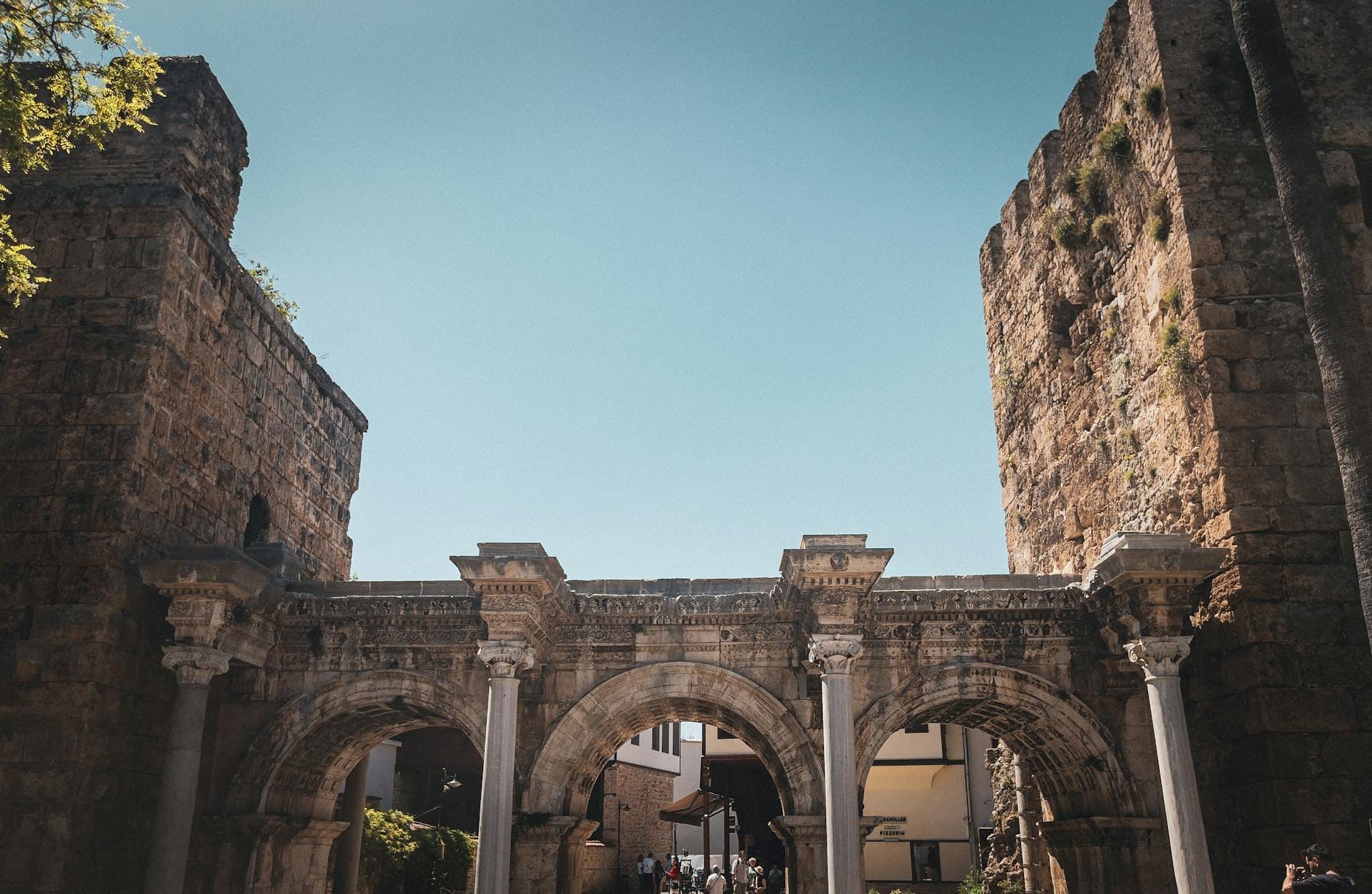
What Hadrian's Gate Actually Is
Hadrian's Gate (Turkish: Üçkapılar, meaning 'The Three Gates') is a Roman triumphal arch built in 130 CE to commemorate the visit of Emperor Hadrian to the prosperous port city then known as Attaleia. It stands roughly 8 meters tall, with three barrel-vaulted arches each approximately 4 meters wide and 6 meters high, constructed in white marble with granite accents. Carved floral friezes run along the entablature, and lion heads accent the decorative stonework — details that reward a few minutes of close inspection rather than a quick photograph from the street.
This is the only original entrance gate that survives from Attaleia's ancient city walls. The gate was partially obscured for centuries until the 1950s, when the outer protective walls built around it collapsed and revealed the structure fully. Two flanking towers frame the arches: the southern tower dates to the Roman period, while the northern tower's base is Roman but its upper section was reconstructed by the Seljuks in the 13th century. That layering of Roman and medieval stonework tells the story of the city's ownership changes more efficiently than any placard could.
ℹ️ Good to know
Hadrian's Gate is open 24 hours and free to enter. You can walk under the arches and examine both faces of the monument at any time of day or night.
The Experience on the Ground
The gate sits at the junction where the wide modern pavement of Atatürk Boulevard meets the first narrow lane of Kaleiçi. The contrast is immediate: on one side, car traffic and pavement cafes; on the other, Ottoman-era stone buildings leaning together over cobblestone alleys. Passing through the arches genuinely marks a transition, not just a photo opportunity.
Look down at the stone floor of the central arch. The deep parallel grooves cut into the marble are ruts worn by centuries of cart and wagon wheels passing through the gate — not damage, but a record of continuous use over nearly two millennia. The texture of the marble under your hands is slightly rough from weathering, with fine chisel marks still visible on protected sections of the carved friezes above the columns.
The gate does not have a viewing platform, a formal entrance, or any queue. You approach it from street level, walk through it, and continue into Kaleiçi. The informality is part of what makes it worth experiencing: this is a working city monument, not a roped-off exhibit.
Tickets & tours
Hand-picked options from our booking partner. Prices are indicative; availability and final rates are confirmed when you complete your booking.
Tazı Kanyon, Safari, Rafting, Buggy Safari, and Zipline in Turkey
From 65 €Instant confirmationFree cancellationAntalya guided city tour with lunch
From 45 €Instant confirmationFree cancellationTraditional Turkish bath experience in Antalya
From 45 €Instant confirmationFree cancellationTurkiye village small group guided tour from Side or Belek
From 39 €Instant confirmationFree cancellation
How the Gate Changes by Time of Day
Early morning, roughly 7–9 AM, is when the gate is least crowded and the light is most useful for photography. The low angle of the morning sun picks out the carved relief details in sharp relief against the white marble. The lanes of Kaleiçi behind the gate are quiet at this hour, which makes the transition through the arch feel more significant.
Midday in summer is the least comfortable time to linger. The marble reflects heat, the surrounding pavement gets hot, and tour groups tend to cluster here between 10 AM and 2 PM. If you visit then, move quickly through to the shaded lanes of Kaleiçi rather than trying to photograph the monument in flat overhead light.
The gate is illuminated at night, and the white marble glows against the dark sky in a way that daytime visits cannot replicate. Evening visits after 8 PM in summer bring cooler temperatures, a quieter street, and a more cinematic version of the monument. The floodlighting emphasizes the arches' height and the carved detailing at the capitals more clearly than direct sunlight does.
💡 Local tip
For photography: shoot from the Atatürk Boulevard side (west) in the morning for front-lit arches, and from the Kaleiçi side (east) in the late afternoon when the sun wraps around the structure. Night illumination makes both faces photogenic from roughly 8:30 PM onward.
Historical and Architectural Context
Attaleia was founded around the 2nd century BCE and grew into one of the most important ports on the Pamphylian coast. By 130 CE, when Hadrian made his tour of the eastern provinces, the city was prosperous enough to construct a permanent triumphal arch in his honor. The choice of white marble and the quality of the carved friezes reflects both the civic wealth of the city and the ambition to mark the imperial visit with something lasting.
The gate's design follows the standard Roman triumphal arch format: three openings of graduated width, the central arch taller than the flanking passages, with decorative columns and a detailed entablature above. What makes Hadrian's Gate architecturally notable is how intact the decorative program remains. Many Roman arches of comparable age have lost their surface ornament entirely; here the floral friezes and lion-head carvings are still legible. The Seljuk reconstruction of the northern tower in the 13th century added a different stone character to that section, which is visually distinct if you compare the masonry directly.
The gate sits at the southern edge of the Kaleiçi old town district, a neighborhood that preserves the street plan, the Roman-era walls, and centuries of layered architecture within a few walkable blocks. The gate is the logical starting point for any exploration of that area.
How to Combine Hadrian's Gate With the Surrounding Area
Most visitors reach the gate, photograph it, and then either turn back to Atatürk Boulevard or continue into Kaleiçi without a clear plan. The better approach: use the gate as the entry point for the Antalya old town walking tour, which takes you through the Roman walls, past the Ottoman mosques, and down to the harbor area in a coherent loop of about 90 minutes.
The Yivli Minaret is approximately 300 meters inside Kaleiçi from the gate — a 5-minute walk along the main lane. The Antalya Museum is about 2 kilometers west along the coast road and worth combining on the same day for context on the Roman artifacts found throughout this region.
If you have more time, the Hıdırlık Tower at the southern tip of Kaleiçi is another Roman-era structure, this one a 2nd-century funerary monument offering views over the harbor. Together with Hadrian's Gate, it brackets the Roman layer of Kaleiçi from two ends of the old town.
Getting There and Practical Notes
The gate is directly accessible from the Hadrian tram stop on the AntRay tram line, which connects the city center to Atatürk Boulevard. From the stop, the gate is a 2-minute walk. Taxis and rideshare drivers in Antalya will recognize 'Hadrian's Gate' or 'Üçkapılar' as the destination; ask to be dropped on Atatürk Boulevard at the Kaleiçi entrance.
There is no formal parking adjacent to the gate. If you are driving, use one of the paid car parks off Atatürk Boulevard or near the marina and walk from there. The gate itself sits on a pedestrian-priority section of pavement.
Accessibility is limited by the ancient stone surface. The gate floor features deep wheel ruts and uneven marble, which creates genuine difficulty for wheelchairs and pushchairs. There is no ramp, no modified surface, and no alternative entrance. The exterior of the monument can be viewed from the surrounding pavement, which is smoother, but passing through the arches requires navigating the historic stone floor.
⚠️ What to skip
Wear flat, closed shoes if you plan to walk through the gate and continue into Kaleiçi. The marble floor inside the arches and the cobblestone lanes immediately beyond are uneven and become slippery when wet.
Honest Assessment: Is It Worth Your Time?
Hadrian's Gate is worth 20 to 40 minutes of your time, not 90. The monument is genuinely impressive — white marble, substantial scale, well-preserved carving — but it is a single outdoor structure with no interior, no interpretive displays, and no controlled experience. Its value comes from understanding what it is and taking a moment to look carefully at the details, then using it as the threshold into Kaleiçi.
If you treat it as a gateway rather than a destination, it works perfectly. If you arrive expecting a site on the scale of the Aspendos Theater or a museum-quality presentation, you will find it underwhelming. The gate rewards those who know what they are looking at.
Visitors who move fast and prioritize interiors or beaches will likely find the gate a 5-minute stop. Visitors with an interest in Roman architecture, urban history, or the relationship between ancient and modern street plans will find it genuinely engaging, especially when combined with the rest of Kaleiçi.
Insider Tips
- Walk to the Kaleiçi side of the gate (east face) and look up at the capitals — the carved details are better preserved on this side and less photographed than the boulevard-facing facade.
- The wheel ruts in the central arch floor are one of the most tangible pieces of Roman daily life in the city. They are easy to miss if you walk through quickly; stop and look down.
- Night illumination begins at sunset and continues late. A visit after dinner combines well with a walk through the lit lanes of Kaleiçi, which stay open and active well into the evening in summer.
- The small tea gardens and cafes just inside the gate on the Kaleiçi side offer good sightlines back toward the arches. Sitting with a çay gives you a longer, more relaxed view of the monument without the pavement crowds.
- If you are visiting in summer, the boulevard-side (west face) of the gate faces into full afternoon sun and becomes very hot by 1 PM. Morning visits or evening visits avoid the worst of the heat and the flattest light.
Who Is Hadrian's Gate For?
- History and archaeology enthusiasts who want to understand the Roman foundations of modern Antalya
- Architecture-focused travelers interested in comparative Roman monument styles
- Photographers working in the golden hour or seeking night illumination shots
- Anyone using Kaleiçi as their base — the gate is essentially at your front door
- First-time visitors to Antalya who want a single landmark to orient themselves in the old town
Nearby Attractions
Other things to see while in Kaleiçi (Old Town):
- Antalya Marina
Kaleiçi Yat Limanı, known to visitors as Antalya Marina, is a semi-circular harbor carved into the limestone cliffs of the old town. Built during the Hellenistic period and used continuously through Roman, Byzantine, Seljuk, and Ottoman times, it now anchors a strip of seafood restaurants, craft shops, and boat tour operators. Admission is free, and the harbor is open around the clock.
- Antalya Boat Tours
Departing from the ancient Kaleiçi Marina, Antalya boat tours take you along dramatic limestone cliffs and into clear turquoise bays. Whether you want a full-day swim-and-lunch cruise or a shorter evening sail, here is everything you need to decide if it is worth your time.
- Clock Tower
Standing at the edge of Antalya's ancient walls, the Saat Kulesi is a 14-metre Ottoman clock tower built in 1901 with a pentagonal stone base dating back to the 9th century. Free to visit at any hour, it marks the gateway between the modern city and the cobbled lanes of Kaleici's old quarter.
- Hıdırlık Tower
Standing at the southern tip of Kaleiçi where ancient city walls meet the Gulf of Antalya, Hıdırlık Tower is a 2nd-century Roman structure that has served as lighthouse, fortification, and landmark for nearly two millennia. Entry is free, the exterior is always accessible, and the surrounding park makes it one of the most rewarding short stops in the old town.