Yivli Minaret: Antalya's 800-Year-Old Skyline Landmark
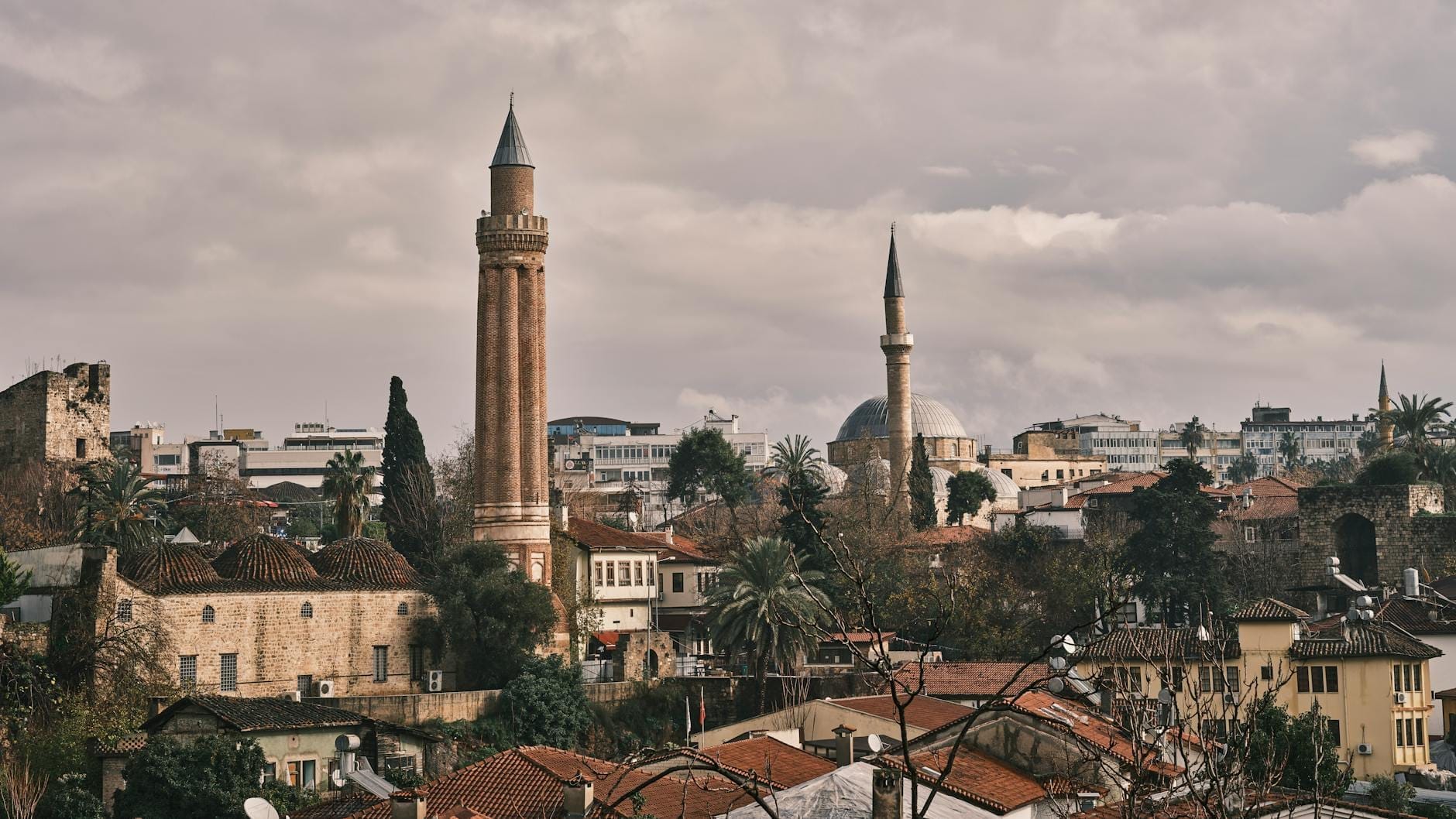
The Yivli Minaret Mosque, commissioned by Seljuk Sultan Alaeddin Keykubad I in 1230, stands 38 meters above Kaleiçi and remains the most recognized silhouette on Antalya's skyline. Its eight fluted sections, clad in dark blue and turquoise tiles, mark the spot where the city's Islamic history truly began. Whether you approach from Kalekapısı Square or glimpse it from the harbor below, the minaret orients every walk through the old town.
Quick Facts
- Location
- Cumhuriyet Street near Kalekapısı Square, Kaleiçi, Antalya
- Getting There
- 5-minute walk from the AntRay tram stop at Müze (Museum) station; taxis drop off at Kalekapısı Square
- Time Needed
- 20–40 minutes to view exterior and surrounding complex; longer if exploring Kaleiçi
- Cost
- Free to view from outside; mosque interior access follows standard mosque etiquette (active place of worship)
- Best for
- History lovers, architecture enthusiasts, photographers, first-time Antalya visitors
What You're Looking At: Antalya's Defining Symbol
The Yivli Minaret, known in Turkish as Yivli Minare Camii, is the single structure most associated with Antalya as a city. At 38 meters (125 feet) tall, its eight ribbed, cylindrical sections rise above the low terracotta rooflines of Kaleiçi in a way that is immediately readable from almost every elevated point in the old town, from the harbor promenade to the cliff-top gardens. The dark blue and turquoise tile cladding is distinctive even from a distance: no other structure in the city center uses this color combination at this scale.
The fluted design, which gives the minaret its name (yivli means grooved or fluted in Turkish), is characteristic of Anatolian Seljuk architecture from the 13th century, but this example stands out for its height and the quality of its surviving tilework. The base measures approximately 5.5 meters wide and 6.5 meters tall, supporting the stacked cylindrical drums above. Inside, 90 steps spiral to the summit, though public access to the interior is not routinely available to visitors.
ℹ️ Good to know
The Yivli Minaret Mosque complex is part of Antalya's Historic City Centre on UNESCO's Tentative List for World Heritage status, submitted alongside other heritage elements of Antalya's historic core. It is an active mosque, so dress modestly if you plan to enter the prayer hall, and avoid visiting during prayer times if you want to linger.
History Built on History: From Byzantine Church to Seljuk Mosque
The site itself predates the minaret by centuries. When Seljuk Sultan Alaaddin Keykubad I ordered the construction of the mosque following the Seljuk conquest of Antalya in 1227, the building was erected on the remains of a Byzantine church. Rather than clearing the site entirely, the builders incorporated ancient column capitals from the earlier structure as interior load-bearing elements, a pragmatic reuse common in early Anatolian Islamic architecture. You can still see some of these repurposed elements if you look carefully inside the prayer hall.
The mosque complex was substantially rebuilt in 1373 by Mehmet Bey, then restored in 1955 and again in 2010. The minaret itself, commissioned by Keykubad I (who ruled from 1220 to 1237), is considered one of the finest surviving examples of Seljuk architectural ambition in southern Anatolia. Keykubad was also the patron behind major construction projects in Konya and Alanya, and his investment in Antalya's skyline reflected the city's growing strategic importance as a Mediterranean port.
The mosque is also referred to historically as Alaaddin Mosque or Ulu Mosque (Grand Mosque), names that still appear on older maps and signs around Kaleiçi. The dual identity, one name honoring the Seljuk sultan, the other describing its congregational role, reflects how central this building has been to the neighborhood's life across eight centuries.
Tickets & tours
Hand-picked options from our booking partner. Prices are indicative; availability and final rates are confirmed when you complete your booking.
Tazı Kanyon, Safari, Rafting, Buggy Safari, and Zipline in Turkey
From 65 €Instant confirmationFree cancellationAntalya guided city tour with lunch
From 45 €Instant confirmationFree cancellationTraditional Turkish bath experience in Antalya
From 45 €Instant confirmationFree cancellationTurkiye village small group guided tour from Side or Belek
From 39 €Instant confirmationFree cancellation
How the Experience Changes by Time of Day
Morning light, especially in the hour after sunrise, hits the eastern face of the minaret and brings out the depth of the turquoise tiles in a way that afternoon haze does not. The square around the base is quiet at this hour: a few shopkeepers opening up along Cumhuriyet Street, the scent of fresh bread from a nearby bakery, and almost no other tourists. This is the window for photography without crowds or scaffolding shadows.
By mid-morning, the area around Kalekapısı Square, just steps from the minaret's base, fills with tour groups arriving from the large beach resort hotels. The minaret becomes a backdrop for guided photo stops and orientation talks. If you are part of a guided city tour, this is likely where your guide will begin. The square itself has a pleasant pedestrian energy at this hour, with a tea house nearby and vendors selling local goods along the edges.
Late afternoon and early evening offer a different register entirely. As the sun drops toward the Taurus Mountains to the west, the minaret catches a warm orange-gold light that makes the tiles glow. The call to prayer from the mosque at dusk is one of those sensory anchors you carry away from Kaleiçi: the sound carries across the old town's narrow streets and echoes off the Roman-era walls.
💡 Local tip
For the best photographs, position yourself on the low slope of Cumhuriyet Street just north of the square, roughly 30 meters from the base, where you can capture the full height of the minaret framed by cypress trees without distortion from wide-angle shooting at close range.
The Surrounding Complex and Kaleiçi Context
The Yivli Minaret does not stand alone. The complex around it includes a medrese (theological school) and a tekke (dervish lodge), now converted to other uses, along with two türbe (mausoleums) nearby. This cluster of Seljuk and early Ottoman structures gives the immediate area a density of historical texture that rewards slow exploration rather than a quick glance.
The minaret sits at the northern entrance to Kaleiçi, which means it functions as a gateway monument for anyone walking the old town on foot. From here, you are a short walk from Hadrian's Gate, the triumphal arch built for the Roman emperor's visit in 130 AD, and from the winding lanes that lead down to Antalya's historic marina. The combination of Seljuk, Byzantine, Roman, and Ottoman layers within this compact area makes Kaleiçi one of the most historically compressed old towns in the eastern Mediterranean.
If you want to understand the full arc of Antalya's architectural history in a single afternoon, the Kaleiçi walking tour covers the Yivli Minaret alongside the Clock Tower, the old bazaar, and the harbor walls. Allow at least two to three hours for the full loop.
Practical Walkthrough: What to Do When You Arrive
From Kalekapısı Square, the minaret is immediately visible to the south. Walk toward it along Cumhuriyet Street and you will reach the small plaza at its base within two minutes. The mosque entrance is on the side facing west. If the mosque is open for visitors between prayer times, remove your shoes before entering and have a scarf or shawl ready to cover shoulders and hair out of respect. The interior is modest in size but notable for the repurposed Byzantine column capitals and the simple Seljuk spatial logic of the prayer hall.
The exterior, however, is the real draw. Spend time walking a full circle around the base to see how the tilework changes in tone and condition, some sections more restored than others following the 2010 work. Look up along the shaft to appreciate the geometric precision of the fluting: each of the eight ridged sections is consistent in width all the way to the balcony (şerefe), where the muezzin would traditionally call prayer.
Accessibility around the base is generally good; the plaza is paved and relatively flat. The interior steps (90 in total) are steep and narrow, as is typical of Ottoman and Seljuk minarets, and are not accessible to visitors under standard conditions.
⚠️ What to skip
Specific opening hours and any admission fees for the mosque interior are not confirmed in current public sources. Check with the local tourism office at Kalekapısı Square on arrival, or ask your accommodation in Kaleiçi for the current access situation before making a special trip solely for interior access.
Is the Yivli Minaret Worth Your Time?
For most visitors, yes, but not as a standalone destination requiring a dedicated half-day. The minaret is most rewarding when treated as the anchor point of a broader Kaleiçi exploration. On its own, a focused visit takes 20 to 40 minutes. Combined with the surrounding complex and a walk toward the harbor or the old bazaar, it becomes the centerpiece of a full and genuinely interesting afternoon.
Travelers who prioritize beaches over history, or those visiting Antalya specifically for the resort strips at Lara or Belek, may find Kaleiçi as a whole less essential to their trip. The minaret itself, viewed from the square, takes minutes to see. What makes the visit worthwhile is the surrounding old town, not the monument in isolation. If you have even a half-day free from the beach, it is the most historically grounded half-day you can spend in Antalya.
For context on how this fits into a wider Antalya itinerary, the Antalya Museum nearby holds the archaeological material that gives these streets their historical weight, and pairing the two makes for a coherent day of discovery. The museum's collection of Seljuk and Byzantine artifacts directly complements what you see at the minaret complex.
Insider Tips
- The small tea house on the northern side of Kalekapısı Square, within sight of the minaret, is a practical rest stop with views toward the shaft. Prices are tourist-facing but not exploitative, and the terrace seating is useful for a quiet observation point.
- The minaret appears on the Antalya Province seal and on a significant amount of local merchandise, which means you will find it reproduced on ceramics and prints throughout the old bazaar. The quality varies enormously: the best pieces come from the workshops on Uzun Çarşı Street, one street east of the main tourist flow.
- If you are in Antalya during Ramadan, the evening call to prayer from the Yivli Minaret Mosque is accompanied by a particularly atmospheric crowd gathering in the square for iftar. The neighborhood feels markedly different during this period: quieter during the day, then suddenly alive at dusk.
- The 2010 restoration replaced some of the exterior tile sections. Look at the joins between old and new tilework on the north face of the minaret shaft: the color difference is subtle but visible, and gives a good sense of how much original material survives.
- From the harbor promenade below the cliff, you can photograph the minaret rising above the old town walls in a single frame with the sea in the foreground. This view, rather than the close-up square view, is what most photographers associate with Antalya's skyline.
Who Is Yivli Minaret For?
- First-time visitors to Antalya who want a single orientation point for the old town
- Architecture and history enthusiasts interested in Anatolian Seljuk building traditions
- Photographers looking for a landmark with strong geometric lines and rich color
- Travelers combining a walking tour of Kaleiçi with nearby Roman and Ottoman monuments
- Anyone curious about the layered Islamic, Byzantine, and Roman history of southern Turkey
Nearby Attractions
Other things to see while in Kaleiçi (Old Town):
- Antalya Marina
Kaleiçi Yat Limanı, known to visitors as Antalya Marina, is a semi-circular harbor carved into the limestone cliffs of the old town. Built during the Hellenistic period and used continuously through Roman, Byzantine, Seljuk, and Ottoman times, it now anchors a strip of seafood restaurants, craft shops, and boat tour operators. Admission is free, and the harbor is open around the clock.
- Antalya Boat Tours
Departing from the ancient Kaleiçi Marina, Antalya boat tours take you along dramatic limestone cliffs and into clear turquoise bays. Whether you want a full-day swim-and-lunch cruise or a shorter evening sail, here is everything you need to decide if it is worth your time.
- Clock Tower
Standing at the edge of Antalya's ancient walls, the Saat Kulesi is a 14-metre Ottoman clock tower built in 1901 with a pentagonal stone base dating back to the 9th century. Free to visit at any hour, it marks the gateway between the modern city and the cobbled lanes of Kaleici's old quarter.
- Hadrian's Gate
Built in 130 CE to honor Emperor Hadrian's visit to the ancient city of Attaleia, Hadrian's Gate is a triple-arched Roman triumphal monument in white marble and granite. Free to enter at any hour, it marks the main threshold between Atatürk Boulevard and the winding lanes of Kaleiçi old town.