Chicago Temple Building: Where a Gothic Spire Crowns a Downtown Skyscraper
The Chicago Temple Building is one of the Loop's most quietly remarkable structures: a 23-story office skyscraper completed in 1924 that doubles as an active Methodist church, topped by an ornate Gothic spire and a sky chapel perched above the roofline. It is home to the First United Methodist Church of Chicago, the city's oldest church congregation, tracing its roots to 1831.
Quick Facts
- Location
- 77 W Washington St, Chicago, IL 60602 — southwest corner of Clark & Washington, The Loop
- Getting There
- Multiple CTA 'L' lines serve the Loop; Washington/Dearborn and Washington/Wells stations are within a short walk
- Time Needed
- 30–60 minutes for a self-guided visit; allow 90 minutes if joining the guided tour
- Cost
- No published admission fee; guided tours available (verify current details directly with the church)
- Best for
- Architecture enthusiasts, history buffs, and anyone curious about Chicago's religious and civic heritage
- Official website
- chicagotemple.org
What the Chicago Temple Building Actually Is
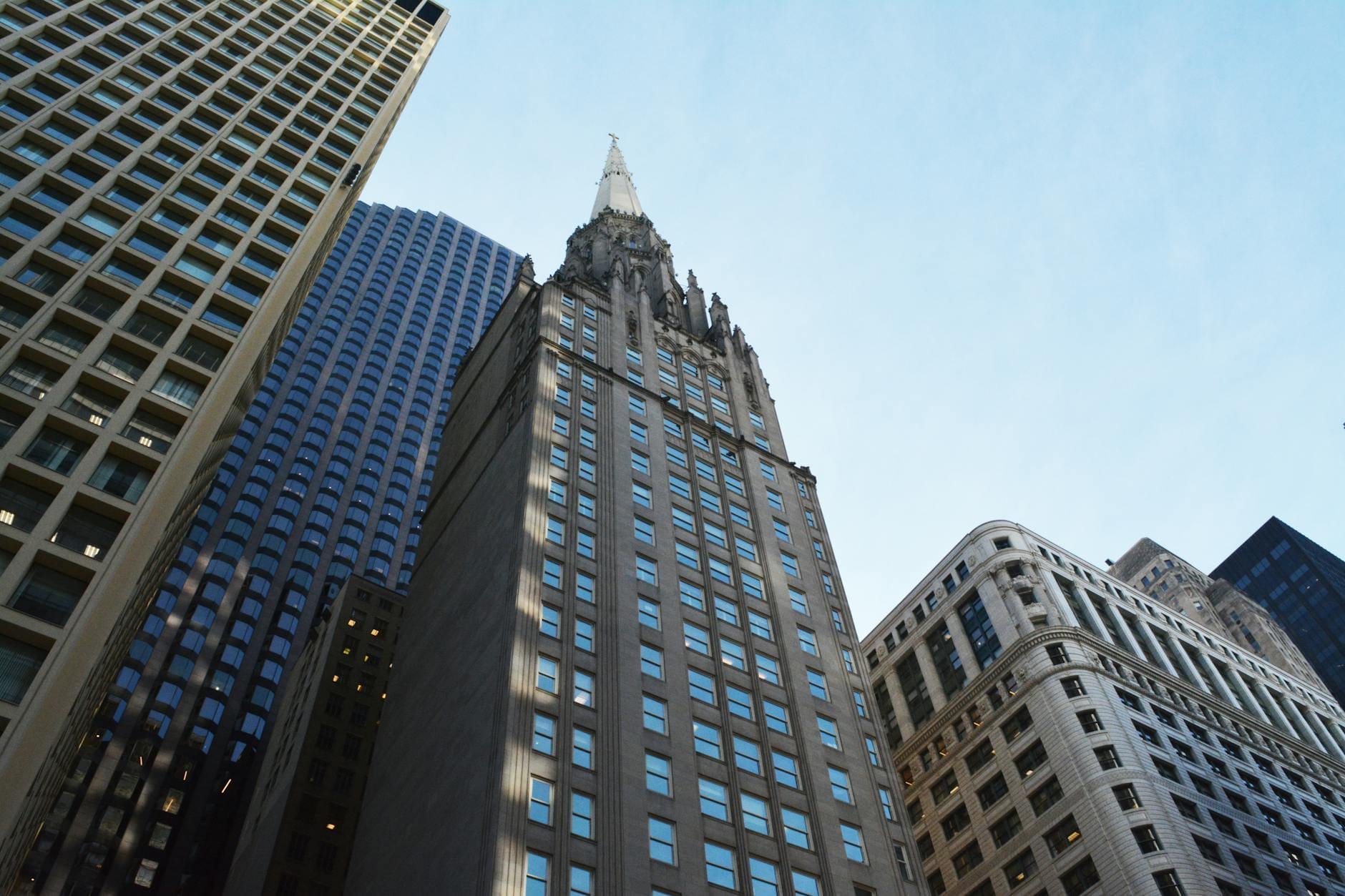
At first glance from Washington Street, the Chicago Temple Building reads like any other Loop skyscraper from the 1920s: limestone-clad, tall, and firmly rooted in Chicago's commercial core. Then you notice the spire. Rising above the 23rd floor, a delicate Gothic crown caps a structure that is simultaneously a downtown office building and an active house of worship. It is genuinely unusual, and no photograph quite prepares you for the cognitive shift of looking up at a church steeple jutting from a skyscraper.
The building is home to the First United Methodist Church of Chicago, a congregation whose history stretches back to 1831, predating Chicago's incorporation as a city. That makes it the oldest church congregation in Chicago. The current structure was completed in 1924 and dedicated on September 28 of that year, described at the time as the 'world's tallest monument to Methodism.' The architects Holabird and Roche — a firm whose fingerprints are all over early Chicago modernism — designed it to solve a practical problem: a prominent congregation needed revenue-generating office space to afford a presence on prime Loop real estate, without giving up its spiritual mission.
ℹ️ Good to know
Visitor hours are commonly reported as roughly 9 AM to 5 PM on weekdays and 9 AM to 5 PM on Saturdays, with shorter hours on Sundays, Guided tours are often reported as running at 2 PM Monday through Saturday, Neither is currently confirmed on the official church website, so call or check chicagotemple.org before making it the centerpiece of your day.
The Architecture: A Crash Course Worth Having
From street level on Washington Street, the building's lower floors present a sober, neo-Gothic limestone facade that nods to ecclesiastical tradition without abandoning commercial pragmatism. Large arched windows mark the church's ground-floor sanctuary. Above that, the building transitions into a fairly straightforward office tower before reasserting its religious identity near the top, where Gothic tracery, pointed arches, and decorative stonework reappear in abundance.
The most photographed element is the sky chapel and steeple at the summit. The chapel, sometimes called the Chapel in the Sky, sits at roughly 400 feet above street level. From Washington Street below, you can see the spire clearly on a clear day, though the full drama of the upper floors is best appreciated from across the plaza of the Richard J. Daley Center directly opposite — a brutalist concrete slab from the 1960s that makes for a striking visual contrast.
For anyone exploring Chicago's broader architectural story, the Chicago Temple Building fits naturally into a longer conversation about how the city invented the skyscraper and then kept reinventing it. The Chicago architecture guide covers the full arc from the 1880s steel-frame pioneers to the supertall towers of the present day, and this building occupies an interesting middle chapter.
Tickets & tours
Hand-picked options from our booking partner. Prices are indicative; availability and final rates are confirmed when you complete your booking.
Go City | Chicago All-Inclusive Pass
From 127 €Instant confirmationFree cancellationiFLY Chicago Lincoln Park indoor skydiving experience
From 126 €Instant confirmationFree cancellationiFLY Chicago Rosemont indoor skydiving tickets
From 117 €Instant confirmationFree cancellationChicago lakefront neighbourhood bike tour
From 18 €Instant confirmationFree cancellation
Visiting: What to Expect at Different Times of Day
Early morning is when the building's exterior reads best. Between 7 and 9 AM, before the Loop crowd reaches peak density, you can stand on the Washington Street sidewalk or in the Daley Center plaza and photograph the facade without people cutting across your frame. The morning light hits the limestone from the east, picking out the carved Gothic detailing in sharp relief. There is also something faintly incongruous and interesting about watching Loop commuters stream past a Gothic church spire at rush hour.
The interior of the ground-floor sanctuary is notably quiet on weekday mornings before services. The space uses dark wood pews, stained glass, and a vaulted ceiling that muffles the street noise from outside almost completely. If you arrive between 9 AM and noon on a weekday, you are likely to find the sanctuary nearly empty and have it largely to yourself. The afternoon guided tour at 2 PM Monday through Saturday, if running as reported, is the only structured way to reach the upper floors and the Chapel in the Sky.
💡 Local tip
The Daley Center plaza, directly across Washington Street, is the best vantage point for exterior photography. The open space gives you enough distance to capture the full height of the spire. Morning light (before 10 AM) hits the west-facing upper sections cleanly.
Avoid arriving during Sunday morning services if a quiet architectural visit is your goal. The building functions as a working church, and weekend morning hours fill the sanctuary with an active congregation. That said, attending a service is a legitimate way to experience the interior, and the church publicly welcomes visitors.
Historical Context: Chicago's Oldest Congregation in Its Tallest Church
The First United Methodist Church of Chicago traces its congregation to 1831, a year before Chicago was platted as a town. For nearly two centuries, it has occupied various structures on or near this stretch of Washington Street. The 1924 building represents the congregation's most ambitious response to a familiar urban problem: how to maintain a significant downtown presence as land values climbed and commercial pressure on Loop real estate intensified.
The solution — stacking offices below and a church above, with a sky chapel at the pinnacle — was architecturally ingenious and financially shrewd. Office tenants funded the building's upkeep while the congregation retained its identity and its corner. The building was dedicated in 1924 as the 'world's tallest monument to Methodism,' a title that combined genuine spiritual pride with unmistakable American boosterism.
Understanding the building also requires some familiarity with the Loop as a neighborhood. Washington Street sits at the civic heart of Chicago: city hall is one block west, the Daley Center is directly across the street, and Federal Plaza is a short walk south. The Chicago Temple Building has served as a kind of spiritual anchor in a district otherwise dominated by government and commerce. The Loop neighborhood still carries that layered quality today.
The Chapel in the Sky: The Reason Most People Take the Tour
The guided tour, reportedly offered at 2 PM Monday through Saturday, is the only reliable way to access the upper portions of the building, including the Chapel in the Sky. This small chapel sits within the spire structure, roughly 400 feet above the street, and offers views over the Loop that are distinct from those at the city's observation decks. Where the Skydeck or 360 Chicago are engineered tourist experiences, the Chapel in the Sky is a working liturgical space that happens to have an extraordinary location.
The interior of the chapel is compact, with seating for a small gathering, simple stained glass, and decorative Gothic stonework. The windows look out over the surrounding Loop rooftops and, on a clear day, toward Lake Michigan to the east. Weddings and small ceremonies are occasionally held here. The combination of height, intimacy, and genuine religious function makes it feel different from a typical observation point.
⚠️ What to skip
Tour availability and access to the Chapel in the Sky depend on the church's schedule and staffing. There is no guarantee the tour runs every day without exception. Confirm directly with the church at chicagotemple.org before planning your visit around it.
If you want to compare elevated views across the Loop, the city's dedicated observation decks are the more reliable option. The Chicago observation decks guide covers the Skydeck, 360 Chicago, and other viewpoints with confirmed operating hours and ticket information.
Practical Information for Visiting
Getting here is straightforward from anywhere in central Chicago. The building sits on Washington Street between Clark and Dearborn, well within the Loop's dense transit grid. The CTA Blue, Red, Green, Brown, Orange, Pink, and Purple lines all stop within a few blocks. Washington/Dearborn (Blue Line) and Washington/Wells (Brown, Orange, Green, Pink, Purple lines) are the closest stations. No driving is needed or recommended.
There is no published admission fee for visiting the ground-floor sanctuary and public areas. The guided tour may involve a donation or small charge; verify current arrangements with the church. Dress modestly if you plan to enter the sanctuary, particularly during or near service times. The building is an active place of worship, not a museum, and it operates on that basis.
Accessibility details are not listed on the official church website. Visitors with mobility requirements should contact the church directly before visiting to confirm elevator access and step-free routes through the building.
The Chicago Temple Building pairs naturally with a broader Loop walking itinerary. The Chicago Cultural Center is a few blocks east and free to enter, with some of the finest interior architecture in the city. Millennium Park is a short walk further. A focused Loop morning could take in all three without requiring any transit.
Honest Assessment: Is It Worth Your Time?
As a purely exterior architectural stop, the Chicago Temple Building is worth ten minutes of anyone's time in the Loop. The spire above a skyscraper is a genuine visual oddity, and the building's history is interesting enough to hold your attention for a short read on the sidewalk. If you have access to the guided tour and the Chapel in the Sky, the experience moves into a different category: genuinely memorable, and unlike anything else in the city.
That said, visitors expecting a richly staffed tourist attraction with interpretive displays, a gift shop, and guaranteed access to all floors will be disappointed. This is a working church that accommodates visitors generously, but it does not operate as a visitor attraction in the commercial sense. The experience rewards patience and a low-key approach.
Anyone on a tight itinerary should weigh this against the Loop's other architectural highlights. If you only have time for one structured architecture experience in Chicago, the Chicago Architecture Foundation river cruise covers more ground. But as a short, free stop that adds genuine texture to a Loop walk, the Chicago Temple Building earns its place.
Insider Tips
- Stand in the Richard J. Daley Center plaza across Washington Street, not on the immediate sidewalk in front of the building, for the best full-height view of the spire. The extra distance lets you see the Gothic crown clearly above the office floors.
- Weekday mornings between 9 and 11 AM are the quietest time to visit the ground-floor sanctuary. You are unlikely to encounter services or tour groups, and the space has a stillness that feels genuinely removed from the Loop outside.
- If you want to join the guided tour, arrive a few minutes before 2 PM and confirm at the front desk that it is running that day. Do not assume it operates on a fixed schedule without exception, particularly around holidays or church events.
- The building's address is 77 W Washington St, but the most photogenic approach is from Clark Street to the north, where you can frame the full height of the tower against the sky before reaching the Washington Street entrance.
- The Chicago Temple Building sits directly across from the Daley Center, which houses the Picasso sculpture in its plaza. Both stops together take under 30 minutes and make a compact architectural pair at the civic center of the Loop.
Who Is Chicago Temple Building For?
- Architecture enthusiasts interested in early 20th-century Chicago skyscraper design and Gothic Revival detailing
- History-focused travelers who want to understand Chicago's religious and civic identity beyond the standard tourist circuit
- Budget travelers looking for free or low-cost Loop experiences with genuine substance
- Photographers seeking unusual angles on the Loop skyline, particularly in morning light
- Visitors with a religious or Methodist heritage interest who want to connect with a congregation active since before Chicago was a city
Nearby Attractions
Other things to see while in The Loop:
- Art Institute of Chicago
One of the largest and most visited art museums in the United States, the Art Institute of Chicago anchors the eastern edge of the Loop with a collection of over 300,000 works spanning 5,000 years. From Georges Seurat's pointillist masterpiece to Grant Wood's American Gothic, the highlights alone demand the better part of a day.
- Buckingham Fountain
The Clarence Buckingham Memorial Fountain is one of the largest decorative fountains in the world, sitting at the heart of Grant Park since 1927. Free to visit during its seasonal run from spring through mid-October, it puts on hourly water displays and a nightly illuminated show that draws crowds from across the city.
- Chicago Architecture Center
Housed in Mies van der Rohe's One Illinois Center on the Chicago River, the Chicago Architecture Center packs nearly 10,000 square feet of exhibition space, a landmark scale model of the city, and access to some of the country's most informative architecture tours. It's the most comprehensive entry point into understanding what makes Chicago's skyline one of the world's most significant.
- Chicago Architecture Foundation River Cruise
The Chicago Architecture Center River Cruise aboard Chicago's First Lady is the most authoritative way to read the city's skyline. In 90 minutes, trained docents walk you through more than 40 landmark buildings across all three branches of the Chicago River, connecting architectural styles to the human decisions that shaped them.