Campo del Príncipe: Granada's Most Sociable Square
Campo del Príncipe is the beating social heart of Granada's Realejo neighbourhood, a wide, flat plaza ringed by tapas bars and shaded terraces where locals outnumber tourists. Free to enter at any hour, it shifts from a quiet morning coffee spot to a lively evening gathering place, with a Sunday flea market rounding out its weekly rhythm.
Quick Facts
- Location
- Campo del Príncipe, Realejo – San Matías, 18009 Granada, Spain
- Getting There
- 15-minute walk from Plaza Isabel la Católica via Calle Pavaneras; no direct metro stop, several urban bus lines serve the Realejo area
- Time Needed
- 30–90 minutes for the square itself; longer if you linger over tapas or catch the Sunday market
- Cost
- Free entry to the square; Sunday Flealejo Market is free to browse (cash recommended for stall purchases)
- Best for
- Slow travel, tapas-hopping, neighbourhood atmosphere, Sunday markets, photography
- Official website
- turismo.granada.org/en/campo-del-principe
What Campo del Príncipe Actually Is
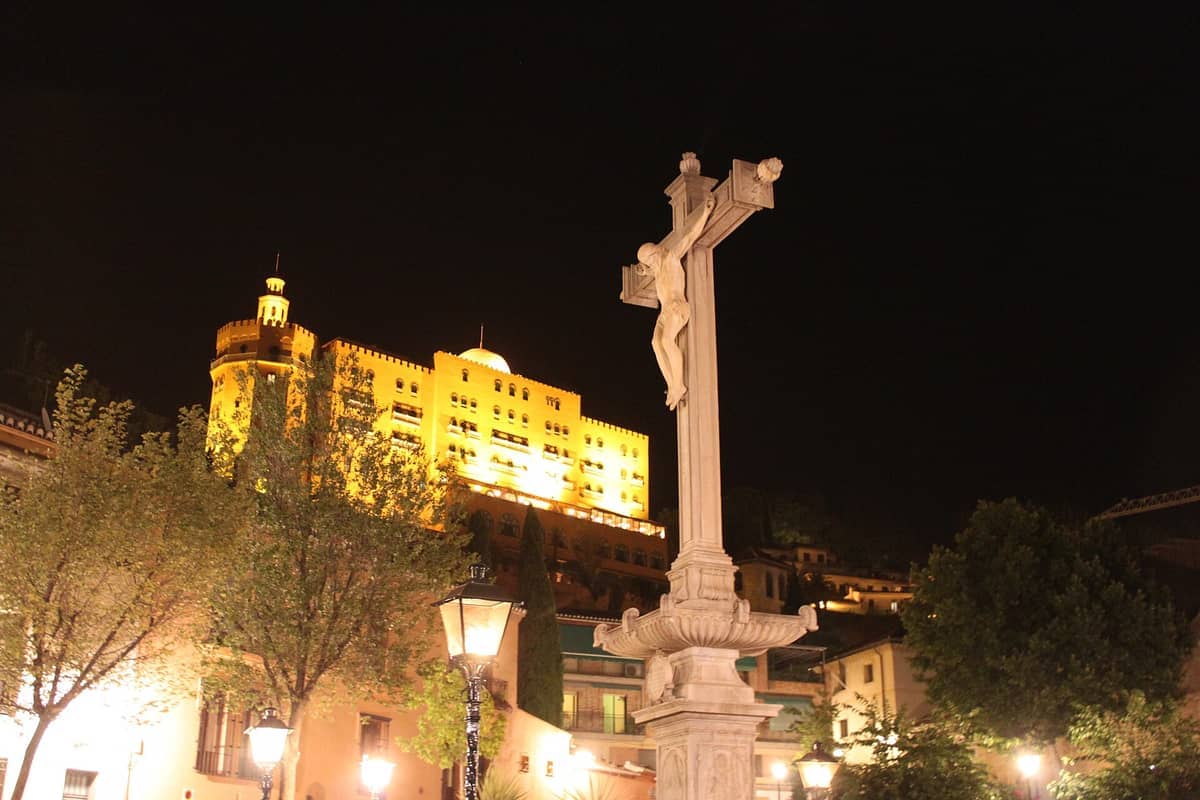
Campo del Príncipe is a large, open public square in Granada's Realejo district, and the city's own tourism office calls it the most emblematic square in the neighbourhood. That's a claim worth taking seriously. Unlike the grand, monument-anchored plazas of Granada's historic centre, this one earns its reputation through daily use rather than architectural spectacle. The surface is flat, paved, and generous in scale; the perimeter is lined with bars and restaurant terraces at ground level, their chairs spilling outward across the stone. A large crucifix sculpture stands near the centre of the square, a focal point that draws attention without dominating the space.
What makes it worth your time is precisely what it lacks: the self-conscious staging of a tourist attraction. Walk in on a weekday morning and you'll find older residents occupying the same terrace chairs they've sat in for decades, nursing coffee and watching nothing in particular. Come back on a Friday evening and the sound changes entirely, conversation rising, children weaving between tables, the clatter of ceramic plates from a dozen kitchens. The square rewards the patient observer.
ℹ️ Good to know
Campo del Príncipe is open 24 hours a day, every day, with no admission fee. The surrounding bars typically open mid-morning and stay open late into the evening.
A Name with a History: 1497 and the Prince's Wedding
The square's name is not decorative. Campo del Príncipe, which translates roughly as the Prince's Field, dates to 1497, when celebrations were held here for the wedding of Prince Juan of Asturias, the only son of Fernando and Isabel, and Margaret of Austria. Granada had only been recaptured from Nasrid rule five years earlier, and the choice of this open ground for royal festivities was both symbolic and practical. The space was large enough for public gatherings at a moment when the Catholic Monarchs were consolidating their presence in a newly conquered city.
Prince Juan died the same year, just months after the wedding, leaving no heir. The field kept his name. Over the following centuries it evolved from open ground into an urban plaza, acquiring the terrace bars and stone paving that define it today. Understanding this gives the square a melancholy undercurrent that most visitors never feel. For deeper context on how Granada's Islamic past and Christian present coexist in the city's fabric, the Granada Moorish heritage guide is worth reading before you arrive.
Tickets & tours
Live prices and dates from our booking partner. If you book, we may earn a commission at no extra cost to you.
Guided tour of the Caminito del Rey from Granada
From 135 €Free cancellationAlhambra guided tour in Italian
From 49 €Instant confirmationFree cancellationAlhambra guided group tour with Nasrid Palaces and Generalife Palace
From 40 €Alhambra guided tour with Carlos V Palace, Generalife and Alcazaba
From 35 €
The Realejo: A Neighbourhood Worth Understanding
Campo del Príncipe sits in the Realejo, Granada's former Jewish quarter, which occupies the lower slopes south of the Alhambra hill. It's a genuinely residential district with a character distinct from the Albaicín or the historic centre. Streets here are narrower than the city's main arteries but wider than the Albaicín's stepped alleys; facades tend to be whitewashed with wrought-iron balconies at the upper floors. The Realejo neighbourhood is quieter than its location on the tourist trail suggests, partly because visitors who stop at the Alhambra often don't continue downhill into it.
Walking to the square from Plaza Isabel la Católica along Calle Pavaneras takes roughly ten minutes. The street descends gently, passing bakeries and ironmongers alongside the occasional tapas bar. By the time you arrive at Campo del Príncipe, you've already left the most heavily trafficked tourist corridor behind. That transition is one of the square's real attractions.
How the Square Changes Through the Day
Morning: coffee and calm
Early mornings in Campo del Príncipe are quiet in the best sense. The stone stays cool well into mid-morning during summer, when temperatures elsewhere in Granada can already be uncomfortable. A few bars open by 8 or 9am serving coffee and tostadas. At this hour the square smells faintly of damp stone and bread. There are no crowds. The crucifix casts a long shadow westward.
Afternoon: siesta rhythm
The midday lull is real. In summer especially, between roughly 2pm and 6pm, Campo del Príncipe empties considerably. Bars shift to a lunch service and then slow down. If you're visiting in July or August, this is not the time to expect atmosphere; the square sits exposed and the heat reflects off the paving. The upside is that the surrounding streets are genuinely quiet, which makes this a reasonable time to photograph the square itself without clusters of people at the tables.
Evening: the square at its best
From around 7pm onward, especially on weeknights and through the weekend, Campo del Príncipe becomes the social centre it's meant to be. Terrace chairs fill steadily, the volume of conversation rises, and bar staff move quickly between tables. This is the hour to order a caña and whatever tapa comes with it. Granada's tapas culture, whereby a small plate arrives automatically with most drinks, is still largely intact in the Realejo.
💡 Local tip
Granada's free-tapas tradition is alive in Campo del Príncipe. Order a drink at almost any bar around the square and expect a complimentary tapa. The quality and portion size vary by bar, so it's worth moving between two or three during an evening.
For a broader map of where to eat and drink in Granada, including the Realejo, the free tapas Granada guide covers the mechanics and the best streets in detail.
The Sunday Flealejo Market
On the Sundays when it runs, the market occupies the central and perimeter areas of the square, filling a space that on other days is almost entirely given over to terrace seating. It is free to browse and operates on a cash basis at most stalls.
The market draws a local crowd more than a tourist one. Vendors tend to be regulars with established spots. What you find depends heavily on the week: one Sunday might yield good-quality second-hand books and old ceramics; another is dominated by clothing rails. The atmosphere is relaxed without the pressure to buy that characterises larger, more commercial markets. Sunday morning is also one of the better times to photograph the square, when the combination of stalls, soft light, and foot traffic creates visual variety.
💡 Local tip
Bring cash to the Flealejo Market. Most individual stallholders don't accept cards, and there is no ATM directly on the square itself.
Practical Information for Visitors
The square is a 10 to 15-minute walk from Plaza Isabel la Católica, the central transport hub near the cathedral. Follow Calle Pavaneras and the route is straightforward; there are no particularly steep sections on this approach. Visitors using urban buses should check current Transportes Rober routes and stops serving the Realejo, as services and timetables change periodically (verify before travel).
Accessibility is generally good. The plaza surface is flat and paved, and the terrace bars around the perimeter typically have step-free access to outdoor seating. The interior of individual bars may vary. The Realejo's streets surrounding the square are narrower and occasionally cobbled, which can make wheelchair navigation more demanding on routes other than Calle Pavaneras.
Photography works best at either end of the day. In the morning, light falls directly into the square from the east and the space is relatively empty. In the hour before sunset, the western facades catch warm light and the occupied terraces provide natural human interest. At midday in summer, the contrast between bright paving and shaded interiors makes balanced exposure difficult.
⚠️ What to skip
In July and August, daytime temperatures in Granada regularly exceed 35°C. The square is largely open and exposed. Visit in the morning or after 6pm to avoid the worst of the heat.
For planning your visit around Granada's seasons and events, the best time to visit Granada guide covers climate, crowd patterns, and key dates across the year.
Who Will Get the Most from Campo del Príncipe
This is not a square that will impress visitors primarily motivated by architectural grandeur or historical spectacle. There is no grand façade here, no palace gate, no sweeping view. Travellers who arrive expecting a set-piece attraction and spend twenty minutes before moving on will leave without understanding what they've seen.
The square rewards visitors who treat it as a stop within a longer walk through the Realejo rather than a destination in isolation. Combining it with a walk up toward the Carmen de los Mártires gardens, or a circuit through the Realejo's quieter streets before arriving at the square for an evening drink, gives it proper context. It also connects naturally to the broader Albaicín walking tour from Granada for those building a half-day itinerary on foot.
People who live in or return regularly to Granada often cite Campo del Príncipe as a place they actually miss. That's a more reliable endorsement than any star rating.
Insider Tips
- Bar quality varies significantly around the square. Locals tend to avoid the most visually prominent spots on the main terrace in favour of the slightly recessed bars on the square's edges, where service is more attentive and tapas tend to be more generous.
- The Flealejo Market on Sunday mornings is quietest in the first 30 minutes after opening (around 10:00–10:30am), when you can browse stalls without competition. By 12:30pm it's significantly more crowded.
- If you arrive by day and the square feels underwhelming, return after 8pm on a Thursday, Friday, or Saturday. The transformation in atmosphere is substantial and tells you far more about the square's character than any midday visit.
- Calle Pavaneras, the approach route from the city centre, has several small food shops and a couple of neighbourhood bars worth noting for a cheaper pre-square drink before the terrace prices kick in.
- The large crucifix in the centre of the square is easy to dismiss as street furniture, but locals attach real significance to it; during Holy Week (Semana Santa) it becomes a focal point for neighbourhood religious observance.
Who Is Campo del Príncipe For?
- Travellers who want to experience Granada as a living city rather than a museum
- Tapas enthusiasts looking for a neighbourhood bar circuit away from the tourist centre
- Sunday visitors who want to combine a market browse with a late-morning drink
- Photographers seeking candid, unhurried street scenes with good evening light
- First-time visitors to Granada building a walking itinerary through the Realejo
Nearby Attractions
Other things to see while in Realejo:
- Huerta de San Vicente (Casa-Museo Federico García Lorca)
The Huerta de San Vicente is the family summer house where Federico García Lorca wrote some of his most celebrated works, now preserved as a house-museum inside Parque Federico García Lorca in the Ronda district. At just 3 euros for adults, it is one of Granada's most intimate and undervisited cultural sites, offering a rare window into the private world of Spain's most beloved 20th-century poet.
Planning a trip? Discover personalized activities with the Nomado app.