Barzan Towers: Qatar's Finest Watchtower Complex Worth the Drive
Barzan Towers stand in the village of Umm Salal Mohammed, roughly 22 kilometres north of central Doha. Built in their present form between 1910 and 1916 from coral rock and limestone, on a site with watchtowers dating back to the late nineteenth century, these restored watchtowers are among the most significant examples of traditional Qatari defensive architecture still standing. Entry is free, managed by Qatar Museums.
Quick Facts
- Location
- Umm Salal Mohammed, approx. 20 km north of central Doha
- Getting There
- Best reached by car or taxi from Doha (approx. 30 min). No direct metro link.
- Time Needed
- 45 minutes to 1.5 hours on site
- Cost
- Free admission
- Best for
- History enthusiasts, architecture lovers, photographers
- Official website
- qm.org.qa/en/visit/heritage-sites/barzan-towers
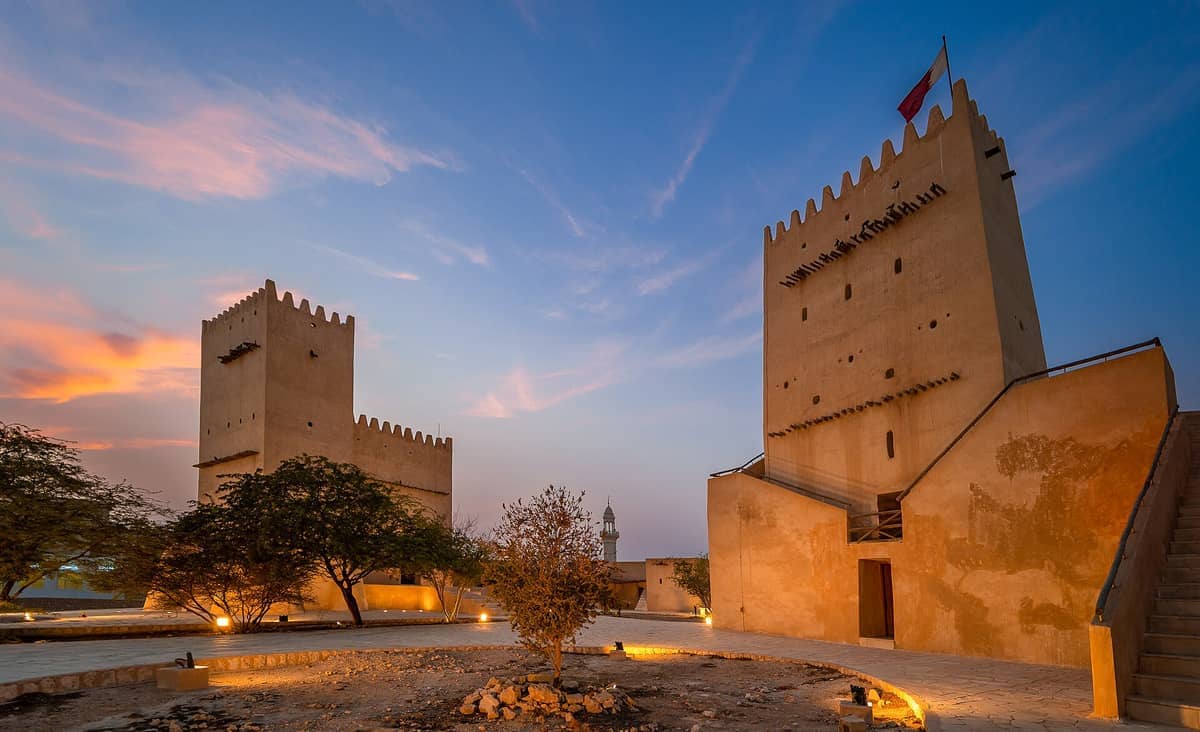
What Barzan Towers Actually Is
Barzan Towers, known in Arabic as Abraj Barzan, is a restored watchtower complex in the quiet village of Umm Salal Mohammed, sitting on a flat expanse of desert scrubland about 20 kilometres north of central Doha. The site is managed by Qatar Museums as a formal heritage attraction and stands as one of the most complete examples of traditional Qatari defensive architecture in the country.
The complex centres on a main tower rising approximately 16 metres, accompanied by a smaller auxiliary tower, both constructed from coral rock and limestone using techniques that predate concrete entirely. The walls are thick, the interiors cool even in warm weather, and the crenellated tops follow a style that would have been functional rather than decorative: this was a working military and civic observation post, not an ornamental structure.
What makes the site genuinely interesting is that it has not been over-restored. The compound retains a rough, honest quality. The stonework shows age. The courtyard is quiet. There are no audio guides, no gift shops, and no crowds. For visitors who find Doha's newer attractions exhausting in their polish, Barzan offers something different: stillness and unmediated history.
⚠️ What to skip
Important: As of the latest Qatar Museums update, Barzan Towers is listed as temporarily closed until further notice. Always check the official Qatar Museums website before making the trip, as the closure dates are not publicly confirmed in advance.
History and Architectural Context
The towers in their current form date to the early twentieth century, with heritage documentation noting construction between 1910 and 1916 under the patronage of Sheikh Mohammed bin Jassim Al Thani, while earlier watchtowers on the same site date back to the late nineteenth century. Some accounts place earlier structures on the same site from the late nineteenth century, with the 1910 renovation producing the towers visitors see today. The choice of Umm Salal Mohammed as a location was deliberate: the elevated position relative to the surrounding flat terrain gave a commanding view over desert approach routes and, in certain conditions, toward the Gulf coast.
Coral rock was the primary building material across much of the Gulf region at this period, harvested from shallow coastal waters and valued for its relative lightness and insulating properties. Combined with limestone mortar and traditional plasterwork, it produced structures that managed internal heat with a degree of sophistication that modern concrete block construction rarely achieves in arid climates. The walls at Barzan are thick enough that the interior air temperature is noticeably lower than outside, even without any mechanical cooling.
Watchtowers of this type served overlapping functions: military surveillance against rival tribal incursions, observation of pearl diving fleets returning to shore, and civic signalling across distances where oral communication was impractical. Barzan was not an isolated fortification but part of a broader pattern of defensive infrastructure across the Qatar peninsula during a period of political tension preceding and during the early decades of British protectorate arrangements.
For visitors who want deeper context on Qatar's pre-modern history, the Al Zubarah Fort in the northwest of the peninsula represents a larger and better-preserved fortification from a slightly earlier period, and the two sites make a logical pairing for anyone seriously interested in the country's defensive heritage.
What the Visit Feels Like
The compound is approached via a gated entrance where visitors have historically signed in informally. The surrounding area is residential and quiet, with low-rise buildings and date palms breaking the flat horizon. The towers appear before you as you turn off the main road: taller than expected, pale against the sky, their crenellations sharp and regular.
The site itself is compact. Both towers can be observed fully in a single circuit, and the main tower's external staircase allows access to upper levels, giving views across the rooftops of Umm Salal Mohammed and, on a clear day, far into the surrounding desert. The stone underfoot is worn smooth in places. The smell is dry and faintly mineral, the way old masonry in arid climates tends to smell: clean, dusty, without moisture.
Early mornings, particularly between October and March, produce the best conditions: the light is low and warm, the shadows across the tower walls are long and sculptural, and the air temperature is comfortable enough to walk the site without rushing. Midday visits in summer are genuinely unpleasant, with surface temperatures on the pale stone reaching considerable heat and almost no shade in the open courtyard area.
💡 Local tip
Go between 8:30 and 10:30 during the cooler months (November to March). The light during these hours is ideal for photography, the site is at its quietest, and the temperature is comfortable for a leisurely look around.
Getting There from Doha
There is no direct public transport connection to Barzan Towers. The Doha Metro's Red, Gold, and Green lines do not extend to Umm Salal Mohammed, and bus routes in the area are not structured for tourist access to the site. The practical options are a private car, a rented car, or a taxi. The drive from central Doha takes roughly 30 minutes under normal traffic conditions, heading north on the main highway.
Karwa taxis are available from central Doha and can be booked via the Karwa app or flagged from major hotels and the Souq Waqif area. Ride-hailing services operating in Qatar are another option, with pickup and drop-off straightforward since the site has a recognisable address. If you plan to return the same day, agree on a return pickup time with your driver before they leave, as taxis do not typically wait in the area.
If you are planning a day of heritage sites, Barzan pairs well with a morning at the Museum of Islamic Art on the Doha waterfront, giving you a strong contrast between the country's ancient and its contemporary approach to cultural preservation.
Photography at Barzan Towers
The towers photograph exceptionally well in the hour after sunrise and the hour before sunset. The pale coral rock takes on warm amber tones in low-angle light, and the long shadows cast by the crenellations create geometric patterns across the courtyard that flat midday light completely flattens. A wide-angle lens captures both towers together from the courtyard; a short telephoto pulls out the surface texture of the stonework in detail.
The surrounding landscape, flat and spare, allows for clean compositional shots where the towers stand alone against the sky without urban clutter intruding. This becomes less true in recent years as Umm Salal Mohammed has grown, but from certain angles within the compound, the skyline remains unobstructed.
Photographers who prioritise architectural heritage in Doha should also consider Msheireb Museums in the city centre, where restored merchant houses from a similar period provide a very different but complementary architectural subject, and the Doha photography guide covers the best light conditions and vantage points across the city.
Practical Notes and Accessibility
Admission to Barzan Towers is free of charge. When open, Qatar Museums lists the standard operating hours as Saturday through Thursday from 08:30 to 12:30, and on Fridays from 15:00 to 18:00, reflecting a morning-focused schedule that suits an early departure from Doha and still leaves the afternoon free for other activities.
The towers involve external staircases with moderate inclines and no elevator access. Visitors with mobility impairments will find the ground-level views of both towers accessible, but the upper levels and crenellated walkways are not. Footwear with grip is advisable, as the stone steps can be polished smooth and slightly uneven.
Dress code expectations follow Qatar's general public norms: modest clothing covering shoulders and knees is appropriate. The site is outdoors and exposed, so a hat and water are essential in warmer months. There are no food or drink facilities on site.
ℹ️ Good to know
The site is currently listed as temporarily closed by Qatar Museums. Views of the towers from the surrounding street and compound perimeter remain possible even during closure, making a brief drive-by worthwhile if you are already heading north of Doha.
Is Barzan Towers Worth Your Time?
Honest answer: it depends on what you are looking for. The site is not large, the interpretive information on offer is minimal, and the 30-minute drive each way represents a meaningful investment of time in a city with a concentrated list of strong attractions. If pre-modern Qatari history and traditional construction methods genuinely interest you, Barzan is rewarding precisely because it is understated. The scale is human, the site is quiet, and the architecture is authentic.
If you are visiting Doha for three days or fewer and are prioritising the major museums and waterfront, this site can reasonably be left out of the itinerary without significant loss. But for visitors on longer stays, or those who find Doha's glass-and-steel skyline less interesting than its older fabric, the drive north is genuinely worthwhile.
Travellers combining a day trip with other destinations north of Doha can consider incorporating Barzan into a broader route that includes Al Thakira mangroves for a day that covers both heritage and natural landscape without backtracking significantly.
Insider Tips
- Call ahead or check the Qatar Museums website the day before your visit. The 'temporarily closed' status has been in place intermittently, and there is no formal notification system if the site reopens quietly.
- If the gate is closed on arrival, the towers are clearly visible from the surrounding road and you can photograph both from street level without entering the compound. The exterior view is genuinely good.
- Combine the trip with a visit to Umm Salal Mohammed's surrounding village area, which retains some traditional low-rise architecture that gives context to what daily life looked like around the towers historically.
- Friday afternoon (15:00 to 18:00, when open) sees slightly more local visitors, particularly families. If you prefer near-solitude, the Saturday or Sunday morning slot around 09:00 is typically very quiet.
- Bring your own water regardless of season. The site has no vending machines, no café, and no shade structures in the courtyard. In October through April this is a minor inconvenience; between May and September it is essential.
Who Is Barzan Towers For?
- Architecture and heritage enthusiasts who want to see traditional Qatari construction materials and methods up close
- Photographers looking for strong geometric subjects in natural light without the crowds of central Doha
- Visitors on longer stays in Qatar who have already covered the main museum circuit
- Families with older children interested in history, particularly those doing a broader tour of the country's forts and defensive sites
- Travellers pairing a northern Doha day trip with Al Thakira mangroves or other sites beyond the city centre
Nearby Attractions
Combine your visit with:
- Al Hazm Mall
Al Hazm Mall is not a typical shopping centre. Built in a classical European-inspired style with colonnaded stone arcades and soaring ceilings, this northern Doha landmark houses luxury boutiques, acclaimed restaurants, and art installations in a setting that feels more like a Milanese galleria than a Gulf mall. Entry is free, the architecture alone justifies the visit, and the restaurant scene is among the strongest in the city.
- Al Safliya Island
A small, uninhabited sand island off the Doha coast, Al Safliya Island draws visitors with clear Gulf waters, a quiet beach, and easy half-day boat access from The Pearl-Qatar or the Corniche. There are no facilities on the island, so what you bring is what you have.
- Al Shahaniya Camel Racetrack
Al Shahaniya Camel Racetrack is Qatar's principal venue for camel racing, a sport central to the country's Bedouin heritage. Located about 40–60 minutes west of central Doha along the Dukhan Highway, the track draws local families, Qatari enthusiasts, and curious visitors during its October-to-April season. Entry to regular race days is free.
- Al Thakira Mangroves
About 64 km north of Doha, the Al Thakira Mangroves protect one of Qatar's largest and most ecologically significant coastal habitats. Whether you paddle through the channels at sunset or simply walk the shoreline at low tide, this protected reserve offers a rare contrast to the capital's urban skyline.