Barrio Chino de Belgrano: What Buenos Aires' Chinatown Is Really Like
Barrio Chino de Belgrano is Buenos Aires' compact Chinatown district, centered on Calle Arribeños between Juramento and Blanco Encalada. Free to enter and open daily, it draws visitors for its Asian supermarkets, dumpling restaurants, tea shops, and the distinctive ceremonial arch at its entrance. Weekend crowds are significant; weekday mornings are a different experience entirely.
Quick Facts
- Location
- Arribeños 2100, Belgrano, Ciudad Autónoma de Buenos Aires
- Getting There
- Subte Line D – Juramento station (6–7 blocks); Mitre train line – Belgrano C station (adjacent)
- Time Needed
- 1–2 hours for a relaxed walk, shopping, and a meal
- Cost
- Free to enter; individual shops and restaurants charge their own prices
- Best for
- Food lovers, curious walkers, families, shoppers looking for Asian ingredients
- Official website
- turismo.buenosaires.gob.ar/en/atractivo/barrio-chino-chinatown
What Barrio Chino Actually Is
Barrio Chino de Belgrano is not a gated district with a single entrance fee and a curated visitor experience. It is a real commercial neighborhood: a cluster of streets in northern Buenos Aires where Chinese and Taiwanese-owned businesses have concentrated since the late 20th century. The core runs along Calle Arribeños, roughly between Juramento and Blanco Encalada, and local tourism information describes the Barrio Chino area as spanning just a few blocks between Arribeños, Mendoza, Juramento, and Montañeses.
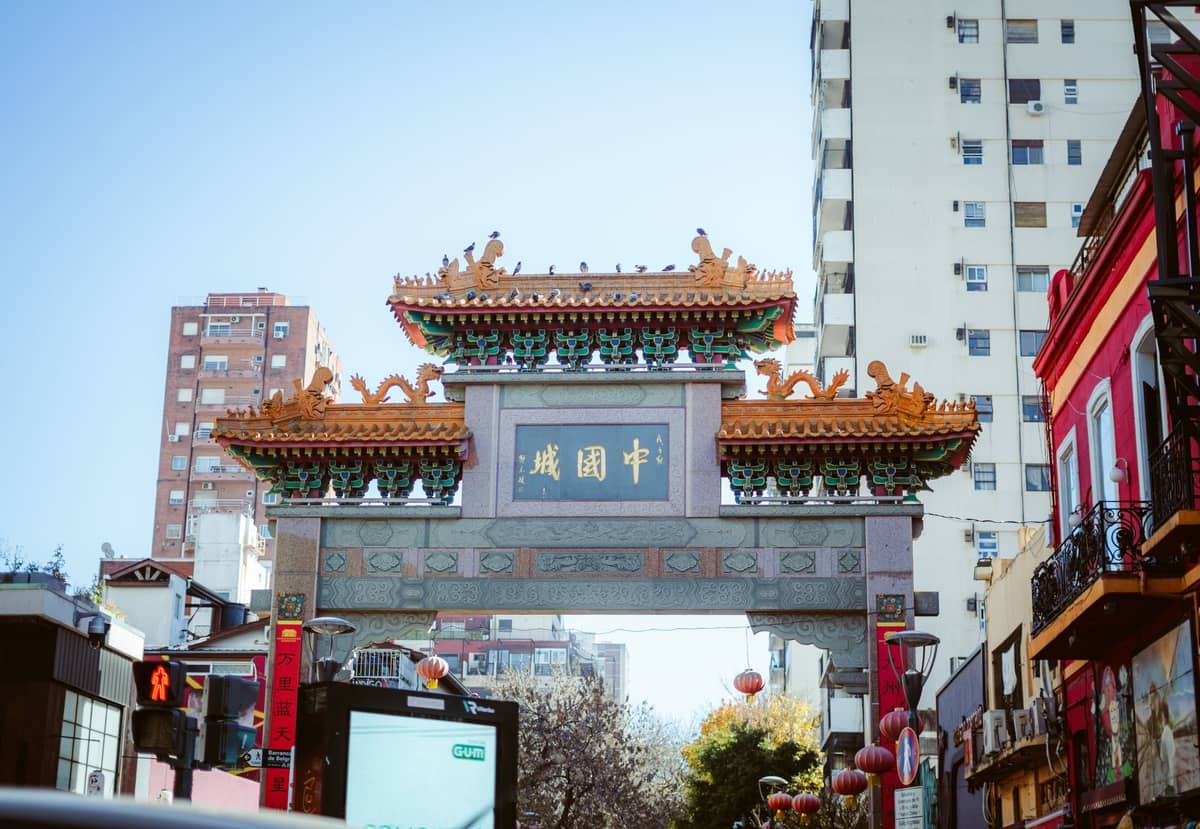
The most photographed landmark is the ceremonial arch at the corner of Arribeños and Juramento, a red-and-gold paifang that frames the entrance to the main pedestrian strip. Beyond it, the street narrows and fills with supermarkets selling everything from fresh lychees and lotus root to bottles of Shaoxing wine, shops offering jade figurines and paper lanterns, and restaurants whose handwritten menus list dim sum, hot pot, and hand-pulled noodles. The smells shift block by block: roasting duck fat near the rotisserie counters, incense from a small Buddhist supply shop, fresh ginger piled in crates outside a produce stall.
ℹ️ Good to know
Barrio Chino is a public street area — there is no admission fee and no single authority managing access. Shop hours vary by owner, but most businesses operate roughly 9:00 or 10:00 to 21:00, with some supermarkets closing around 20:00 and many restaurants closed on Monday.
How the Experience Changes by Time of Day
Weekday mornings, particularly before noon, are when Barrio Chino functions most like a working neighborhood rather than a tourist attraction. The supermarkets are restocking shelves; delivery scooters edge past pedestrians; local residents from Belgrano's largely residential streets nearby are picking up produce. The arch is easy to photograph without crowds, and the sidewalks are wide enough to browse without jostling.
By early afternoon on weekends, the character changes sharply. Arribeños fills with visitors from across the city, and the narrow sidewalks become genuinely congested between the arch and the first major supermarket. Vendors sell bubble tea and sesame pancakes from small counters directly onto the street. The energy is high and the noise level rises considerably: conversation competes with pop music from storefronts and the crackle of something frying. If sensory overload is not your preference, this is worth factoring into your timing.
Late Sunday afternoons, after around 17:00, see a second wind as families come for an early dinner. The restaurants are at their most active, and the supermarkets run through their remaining fresh stock. Arriving at 18:00 on a Sunday is the worst time for produce selection but among the better times to find a table at the mid-range restaurants, since the lunch rush has cleared.
💡 Local tip
For the calmest visit: Tuesday to Thursday, arriving before noon. For the fullest street atmosphere: Saturday afternoon, between 13:00 and 16:00, but expect very crowded sidewalks.
Tickets & tours
Live prices and dates from our booking partner. If you book, we may earn a commission at no extra cost to you.
Madero Tango Show tickets with optional dinner
From 32 €Instant confirmationFree cancellationBuenos Aires small-group city tour with optional lunch and cruise
From 25 €Instant confirmationFree cancellationPiazzolla Tango Show VIP tickets with transfer and optional dinner
From 112 €Instant confirmationFree cancellationBuenos Aires shopping tour
From 15 €Instant confirmationFree cancellation
History and Cultural Context
Chinese immigration to Argentina developed in waves across the 20th century, with notable growth from Taiwan in the 1980s and from mainland China in the 1990s. The Belgrano neighborhood, already a predominantly middle-class residential area with good transport links, became the nucleus where this community established businesses and community associations. The concentration of activity on Arribeños and the surrounding blocks emerged organically rather than through government urban planning, which is partly why the district feels genuinely lived-in rather than staged.
The district is small by global Chinatown standards — there is no comparison in scale to those in San Francisco, London, or Sydney — but it is functionally significant for Buenos Aires' Chinese and Taiwanese diaspora as a place of commerce, community, and cultural continuity. The Buddhist and Taoist temples and associations in the area are not tourist attractions; they are working religious spaces, and visitors should treat them accordingly if they are open to the public.
Belgrano itself has a longer history as one of Buenos Aires' established northern neighborhoods. It sits several kilometers up Avenida Cabildo from Recoleta and carries a different texture: wider tree-lined streets, a significant Moroccan and Korean commercial presence in addition to the Chinese district, and less foot traffic from international tourism. The Chinatown block is an anomaly within it, dense and loud in contrast to the surrounding residential calm.
What to Do: A Practical Walkthrough
The natural entry point is the arch at Arribeños and Juramento. Walk through it and continue along Arribeños toward Blanco Encalada. On both sides you will find large Asian supermarkets with produce sections stocking ingredients rarely found elsewhere in Buenos Aires: fresh tofu, banana blossoms, dried shiitake mushrooms, various soy sauces, rice vinegar, and packaged snacks from China, Taiwan, Japan, and South Korea. These supermarkets are genuinely useful for anyone cooking at home or self-catering, and the prices are competitive.
For eating, the block concentrates a range of options. Several restaurants serve Cantonese-style dim sum on weekends, typically from mid-morning until early afternoon when the trays run out. Others offer Japanese ramen, Korean barbecue, or generalized pan-Asian menus. Quality is uneven and menus change; the best indication of a kitchen's current form is simply how full it is with local diners rather than tourists. A restaurant that is half-empty at 13:00 on a Sunday is telling you something.
Gift shops sell paper fans, chopstick sets, Chinese New Year decorations, small ceramic figures, and bulk tea. The tea shops, in particular, are worth a slow look: loose-leaf oolongs, jasmine pearls, pu-erh cakes, and packaged blends line the shelves, and the prices reflect a community market rather than a tourist markup. If you are interested in Asian groceries or ingredients, this is the most practical stop in all of Buenos Aires for that purpose.
💡 Local tip
Bring cash in Argentine pesos. While many establishments accept cards, smaller vendors and street food stalls typically do not. ATMs are available on Avenida Cabildo, a few minutes' walk from the arch.
Getting There and Getting Around
The most straightforward public transport option is the Subte Line D to Juramento station, from which Barrio Chino is roughly a 6–7 block walk. Alternatively, the Mitre commuter train line stops at Belgrano C station, which sits adjacent to the district. Numerous colectivo bus lines run along Avenida Cabildo nearby, including lines 15, 29, 42, 44, 55, 60, 63, 64, 65, 80, 107, 113, 114, 118, and 130, among others. For a broader overview of moving around the city, see the getting around Buenos Aires guide.
The streets within Barrio Chino are flat and paved, making them navigable with a stroller or wheelchair in the general sense. However, the sidewalks on Arribeños are narrow and on busy weekend afternoons they fill to the point where moving at your own pace is difficult. Ramps and step-free access into individual businesses varies significantly; assume you will need to assess each shop entrance individually. There is no central accessible-visitor infrastructure.
Barrio Chino is easy to combine with other stops in the northern part of the city. The Museo Larreta is in the same neighborhood, and the broad green spaces of Belgrano make the surrounding area pleasant for a longer half-day.
Photography and Practical Notes
The arch at Arribeños and Juramento photographs well in morning light, when the sun hits it from the east and the sidewalk is relatively clear. By midday on weekends, getting a clean shot of the arch without crowds in frame requires patience or creative framing. The interior of the supermarkets, with their layered shelves of colorful packaging, are visually interesting; ask before photographing staff or private shops.
Wear comfortable flat shoes. The streets are paved but the foot traffic means you will be stopping and starting frequently. There is no dress code consideration for the outdoor areas; for any religious site or association building in the vicinity, dress respectfully as you would anywhere.
Weather matters here more than you might expect. On summer afternoons (December through February), the narrow block between buildings traps heat and the crowds amplify it. Visiting in the cooler months of autumn or spring is genuinely more comfortable. For a sense of Buenos Aires' seasonal patterns, the best time to visit Buenos Aires covers the full picture.
What It Offers — and What It Does Not
Barrio Chino is a specific kind of attraction: it rewards visitors who are interested in food, ingredients, and the texture of immigrant community life. It does not reward visitors who are looking for traditional Argentine culture, wide pedestrian streets, or a quiet contemplative experience. It is a working commercial district that gets very crowded at peak times, and the stretch of Arribeños that constitutes the main tourist circuit is genuinely short — you can walk it end to end in under ten minutes.
If you are spending a week or more in Buenos Aires and want to see the city's different urban layers, Barrio Chino earns its place on an itinerary. If you are on a tight two-day trip focused on Buenos Aires' most iconic sights, it is lower priority than the historic center, San Telmo, or the city's major museums. Travelers who love Asian cooking and want to stock up on ingredients will find it indispensable. Those who dislike congested commercial streets in summer heat may find it more stressful than rewarding.
For travelers putting together a fuller Buenos Aires itinerary, the things to do in Buenos Aires guide helps contextualize where Barrio Chino fits relative to the city's other draws.
Insider Tips
- The large Asian supermarkets are better stocked mid-week than on Sundays. If you are shopping for specific ingredients — fresh lotus root, specific brands of miso, or particular dried goods — a Tuesday or Wednesday visit gives you the best selection before weekend shoppers deplete the fresh stock.
- Chinese New Year celebrations (date varies with the lunar calendar, typically late January or February) bring lion dances, firecrackers, and food stalls to Arribeños. The crowd is intense, but the spectacle is unlike anything else in Buenos Aires. Arrive early and stay near the arch for the best sightlines.
- Several of the tea shops along Arribeños will let you smell and discuss teas before you buy. If you have any interest in oolong or pu-erh, this is the best place in Buenos Aires to find a genuine selection at non-tourist prices — take your time in these shops rather than rushing past.
- The Belgrano C commuter train station is literally next to the district and often faster than the Subte for trips from downtown. Trains run frequently and the walk to the arch from Belgrano C is shorter than the walk from Juramento Subte station.
- Avoid Sunday lunch hour (13:00–15:00) if you want to eat at a specific restaurant without waiting. Arrive before noon or after 15:30 to find tables available without a queue.
Who Is Barrio Chino de Belgrano (Chinatown) For?
- Food-focused travelers who want to explore Asian ingredients and cooking cultures within Buenos Aires
- Visitors with time to explore beyond the city center who want to see how immigrant communities have shaped the city's neighborhoods
- Families with children who respond well to sensory-rich, food-centered environments with street snacks and colorful storefronts
- Self-caterers or those with kitchen access who want to find Asian grocery staples unavailable in general supermarkets
- Travelers visiting during Chinese New Year who want to see the city's most lively seasonal street celebration outside of tango festivals
Nearby Attractions
Other things to see while in Belgrano:
- Museo de Arte Español Enrique Larreta
Housed in the former Belgrano residence of Argentine writer Enrique Larreta, this city-run museum holds one of Buenos Aires's most focused collections of Spanish art, from medieval religious pieces to Golden Age paintings. The Andalusian-style garden at its rear is quietly one of the most distinctive outdoor spaces in the northern neighborhoods.
Planning a trip? Discover personalized activities with the Nomado app.