American Museum of Natural History: What to Know Before You Go
One of the largest natural history museums in the world, AMNH spans 21 interconnected buildings and 45 permanent exhibition halls on the Upper West Side of Manhattan. From the 94-foot blue whale to the Rose Center for Earth and Space, it rewards several hours of focused exploration.
Quick Facts
- Location
- 200 Central Park West, Upper West Side, Manhattan, NY 10024
- Getting There
- B/C train to 81st St–Museum of Natural History; 1 train to 79th St (2 blocks west)
- Time Needed
- 3–5 hours minimum; a full day for serious visitors
- Cost
- Adults $30, Seniors/Students $24, Children $18 (outside NY State). NY State residents pay-what-you-wish.
- Best for
- Families, science enthusiasts, architecture lovers, rainy-day visits
- Official website
- www.amnh.org
What the American Museum of Natural History Actually Is
The American Museum of Natural History, known universally by its initials AMNH, is one of the largest and most significant natural history institutions in the world. Founded on April 6, 1869, it occupies a sprawling complex of 21 interconnected buildings along Central Park West on Manhattan's Upper West Side. The complex contains 45 permanent exhibition halls, a research library, a planetarium, and collections that number over 34 million specimens and artifacts. That last figure is worth pausing on: the vast majority of those objects are never on public display. What you see in the galleries is a curated fraction of one of the world's great scientific archives.
The museum is open daily from 10:00 am to 5:30 pm. It draws millions of visitors each year, which means crowd management is a real consideration, especially on weekends and school holiday weeks. But it's also a genuinely large building, and unlike many popular NYC attractions, it rarely feels dangerously packed because visitors spread across dozens of halls simultaneously.
💡 Local tip
Buy tickets online in advance, especially for ticketed special exhibitions. Walk-up lines at the admissions desk move slowly on weekend mornings, and some timed-entry exhibitions can sell out.
The Architecture and the Approach
The main facade on Central Park West is Romanesque Revival stone, heavy and assured, completed in stages from the 1870s onward. The Theodore Roosevelt Memorial, the grand entrance on this side, opened in 1936 and gives the museum a ceremonial gravity that prepares you for what's inside. Roosevelt himself sits equestrian above the broad front steps, a monument that has generated ongoing discussion about its symbolism, and the museum has engaged with that publicly.
The 81st Street side, where the Rose Center for Earth and Space announces itself with an enormous glass cube encasing a luminous sphere, is visually striking enough to justify a walk around the block before you enter. Architect Polshek Partnership completed the Rose Center in 2000, and it remains one of the more successful science-architecture intersections in New York. At night, the glass cube glows from within. If you happen to walk past in the early evening, it's worth a look even if the museum has already closed.
The museum sits directly across Central Park West from Central Park, and the combination makes for a natural half-day itinerary on the Upper West Side, particularly in spring and autumn when the park is at its most walkable.
Tickets & tours
Hand-picked options from our booking partner. Prices are indicative; availability and final rates are confirmed when you complete your booking.
New York American Museum of Natural History and In App Audio Tour
From 0 €Instant confirmationNYC American Museum of Natural History family private tour
From 326 €Instant confirmationFree cancellationChelsea Market, High Line and Meatpacking food and history tour
From 48 €Instant confirmationFree cancellationMidtown Manhattan: architecture and history private walking tour
From 72 €Instant confirmationFree cancellation
Navigating the Halls: What to Prioritize
The scale of the museum is its greatest asset and its biggest practical challenge. First-time visitors often underestimate how much time they need, then exhaust themselves trying to see everything. The layout is not intuitive: the 21 buildings were constructed across different decades and connected over time, producing a floor plan that loops back on itself in unexpected ways. Grab a map at the entrance and commit to a strategy.
The Hall of Ocean Life on the first floor is where most visitors pause longest, and rightly so. The 94-foot fiberglass blue whale suspended from the ceiling is one of the great set pieces of any museum in the country. The hall itself is dim and cool, lit to suggest the underwater environment it represents, and the whale seems to shift scale every time you move beneath it. Early morning on a weekday, this room is remarkably quiet, which makes the experience considerably more affecting than during a crowded Saturday afternoon.
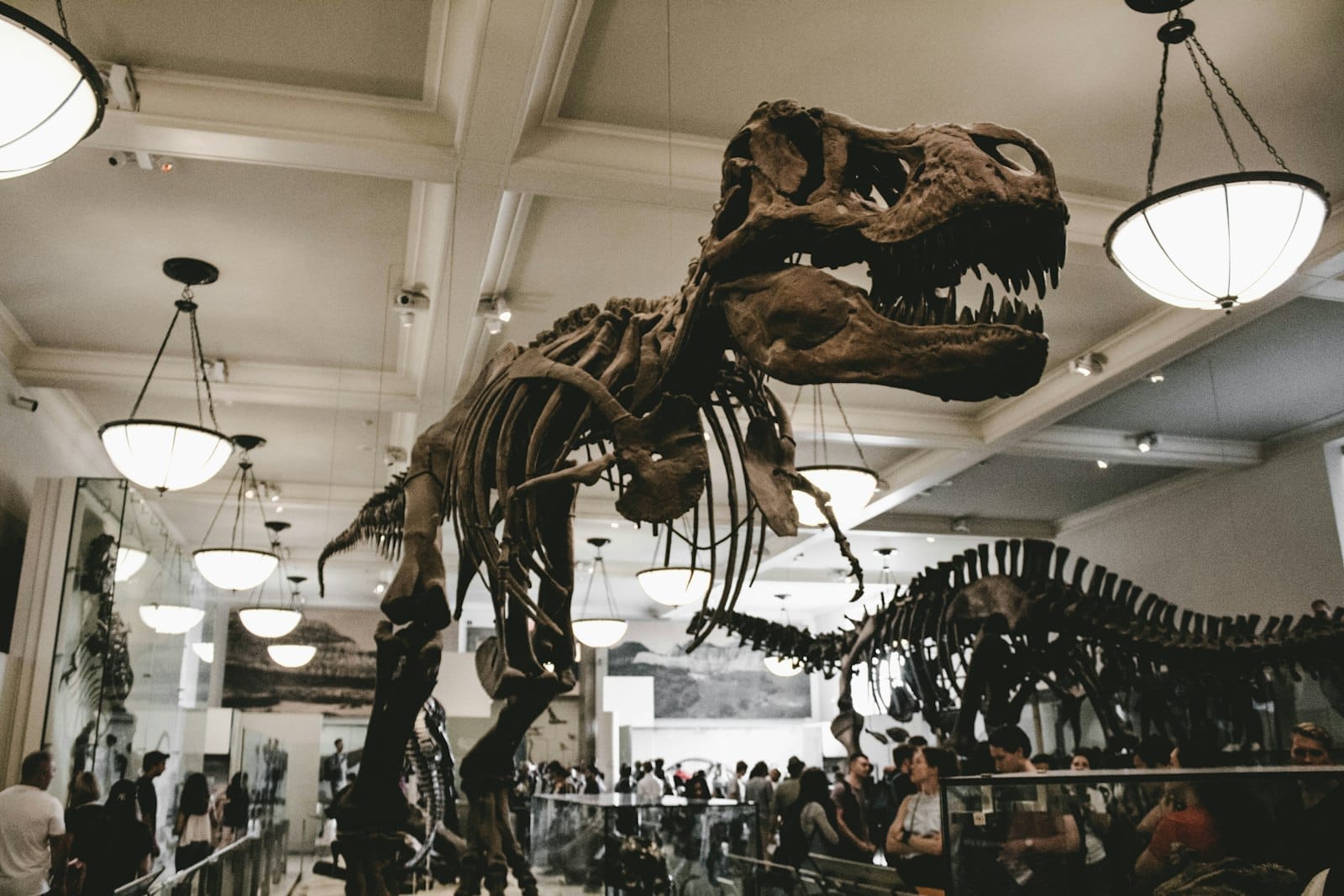
The fourth-floor fossil halls are the deepest draw for many adult visitors. The layout takes you through vertebrate evolution with genuine scientific precision, and the mounted dinosaur skeletons combine real fossil bone with casts and reconstruction — the T. rex and Apatosaurus are composites, not wholly original fossils. The collections of ceratopsians represent decades of fieldwork. The halls are extensive and relatively uncrowded compared with the floors below. Budget at least 45 minutes here if paleontology interests you at all.
The Hayden Planetarium inside the Rose Center offers separate ticketed Space Shows on a spherical screen inside the dome. The shows run roughly 25 minutes and are worth adding if you have children in your group or a particular interest in astrophysics. Ticket these separately when you book your general admission.
How the Experience Changes by Time of Day
Arriving at 10:00 am on a weekday gives you the best conditions in the building. The halls on the lower floors, which tend to be the most popular, are genuinely calm for the first 60 to 90 minutes. The light is consistent throughout since the galleries rely almost entirely on artificial lighting, so time of day doesn't affect what you see inside the way it would at an outdoor site. What changes is the density of other visitors.
By midday on weekends, the ground floor and the Hall of Ocean Life become significantly more crowded, and the cafe areas fill up with school groups. If you arrive after 1:00 pm on a Saturday, the experience on the popular floors is noticeably noisier and more compressed. The fossil halls on the fourth floor remain calmer throughout the day and are the best refuge if you arrive late.
The museum closes at 5:30 pm. The last 30 minutes before closing tend to see a natural thinning of the crowd as families with young children leave, and there's something pleasantly contemplative about the late afternoon light outside as you exit. The Central Park West steps face west, catching the last of the afternoon sun in warmer months.
⚠️ What to skip
The 81st Street subway station is not wheelchair accessible. Visitors requiring step-free access should use the 72nd Street station (1, 2, 3 trains) and connect northbound via the M7 bus on Amsterdam Avenue, or enter the museum via the 81st Street/Rose Center entrance or the Gilder Center on Columbus Avenue at 79th Street.
Tickets, Pricing, and What NY State Residents Should Know
Admission is structured differently depending on where you live. New York State residents, and students from New York, New Jersey, and Connecticut, are entitled to pay-what-you-wish pricing for general admission. Suggested rates are $25 for adults, $20 for students and seniors over 60, and $14 for children aged 3 to 12. Visitors from outside New York State pay standard rates: $30 for adults, $24 for seniors and students with valid ID, and $18 for children.
Combination tickets that include one or all ticketed special exhibitions are available at $36 and $41 respectively for adults. Whether these are worth adding depends entirely on what exhibitions are running during your visit. Check the AMNH website before you book, as special exhibitions vary considerably in depth and quality.
AMNH is included on the New York City Pass and similar multi-attraction discount products. If you plan to visit several major museums, it's worth consulting a New York City Pass guide to see whether bundling makes financial sense for your itinerary.
For a broader sense of what the Upper West Side's cultural institutions offer, the museum sits within reach of several other significant stops. For travelers building a multi-museum day, our guide to the best museums in New York City provides useful context on how AMNH fits into the wider landscape.
Practical Details: Getting There and Getting Around
The most direct subway option is the B or C train (the B runs weekdays only) to 81st Street–Museum of Natural History, which deposits you directly at the museum's side entrance. The 1 train stops at Broadway and West 79th Street, about two blocks west, and is an easy walk. Crosstown buses including the M79 stop near the museum on West 81st Street, and the M7, M10, M11, M86, and M104 serve nearby routes.
On-site parking is available in a garage accessible from 81st Street between Central Park West and Columbus Avenue, though driving to this part of Manhattan on weekends involves considerable traffic and parking expense. Taxis and rideshares drop off and pick up smoothly on Central Park West.
The museum has two restaurants, a food court-style cafe, and a gift shop. The cafe food is functional and not particularly cheap, which is standard for a major NYC institution of this type. If you prefer something better, the Upper West Side has a dense concentration of cafes and restaurants on Columbus and Amsterdam Avenues within a five-minute walk.
ℹ️ Good to know
Bag check is available near the entrance. Large backpacks and strollers are manageable inside the museum, but the fourth-floor fossil halls have narrower corridors around some exhibits. A smaller bag makes navigation easier on the upper floors.
Who This Museum Suits Best, and Who Might Be Disappointed
AMNH is one of the rare large institutions that genuinely works for multiple types of visitors at the same time. Children respond viscerally to the scale: the blue whale, the dinosaur skeletons, the dioramas in the African and North American mammal halls. Adults with serious scientific interests find real depth in the paleontology and biodiversity collections. The building itself is worth studying for anyone interested in institutional architecture from the late 19th and early 20th centuries.
Visitors primarily focused on contemporary art or design will find little to hold their attention here. If your priority is fine art collections, the Metropolitan Museum of Art is a short distance away on the Upper East Side and a natural pairing for a full-day cultural itinerary.
Travelers who dislike crowds at any level may find weekend visits frustrating on the lower floors. The museum is genuinely enormous, but the most popular halls do compress visitors significantly between 11:00 am and 3:00 pm on Saturdays and Sundays, and during school holiday weeks in February, April, and December. The experience is far calmer on a weekday morning.
If you are traveling with children and planning a broader itinerary, the New York City with kids guide outlines how to structure days around major family-oriented attractions across the city.
Insider Tips
- The fourth-floor fossil halls are consistently the least crowded part of the museum and contain some of its most significant scientific objects. If you arrive late on a busy day, go there first.
- New York State residents pay what they wish for general admission. If you qualify, bring ID. There is no minimum, though suggested rates are listed at the desk.
- The Rose Center for Earth and Space is visually striking from outside at night, even when the museum is closed. If you are in the neighborhood after dark, it is worth walking past the 81st Street entrance.
- The Hayden Planetarium Space Show requires a separate ticket and has limited showtimes. Book it alongside your general admission online rather than hoping for a walk-up slot on a busy weekend.
- The museum's research library and some of its rotating gallery spaces are less promoted in standard visitor materials but can include genuinely significant temporary exhibitions. Check the AMNH website for current programming before you go.
Who Is American Museum of Natural History For?
- Families with children aged 5 and up, particularly those interested in dinosaurs, ocean life, or space
- Science and natural history enthusiasts who want depth in paleontology, anthropology, or ecology
- Architecture and history travelers interested in large 19th-century institutional building complexes
- Rainy-day or winter visits when outdoor options in the city are limited
- First-time visitors to New York City building a classic Manhattan cultural itinerary
Nearby Attractions
Other things to see while in Upper West Side:
- Lincoln Center for the Performing Arts
Lincoln Center for the Performing Arts is New York City's premier cultural campus, packing the Metropolitan Opera, New York Philharmonic, New York City Ballet, and the Juilliard School onto a single 16-acre campus on the Upper West Side. The outdoor plazas are free to visit any time, while ticketed performances range from affordable rush seats to full-price orchestra tickets at some of the world's most storied venues.
- New-York Historical Society
Founded in 1804, the New-York Historical Society is New York City's oldest museum, located on the Upper West Side across from Central Park. Its permanent and rotating collections span over 400 years of American history, from colonial-era documents to Tiffany lamps, making it a serious alternative to the blockbuster institutions nearby.