Cabaret Voltaire: Where Dada Was Born in Zurich's Niederdorf
Cabaret Voltaire at Spiegelgasse 1 is the founding site of the Dada art movement, opened on 5 February 1916 and reopened as a cultural venue in 2002. Today it combines a bar, a vaulted cellar gallery, a historic performance hall, and a specialist Dada library — all in a compact medieval building in the heart of Niederdorf.
Quick Facts
- Location
- Spiegelgasse 1, 8001 Zürich (Niederdorf)
- Getting There
- Approx. 9-min walk from Zurich HB; nearest tram stops at Rathaus/Rathausbrücke
- Time Needed
- 45 min to 2 hours; longer on event nights
- Cost
- CHF 7 regular; CHF 4 members; free with Zürich Card
- Best for
- Art history enthusiasts, nightlife seekers, curious cultural explorers
- Official website
- www.cabaretvoltaire.ch
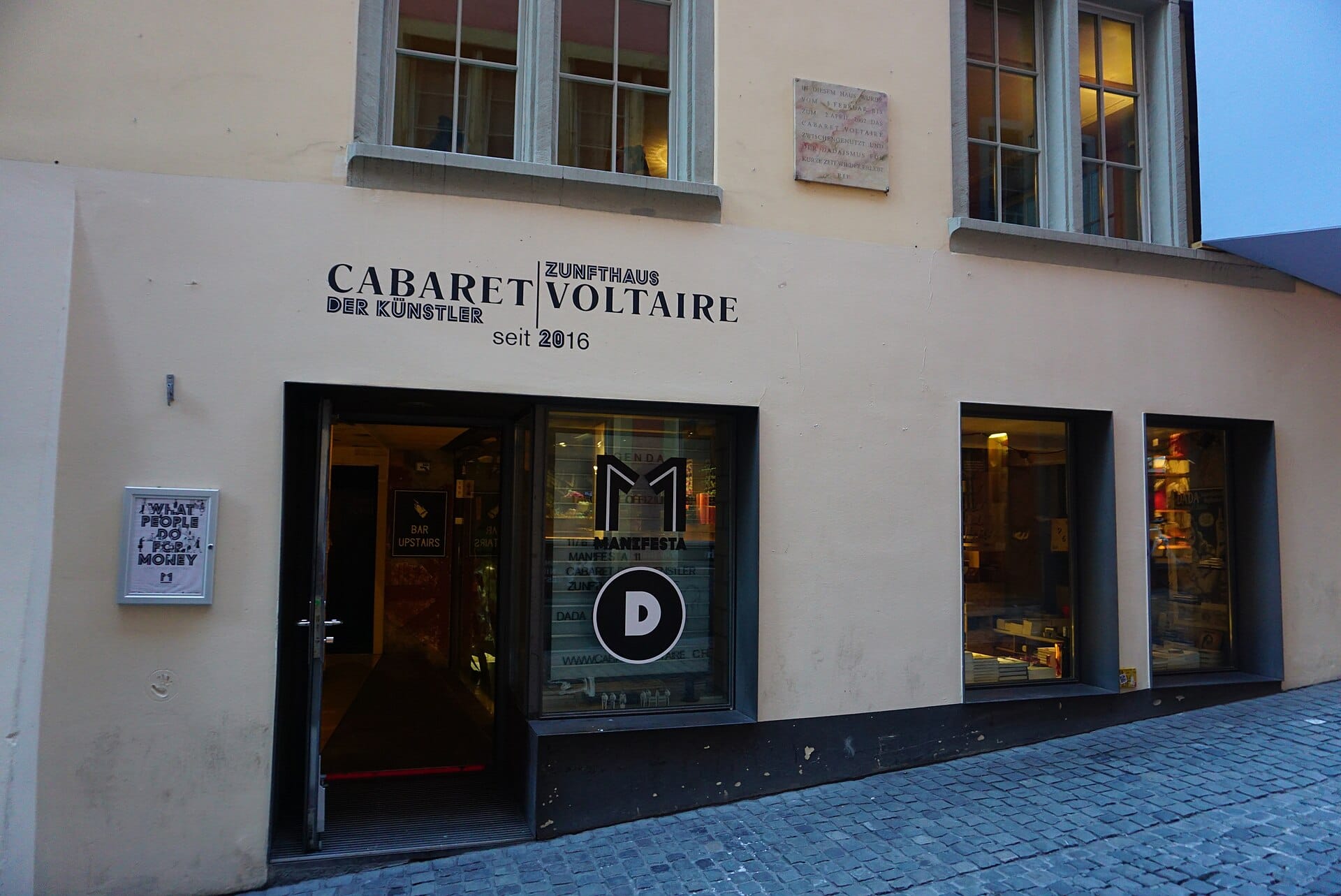
What Cabaret Voltaire Actually Is
Cabaret Voltaire is a small, storied cultural venue at Spiegelgasse 1 in Zurich's Niederdorf quarter. The building is not a museum in any conventional sense: there are no velvet ropes, no echoing halls, no audio guides pressed into your hand at the door. What you get instead is a layered space that works simultaneously as a bar, an art exhibition venue, a performance hall, and a library dedicated to one of the 20th century's most radical art movements.
The Dada movement was founded here on 5 February 1916, when the writer Hugo Ball and his partner Emmy Hennings opened a literary cabaret in a rented room in this building. Within weeks, artists including Tristan Tzara, Jean Arp, Richard Huelsenbeck, and Sophie Taeuber had joined them. They performed nonsense poetry, invented new theatrical forms, and deliberately rejected the rationalist logic they blamed for the horrors of the First World War raging nearby. The word 'Dada' itself was chosen partly because it meant nothing specific, and partly because it meant too many things at once. The movement that began in this single room eventually reshaped modern art, influenced Surrealism, Fluxus, punk, and conceptual art.
ℹ️ Good to know
Admission is CHF 7 (regular), CHF 4 for members, and free with a Zürich Card. The venue is closed on Mondays.
The Space Itself: Four Rooms, Four Registers
The building at Spiegelgasse 1 is narrow and vertical, as most Niederdorf structures are. The ground floor opens onto the Artists' Bar in the entrance area, where the tone is informal and the drinks are reasonably priced by Zurich standards. This is not a curated silence space: conversations carry, someone is usually sketching at a table, and the small bar staff are accustomed to fielding questions about the building's history between orders.
The Historical Hall, which occupies the core of the venue, is designed to evoke the space where Hugo Ball held the original cabarets. Its walls are layered with photographs, reproductions, and text panels, and it doubles as the main bar area in the evenings. Soirées and live events are held here regularly, and when one is scheduled, the room shifts character entirely: the lights drop, the furniture shifts, and the space recalls something of what it might have felt like in 1916, when a raucous crowd crammed in to watch Ball perform his 'sound poems' in a papier-mâché bishop's costume.
Downstairs, a vaulted cellar hosts temporary exhibitions, typically running for several weeks at a time and usually featuring contemporary artists working in dialogue with Dadaist ideas. The cellar's rough stone walls and low ceilings give exhibitions a compressed, intimate quality that purpose-built gallery spaces rarely achieve. Check the official website before visiting to see what is currently showing, as the quality and relevance of these exhibitions varies.
On the second floor, the Dada Library holds a specialist collection of books, periodicals, and research materials related to the movement. It is genuinely useful for anyone with a serious interest in the subject, not just a decorative nod to the past.
Tickets & tours
Live prices and dates from our booking partner. If you book, we may earn a commission at no extra cost to you.
Mount Titlis snow fun for first-time skiers from Zurich
From 212 €Instant confirmationFree cancellationSwiss ski experience from Zurich
From 321 €Instant confirmationFree cancellationBest intro tour of Zurich with a local
From 116 €Instant confirmationFree cancellationZurich Old Town guided walking tour
From 27 €Instant confirmationFree cancellation
How the Experience Changes by Time of Day
If you want quiet and space to absorb the history without distraction, arrive shortly after opening on a Friday or Saturday afternoon, around 13:30 to 15:00. The venue is lightly attended at that hour, the natural light is better in the upper floors, and you can move through the exhibitions at your own pace without the bar crowd arriving.
By early evening on weekends, the atmosphere shifts noticeably. The bar fills, the sound level rises, and Cabaret Voltaire transitions from cultural site to genuine social venue. This is not a bad thing if you are after the full layered experience, the sense of a place that is still alive rather than preserved behind glass. Tuesday through Thursday evenings are noticeably quieter across the board, making them a good option if you want to visit the Historical Hall and actually speak to someone without raising your voice.
💡 Local tip
Check the events calendar on the official website before you visit. Soirée nights transform the Historical Hall into a performance space, which can either be the highlight of your visit or a reason to come another day, depending on your interests.
The Neighborhood Context: Niederdorf on Foot
Spiegelgasse 1 sits on a narrow lane in Niederdorf, the medieval quarter on the east bank of the Limmat river. The street itself has a secondary historical footnote: Lenin lived at Spiegelgasse 14, just a few doors away, from February 1916 to April 1917, essentially the same period the Dada movement was coalescing in the building next door. The two groups were aware of each other but famously never collaborated. It remains one of the more compressed coincidences in 20th-century cultural history.
The lane is cobblestoned and slightly uneven underfoot, worth noting if mobility is a concern. Spiegelgasse opens onto the broader Niederdorf quarter, which connects northward toward the Grossmünster and southward toward the central Limmat crossings. The surrounding streets are lined with small restaurants, independent bookshops, and bars, meaning there are good options for extending the evening in either direction.
Practical Details for Visitors
Opening hours are: Tuesday to Thursday 17:00 to 23:00; Friday and Saturday 13:30 to 01:00; Sunday 13:30 to 18:00. The venue is closed on Mondays. These hours are correct as of the time of writing but should be verified on the official website before your visit, particularly around public holidays.
The walk from Zurich HB takes roughly nine minutes through the old town, passing through the Niederdorf lanes. Tram stops on the Rudolf-Brun-Brücke or Central serve the broader area. There is no on-site parking and none is expected in this district: the streets are too narrow and the pedestrian flow too constant.
The Zürich Card, available through Zurich Main Station and online, covers admission. If you are planning multiple paid cultural visits in a single day, it can represent reasonable value.
No explicit wheelchair-accessibility information was found in official sources for this venue. Given the building's age, narrow internal staircases, and cellar exhibition space, visitors with mobility requirements should contact the venue directly before visiting.
⚠️ What to skip
The building is historic and compact. The vaulted cellar involves a staircase, and the overall floor plan is vertical rather than open-plan. This is not an accessible space by modern standards, though the ground-floor bar area is step-free from the street entrance.
Is It Worth Your Time? An Honest Assessment
Cabaret Voltaire is genuinely significant as a cultural site, and it earns that significance without overstating it. The building is small; you will not spend three hours here on the strength of the permanent collection alone. What makes it worthwhile is the accumulation of layers: the historical resonance of the room itself, the quality of the temporary exhibitions when they are strong, the library as a working resource, and the bar as a place where the ideas of Dada are still, in some diffuse way, in the air.
Travelers who want conventional museum experiences with clear interpretive frameworks and large collections should look elsewhere. The Kunsthaus Zürich a short walk away offers a far more extensive permanent collection and includes significant Dada works in its holdings. Cabaret Voltaire is not a substitute for that; it is a complement to it, and ideally visited the same day or evening.
For anyone interested in the history of modern art, experimental performance, or the cultural conditions that made radical ideas possible, spending an hour here alongside a visit to the Swiss National Museum gives a vivid sense of what Zurich was in 1916: a neutral city full of exiles, ideas, and suppressed energy.
Insider Tips
- The temporary cellar exhibitions change every few weeks. Check the official site at cabaretvoltaire.ch for the current program before visiting, since some exhibitions are considerably stronger than others.
- If you visit on a soirée night, the Historical Hall is rearranged for performance and regular browsing of the space becomes limited. Arrive early if you want to see the room in its default configuration before the event begins.
- The Dada Library on the second floor is a genuine specialist resource, not just atmospheric dressing. If you have a serious interest in Dada, Surrealism, or early 20th-century avant-garde movements, ask at the bar about accessing the collection.
- Lenin's former lodgings at Spiegelgasse 14 are a two-minute walk along the same street. A small plaque marks the building. It adds historical context to the visit at no additional cost or time.
- Tuesday and Wednesday evenings are the least crowded across the whole venue. If you want to have a proper conversation in the Historical Hall or linger in the cellar exhibition without other visitors behind you, those are the nights to come.
Who Is Cabaret Voltaire For?
- Art history and design enthusiasts with an interest in early 20th-century avant-garde movements
- Travelers combining culture and nightlife who want a venue that functions well as both
- Visitors doing a dedicated cultural day in the old town alongside the Kunsthaus and Grossmünster
- Anyone interested in the political and intellectual history of World War One-era Europe
- Couples or solo travelers who prefer intimate, atmospheric venues over large institutional museums
Planning a trip? Discover personalized activities with the Nomado app.