Xochimilco Canals & Trajineras: Mexico City's Ancient Waterways
Xochimilco's 170-kilometer canal network is one of the last surviving fragments of the pre-Hispanic lake system that once defined the Valley of Mexico. Visitors rent brightly painted wooden boats called trajineras and drift past floating gardens, flower vendors, and roving mariachi ensembles. It is a UNESCO World Heritage Site, a living ecological system, and an experience unlike anything else in Latin America.
Quick Facts
- Location
- Xochimilco borough, ~23 km south of Mexico City's historic center. Main dock: Embarcadero Nuevo Nativitas, Av. Mercado S/N, 16090 CDMX
- Getting There
- Metro Line 2 to Tasqueña, then Tren Ligero (light rail) to Xochimilco station. Ride-hail apps (Uber, Didi) also serve the area directly
- Time Needed
- 2–4 hours on the water; allow 3–5 hours total including transit and dockside activity
- Cost
- No park entrance fee. Trajinera rental approx. MXN $500–600 per boat per hour (not per person); confirm pricing on-site as rates vary by dock
- Best for
- Families, groups, cultural travelers, weekend explorers, photography
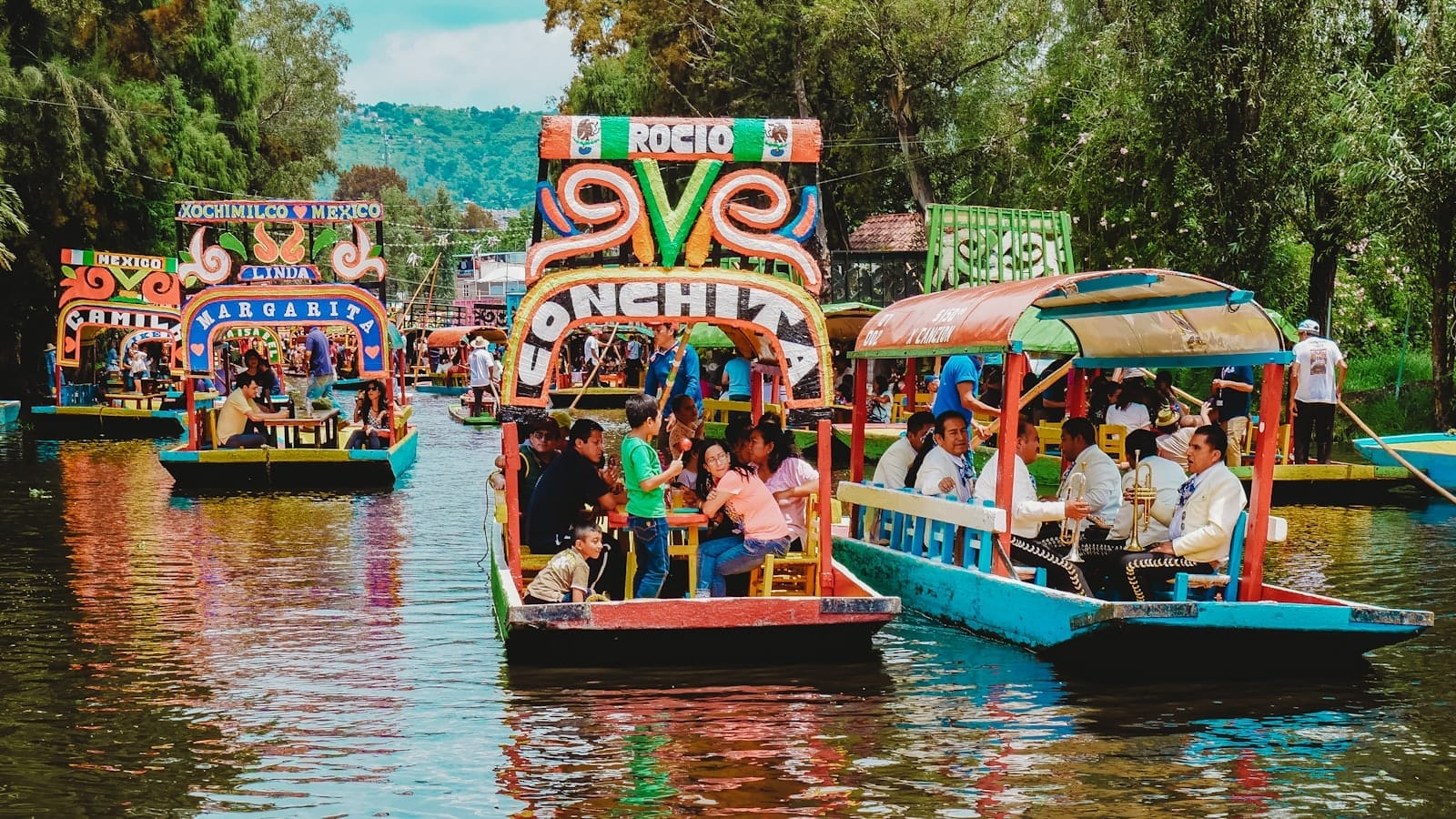
What Xochimilco Is
The Xochimilco Canals and Trajineras are not a theme park or a manufactured attraction. They are a functioning, living relic of a civilization that engineered an entire city on water. Long before Spanish colonizers arrived in the sixteenth century, the Aztec (Mexica) world was built around lakes, causeways, and chinampas — artificially constructed agricultural islands formed by layering aquatic vegetation, mud, and soil over shallow lake beds. The surrounding lakes were largely drained by colonial authorities over subsequent centuries. Xochimilco's canal network is what remains: roughly 170 kilometers of waterways threading between chinampa plots still farmed today, inscribed as a UNESCO World Heritage Site in 1987 alongside Mexico City's historic center zone.
What makes Xochimilco distinctive is the collision of the ancient and the festive. On any given Saturday, the canals are thick with trajineras — wide, flat-bottomed wooden boats painted in loud colors and crowned with arched floral signs spelling out women's names. Families haul coolers aboard, vendors paddle alongside selling corn, carnitas tacos, and micheladas, and at least one marimba or mariachi boat will find you within the first fifteen minutes. The noise, the crowds, and the cheerful disorder are very much part of the experience.
ℹ️ Good to know
Trajinera rental is priced per boat, not per person. A boat fits roughly 8–20 people depending on size. Splitting the cost across a group makes this one of Mexico City's more affordable experiences. Confirm rates directly at the dock before boarding.
The Canals by Time of Day
Weekday mornings, particularly before 11:00, offer a version of Xochimilco that most visitors never see. The light is flat and cool, mist sometimes sits over the water, and the dominant sounds are birdsong and the slow dip of a boatman's pole rather than recorded cumbia. A handful of farmers are already out on the chinampas, tending crops of lettuce, herbs, and flowers. The canals smell faintly of vegetation and damp earth. This is the ecological Xochimilco — quieter, more meditative, and easier to photograph without a party boat drifting into frame.
By Saturday afternoon, the atmosphere shifts completely. The embarcaderos at Nuevo Nativitas and Cuemanco become organized chaos: boat negotiators call out from the docks, vendors stack flowers and snacks on floating platforms, and the narrow canals become congested with trajineras moving in both directions. The smell shifts too — roasting corn, beer, and sunscreen. Children lean over the sides to grab at passing boats. It is loud, it is crowded, and for many visitors it is exactly what they came for.
Late afternoon light, roughly 16:00–18:00, is the sweet spot for photography. The angle of the sun across the chinampas and the painted wood of the boats produces warm, saturated color. Crowds begin to thin slightly after 17:00 on weekdays. If you are visiting primarily for the visual experience rather than the party atmosphere, a late weekday afternoon is the best window.
💡 Local tip
Avoid visiting on public holidays if crowds unsettle you. Days like Mexican Independence Day (September 16) or the period around Day of the Dead bring exceptionally large numbers of both local families and tourists to the embarcaderos.
Tickets & tours
Live prices and dates from our booking partner. If you book, we may earn a commission at no extra cost to you.
Xochimilco, Coyoacan and Frida Kahlo Museum with skip-the-line tickets
From 63 €Instant confirmationFree cancellationBlue House, Coyoacan and Xochimilco tour with transportation
From 68 €Instant confirmationFree cancellationXochimilco, Coyoacan and Frida Kahlo Museum private tour
From 356 €Instant confirmationFree cancellationShared Tour to Xochimilco, Coyoacan and UNAM Murals
From 32 €Instant confirmationFree cancellation
Getting There and Choosing Your Dock
The most reliable public transit route is the Metro Line 2 to Tasqueña terminal, followed by the Tren Ligero (light rail) south to Xochimilco station. The light rail runs frequently and takes around 45–60 minutes from Tasqueña. From Xochimilco station, the main embarcaderos are a short walk or quick local taxi ride away. The full journey from the historic center typically takes 60–90 minutes depending on connections.
Ride-hail apps including Uber and Didi will take you directly to the embarcadero of your choice and save significant time, though weekend afternoon traffic on the southern approaches to Xochimilco can add 20–30 minutes. For getting around the rest of the city, the Mexico City transport guide covers all the transit options in detail.
There are multiple embarcaderos (boat docks) in Xochimilco. Embarcadero Nuevo Nativitas is the largest and most accessible, with the widest selection of boats and vendors, but it is also the most crowded. Embarcadero Cuemanco, operated by the city government, is slightly further from the center but tends to be somewhat less overwhelming and connects to a larger ecological reserve. Smaller docks like Fernando Celada or San Cristóbal see fewer tourist groups and can be a better choice for a calmer experience, though boat availability is more limited.
The Chinampa System: What You Are Actually Floating Past
The rectangular island-plots between the canals are chinampas, and they are not decorative. Farmers still cultivate vegetables, flowers, and herbs on them using techniques refined over centuries. The soil is extraordinarily fertile because it is continuously enriched by canal sediment. Flowers grown here supply an important portion of Mexico City's cut flower market, which feeds into the enormous Mercado Jamaica wholesale hub in the eastern part of the city.
The ecological integrity of the chinampa system is under ongoing pressure from urban encroachment, water quality issues, and the introduction of non-native species. The axolotl (Ambystoma mexicanum) — Mexico's critically endangered endemic salamander — still survives in portions of the Xochimilco canal system, though sightings from a trajinera are rare. Conservation programs backed by the Mexico City government and UNAM work to protect remaining habitat. If the ecological dimension interests you, the Xochimilco neighborhood guide covers both the canals and the surrounding borough in more depth.
The Social Experience on the Water
A standard trajinera is a wide, bench-lined wooden boat with a table running down the center and a fabric or flower canopy overhead. A boatman (trajinero) poles or paddles from the stern — the canals are shallow enough that a long wooden pole is often sufficient. Most visitors bring food and drink from the dock or purchase from vendor boats that pull alongside throughout the trip.
Vendor boats selling everything from pozole to fresh fruit to craft beers will approach your trajinera regularly. Roving mariachi and marimba ensembles will pull alongside and offer to play. Tipping is standard and expected if you accept a song. This is a festive scene, and for visitors who appreciate the communal spirit of Mexican leisure culture, it is one of the most authentic social experiences in the city. It pairs naturally with a visit to the Mercado de Coyoacán, which is roughly 10 kilometers north and makes a practical same-day combination.
Solo travelers and couples are welcome but will likely feel outnumbered. This attraction is built for groups. If you are visiting alone, consider booking onto a shared tour through a reputable operator rather than paying for an entire boat independently, which can be costly and a little isolating.
Practical Details Worth Knowing Before You Go
Dress in comfortable layers. Mornings on the water are noticeably cooler than the city center, and the shade from the canopy can make late-afternoon trips feel chilly. A light jacket is useful. Sunscreen is essential for midday visits when the sun reflects off the water directly onto the open sections of the boat.
Payment at most docks and aboard vendor boats is in Mexican pesos (MXN). Bring cash in smaller denominations — 50s and 100s — as vendors rarely carry change for large bills. ATMs near Nuevo Nativitas exist but can have queues on weekends. For broader budget planning across the city, see the Mexico City on a budget guide.
Accessibility is limited. Boarding requires stepping down from a floating dock into a boat that may rock slightly on approach. There are no ramps or mechanical lifts at most embarcaderos, and dock surfaces can be wet and uneven. Visitors with significant mobility limitations should contact the embarcadero in advance or arrange a private tour operator who can accommodate specific needs.
Weather matters. The rainy season (roughly May to October) brings afternoon thunderstorms that can arrive quickly. Morning visits during this period are usually fine, but a trip that starts at midday can be caught in a downpour by early afternoon. The dry season (November to April) is more predictable for full-day visits, and February through April tends to offer the most comfortable temperatures combined with clear skies.
⚠️ What to skip
Do not drink the canal water and be cautious about food hygiene from vendor boats if you have a sensitive stomach. The canals are not clean waterways in the ecological sense, and while the vendor food is generally fine, basic food safety awareness applies.
Is Xochimilco Worth Your Time?
For most visitors, yes — but with calibrated expectations. Xochimilco is not a serene nature retreat. On a busy Saturday it is closer to a floating street fair with historical roots. Visitors who go expecting tranquil countryside floating will be surprised by the noise and the crowd density. Those who go expecting a raucous, colorful, thoroughly Mexican experience will find it. It belongs on any 3-day Mexico City itinerary but works best when paired with realistic expectations about the ambiance.
Who should skip it: travelers who dislike crowded leisure environments, those with significant mobility issues who cannot board small boats independently, or visitors on a very tight schedule who cannot spare a half-day for transit and time on the water. The journey from the city center takes meaningful time each way.
Insider Tips
- Negotiate the hourly rate before boarding, not after. Prices at the dock can be inflated for obvious first-time visitors. A polite but firm negotiation, or simply walking to an adjacent boat and comparing rates, often brings the price closer to the standard range.
- If you want to try the chinampa farming experience rather than the party-boat circuit, look for 'agroturismo' or 'ecoturismo' operators near Embarcadero Cuemanco. These smaller tours focus on the ecological and agricultural side of Xochimilco and avoid the main vendor-congested channels entirely.
- Bring a small dry bag or waterproof case for your phone. Water splashes from passing boats are common, and dock boarding can involve reaching awkwardly over the boat edge.
- The flower-name canopy on your trajinera is essentially a marketing piece — but you can often request specific colors or flower arrangements for an extra fee if you are visiting for a celebration or photography session. Ask at the dock before departure.
- Arrive at Nuevo Nativitas before 09:30 on a Saturday if you want to beat the main wave of local families who typically arrive between 10:00 and 12:00. The midmorning calm makes the first hour on the water noticeably more pleasant.
Who Is Xochimilco Canals & Trajineras For?
- Groups and families looking for a shared leisure experience that combines sightseeing with food, music, and local culture
- Cultural travelers who want to understand the pre-Hispanic landscape that shaped Mexico City's geography
- Photography enthusiasts drawn to color, texture, and candid human moments on the water
- Weekend visitors wanting a half-day escape from the urban intensity of central CDMX
- Travelers visiting during the Day of the Dead season, when the canals host decorated processions and special events
Nearby Attractions
Other things to see while in Xochimilco:
- Museo Dolores Olmedo
The Museo Dolores Olmedo Patiño holds the largest single collection of works by Diego Rivera and Frida Kahlo in the world. Housed in a 16th-century hacienda in Xochimilco, the museum has been closed since 2020 and is scheduled to reopen at its historic La Noria site in 2026. Here is everything you need to know before planning a visit.
Planning a trip? Discover personalized activities with the Nomado app.