Wreck Beach: Vancouver's Wild, Clothing-Optional Shoreline
Wreck Beach is Canada's first and one of its largest official clothing-optional beaches, stretching 6.7 km beneath the forested cliffs of the UBC campus. Free to enter and genuinely unlike any other beach in Vancouver, it rewards visitors who don't mind a steep staircase with seclusion, salt air, and a laid-back counterculture atmosphere that has defined the spot for decades.
Quick Facts
- Location
- 6572 NW Marine Drive, Vancouver, BC (UBC / Pacific Spirit Regional Park)
- Getting There
- Multiple Vancouver bus routes serve UBC campus; Trail 6 trailhead is a short walk from campus bus stops
- Time Needed
- 2–4 hours; allow extra for the steep descent and return climb
- Cost
- Free public access; no entrance fee
- Best for
- Sunbathers, nature lovers, counterculture curious, summer day-trippers
- Official website
- visit.ubc.ca/see-and-do/gardens-and-nature/wreck-beach
About Wreck Beach
Wreck Beach occupies a narrow strip of sand and driftwood at the base of steep forested bluffs on the western edge of the UBC campus, inside Pacific Spirit Regional Park. In the Squamish language, the place is known as Tsʼatʼlhm, a name also used in local coverage of the beach’s culture. To most Vancouverites, it is simply Canada's largest clothing-optional beach — a designation the Greater Vancouver Regional District made official in 1991, though the culture here predates that by at least two decades.
The beach runs approximately 6.7 km (4.2 mi) from Acadia Beach in the north down to Booming Grounds Creek on the North Arm of the Fraser River. That length gives it room to breathe in a way that no other Vancouver beach manages. On a busy July afternoon you can walk fifteen minutes south from the main access point and find yourself on a stretch of sand with almost nobody around, the only sounds being the surf, the wind through the Douglas firs above, and the occasional freighter passing in the distance.
ℹ️ Good to know
Wreck Beach is treated as a public beach accessible year-round, but some guides note practical hours from about 7 a.m. until dusk, but swimming, vendor activity, and the bulk of visitors are concentrated in the summer months (June to August).
The Descent: Trail 6 and What to Expect
The main access point is Trail 6, a long wooden staircase at the west end of University Boulevard on the UBC campus. The descent covers hundreds of steep wooden steps through dense second-growth forest. Coming down takes most people around ten to fifteen minutes. Going back up takes longer, and on a warm day it is genuinely tiring — wear shoes with grip, not sandals, and bring more water than you think you need.
At the base of the stairs, the tree canopy opens suddenly and the Pacific is right in front of you. In summer, a cluster of informal vendors tends to set up near the foot of Trail 6, selling cold drinks, snacks, and various goods. This small economy is part of the beach's long-standing character and worth knowing about if you forget to bring supplies.
⚠️ What to skip
There is no road or wheelchair-accessible route to the sand. Access is on foot via stairs only. Visitors with significant mobility limitations should be aware that the return climb is steep and has no lift or alternative route.
Nearby parking includes West Parkade on the UBC campus, a common option for Wreck Beach visitors. If you are arriving by transit, multiple Vancouver bus routes serve UBC, and the Trail 6 trailhead is reachable on foot from the main bus loop. Confirm current TransLink routes before travel, as services are periodically updated.
Tickets & tours
Hand-picked options from our booking partner. Prices are indicative; availability and final rates are confirmed when you complete your booking.
Grouse Mountain and Capilano Suspension Bridge Park tour
From 252 €Instant confirmationFree cancellationVancouver Art Gallery Tickets
From 19 €Instant confirmationFree cancellationVancouver Stanley Park cycling tour
From 56 €Instant confirmationFree cancellationWhistler, Shannon Falls and Sky Gondola tour from Vancouver
From 135 €Instant confirmationFree cancellation
How the Beach Changes Through the Day
Early morning at Wreck Beach belongs almost entirely to dog walkers, solitary swimmers, and people who have made the effort precisely to avoid crowds. The light comes over the bluffs in a particular way before 9 a.m., angling through the trees and hitting the water at low tide to reveal flat exposed sand that disappears later in the day. The air smells of salt, wet kelp, and forest duff from the slope above.
By mid-morning on a clear summer day, the staircase sees a steady flow of visitors. The main stretch near Trail 6 fills up between noon and 3 p.m., which is when the vendor presence is most active and the atmosphere most social. This is peak Wreck Beach: towels close together, music from portable speakers, the sound of the surf underneath it all. If the social dimension is what you came for, this window is the right time.
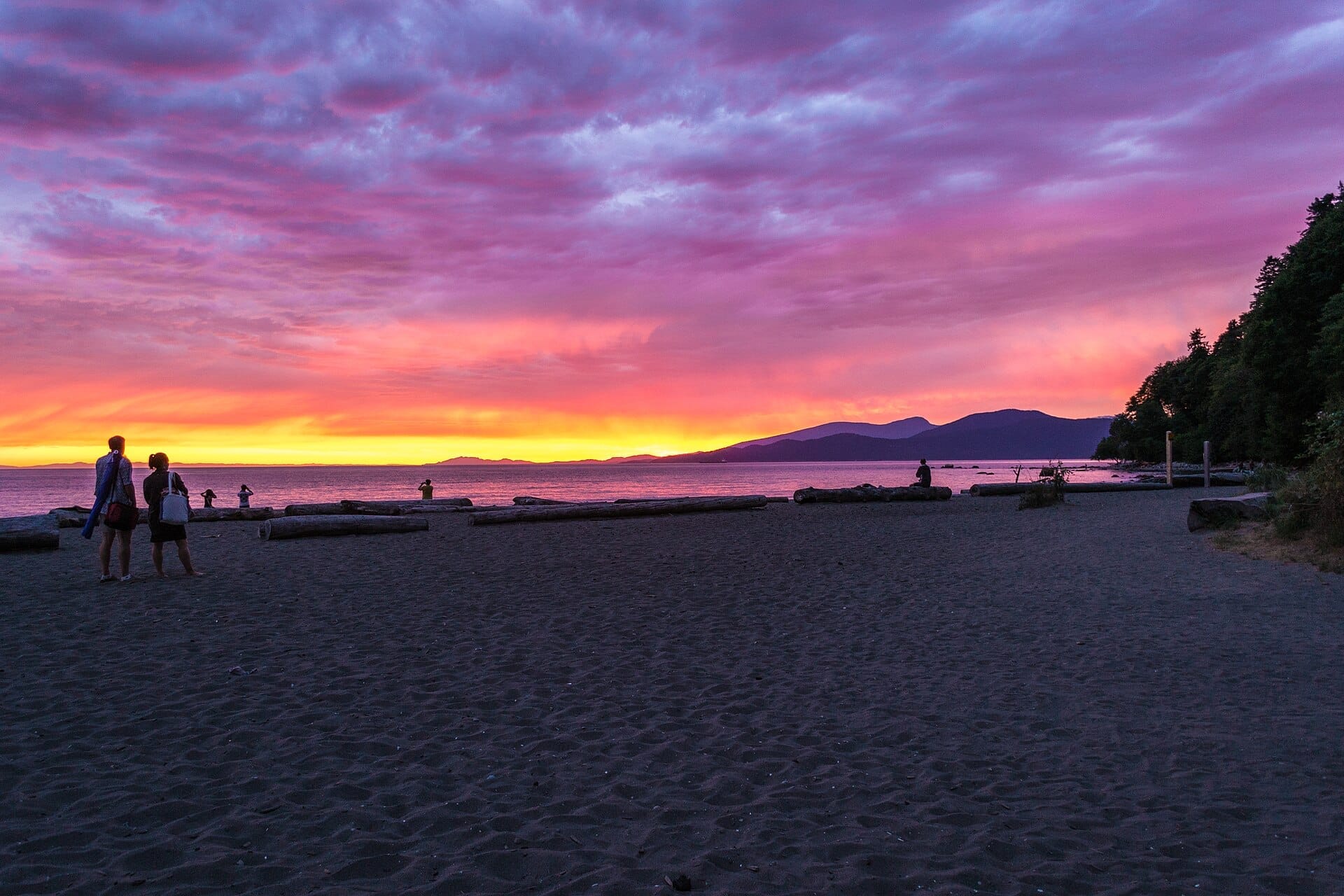
Late afternoon brings a gradual thinning of the crowd, and by early evening in summer the beach takes on a quieter character. Sunset from the sand, looking southwest toward the Strait of Georgia, is one of those views that is genuinely difficult to replicate elsewhere in the city. The sky can turn deep orange over the water while the bluffs behind you go into shadow.
The Clothing-Optional Culture
Nudity is legally permitted on Wreck Beach, and many visitors do go without clothing, particularly in the section nearest Trail 6. This has been part of the beach's identity since at least the 1970s, and the community that uses the beach has a strong sense of place and informal norms around respect. First-time visitors who are curious but uncertain should know that clothed visitors are also completely welcome and unremarkable. Nobody is required to disrobe.
The Wreck Beach Preservation Society has historically advocated for the beach's protection from development and for maintaining its character. That grassroots ownership of the space shows in how the regular community treats it: dogs are common, litter is not. The beach has a low-key, self-governing atmosphere that is quite different from the more manicured experience at Kitsilano Beach or English Bay.
If you are comparing Vancouver's beaches before deciding where to spend your day, the guide to Vancouver's best beaches covers the full range from family-friendly to wild shoreline, so you can match the beach to your mood.
Historical and Natural Context
The bluffs above Wreck Beach are part of Pacific Spirit Regional Park, a roughly 750-hectare park that was established in 1989 to protect the forest on the UBC Endowment Lands. The forest on the slopes above the beach is second-growth Douglas fir and western red cedar, recovering from earlier logging, and it provides both the dramatic visual backdrop to the beach and a habitat corridor that supports a variety of coastal wildlife.
The beach sits at the western edge of the UBC campus in the UBC and Point Grey area, which also contains some of Vancouver's most significant cultural institutions. The Museum of Anthropology is a fifteen-minute walk from the Trail 6 trailhead, making it a logical pairing if you want to balance an afternoon on the beach with a morning of genuine cultural depth.
The name 'Wreck Beach' is believed to derive from ships that once ran aground on this stretch of coastline, though the beach's modern reputation has nothing to do with maritime history. The Indigenous Squamish name Tsʼatʼlhm reflects a much older relationship with this part of the coast, predating European settlement by thousands of years.
Photography, Weather, and Practical Preparation
Photography requires common sense and respect. The open beach in the context of a clothing-optional space means you should ask before pointing a camera at anyone. The landscape itself — bluffs, driftwood, water, sunset light — is unreservedly photogenic and does not require people in the frame at all. A wide-angle lens in the late afternoon, with the bluffs framing the strait, produces images that look nothing like standard Vancouver beach photography.
Weather matters significantly at Wreck Beach. Vancouver's summer (June through August) is reliably dry, with mean July temperatures around 18 °C (64 °F), and these are the months when the beach is genuinely comfortable for extended visits. The rest of the year sees the city's characteristic oceanic climate: mild but frequently rainy, with October through March being the wettest period. Out of season, the beach is wild and atmospheric but cold, and the surf can be rough.
For a broader look at planning your timing in Vancouver, the best time to visit Vancouver guide lays out what each season actually delivers for different kinds of travelers.
💡 Local tip
Bring everything you need with you: sunscreen, water, food, and a bag for your rubbish. There are no facilities on the beach itself. The climb back up is significantly harder than the descent, especially after a few hours in the sun.
Who Should Think Twice
Wreck Beach is not the right choice for everyone. Families with young children may find the clothing-optional culture and the difficult access more complicated than it is worth, particularly with a stroller or a child who cannot manage the stairs independently. Visitors with mobility limitations face a genuine barrier: the staircase descent is the only pedestrian access route, and there is no alternative.
If your priority is facilities, the beach will frustrate you. There are no restrooms at the bottom of Trail 6, no shower stations, no food concessions in any formal sense, and no lifeguards. The informal vendor economy operates in summer, but it is not a reliable infrastructure. Plan accordingly or choose a different beach.
Insider Tips
- Arrive before 10 a.m. on summer weekends to get space near the Trail 6 base without fighting the midday crowd. The early light is also better for photography.
- Walk south along the beach for at least ten to fifteen minutes past the main cluster of visitors. The beach opens up considerably and the crowds thin to almost nothing within a short distance.
- The climb back up Trail 6 takes most people twice as long as the descent. Budget for this honestly, especially if you are on a schedule or visiting in hot weather.
- There are no public restrooms at the bottom of the trail. Use the facilities on the UBC campus before you descend — this is a detail many first-time visitors regret skipping.
- Combine a beach visit with the Museum of Anthropology nearby. Both experiences are relatively low-cost, they are a fifteen-minute walk apart, and they offer a striking contrast between Indigenous cultural heritage and raw coastal landscape.
Who Is Wreck Beach For?
- Adults seeking a genuinely alternative beach experience with space and seclusion
- Nature lovers interested in forested bluffs, coastal wildlife, and undeveloped shoreline
- Photographers looking for dramatic sunset views over the Strait of Georgia
- Budget travelers: free access, free entry, manageable by transit
- Visitors pairing a beach afternoon with UBC's cultural institutions
Nearby Attractions
Other things to see while in UBC & Point Grey:
- Museum of Anthropology at UBC
The Museum of Anthropology at UBC is one of Canada's foremost anthropology museums, set inside Arthur Erickson's soaring concrete-and-glass landmark on the University of British Columbia's Point Grey campus. With nearly 50,000 ethnographic objects and a collection rooted in Northwest Coast Indigenous cultures, it offers a serious, rewarding experience for anyone curious about the peoples of the Pacific Northwest and beyond.
- Nitobe Memorial Garden
Tucked behind the UBC Asian Centre, Nitobe Memorial Garden is a 2.5-acre traditional Japanese garden consistently ranked among the most authentic outside Japan. Designed by landscape architects recommended by the Government of Japan and completed in 1960, it rewards slow, deliberate visiting at almost any time of year.
- Pacific Spirit Regional Park
Spanning roughly 860 hectares of second-growth rainforest on Vancouver's west side, Pacific Spirit Regional Park wraps around the UBC campus and offers over 55 km of free, multi-use trails through dense forest, creek ravines, coastal cliffs, and bog. It is one of the larger continuous green spaces within the city of Vancouver, and almost nobody from outside Vancouver knows it exists.
- Spanish Banks Beach
Spanish Banks Beach stretches along English Bay in Vancouver's West Point Grey neighbourhood, offering nearly 1 kilometre of tidal flats, unobstructed views of the North Shore mountains, and a noticeably quieter atmosphere than the city's more central beaches. Access is free, lifeguards patrol seasonally, and the beach connects by bike path to Jericho and Locarno.