Wereldmuseum Amsterdam: A World Cultures Museum Worth Knowing
Housed in a 1926 building in the Plantage district, Wereldmuseum Amsterdam holds one of the world's significant ethnographic collections, tracing cultures across Africa, Asia, Oceania, and the Americas. Formerly the Tropenmuseum, it rebranded in 2023 as part of a multi-location museum network dedicated to honest, critical storytelling about global cultures and Dutch colonial history.
Quick Facts
- Location
- Linnaeusstraat 2, 1092 CK Amsterdam (Plantage district)
- Getting There
- Tram 9 or Metro lines 51/53/54 (Weesperplein); check GVB for current routes
- Time Needed
- 2 to 3.5 hours for a thorough visit
- Cost
- Adults from €18 online / €20 on-site; children 6–18 from €7.50; under 6 free; I amsterdam City Card accepted
- Best for
- History-minded adults, families, anyone curious about colonial legacies and world cultures
- Official website
- amsterdam.wereldmuseum.nl/en
What Wereldmuseum Amsterdam Actually Is
Wereldmuseum Amsterdam is an ethnographic museum dedicated to world cultures, situated on Linnaeusstraat in Amsterdam's Plantage neighborhood. It opened in its current monumental building in 1926, but the institution traces its roots to 1864, when it was founded as the Koloniaal Museum. For most of the 20th century it operated as the Tropenmuseum, and that name still appears on the architecture and in local conversation. In 2023, it joined sister institutions — Museum Volkenkunde in Leiden, the Afrika Museum in Berg en Dal, and Wereldmuseum Rotterdam — under the shared Wereldmuseum name.
The combined network holds around 450,000 objects and 260,000 photographs. The Amsterdam branch carries a substantial share of that collection, covering cultures from Sub-Saharan Africa, South and Southeast Asia, the Pacific, and the Americas. What separates this museum from a generic world history collection is the frank framing: exhibitions here engage directly with how objects arrived in Dutch collections and what that means for questions of restitution and cultural ownership.
💡 Local tip
Book tickets online in advance at €18 per adult rather than paying €20 at the door. Booking ahead also lets you skip the entrance queue on busy weekend mornings.
The Building: Architecture That Demands Attention
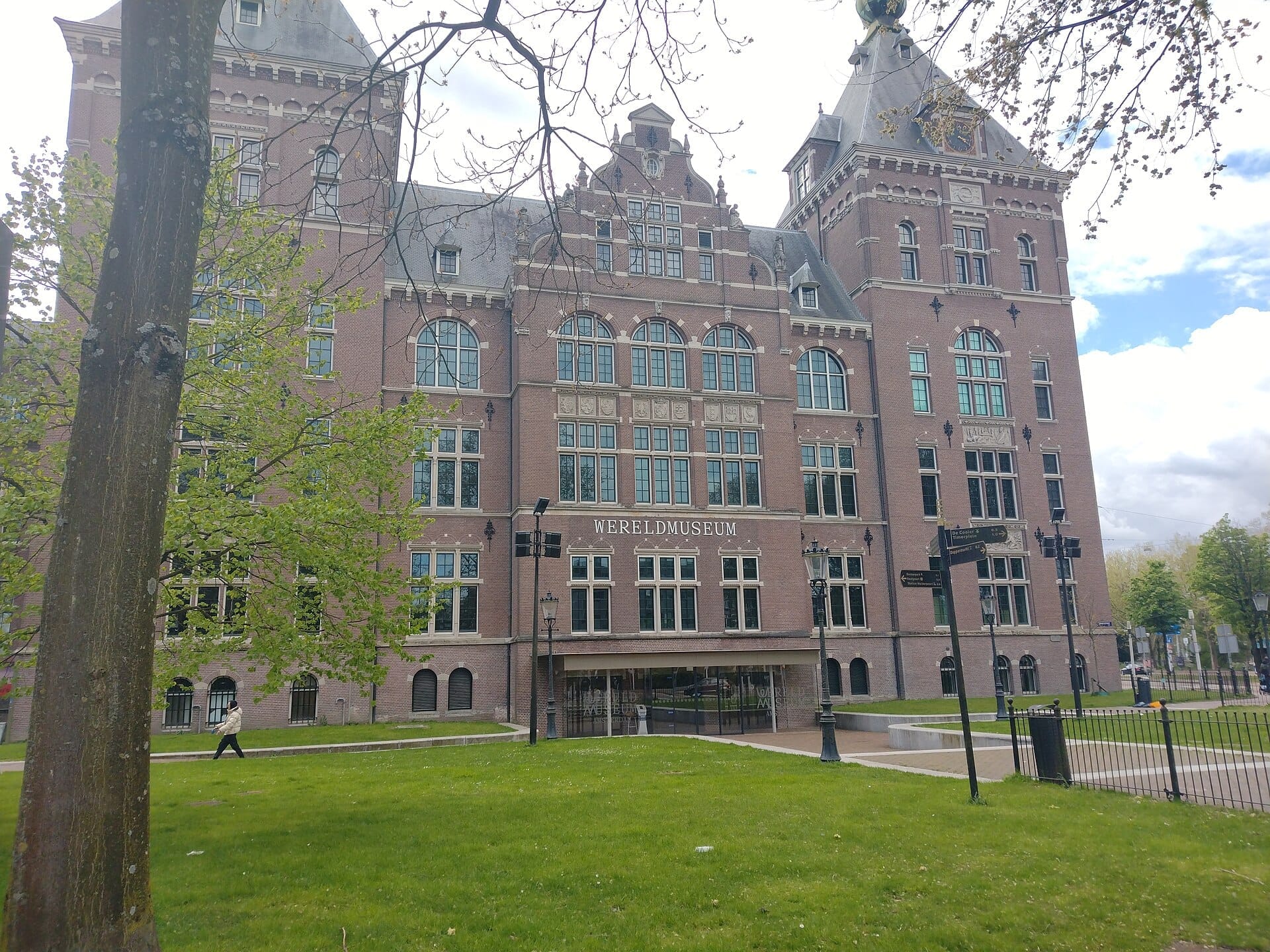
The Wereldmuseum Amsterdam building is an Amsterdam School-influenced colonial structure designed by J.J. van Nieukerken and completed in 1926. The facade is heavy and imposing, dressed in brick and stone with ornamental detailing that reflects the early 20th-century confidence of Dutch colonial enterprise. Standing in front of it from Linnaeusstraat, the scale takes a moment to register: the entrance hall is cavernous, with high ceilings and a central atrium that floods the interior with light on clear days.
The atrium itself is one of the more memorable interior spaces in Amsterdam's museum landscape. On the ground floor, food stalls and a market-style layout occasionally bring in ambient sound and smell from the café and temporary setups. Upper floors open onto balcony walkways overlooking the central hall, giving a sense of layered activity rather than a linear corridor experience.
If you have an interest in Amsterdam's architectural heritage, the building fits into a broader pattern of civic and cultural construction from the same era. The Het Schip museum in Spaarndammerbuurt showcases the domestic side of Amsterdam School architecture, providing useful contrast to the Wereldmuseum's institutional grandeur.
Tickets & tours
Live prices and dates from our booking partner. If you book, we may earn a commission at no extra cost to you.
Gray Line Canal Cruise with snackbox & Heineken Experience
From 48 €Instant confirmationFree cancellationAmsterdam evening canal cruise
From 18 €Instant confirmationFree cancellationRipley's Believe It or Not! Amsterdam ticket and one-hour canal cruise
From 35 €Instant confirmationFree cancellationAmsterdam City Canal Cruise and Moco Museum Entrance Ticket
From 38 €Instant confirmationFree cancellation
The Collection: What You Will Actually See
The permanent galleries are organized by geographic region and thematic focus rather than a strict chronological layout. Highlights include the South and Southeast Asia rooms, which hold detailed textile collections, shadow puppetry objects from Java, and religious artifacts from across the Indian subcontinent. The Africa galleries include carved wooden objects, ceremonial masks, and personal adornments, presented with contextual information about their original function rather than treating them as aesthetic curiosities.
The Oceania and Americas sections are smaller but contain objects that rarely appear in European collections of comparable public access. Labels throughout are bilingual in Dutch and English, and the interpretive text consistently acknowledges provenance questions where they exist. This is not a museum that pretends its collection arrived without complications.
Temporary exhibitions rotate regularly and have covered topics ranging from contemporary African art to the global history of clothing. Check the museum website before visiting, because the temporary spaces significantly shape what a visit feels like on any given month.
ℹ️ Good to know
The museum is closed on Mondays, with some exceptions during school holidays and public holidays. It is closed on King's Day (27 April). Opening hours are Tuesday through Sunday, 10:00 to 17:00.
When to Visit and How the Experience Changes
Weekday mornings, particularly Tuesday through Thursday, are the quietest periods. By 10:15 on those days, the atrium is nearly empty and the galleries feel spacious. Weekend afternoons, especially Saturdays between 12:00 and 15:00, bring families and school groups that create genuine noise in the open atrium. If you are visiting for focused looking and reading, a weekday morning is a significantly different experience than a Saturday afternoon.
Natural light in the atrium is best in the late morning on sunny days, when light falls through the upper windows at an angle that illuminates the ground floor displays. The upper gallery walkways can feel slightly dim in overcast weather, which is worth knowing if you plan to photograph textiles or detailed objects without flash.
The Plantage district rewards time before or after the museum. Artis Amsterdam Royal Zoo is a short walk away, as is the Hortus Botanicus, one of the world's oldest botanical gardens. A half-day that combines one of these with the Wereldmuseum works well for families.
Getting There and Practical Logistics
The museum sits at Linnaeusstraat 2 in the Plantage district, east of the city center. Tram line 9 provides a direct connection from the center, and Weesperplein metro station (lines 51, 53, and 54) is within comfortable walking distance. Cycling is the most practical option if you are already in the canal ring area, with bike parking available outside the museum. Always verify current GVB routes before traveling, as Amsterdam's tram network has undergone periodic realignments.
There is no dedicated car parking at the museum. Amsterdam's Plantage neighborhood has paid street parking with limited availability. Public transport or cycling is the practical choice for most visitors.
The museum building has an elevator and is wheelchair accessible. Note that the lift accommodates wheelchairs but not mobility scooters, so visiting with a mobility scooter is not possible. The ground floor is level and navigable without stairs.
⚠️ What to skip
The I amsterdam City Card covers admission to Wereldmuseum Amsterdam. If you are visiting multiple major museums, calculate whether the card offers value for your itinerary before buying tickets individually.
Honest Assessment: Is It Worth Your Time?
Wereldmuseum Amsterdam is not a crowd-pleasing spectacle museum. There are no immersive cinema experiences or interactive technology floors designed to keep short attention spans engaged for ninety minutes. What it offers is a serious, well-curated ethnographic collection in a remarkable building, with interpretive framing that takes the moral questions around colonial collecting seriously rather than brushing them aside.
For travelers with a genuine interest in world history, material culture, or the ongoing debate around museum restitution, this is one of the most intellectually substantial museums in Amsterdam. For travelers primarily chasing iconic image-making opportunities or a fast cultural check-box, the Rijksmuseum or the Van Gogh Museum will deliver more immediate visual satisfaction.
If your Amsterdam schedule allows for depth over breadth, the Plantage district itself supports a full cultural day. The nearby Dutch Resistance Museum addresses a completely different chapter of history but shares the Wereldmuseum's commitment to uncomfortable truths told carefully. Together, they make for an unusually rigorous museum day in a city that can sometimes feel dominated by its tourist-facing surface.
Travelers planning ahead can explore options through the Amsterdam City Card guide to assess whether the combined admission savings justify the card cost for their specific itinerary.
Insider Tips
- The museum café in the atrium serves decent lunch options at prices below central Amsterdam averages. It is a practical midday stop if you are spending the morning in Plantage.
- Audio guides and apps are available in English and significantly deepen the experience of the permanent collection, particularly for the African and Oceanian galleries where label text is necessarily brief.
- If you are visiting with children, ask at the front desk about family activity sheets. The museum produces these for several permanent galleries and they are better designed than typical museum worksheets.
- Photography is permitted in most permanent galleries without flash. The textiles in the Asia rooms photograph particularly well in the late-morning light from the upper atrium windows.
- The museum shop carries a curated selection of books on ethnography, decolonization, and world art that goes beyond the standard postcard-and-poster format. It is worth fifteen minutes even if you are not buying.
Who Is Wereldmuseum Amsterdam For?
- Adults with an interest in world history, colonial legacies, and material culture
- Families with children aged 8 and older who want a substantive cultural experience
- Travelers holding the I amsterdam City Card looking to maximize included admissions
- Anyone spending a half-day or full day in the Plantage district alongside Artis or Hortus Botanicus
- Students and researchers with interests in ethnography, anthropology, or Dutch history
Nearby Attractions
Other things to see while in Plantage & Jewish Quarter:
- ARTIS Amsterdam Royal Zoo
Founded in 1838, ARTIS Amsterdam Royal Zoo is the oldest zoo in the Netherlands and the fifth oldest zoo in the world still in operation. Set across landscaped grounds in the Plantage neighborhood, it blends wildlife, botanical gardens, and 19th-century heritage architecture into a single half-day destination that works for families, history enthusiasts, and curious solo travelers alike.
- Brouwerij 't IJ
Brouwerij 't IJ is Amsterdam's most distinctive craft brewery, operating inside an early-20th-century bathhouse at the foot of the De Gooyer windmill. The tasting room is free to enter, pours a rotating lineup of house-brewed beers, and offers short brewery tours on weekends. It is one of the few places in the city where industrial heritage, local brewing culture, and canal-side atmosphere converge in a single address.
- De Gooyer Windmill
Standing 26.6 metres tall on the eastern edge of the city, De Gooyer is widely described as the tallest wooden windmill in the Netherlands and one of Amsterdam's most photogenic historic structures. The mill itself is private, but the exterior is free to visit, and the craft brewery in the former bathhouse beside it is reason enough to linger.
- Dutch Resistance Museum
The Dutch Resistance Museum (Verzetsmuseum Amsterdam) tells the story of the Nazi occupation of the Netherlands through the choices ordinary people made: those who resisted, those who complied, and those who stood between. Located in the Plantage district, it is one of the most thoughtfully curated war museums in Europe.
Planning a trip? Discover personalized activities with the Nomado app.