Großer Wannsee: Berlin's Lake Escape with a Dark History
Großer Wannsee is a broad bay of the River Havel in southwest Berlin where Berliners have swum and sailed for over a century. The same shoreline holds Strandbad Wannsee, one of Europe's largest inland lidos, and just minutes away stands the villa where Nazi officials coordinated the Holocaust in 1942. That contrast — holiday beach beside a site of genocide — makes Wannsee unlike any other lakeside destination in Germany.
Quick Facts
- Location
- Steglitz-Zehlendorf, southwest Berlin; main beach access at Wannseebadweg 25, 14129 Berlin
- Getting There
- S-Bahn S1 or S7 to S-Bahnhof Nikolassee; then bus 112/218 or a 10–15 minute walk to the lakeshore and Strandbad Wannsee
- Time Needed
- 2–5 hours for the beach alone; full day if combining with Haus der Wannsee-Konferenz and a Havel ferry
- Cost
- Lake access is free; Strandbad Wannsee charges seasonal admission (check Berliner Bäder-Betriebe for current prices)
- Best for
- Summer swimming, family outings, history buffs, cyclists, sailing day trips
- Official website
- www.berlin.de/sehenswuerdigkeiten/3561521-3558930-wannsee.html
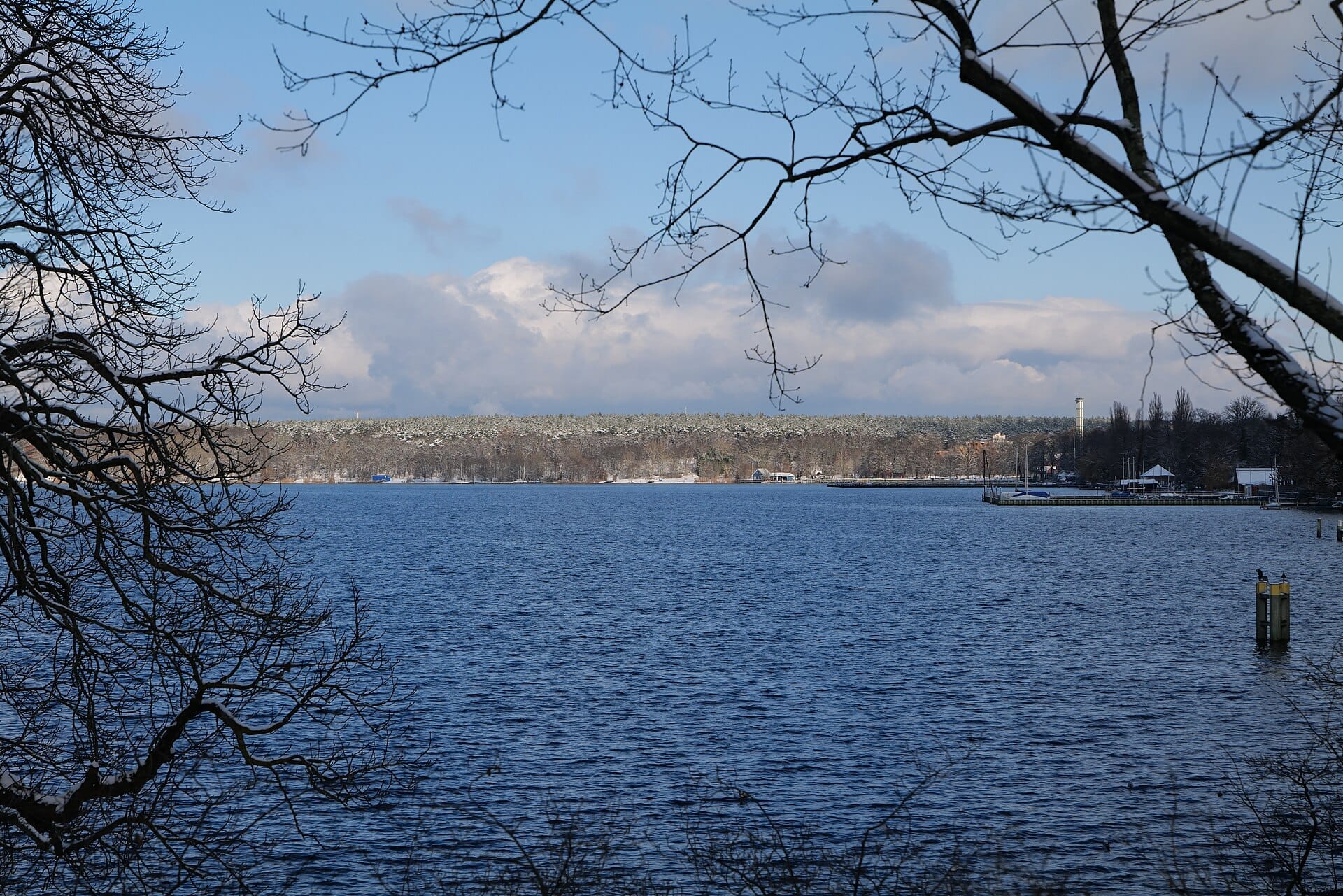
What Großer Wannsee Actually Is
Großer Wannsee is technically not a lake. It is a bay-like widening of the River Havel, part of the federal waterway network managed by the Wasserstraßen- und Schifffahrtsamt Spree-Havel. That classification matters in practice: the water flows, sailboats and motorized vessels share it with swimmers, and the shoreline shifts subtly with the current. What most visitors experience as a placid lake is actually a stretch of river that happens to be about 2.5 kilometres across at its widest.
The area sits in the Steglitz-Zehlendorf district, the leafy southwest corner of Berlin, roughly 25 kilometres from Alexanderplatz. S-Bahn lines S1 and S7 connect S-Bahnhof Nikolassee to central Berlin in around 35–45 minutes, making this the closest thing the city has to a genuine seaside excursion without leaving the city boundary. On a hot July afternoon the train cars heading southwest smell of sunscreen and carry families dragging inflatable toys.
💡 Local tip
On summer weekdays the S1/S7 to Wannsee is noticeably quieter than on weekends. If you have flexibility, aim for a Tuesday or Wednesday visit to avoid the weekend crush at Strandbad Wannsee.
Strandbad Wannsee: A Lido Over 100 Years Old
The east shore of Großer Wannsee is home to Strandbad Wannsee, a public lido with roughly 1,275 metres of sand beach and one of the highest visitor capacities of any inland bathing facility in Europe. It opened more than a century ago and has been a protected heritage site for years, meaning the distinctive white changing cabins and the row of covered pavilions are preserved as part of the site's architectural character.
Arriving through the main entrance off Wannseebadweg, you pass ticket booths and then descend a gentle slope toward the water. The beach is wide and flat, with roped-off swimming zones and shallow entry points that make it usable for children. On a peak summer Saturday, the sand can be genuinely crowded, with towels touching towels and a persistent smell of grilled sausages drifting from the kiosk stands. On a warm weekday morning before 11:00, the same stretch feels almost generous.
The lido operates seasonally. In summer 2026, the main season runs from 29 June to 30 August with daily hours of 09:00 to 20:00. Admission fees are charged by Berliner Bäder-Betriebe, who operate the facility; check their website for current pricing before you go, as rates are updated each season. The lake itself, beyond the lido boundary, is free to access from the public promenades.
⚠️ What to skip
Water quality at Strandbad Wannsee is monitored by Berlin authorities and occasionally results in temporary swim bans after heavy rainfall. Check the current bathing water status on the Berliner Bäder-Betriebe website or the EU bathing water portal before making a special trip in summer.
Tickets & tours
Hand-picked options from our booking partner. Prices are indicative; availability and final rates are confirmed when you complete your booking.
2 hour-cruise around seven lakes in Wannsee and Havel
From 19 €Instant confirmationFree cancellation3-hour Berlin World Heritage boat tour from Wannsee
From 24 €Instant confirmationFree cancellationWild plant foraging guided walk in Berlin Wannsee
From 39 €Instant confirmationGuided bike tour from Berlin Wannsee to Potsdam
From 30 €Instant confirmationFree cancellation
The Havel by Boat: Ferries and Sailing
One of the most underused ways to experience Großer Wannsee is from the water. The BVG ferry line F10 operates as a scheduled public transport route and crosses the Havel between Wannsee and Kladow near the Wannseebrücke at the south end of the lake. Using a standard BVG ticket or Berlin Welcome Card, you can ride the ferry as part of the regular transit network — a rare pleasure in any major European city.
Passenger ships also depart from the Wannsee pier on longer excursions toward Potsdam or along the Havel chain of lakes. These are operated by separate companies and require separate tickets. If your itinerary includes Sanssouci Palace in Potsdam, arriving by river rather than rail adds significant atmosphere, especially in the late afternoon when the water catches the low western sun.
Sailors will notice a steady traffic of private vessels crossing the bay throughout summer. The Havel here is part of an extended waterway system connecting Berlin's lakes to the broader Brandenburg river network, and Wannsee's marinas cater to that culture. Even if you stay on shore, watching a convoy of dinghies and vintage motorboats negotiate the water while a paddle boarder zigzags through them is a distinctly Berlin scene.
Haus der Wannsee-Konferenz: The Memorial Next Door
About 15 minutes on foot along the wooded lakeshore from the S-Bahnhof, at Am Großen Wannsee 56–58, stands one of the most significant memorial sites in Germany. The House of the Wannsee Conference is a 19th-century lakeside villa where, on 20 January 1942, fifteen senior Nazi officials met to coordinate the logistics of the genocide of European Jews — what they referred to in the meeting's minutes as the 'Final Solution to the Jewish Question'. The meeting lasted about 90 minutes. The building has operated as an official memorial and educational institution since 1992.
The permanent exhibition uses original documents, including the Wannsee Protocol — the only surviving copy of the meeting's minutes — to trace both the decision-making process and the broader history of the Holocaust. The presentation is measured and scholarly, not sensationalist, and the villa's elegant surroundings create an uncomfortable dissonance with what happened inside it. That dissonance is partly the point.
Accessibility at the memorial is limited: the elevator is not accessible from the ground floor, and several areas including the library and cloakroom are only reachable via stairs. Visitors with mobility requirements should contact the site directly before visiting. Admission to the memorial is free. Bus 114 from S-Bahnhof Wannsee stops directly outside at the Haus der Wannsee-Konferenz stop.
ℹ️ Good to know
The Haus der Wannsee-Konferenz and Strandbad Wannsee are about 1.5 kilometres apart along the lakeshore path. Many visitors combine both in a single day — swimming in the morning, memorial in the early afternoon. The tonal shift is abrupt and deliberate, and both deserve full attention rather than a rushed back-to-back.
How the Place Changes by Time of Day and Season
Early morning at Wannsee — before 09:00 on a summer weekday — has a quality that the midday crowds erase entirely. Mist sits on the water surface. Joggers use the lakeshore path through the Grunewald forest on the far side. The smell is green and slightly damp, the kind of air that belongs to a river more than a lake. A few elderly swimmers enter the water before the lido opens, using the free public shoreline that extends beyond the Strandbad boundary.
By noon on a hot day in July or August the character changes completely. The Strandbad fills to capacity, the kiosks sell ice cream and beer, children's voices carry across the sand, and the promenade fills with cyclists who have come out from the Grunewald forest on the western side of the Havel. This is Berlin at its most relaxed and least self-conscious: a city that has spent a century treating this stretch of water as a collective back garden.
In autumn, Wannsee becomes quieter but not empty. The forest paths turn amber and the lido closes, but the lakeshore promenade remains walkable, and the memorial site is actually easier to visit without summer crowds. Winter brings occasional fog over the water and near-total solitude — which some visitors find appealing. The S-Bahn still runs, the ferry F10 usually operates year-round except in rare cases such as ice, and the memorial is open regardless of season.
Getting There and Getting Around
S-Bahn lines S1 and S7 both stop at S-Bahnhof Wannsee, making this one of the most straightforward day trip destinations from central Berlin. From Alexanderplatz, the journey takes roughly 40–45 minutes on the S7; from Potsdamer Platz on the S1, around 30 minutes. Regional trains (RE and RB lines) also call at Wannsee station, which can be useful if you are connecting from Potsdam or further afield.
From the station, bus 114 runs from S-Bahnhof Wannsee to the Haus der Wannsee-Konferenz stop, while buses 112 and 218 from S-Bahnhof Nikolassee serve the Strandbad Wannsee stop close to the lido. The walk from Nikolassee station to the lido takes around 10–15 minutes along a straightforward path. Cyclists can ride the dedicated cycle path through Grunewald directly to the lake — a popular route on summer weekends that takes around 20 minutes from the forest car parks on the Avus side.
A standard Berlin AB zone ticket covers the S-Bahn from central Berlin to Wannsee, since the station is within Berlin's city limits (Zone B). If you are making multiple journeys across Berlin over several days, the Berlin Welcome Card covers ABC zone travel and can represent good value for a Wannsee day trip combined with other sightseeing.
Who Should Consider Skipping This
Wannsee is not a polished resort destination. The beach is sandy but urban, the surrounding infrastructure is functional rather than charming, and on peak summer weekends the lido can feel genuinely overcrowded. Visitors expecting the landscaped refinement of a Bavarian lake, or the clear blue water of a mountain reservoir, will be disappointed. The Havel is a working waterway, and the water is a murky green-grey on most days.
If your priority is architectural or cultural density and you have limited time in Berlin, the city centre — Museum Island, the Holocaust Memorial, the Reichstag — will deliver more per hour. Wannsee rewards visitors who want space, air, and a change of pace rather than another layer of concentrated history.
Insider Tips
- The free public shoreline north of Strandbad Wannsee's paid entrance is perfectly usable for swimming and significantly less crowded — locals know this and you should too.
- Bus 114 from S-Bahnhof Wannsee runs infrequently, so check the BVG schedule before leaving the station; a missed bus can mean around a 15-minute wait with limited shelter on some days.
- The ferry F10 uses a standard BVG ticket, which means it is included in the Berlin Welcome Card (ABC zone). Riding the ferry as a round trip — out and back — is a relaxed way to see the lake from the water without booking an excursion boat.
- The Haus der Wannsee-Konferenz offers free guided tours in German and English, but they must be booked in advance through the memorial's website. Walk-in visitors can use the permanent exhibition independently.
- The cycle route through Grunewald to Wannsee connects to the longer Havel cycling path, which continues south toward Potsdam. Renting a bike in central Berlin and cycling out is a full-day itinerary in itself, especially if combined with a one-way return by S-Bahn.
Who Is Wannsee (Großer Wannsee) For?
- Berliners and visitors seeking a proper summer swim without leaving the city
- History-focused travellers combining the Wannsee Conference memorial with a lakeside walk
- Families with children who need space, sand, and water after several days of indoor museums
- Cyclists using Wannsee as the turning point on a Grunewald forest ride
- Anyone who wants to understand the full geography of Berlin beyond the central tourist corridor
Nearby Attractions
Combine your visit with:
- Grunewald Forest
Grunewald Forest is Berlin's largest forested area, stretching across 3,000 hectares in the city's west. Free to enter and open at all hours, it offers lakes, woodland trails, a Renaissance hunting lodge, and genuine quiet within one of Europe's great capital cities.
- House of the Wannsee Conference (Gedenk- und Bildungsstätte)
On 20 January 1942, fifteen Nazi officials met in a lakeside villa southwest of Berlin and coordinated the systematic murder of European Jews. The House of the Wannsee Conference is now a permanent memorial and educational site. Admission is free. The experience is unforgettable.
- Olympiastadion Berlin
Built for the 1936 Summer Olympics and thoroughly renovated in 2004, the Olympiastadion Berlin is one of Europe's most architecturally significant sports venues. With a capacity of about 74,500, it hosts Hertha BSC matches, major concerts, and regular sightseeing visits that take you from pitch level to the roof walkway.
- Sanssouci Palace and Park (Potsdam)
Built for Frederick the Great between 1745 and 1747, Sanssouci Palace is Germany's most celebrated royal summer retreat. Set within a UNESCO-listed park of terraced vineyards, fountains, and baroque pavilions just outside Potsdam, it rewards visitors who arrive early and stay long.